5 Ways to Manage Event Hardware Supply Chain Costs
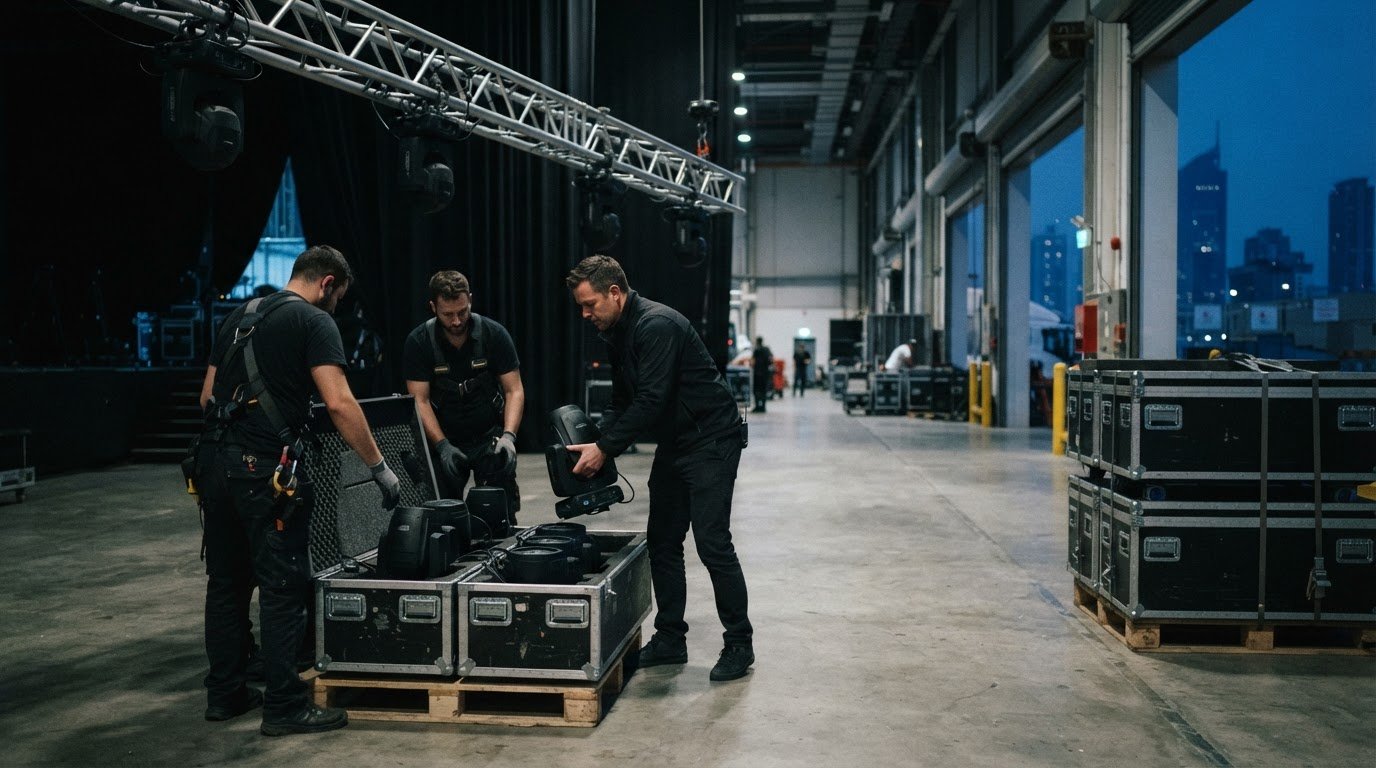
Availability is planned, not improvised. A disciplined approach to mitigating supply chain issues for event hardware combines supplier risk assessment, diversified sourcing, careful inventory planning, financial contingencies and technology that makes dependencies visible. Together, these measures help teams spot disruption early and protect the equipment needed to deliver an event.
Hardware delays can affect budgets, schedules and the smooth delivery of a live event. Resilience is therefore part of production planning, not just procurement. This article sets out practical ways to reduce exposure, from mapping supplier risks and balancing stock with demand to preparing for financial pressure and assessing nearshoring.
Technology is central to the approach. Digital models can reveal dependencies and risk pathways, giving teams a clearer basis for decisions before disruption reaches the production schedule. The sections ahead explain how to combine visibility with practical planning to support event hardware availability across complex projects.
Key Takeaways
• Map critical suppliers and dependencies to spot where a disruption could affect event hardware availability.
• Balance lean inventory with targeted buffers for essential equipment, guided by demand and delivery uncertainty.
• Build disruption scenarios into financial planning so schedule changes and supply delays are easier to manage.
• Assess nearshoring as one way to add flexibility across sourcing and production networks.
• Use digital models to make supply chain dependencies and emerging risks more visible to decision-makers.
1. What Are Supply Chain Risks?
Supply chain risk is any threat that interrupts the delivery, security or reliability of event hardware. A delayed component can hold up an entire system, while a compromised software update can introduce a digital vulnerability. Start by mapping critical equipment, its components and suppliers. This shows where a single disruption could affect several parts of a production.
Common issues include raw material shortages, transport delays, supplier capacity constraints and geopolitical disruption. Cybersecurity incidents can also affect hardware supply chains through compromised software or firmware. For event teams, the practical consequences may include late equipment, substitutions, extra coordination or schedule changes.
Assess each supplier against operational risk, financial stability, geopolitical exposure and regulatory compliance history. Map the countries of origin for key inputs, then identify any components with a single source. A weighted scoring method can rate each supplier from 1 to 5 for each risk factor, with 5 representing the highest risk. This makes comparisons consistent and helps prioritise follow-up.
Security checks should cover both physical equipment and digital integrity. Confirm how suppliers protect hardware, manage software and firmware, share threat intelligence, train employees and conduct regular security audits. The U.S. Cybersecurity Executive Order EO 14028 is identified as a framework relevant to hardware supply chain compliance, according to the Federal Register. Treat cybersecurity as part of supplier assessment, not as a separate technical afterthought.
For end-to-end visibility, map tier-one suppliers and trace critical components to Tier 2 and Tier 3 suppliers. Record the item, supplier, origin, order status, expected delivery date and any known dependency in a shared tracking system. Update it when orders change or supplier documents expire. Analytics can help teams identify patterns, such as repeated delays from one route or supplier, before they affect event plans.
Backup options include prequalified substitute suppliers, distributors and buying-group sources. Rental can also be a contingency when compatible equipment is needed temporarily. Compare approved alternatives with the equipment specification and delivery requirements to ensure a substitute does not create new technical or scheduling risks.
Refurbished or rented hardware can bring uncertainty about condition, compatibility, maintenance history and software integrity. Reduce these risks by recording the equipment model and configuration, reviewing maintenance records, checking software and firmware integrity, and testing the unit with the intended system before deployment. A physical inspection can also reveal damage or missing components.
Diversification reduces reliance on a single supplier, but alternatives need to be understood before disruption occurs. Prequalify backups, map upstream dependencies and maintain clear order records. These steps give event teams a stronger basis for decisions when availability changes.
2. Inventory management
Inventory planning should protect essential equipment without tying up resources in excess stock. Start with a shared list of required hardware, current quantities, open orders and expected delivery dates. Flag items that are difficult to substitute or commonly used across productions. This gives teams a clear view of availability and where a shortage could affect delivery.
Prioritise stock by considering demand and supply risk together. A frequently used cable or connector may warrant a buffer if it is also difficult to source. Specialist equipment used for one production may be better managed through early ordering and a documented contingency. Keep the list current as specifications, schedules and supplier commitments change.
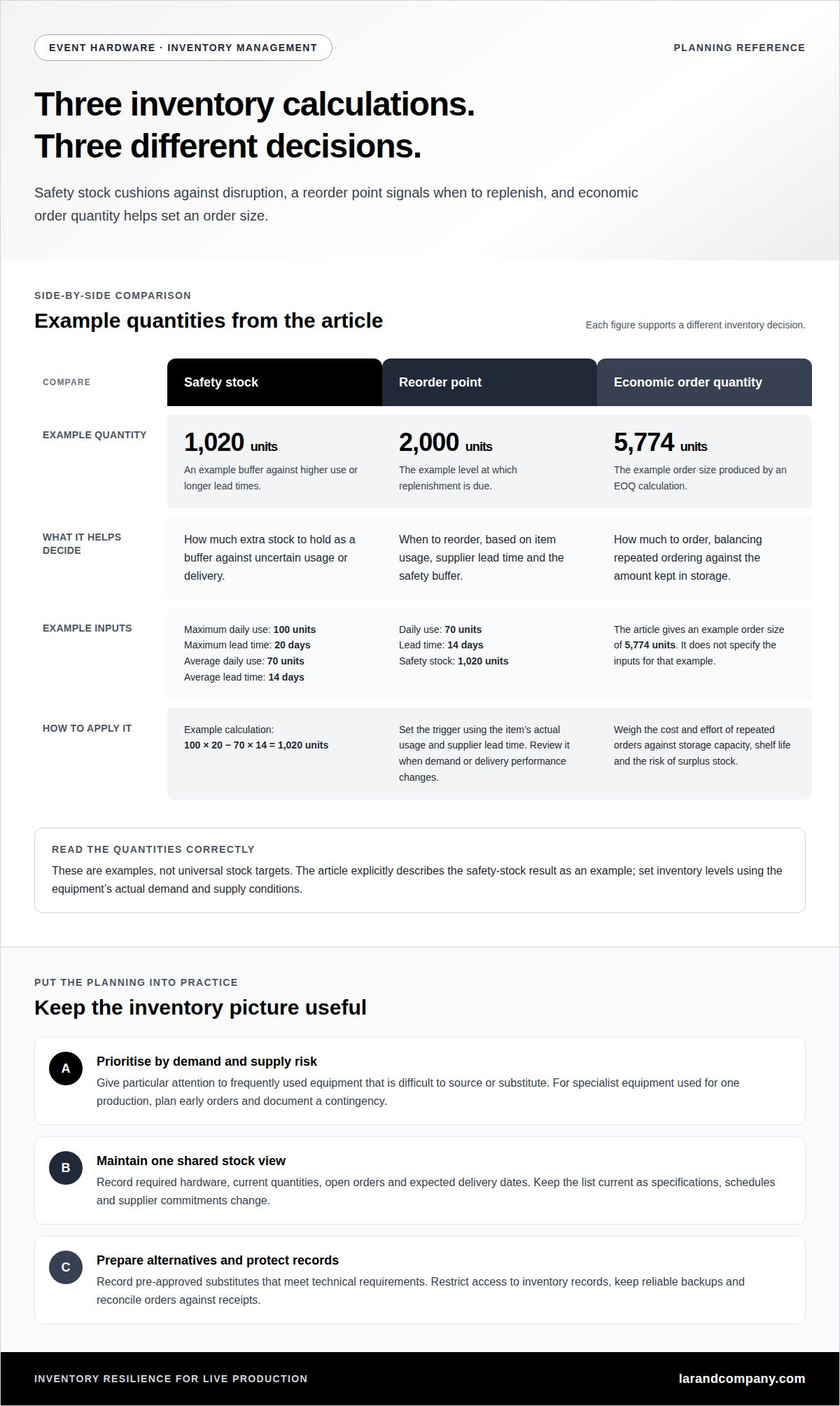
Safety stock provides a buffer against higher-than-expected use or longer lead times. One example calculates a buffer of 1,020 units using maximum daily usage of 100 units, maximum lead time of 20 days, average daily usage of 70 units and average lead time of 14 days. The calculation is maximum usage multiplied by maximum lead time, less average usage multiplied by average lead time. The result is an example, not a universal stock target.
A related reorder-point example reaches 2,000 units when daily usage is 70 units, lead time is 14 days and safety stock is 1,020 units. In practice, set reorder points using the item’s actual usage and supplier lead time. Review them when demand shifts or delivery performance changes. During the pandemic, sudden demand for hand sanitiser showed how quickly availability can change, making planned buffers valuable for essential supplies.
Economic order quantity can help balance ordering frequency against the amount held in storage. One example produces an order size of 5,774 units. The useful lesson is to weigh the cost and effort of repeated orders against storage capacity, shelf life and the risk of holding stock that a production no longer needs.
Long-lead items have extended or unpredictable delivery timelines; the specific equipment depends on its specification, source and availability. Hardware prices also vary by type, configuration, quantity and market conditions, so no single typical price applies across event equipment.
When equipment is unavailable, use a pre-approved substitute with compatible specifications, or activate a contingency plan covering alternative sourcing, delivery routes and schedule communications. Record approved alternatives alongside the inventory list so teams can act without losing sight of technical requirements.
Protect inventory records as well as physical stock. Restrict access, keep reliable backups and reconcile orders against receipts. Otherwise, cyberattacks affecting inventory systems could leave teams relying on inaccurate availability data.
Record approved alternatives and unsuitable products alongside inventory items, then share the lists with teams to identify supply risks. Keep commonly used, hard-to-source items on hand, balancing just-in-time operations with just-in-case inventory and safety stock. Plan forecasting, demand, response, supply, replenishment and inventory together. Predictive analytics can help teams adjust delivery routes or build buffer stock ahead of shipping congestion.
3. Financial impacts of supply chain disruptions
A supply disruption can raise logistics costs, delay installation and reduce the time available to resolve technical problems. For an event, a late component may also affect connected equipment, crew schedules and delivery milestones. The financial impact depends on what is delayed, how easily it can be substituted and whether the schedule can absorb the change.
External causes include extreme weather, transport interruptions, geopolitical events and manufacturing shutdowns. The Suez Canal was blocked for six days in March 2021, delaying goods worldwide. The Baltimore bridge collapse in March 2024 disrupted the flow of cars and auto parts. These examples show how a local incident can affect distant supply routes and the ability to deliver materials on schedule.
Internal processes can also disrupt supply. An inaccurate demand forecast may result in an undersized order, while late approvals can put procurement behind production needs. A specification change can make already-ordered stock unsuitable. Reduce these risks by connecting procurement decisions to current designs, event milestones and approved changes.
The financial impact extends beyond the price of replacement equipment. A delay can require revised transport arrangements, additional labour coordination or changes to installation sequencing. It can also affect revenue if an event or production cannot proceed as planned. List material dependencies, then model how a delay would affect each milestone, response and budget assumption.
McKinsey Global Institute modelled supply chain disruption scenarios for 13 industries. One scenario involved a manufacturing shutdown lasting 100 days. A single prolonged production-only shock could wipe out between 30-50 percent of one year’s EBITDA for most companies. This is not an event-sector forecast, but it illustrates how sustained production interruption can place pressure on operating results.
Companies can expect a supply chain disruption lasting 1-2 months and causing a significant financial loss every 3.7 years. Over a decade, disruptions can erase half a year’s worth of profits or more. Treat these figures as a reason to plan for interruption, not as a prediction of a specific event’s outcome.
Build a financial response around likely triggers. Identify orders with uncertain delivery, components without substitutes and schedule changes that could create extra costs. Set decision points for expediting, substitution or resequencing, and assign an owner to each action. Financial Management can connect those decisions to forecasts, commitments and cash flow, helping teams anticipate pressure earlier.
Strong planning also considers cash timing. Collect equipment deposits well in advance to reduce the risk of later cash-flow problems. Keep clients informed about how supply delays may affect installation schedules and completion dates. Clear assumptions help distinguish a manageable delay from a disruption that requires a wider production response.
4. Nearshoring
Nearshoring shifts sourcing or production closer to the market where equipment will be used. For an event organisation, this may mean using vendors in the same region or a neighbouring country rather than relying on a distant manufacturing network. The aim is to add sourcing options and reduce exposure to long transport routes, not eliminate every supply risk.
Geographic shifts can change which vulnerabilities matter most. A nearby supplier may shorten transport distances while still relying on raw materials or components from elsewhere. Map the full path, from material origin to finished hardware, before treating a local vendor as an independent backup. Two suppliers in one region may share an upstream factory, port or transport corridor.
Nearshoring is most useful when a production depends on components that are difficult to substitute or slow to replenish. Identify those items first, then assess whether regional production can meet the technical specification, required volume and delivery window. A flexible product design and manufacturing network can make nearshoring lower-tier supply chain functions more feasible.
McKinsey Global Institute estimated that 16 to 26 percent of exports, worth $2.9 trillion to $4.6 trillion in 2018, could be in play over the next five years. This points to the scale of potential geographic change. It does not mean every event supplier will relocate, or that shifting a source automatically improves availability.
Compare the resilience of each route, not just the distance. Assess a vendor’s production footprint, raw material dependencies, financial stability and continuity planning. Check whether production can shift between sites if one location is disrupted. Companies can improve resilience by building the ability to reroute components and adjust production across sites.
For US venues, locally based equipment suppliers and event equipment rental companies can serve regional production needs. Equipment, stock and delivery capabilities vary by location and requirement, so plans should distinguish temporary rental from owned or newly sourced hardware.
A practical nearshoring assessment can follow a clear sequence:
• List critical hardware and trace its components to their countries of origin.
• Identify regional vendors capable of supplying or producing suitable alternatives.
• Compare transport routes, upstream dependencies and production flexibility.
• Document which items can be substituted, rerouted or sourced locally.
Nearshoring works best as part of a wider supplier network. Keeping more than one viable route can limit dependence on a single production region. For event hardware, a strong strategy may combine regional vendors for selected components with established global sources for others. Base the decision on each item’s specification, origin and role in the production, rather than shifting all sourcing locally.
5. Technology for supply chain resilience
Digital tools make supply chain dependencies easier to see and act on. A digital supply chain model can map event hardware components, suppliers, production sites and transport routes. Teams can simulate a disruption, such as a delayed component, and trace the equipment or milestones it could affect. A practical model supports mitigating supply chain issues for event hardware by connecting insights to decisions, rather than simply displaying a complex network.
Begin with a reliable record of critical components and their dependencies. For each item, connect its specification to the supplier, order status, origin and planned delivery date. Link this information to the event production schedule and identify the milestones that depend on each component. If a delivery date changes, the team can assess affected systems, alternatives and whether work should be resequenced.
Digital models can compare risk pathways. For example, a team can model how a transport delay affects a production site, then test an alternative route or supplier. This may reveal shared dependencies that a simple vendor list misses. Record the assumptions behind each scenario, such as the affected component or route, and update them when an order, specification or production plan changes.
Internet of Things (IoT) solutions can support nearshoring by helping organisations optimise machines and assets across production sites. Used with current production data, they can show where capacity exists and whether work can move between locations. This can help teams assess whether a component can be produced elsewhere if disruption affects one site. The model should distinguish available capacity from capacity already committed to other work.
On-demand 3D printing offers another option for selected components. It can support virtual inventories, where a digital design is held instead of keeping every physical part in stock. The approach depends on the component’s design, material and suitability for its intended use. It is a targeted resilience strategy, not a universal replacement for stocked event hardware. Teams need to account for approval and testing before adopting a printed substitute.
To make digital systems useful during supply challenges:
• Keep component records, order updates and production schedules aligned.
• Set alerts for changed delivery dates or supplier documents needing attention.
• Model the effect of a delayed component on connected equipment and milestones.
• Record who can approve a substitute, route change or revised production sequence.
For teams mitigating supply chain issues for event hardware, technology must support a clear production decision. A dashboard that flags a late component has limited value unless the team understands its impact and response options. Technical Production can align equipment requirements with production planning; discuss your technical production requirements as part of a more resilient event plan.
Lar&Co
Lar&Co brings production planning and delivery into one coordinated view when event hardware risks could affect schedules, budgets or site operations. Its Show Production, Technical Production and Site Management work can align equipment requirements with production priorities, site logistics and the event plan. Creative Direction also helps keep technical decisions connected to the intended experience, so necessary adjustments remain purposeful. This support is relevant when a project has complex requirements, changing timelines or several interdependent production elements. For a considered discussion about your event, contact Lar&Co.
Set the next decision in motion
Resilience is strongest when supply decisions connect to the production plan before pressure builds. Set a clear point for reviewing hardware requirements whenever the schedule, design or delivery assumptions change. Assign an owner to each decision, and ensure the production team knows which adjustments need approval. This makes mitigating supply chain issues for event hardware an ongoing part of delivery, rather than a response assembled under deadline.
For complex events, the next step is to align equipment needs with the wider production brief. Lar&Co brings Show Production, Technical Production and Site Management to high-profile live experiences, helping teams coordinate the requirements that shape delivery. A conversation can clarify where production planning and hardware dependencies intersect.
Contact Lar&Co to discuss your event hardware needs and take a considered next step towards a more resilient event plan.
Frequently Asked Questions
What Are Supply Chain Risks?
Supply chain risks are events or weak points that can interrupt the flow of equipment, components or information needed for an event. A supplier production issue is one example; a transport delay or compromised software update is another. The effects depend on how essential the affected item is, whether a substitute works with the event system and how much schedule flexibility remains.
How can event planners forecast hardware needs and order early?
Start with the event brief, technical design and production schedule, then turn each system requirement into an equipment list. Separate confirmed quantities from provisional choices, and update the forecast when the design or programme changes. Compare required-on-site dates with supplier lead times, allowing time for delivery, inspection and testing. Order critical items once specifications and approvals are stable.
How can event teams reduce dependence on single-source hardware suppliers?
Identify equipment with only one approved source, then determine which alternatives meet the same technical and operational requirements. Test substitutions before committing to them, particularly when components must integrate with existing systems. Where suitable for the production, teams can also reduce reliance by specifying commonly available components during design. Keep alternative models and compatibility notes with the equipment schedule.
How can planners manage shipping delays, customs, and freight costs for event equipment?
Build shipment milestones into the production schedule, including dispatch, transit, border processing, venue delivery and equipment checks. Keep shipment descriptions, quantities and delivery instructions consistent across planning records, and assign an owner to track changes. Compare freight options by route, handling, storage and timing, not just headline charge. Grouping compatible items may simplify coordination, while separate shipments can protect critical equipment from a single delay.
What backup suppliers and rental options are available for event equipment?
Prequalify substitute suppliers, distributors and buying-group sources against equipment specifications and delivery needs. Rental can provide compatible equipment temporarily; check its condition, compatibility, maintenance history and software integrity before deployment.