Alternatives to a Standard Corporate Conference: Five Formats That Work
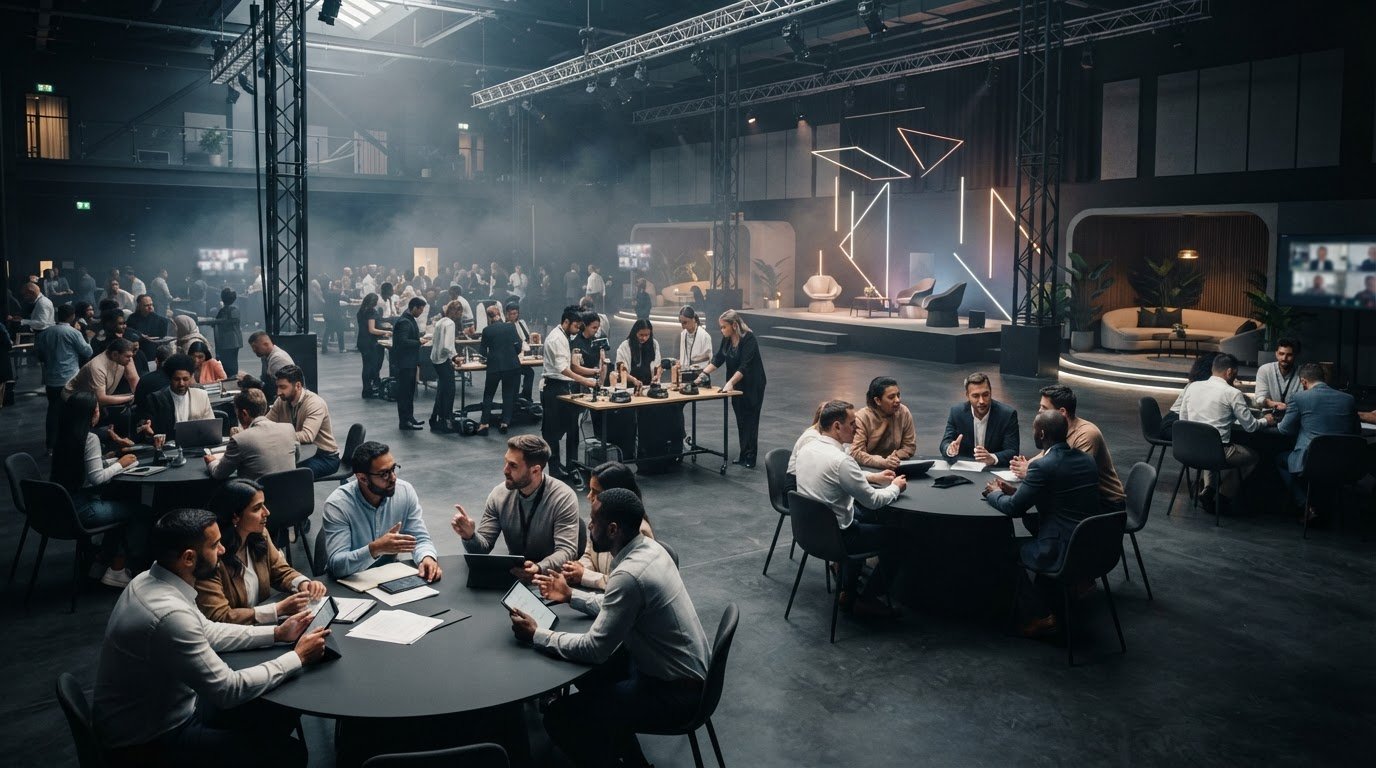
What if the best alternative to a conference isn’t a bigger stage, but a better reason for people to come together? If a familiar run of presentations feels predictable, it’s worth looking beyond it. The strongest alternatives to a standard corporate conference change the audience experience while keeping the business purpose clear.
The format needs to work on two levels: it should give people a meaningful way to participate and be practical to deliver. A more ambitious idea doesn’t have to mean a more complicated event when creative direction, technical production and site management are aligned from the outset.
This guide compares five formats: participant-led unconferences, practical workshops and masterclasses, focused retreats, collaborative roundtables, and asynchronous communication for internal teams. It explains what each is suited to, how it shapes the audience experience and what its production demands mean in practice. The aim is a distinctive event with a clear message and a purposeful experience.
Key Takeaways
• Match the event format to its business objective, audience and the level of participation you want to create.
• Compare five alternatives to a standard corporate conference, from participant-led sessions to focused retreats and asynchronous communication.
• Weigh each format’s audience experience against its site, production and technical requirements.
• Use a clear planning sequence to keep the brief, creative direction and delivery aligned.
• See how disciplined show production can turn an ambitious concept into a clear, well-managed experience.
Why look beyond a standard corporate conference?
A standard corporate conference often follows a recognisable sequence: a keynote, presentations or panels, scheduled breaks and time for networking. This structure gives organisers a clear way to share information, align stakeholders and communicate priorities. It can be exactly right when the main task is to deliver a consistent message to a broad audience.
Considering alternatives to a standard corporate conference doesn’t mean abandoning its business purpose. It means asking whether a different audience experience could serve that purpose more effectively. A strategy update, for instance, may need a clear platform for leadership communication. A session focused on solving shared challenges may benefit from giving participants time and structure to contribute.
A conference alternative is a different event format that changes the audience’s role in service of a defined business purpose.
What makes a conference format feel conventional?
A format feels familiar when its agenda is largely presenter-led. Speakers share information from a stage, panels bring several perspectives together, and networking usually happens during planned breaks. This can work well for formal announcements or complex updates, especially when everyone needs to hear the same core message. The format isn’t inherently ineffective; the question is whether it gives the audience the right role.
Consider the difference between informing a team about a new direction and asking them to identify the practical challenges of putting it into action. Both activities relate to the same business objective, but they call for different kinds of attention. The first may suit a presentation. The second needs a deliberate opportunity for people to discuss, test and build on ideas.
When is an alternative format worth considering?
Consider a different approach when the objective depends on more than information being received. Participation matters when people need to share expertise or shape a response. Recognition may call for a more celebratory experience than a sequence of presentations. Cultural exchange may benefit from bringing people together around shared experiences, rather than relying solely on formal speeches.
Look for signals in the brief and in the audience’s needs. Are attendees expected to make decisions, practise a skill, contribute ideas or connect across teams? Is the subject familiar enough that another presentation would add little, or does it require focused discussion? These questions help establish whether changing the format solves a real problem.
Define the intended outcome.
State what people should know, decide or contribute by the end.
Identify the audience’s role.
Decide whether they’re listening, discussing, practising or creating together.
Test the creative idea.
Keep it only if it strengthens participation or supports the objective, not simply because it feels novel.
A distinctive event earns its difference. If a new format creates activity without helping people understand the message or participate meaningfully, it adds complexity without clear value. Start with the purpose, then choose an experience that makes that purpose easier to achieve.
Five alternatives to a standard corporate conference, compared
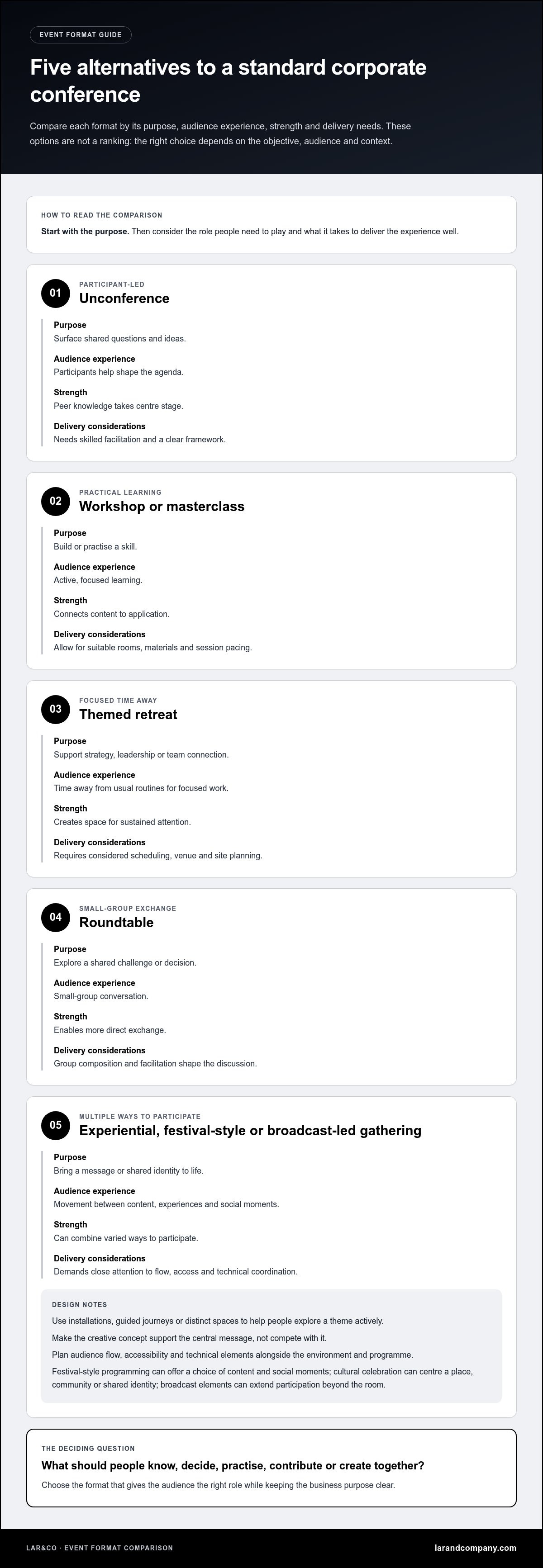
The right choice depends on the objective, audience and context. An open discussion may suit a team developing ideas, while a structured workshop is better for practising a defined skill. The comparison below sets out the main trade-offs. These options aren’t a ranking: each can work when its design supports the purpose.
| Format | Purpose | Audience experience | Strength | Delivery considerations |
|---|---|---|---|---|
| Unconference | Surface shared questions and ideas | Participants help shape the agenda | Peer knowledge takes centre stage | Needs skilled facilitation and a clear framework |
| Workshop or masterclass | Build or practise a skill | Active, focused learning | Connects content to application | Allow for suitable rooms, materials and session pacing |
| Themed retreat | Support strategy, leadership or team connection | Time away from usual routines for focused work | Creates space for sustained attention | Requires considered scheduling, venue and site planning |
| Roundtable | Explore a shared challenge or decision | Small-group conversation | Enables more direct exchange | Group composition and facilitation shape the discussion |
| Experiential, festival-style or broadcast-led gathering | Bring a message or shared identity to life | Movement between content, experiences and social moments | Can combine varied ways to participate | Demands close attention to flow, access and technical coordination |
Experiential and immersive gatherings
An immersive environment might use an installation, a guided journey or distinct spaces to invite people to explore a theme actively. The creative concept should make the central message easier to understand, not compete with it. Plan audience flow so people can move comfortably, consider accessibility from the outset, and coordinate technical elements with the environment and programme.
Festival-style, cultural and broadcast-led events
Festival-style programming can bring together different content and social moments, giving attendees choice in how they spend their time. A cultural celebration can centre a place, community or shared identity. Broadcast elements can extend participation beyond the room, provided remote audiences have a purposeful role rather than simply watching a live feed.
These formats can also be combined. A gathering might pair a central broadcast with facilitated roundtables, or set practical workshops within a broader festival-style programme. The more varied the experience, the more important it is to make transitions, technical cues and the audience journey coherent.
Lar&Co’s live event work portfolio includes corporate, cultural and live experiences that illustrate different approaches. Use each format as a starting point, then test it against the outcome you need and the experience your audience will value.
How to compare conference alternatives without losing the objective
A strong concept is useful only if it serves the event’s purpose and can be delivered well. Assess each alternative to a standard corporate conference against four factors: the business outcome, audience needs, scale and desired level of participation. This keeps the decision grounded. A high-energy experience may attract attention, but a focused conversation could be more valuable when the goal is to reach a decision.
Match the format to the audience and outcome
Map who will attend, including audience groups, levels of seniority and cultural context. Then define what each group needs to do: listen, practise, contribute, make a decision or connect with others. The answer may differ across the room. Senior stakeholders might need a concise briefing, while cross-functional teams need time to explore how a decision affects their work.
Give the objective a visible measure. This could be decisions recorded, actions assigned, questions resolved or a skill demonstrated during a session. These measures make it easier to judge whether the format helped, without mistaking activity for progress.
Use focused discussion
when stakeholders need to compare views, examine a shared issue or agree a course of action.
Use a more expressive experience
when recognition, cultural exchange or a shared identity is central to the purpose.
Check participation expectations
so attendees know whether they’re being asked to observe, contribute or lead.
Test the scale
by considering whether the format still works for the intended audience size and mix.
Understand the production trade-offs
Every creative choice has practical consequences. A room designed for roundtable discussion has different layout needs from a space built around a stage or guided experience. Consider sightlines, audience movement, access, seating and transitions between sessions. A tight schedule may leave little room for open-ended participation, while a flexible programme needs clear direction so attendees can follow it.
Technical requirements should serve the format. A broadcast element, interactive content or multiple programme spaces can add value, but each introduces dependencies that need coordination. Map what must happen, where it happens and what the audience needs to see or hear. The architecture of live event production starts with these connections between the creative idea, technical plan and people moving through the space.
International projects also call for locally informed planning. Venue conditions, site logistics and audience expectations can vary between the UK, USA, United Arab Emirates, Saudi Arabia and Qatar. Build those realities into the design early, rather than treating them as details to resolve after choosing the format.
The right format is the one aligned with the intended outcomes and the conditions required to deliver it clearly. Keep distinctive moments where they deepen the experience, and remove anything that distracts from the message or makes participation harder.
Plan a corporate conference alternative from brief to delivery
A clear process lets creative ambition develop alongside the practical plan. When planning alternatives to a standard corporate conference, define the purpose first, then connect the programme, venue, technical requirements and budget to that purpose. This helps prevent a striking idea from becoming difficult to deliver or detached from the message.
Turn the brief into a workable event concept
Start by agreeing what the event must achieve, who it needs to reach and what people should take away. Set the key messages and decide how you’ll recognise progress, whether through decisions made, ideas captured or actions agreed. Creative direction can then shape a programme in which each element has a clear role, from the opening moment to the final transition.
Test the concept against the venue, schedule and audience journey before it becomes fixed. A format that asks attendees to move between spaces, for example, needs a layout and programme that make those transitions clear and comfortable.
Define the brief.
Confirm the business objective, audience groups, key messages and intended outcomes.
Shape the format.
Choose the experience and programme elements that best serve those outcomes.
Assess the site.
Consider the venue layout, access, audience movement and operational needs.
Build the production plan.
Align technical requirements, people, responsibilities and programme transitions.
Review and deliver.
Check that the concept, schedule and resources remain aligned, then assess the event against its original objectives.
Coordinate the people, place and production
Production management connects the creative plan to its delivery. Stakeholders need clear responsibilities, timelines and agreed deliverables so decisions can be made in sequence and dependencies are visible. Technical production translates programme requirements into a workable plan; site management considers how the venue will operate around them. Each workstream informs the others.
Financial oversight belongs in this process from the outset. Allocate resources against priorities, track commitments as plans develop and keep contingency in view for changes that affect delivery. This makes trade-offs clearer: if a creative element adds technical or site demands, its value can be considered alongside its implications without losing control of the overall plan.
Local conditions matter too. A project in the UK, USA, United Arab Emirates, Saudi Arabia or Qatar may involve different venues, teams and operating contexts. Plan for the specific location rather than assuming that a production approach transfers unchanged. Lar&Co’s international show production work brings creative direction, technical production, site management and financial oversight together across live projects.
A corporate event with a distinctive format benefits from a production plan that connects its creative concept to the site, schedule, technical requirements and budget.
Make the right alternative work with an experienced show production partner
A distinctive format needs more than a strong idea. It needs a production approach that carries the concept through planning, technical delivery and the live environment. A show production partner connects those decisions, helping the audience experience remain coherent while teams, site and programme work together.
Lar&Co is an independent international show production practice founded in 2005. Its work spans corporate events, cultural celebrations, festivals and concert tours. The team brings over 20 years of expertise to complex live entertainment and corporate projects where creative intent needs to be matched by disciplined planning and delivery.
What end-to-end production brings to an alternative format
A coordinated production approach brings creative direction, technical production and site management into the same conversation. The format informs the technical plan; the venue and site conditions shape what can be delivered; and those realities feed back into the creative choices. This connection helps teams resolve dependencies early and gives stakeholders a clearer view of how the event will work in practice.
Financial management supports oversight of project budgets as plans develop. It helps make commitments and priorities visible, so decisions about creative elements can be considered alongside their production requirements. Where a programme includes performers or other talent, artist liaison supports the practical coordination around their involvement. It is a distinct production function, not talent booking agency work.
From a clear brief to a distinctive live experience
The process begins with the objective, audience and delivery context. With those defined, the team can shape a format that fits the purpose, establish the production requirements and coordinate the people and site needed to bring it to life. The experience can be ambitious without losing clarity, provided each decision supports the brief and has a practical place in the plan.
Creative direction
translates the purpose into a coherent experience and programme.
Technical production
aligns the show requirements with the chosen format and venue.
Site management
coordinates the operational picture around the location and event activity.
Financial management
keeps budget considerations connected to evolving decisions.
For organisations considering alternatives to a standard corporate conference, experienced production brings creative ambition and execution into alignment. Lar&Co’s over 20 years of expertise provide a foundation for planning international live projects, with decisions shaped around the specific brief rather than a fixed template. The result is a format selected for its purpose and planned with its delivery conditions in view.
Shape the next gathering around what matters
The next step isn’t to choose the most striking format. It’s to decide what you want people to carry into their work once the event is over. Let that intention guide the experience, from the first point of contact to the final moment, and give the audience a clear reason to take part.
Use alternatives to a standard corporate conference as a starting point, not a template. A strong brief makes room for creative thinking while setting boundaries around the message, audience and delivery context. That balance helps an event feel distinctive for the right reasons, with each element earning its place.
Lar&Co brings show production, technical direction, site management, creative direction and financial oversight together to support complex live projects. To explore a format that fits your organisation’s objectives, discuss your event brief with Lar&Co. A clear purpose is an excellent place to begin.
Frequently Asked Questions
What are the best alternatives to a standard corporate conference?
The best alternatives to a standard corporate conference depend on what attendees need to do. A leadership team preparing for a decision might benefit from a facilitated discussion; a product team building practical capability could use a hands-on learning session. For a dispersed internal team sharing routine updates, recorded briefings and collaborative documents may be more useful than an event. Start with the task, then select the format that supports it.
Can a corporate event be entertaining and still achieve business objectives?
Yes. Entertainment can give a business message emotional context, provided it supports the purpose rather than distracting from it. For example, a recognition event can use performance and storytelling to bring company values to life, then make space for leaders to connect those values to future priorities. Keep the message clear before, during and after the entertainment, and give the audience a meaningful next step.
How do I choose an event format for a corporate audience?
Choose by considering what attendees already know, what they need from the event and how they’re expected to contribute. A mixed audience of executives and specialists may need a shared opening followed by smaller, role-specific conversations. For events involving teams in the UK, USA, United Arab Emirates, Saudi Arabia or Qatar, consider how location, language and cultural context may shape participation and the programme.
Are immersive corporate events suitable for every business gathering?
No. Immersive formats are most suitable when exploration, storytelling or active discovery helps the audience engage with the subject. They may be unnecessary for a confidential update, a short decision meeting or an agenda where speed and direct exchange matter most. Before developing an immersive concept, check that attendees can understand its connection to the event’s message and take part comfortably, including those with different access needs.
Can an alternative corporate event include remote attendees?
Yes, if remote participants have a designed role rather than being left to watch from a distance. They might submit questions for a moderator, join a small-group discussion or respond to a prompt alongside people in the venue. Decide how contributions will be heard and acknowledged, and build those moments into the running order. A broadcast link alone extends viewing, but doesn’t necessarily create participation.
How can we measure whether a conference alternative worked?
Set measures before the event that relate directly to its purpose. For a decision-focused session, record the decisions reached and owners assigned; for a learning event, use a short task or follow-up check to assess whether participants can apply a skill. You can also compare intended actions with what happens afterwards. Attendance and satisfaction can provide context, but neither alone shows whether the business objective was met.
Does a more creative corporate event always require more production complexity?
No. Creativity can come from changing how a session is facilitated, arranging the room to encourage conversation or giving attendees a choice of focused activities. Complexity tends to rise when concepts add multiple spaces, intricate transitions or substantial technical dependencies. Make deliberate choices: retain the elements that improve the audience experience, and simplify those that don’t. Clear creative direction helps keep production decisions purposeful and manageable.