Arena Show Production Company: From Creative Vision to Live Delivery
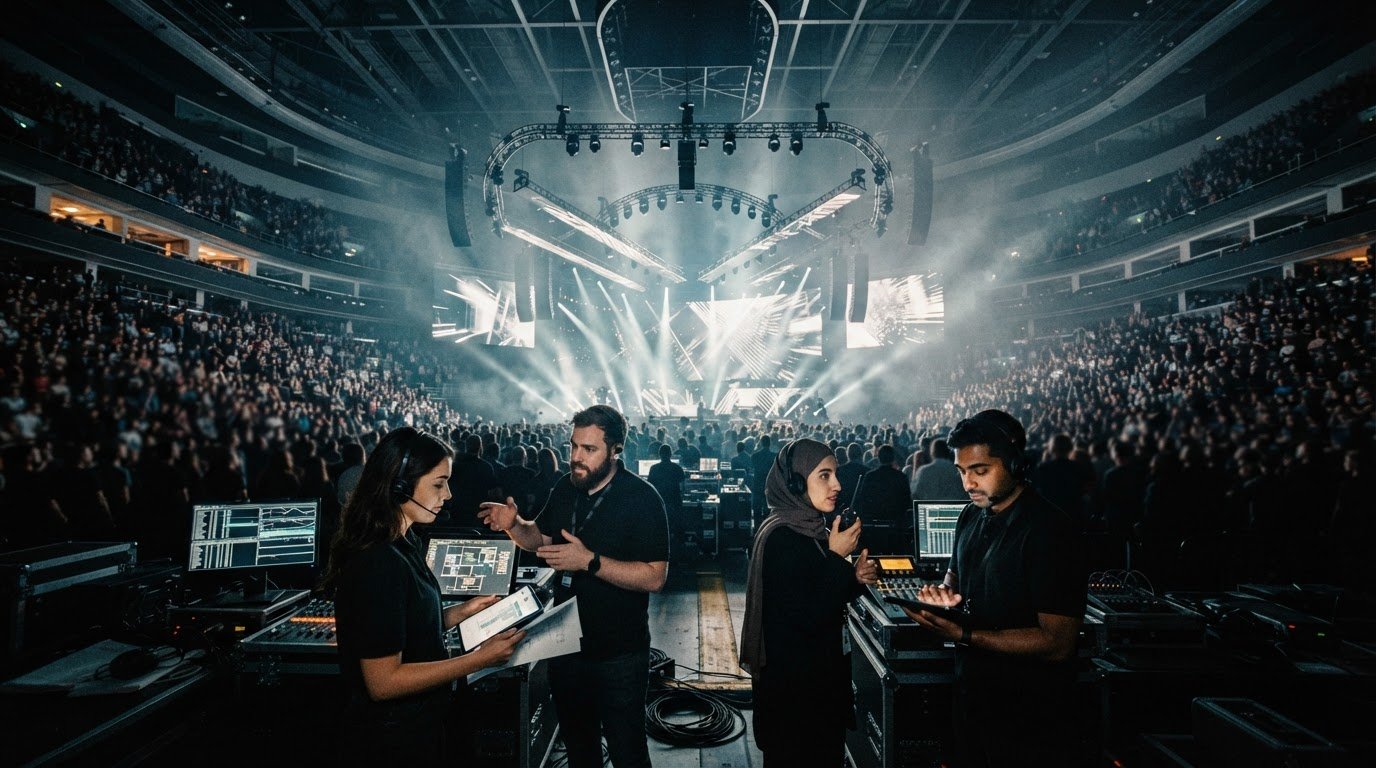
An arena show is shaped as much by the decisions behind the scenes as by what the audience sees. For an arena show production company, the challenge is to bring creative ambition, technical planning and operational delivery into one coherent plan. That means aligning teams, suppliers, venue requirements and schedules from the outset.
Anyone developing a large-scale live event knows that a strong concept must work within the realities of the venue and production schedule. International projects add coordination across markets, stakeholders and venues. A production partner connects those decisions early and keeps them aligned through to show day.
This article explains what an arena show production company manages and how production decisions connect from concept to live delivery. It explores creative direction, technical production, site management, financial management and artist liaison, and what to look for in an experienced partner. With more than 20 years in high-profile live entertainment, Lar&Co brings these disciplines together across projects from its London and Los Angeles offices.
Key Takeaways
• Map the journey from creative brief through planning, coordination, rehearsals, live delivery and review to see where key decisions connect.
• Set clear hand-offs between creative direction, technical production, site management and financial management so teams work to one plan.
• An arena show production company coordinates production planning and delivery, distinct from venue operations, equipment supply and talent booking.
• Assess how a production partner manages scope, decision-making, communication and coordination across venues and markets.
• Shape a useful initial brief around the event’s ambition, format, stakeholders, venue and timing.
What does an arena show production company manage?
An arena show production company coordinates the planning and live delivery of an event, connecting the creative brief with the people, decisions and schedules needed to bring it to the stage. Its role is to establish a shared production plan, clarify responsibilities and keep workstreams aligned as the project develops.
That remit is distinct from running the venue, supplying equipment or booking talent. Venue operations sit with the venue; specialist suppliers may provide equipment; and talent booking is a separate function. Production management coordinates with these parties while focusing on the overall delivery framework. The scope depends on the brief, with responsibilities and decision routes agreed across the project.
Which responsibilities sit within arena show production?
Production management connects the work from brief and planning through delivery and close-out. Technical production translates creative requirements into practical plans. Site management coordinates activity across the event site, while financial management tracks budgets and related decisions.
Artist liaison supports communication between talent teams and production stakeholders, helping relevant information and requirements reach the right people. These disciplines are interdependent: a change to the show plan may affect technical requirements, site coordination and budget. A concert tour offers a useful comparison, bringing promoters, managers and production crews into a connected operation, as outlined in this overview of concert-tour production.
How is arena production different from smaller live events?
The difference is not simply the size of the room. An arena production may involve more teams, suppliers, schedules and interfaces with venue operations. Each dependency needs an owner. A change in one area can affect another, so decisions need to be communicated clearly and promptly.
Shared production information gives stakeholders a common reference for timings, responsibilities and current plans. A decision log can record what has been agreed, who approved it and which teams need to act. Clear decision routes also show who can approve a change and who needs to respond. Without that structure, teams can work from different assumptions. With it, creative, technical and operational decisions can be coordinated rather than handled in isolation.
For a complex project, the production partner’s value lies in connecting these moving parts, not in claiming to control every supplier or venue function. Lar&Co brings show production, technical production, site management, creative direction, financial management and artist liaison together across high-profile live entertainment projects. The scope is shaped around the brief, then defined so each party understands its responsibilities from planning through delivery.
How an arena show moves from creative brief to show day
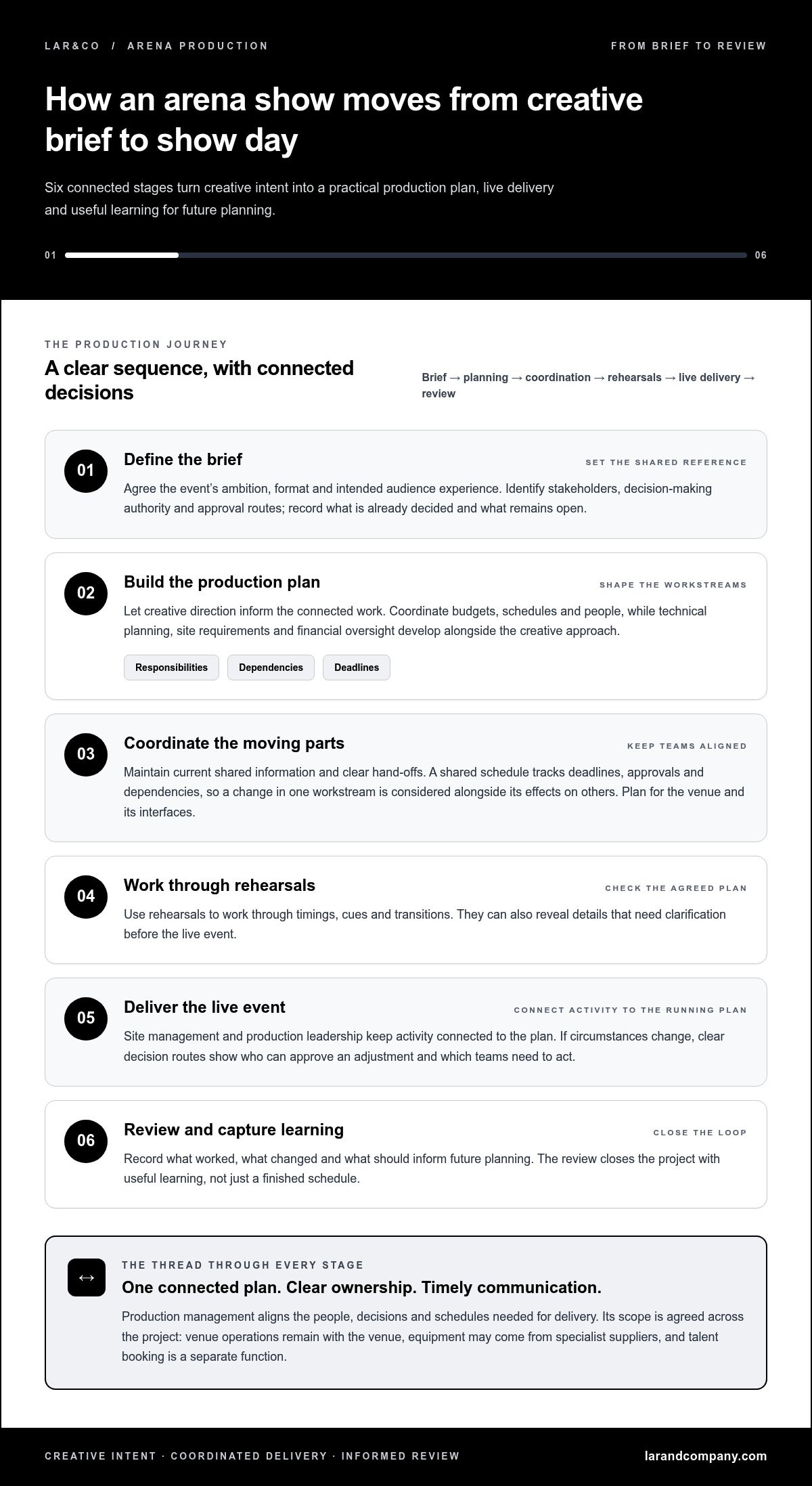
A live show moves through connected stages, each turning creative intent into decisions teams can act on. The sequence is brief, planning, coordination, rehearsals, live delivery and review. The details vary by project, but the principle stays the same: agree what the event needs to achieve, then build a production plan around it.
Turn the creative brief into a deliverable production plan
Start by defining the event’s ambition, format and intended audience experience. Identify the stakeholders, who holds decision-making authority, and how approvals will be made. Record what is already decided and what remains open. This gives the creative team and production partners a shared reference before practical planning begins.
Creative direction then informs connected workstreams. A production manager can coordinate budgets, schedules and the people involved, as described in Berklee College of Music’s overview of the role of a production manager. Technical planning, site requirements and financial oversight can develop alongside the creative approach, with responsibilities, dependencies and deadlines made visible. For a deeper look at the creative discipline, explore Lar&Co’s live event work.
Coordinate planning, rehearsals and live delivery
As plans develop, teams need current information and clear hand-offs. A shared schedule can track key deadlines, approvals and dependencies, so a change in one workstream is considered alongside its implications for others. Technical direction translates creative requirements into technical plans, while venue-specific planning accounts for the site and its interfaces.
Rehearsals give teams the opportunity to work through timings, cues and transitions using the agreed plan. They can also reveal details that need clarification before the live event. An arena show production company coordinates these stages so decisions and updates reach the relevant stakeholders rather than remaining within separate teams.
On show day, site management and production leadership keep activity connected to the running plan. If circumstances change, clear decision routes help the team understand who can approve an adjustment and who needs to act. After delivery, a review can capture what worked, what changed and what should inform future planning. It closes the project with useful learning, not just a finished schedule.
For an early discussion, a concise brief covering ambition, format, stakeholders, venue and timing gives Lar&Co’s production team a practical starting point.
How creative, technical and operational teams work together
Arena production depends on disciplines making connected decisions. Creative direction defines the intended experience; technical production tests how it can be realised; site management coordinates activity at the venue; and financial management tracks the resources and commitments that support delivery. An arena show production company helps connect these workstreams, with clear owners for decisions, approvals and hand-offs.
| Discipline | Key decisions and inputs | Hand-off |
|---|---|---|
| Creative direction | Shapes the show concept, visual language and audience experience from the brief. | Communicates creative requirements to technical and production teams. |
| Technical production | Develops technical plans in response to creative needs and venue conditions. | Coordinates technical requirements with site planning and relevant suppliers. |
| Site management | Plans how activity, teams and venue interfaces are coordinated on site. | Shares operational information with production leads and venue stakeholders. |
| Financial management | Tracks budget, commitments, procurement coordination and reporting. | Gives decision-makers clear financial information as plans develop. |
The exact structure varies with the project. Some responsibilities may sit together; others may need distinct leads. What matters is that every decision has an accountable owner and changes are shared with the people whose work depends on them. This is central to a profession that spans all aspects of live event production and management, as reflected by the International Live Events Association.
Where creative direction meets technical production
Design intent needs to be considered alongside the venue and production requirements. A creative choice may affect technical plans, schedules or how teams use the site. Technical production translates that intent into coordinated plans, identifies dependencies and communicates what other workstreams need to know. This exchange keeps practical decisions connected to the original brief without assuming every concept or venue calls for the same approach.
How site and financial management support delivery
Site management connects venue activity and on-site operations, sharing plans and updates with the teams involved. Financial management provides visibility of budget commitments, procurement coordination and reporting as decisions are made. Together, these functions help stakeholders understand the operational and financial implications of changes, then route approvals to the right people.
Clear communication is essential when teams share deadlines. A revised technical requirement, for example, may affect site coordination and financial tracking. Defined responsibilities and timely updates help each lead respond within their remit. The production partner makes those connections visible and maintains a coherent view of the work, while tailoring team structure and scope to the project.
How to assess an arena show production company for your project
The right production structure depends on the show, the venue and the people involved. Assess how a partner turns those factors into clear scope, accountability and communication, rather than relying on a general promise of scale. Lar&Co brings show production, technical production, site management, creative direction, financial management and artist liaison together for complex live entertainment projects.
Match production scope to the show’s demands
Begin with the demands of the brief. Consider which functions need to connect, how many stakeholder groups and venue interfaces are involved, how fixed the schedule is, and whether the project spans different markets. These details shape the production structure. Lar&Co aligns its disciplines around the project, with responsibilities and reporting lines defined so stakeholders know who is leading decisions and where updates should go.
Scope
Identify whether the project requires show production, technical production, site management, financial management, creative direction or artist liaison, and how these functions interact.
Governance
Set out who approves creative, technical and financial decisions, and how changes are communicated.
Coordination
Account for venue interfaces, schedule dependencies and international coordination where relevant.
This clarity matters because a technical decision can affect site activity, timing or financial tracking. An experienced arena show production company makes those connections visible and establishes a practical route for resolving them.
Look for relevant experience and disciplined communication
Experience is most useful when it relates to the project’s complexity, not just its format. Lar&Co’s work spans concert tours, festivals, cultural celebrations and corporate events. Its live entertainment portfolio offers context for that breadth, without suggesting that every project follows the same model.
Look for a coherent approach to decision-making and information flow. Plans should have clear owners, stakeholders should receive relevant updates, and changes should be assessed across affected workstreams. Shared information and defined responsibilities support effective problem-solving, particularly when the venue, schedule or stakeholder mix adds complexity. Lar&Co’s international practice, with offices in London and Los Angeles, also brings perspective to projects involving different venues and markets, including the UK, USA, United Arab Emirates, Saudi Arabia and Qatar.
For related operational context, explore Lar&Co’s guide to large-scale event management. To discuss how production scope could align with your project’s venue, stakeholders and schedule, contact Lar&Co about your show.
Plan your arena show with an experienced production partner
Once the creative ambition and delivery requirements are clear, bring them into one practical project brief. An experienced arena show production company can connect the disciplines the event needs, from show and technical production to creative direction, site management, financial management and artist liaison. The right mix depends on the project, its stakeholders and the venue.
Bring the essential information into the first conversation
A concise overview is enough to establish useful context. Set out what the event should achieve, its format and intended audience experience, where it will take place and what stage planning has reached. Include the main stakeholders, known venue or schedule constraints and key decision milestones.
Some details may still be developing. That is expected. A clear account of what is decided, what remains open and who is involved helps shape the next discussion. It also gives the production team a starting point for understanding dependencies and identifying where creative, technical and operational planning need to connect.
Ambition and format
What is the event, and what experience should it create?
Location and timing
Which venue or market is involved, and what dates or milestones are known?
People and decisions
Who are the key stakeholders, and how will approvals be made?
Current stage
What has already been planned, and where does the project need coordination?
Move from initial discussion to coordinated planning
From that starting point, define the production scope, responsibilities and reporting lines. The planning approach can then be shaped around the brief, with relevant disciplines aligned and priority decisions, dependencies and next steps made clear. This creates a shared framework for the client, production team, venue and other stakeholders.
Lar&Co is an international show production practice with offices in London and Los Angeles and more than 20 years of experience across high-profile live entertainment. Its work spans concert tours, festivals, cultural celebrations and corporate events. Read more about Lar&Co’s background and international practice.
Share the ambition, format, stakeholders, venue and timing for your project. Discuss your arena show brief with Lar&Co.
Bring your arena show vision into focus
Arena production works best when creative ambition and operational planning move together. The right production partner connects the brief to coordinated decisions across creative direction, technical production, site management and show delivery. Clear responsibilities and communication help keep teams aligned as plans develop.
Choosing an arena show production company means looking for a scope that fits the project, relevant live-event experience and a considered approach to the venue, stakeholders and schedule. Lar&Co was founded in 2005 and brings more than 20 years of live entertainment experience, with an international practice based in London and Los Angeles and projects across the UK, USA, United Arab Emirates, Saudi Arabia and Qatar.
Its work spans show production, technical production, site management and creative direction, bringing connected disciplines to complex live projects. Share your event’s ambition, format, venue and timing to start shaping a practical production approach.
Discuss your arena show brief. A clear first conversation can set your project on a considered path from creative vision to live delivery.
Frequently Asked Questions
What does an arena show production company do?
An arena show production company coordinates the planning and delivery of a live event, connecting creative requirements with technical, operational and financial decisions. Its scope may include show production, technical production, site management, creative direction, financial management and artist liaison. It helps align stakeholders, responsibilities and schedules. Venue operations, equipment supply and talent booking are separate functions, though production teams may need to coordinate with those parties.
When should you appoint an arena show production company?
Appoint a production partner while the event’s format, venue and schedule are being developed, so production considerations can inform decisions early. This gives the team time to understand the creative ambition, identify dependencies and clarify who is responsible for approvals. For a project in the UK, USA or another market, early coordination can also help account for local venue and stakeholder interfaces as plans take shape.
How is arena show production different from festival production?
Arena production is typically planned around a specific venue and its operational interfaces. Festival production may involve coordinating activity across a broader event site, multiple stages or different performance areas. Both require clear schedules, stakeholder communication and technical planning, but the site layout and workstreams differ by project. In the UK, USA, United Arab Emirates, Saudi Arabia and Qatar, venue and event requirements should shape the production plan.
What should an arena show production brief include?
A useful brief outlines the event’s ambition, format, intended audience experience, location and timing. Include the project stage, key stakeholders, decision-makers, known venue or schedule constraints, and major approval milestones. For a show planned in the UK, USA, United Arab Emirates, Saudi Arabia or Qatar, identify the intended market and venue early. The brief can be concise, with open questions clearly distinguished from decisions already made.
How do creative and technical teams work together on an arena show?
Creative direction establishes the intended experience and design priorities; technical production translates those priorities into coordinated plans. The teams assess creative decisions against the venue, schedule and production requirements, then share implications with relevant stakeholders. For example, a change to a visual element may affect technical planning and other workstreams. Clear hand-offs help preserve the creative intent while keeping decisions practical for the project.
Can an arena show production company manage international projects?
Yes. An international production practice can coordinate projects involving different markets, venues and stakeholder groups. Lar&Co has primary offices in London and Los Angeles and works across high-profile live entertainment. Its international perspective is relevant to projects in the UK, USA, United Arab Emirates, Saudi Arabia and Qatar, where the production approach can be shaped around the brief, local venue context and project stakeholders.
How do you choose an arena show production company?
Look for a partner whose production scope fits the brief and whose experience reflects the project’s complexity. Assess how responsibilities, reporting lines, approvals and updates will be managed, as well as the company’s ability to coordinate creative, technical, site and financial work. Lar&Co brings more than 20 years of live entertainment experience across concert tours, festivals, cultural celebrations and corporate events, with an international practice based in London and Los Angeles.