Artist Liaison for Live Events: From Talent Confirmation to Show Day

A confirmed celebrity appearance is not yet a show-ready commitment. Booking secures the talent; artist liaison for live events helps turn that commitment into a coordinated plan, connecting representatives with production and event teams.
The person who sources and contracts talent may not be the person managing communication, schedules and requirements once an appearance is confirmed. If those responsibilities are unclear, details can be missed and production plans may fall out of step with the artist’s needs.
This guide explains where booking ends and liaison begins, and how to co-ordinate the work from confirmation through show day. It covers clear points of contact, practical information-sharing and alignment with production. Lar&Co brings over 20 years of international show production experience, with offices in London and Los Angeles, and offers artist liaison alongside show and technical production.
Key Takeaways
• Separate talent sourcing and contracting from the operational co-ordination that follows a confirmed appearance.
• Use artist liaison for live events to connect representatives with event teams through clear contacts, a written brief and an agreed handover.
• Choose between in-house, dedicated or production-led liaison based on event complexity, stakeholder numbers and schedule sensitivity.
• Set clear processes for changes, confidentiality, access and escalation so expectations stay aligned as plans evolve.
• Bring liaison into the wider production plan, aligning creative, technical, site and show production teams around the event brief.
What artist liaison for live events actually covers
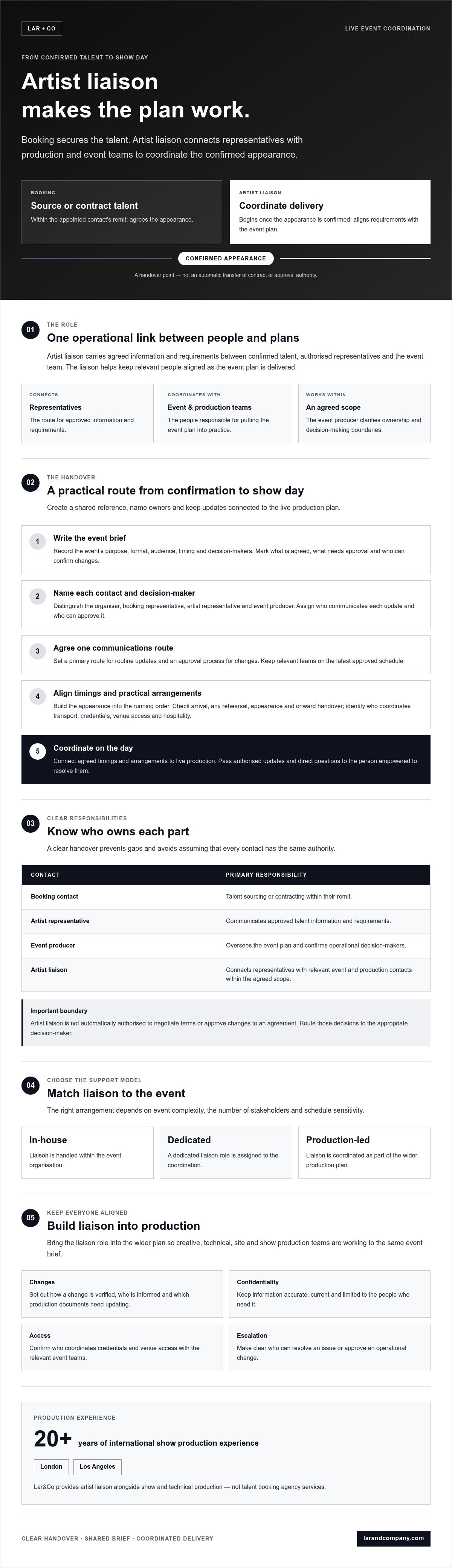
Artist liaison for live events is the operational co-ordination between confirmed talent, their authorised representatives and the event team. The role carries agreed information and requirements into the event plan, then keeps the relevant people aligned as that plan is delivered. It supports an appearance; it doesn’t source or secure talent.
A confirmation alone doesn’t establish who will answer questions, share approved updates or flag a change that affects the schedule. An accountable liaison point helps prevent gaps between representatives and the teams producing the event. Agree the role’s boundaries with the event producer so everyone knows what the liaison owns and what must be decided elsewhere.
What does an artist liaison do before and during an event?
Before the event, liaison provides a communication route between representatives and production. Depending on the agreed brief, this may include co-ordinating schedule details, sharing approved event information and passing practical requirements to the relevant teams. Keep information accurate, current and limited to those who need it.
On the day, the liaison helps connect agreed timings and arrangements to the live production plan. This might mean checking the schedule, passing on an authorised update or directing a question to the person empowered to resolve it. Touring roles can overlap: a Road manager, for example, may handle artist-related arrangements on tour. The event producer should define how that role and the event liaison work together rather than assume their responsibilities are interchangeable.
Artist liaison versus talent booking: who does what?
Booking and liaison operate at different points in the process. Where it falls within an appointed agency’s remit, talent booking involves sourcing or contracting an artist and agreeing the appearance. Liaison begins once an appearance is confirmed and co-ordinates it with the event’s delivery requirements. The liaison isn’t automatically authorised to negotiate terms or approve changes to the agreement.
Before work begins, establish who holds each responsibility:
Booking contact
handles talent sourcing or contracting within their remit.
Artist representative
communicates the talent’s approved information and requirements.
Event producer
oversees the event plan and confirms who can make operational decisions.
Artist liaison
connects representatives with the relevant event and production contacts within the agreed scope.
Lar&Co provides artist liaison and production, not talent booking agency services. Making that distinction explicit helps organisers appoint the right support and establish a clear handover once the appearance is confirmed.
Co-ordinating celebrity talent: confirmation to show day
Once an appearance is confirmed, turn the available information into a working plan. Start with a written brief covering the event’s purpose, format, audience, timing and decision-makers. Record what’s agreed, what still needs approval and who can confirm changes. This gives representatives and production teams a shared reference instead of leaving them to rely on separate email threads or assumptions.
Map responsibilities early: naming each contact, decision-maker and escalation route against outstanding approvals and schedule dependencies helps prevent gaps between representatives, organisers and production. Distinguish the organiser, booking representative, artist representative and event producer. Note who communicates each type of update and who has authority to approve it, without assuming terms that belong in an agreement.
Set one communications route
Agree a primary route for routine updates and a clear approval process for changes. If an appearance time shifts, for example, the person receiving the update should know who verifies it, who needs to be informed and which production documents must change. Share approved information with the relevant teams and make sure everyone is working from the latest schedule. A Harvard University role description offers a practical reference for artist liaison responsibilities, including itinerary co-ordination and serving as a point of contact.
Align schedules, access and production information
Build the appearance into the running order, then check related timings, including arrival, any rehearsal, the appearance and the onward handover. Confirm who is responsible for co-ordinating transport, credentials, venue access and hospitality. These arrangements may sit with different event teams, so the liaison should direct questions to the right owner rather than assume responsibility or promise provision.
Apply the same discipline to production details. Check relevant technical and site requirements with production leads, and record open decisions with their owner and status. If an agreed detail changes, communicate it through the established route and update the working plan.
On show day, hand over the current schedule, confirmed arrangements, open items and escalation contacts to the people managing delivery. Make the handover direct: who is expected, where the latest information sits and who to contact if plans change. For complex events, production support can help organisers connect liaison with the wider production plan.
Compare artist liaison options and choose the right event support
The right model depends on what the event requires, not on a universal hierarchy of roles. A single appearance with a straightforward schedule may suit an in-house coordinator. Several representatives, sensitive timings, complex venue conditions or international co-ordination may call for a dedicated liaison or a production-led approach. Assess stakeholder numbers, schedule sensitivity, venue demands and how closely the role needs to connect with production.
| Support model | Strength | Limitation | Best suited to |
|---|---|---|---|
| In-house coordinator | Knows the organiser’s team and internal processes. | May be balancing liaison with other event responsibilities. | A contained appearance with clear contacts and manageable timings. |
| Dedicated liaison | Provides a named point of contact focused on artist-side co-ordination. | Needs clear authority and integration with the wider event team. | A high-profile appearance involving multiple representatives or a sensitive schedule. |
| Production-led liaison | Connects artist communication directly with show and production planning. | Scope must be defined so liaison and production responsibilities remain clear. | An event where timing, venue conditions and production decisions are closely linked. |
These approaches can be combined, provided accountability is explicit. Artist liaison for live events needs a defined remit, reporting line and route for raising decisions. A one-off appearance has different demands from tour-wide co-ordination, where responsibilities extend across multiple dates and production plans.
When is dedicated artist liaison useful?
A dedicated liaison can be valuable when several representatives need aligned information, the schedule has little flexibility or the event involves multiple handovers. A named contact can help updates reach the right people and reduce fragmented communication. The role can’t guarantee plans will remain unchanged, so agree its authority and escalation route. Assess tour-specific requirements separately from those of a single event appearance.
What should an event organiser check before appointing support?
Before appointing support, confirm the scope, authority, reporting lines, availability and escalation arrangements in writing. Ask how the liaison will work with show production and technical teams, and who owns decisions outside the liaison remit. Check relevant delivery experience against the demands of your event. Lar&Co’s live event work provides context for its production practice. Review examples relevant to your brief without assuming experience with a particular artist or event type.
Lar&Co’s international practice, with offices in London and Los Angeles, is relevant to organisers considering international co-ordination. Whether an event is in the UK, USA, United Arab Emirates, Saudi Arabia or Qatar, choose support according to the brief and the communication links required between representatives and production teams.
Manage risks, expectations and international event requirements
A confirmed appearance is a starting point, not a complete delivery plan. Schedules can shift, approvals may remain open and details may need to reach several teams. Artist liaison for live events helps keep those moving parts aligned, but it works best when responsibilities and limits are clear from the outset.
How can organisers reduce last-minute co-ordination problems?
Keep one current schedule, a controlled contact list and a decision log. For each change, record what changed, who approved it and which stakeholders need the update. Agree who can authorise schedule or access changes, and who communicates them to representatives, the organiser and production teams. This helps prevent people acting on conflicting information.
Protect confidential details by agreeing what can be shared, with whom and through which channel. Confirm access arrangements with the responsible event team and identify dependencies, such as a rehearsal time that affects the running order. Plan contingencies with production leads while respecting the artist’s confirmed arrangements and decisions reserved to the organiser or representatives.
General practice
Maintain a single current schedule, controlled contact list and documented decision log.
General practice
Confirm change approvals, communications ownership, confidentiality boundaries and escalation contacts.
General practice
Review access and schedule dependencies with the responsible event and production teams.
Local advice
Verify entry, work authorisation, tax, insurance and contracting questions with qualified advisers for the relevant jurisdiction and engagement.
Local advice
Confirm venue, transport, security and protocol arrangements with responsible local specialists.
What changes when an event crosses borders?
International co-ordination adds questions that cannot be answered with a universal checklist. Requirements may depend on the country, the nature of the appearance and the specific engagement. For events in the UK, USA, United Arab Emirates, Saudi Arabia or Qatar, organisers should seek qualified local advice on relevant entry, work authorisation, tax, insurance and contracting matters. Don’t assume guidance for one country or event applies to another.
Local specialists should also confirm venue procedures, transport arrangements, security co-ordination and any applicable protocol. Keep their advice distinct from the operational plan: document who has verified each requirement, what remains unresolved and who owns the next action. The liaison can connect representatives and event teams, but shouldn’t replace legal, tax or other qualified local advice.
To discuss how artist liaison can connect with show and technical production, contact Lar&Co about production support.
Integrate artist liaison into show production and take the next step
Artist liaison is most effective when its communication sits within the production plan, rather than alongside it. The liaison can relay approved artist-facing information, while the producer maintains the overall event plan and specialist leads confirm decisions within their areas. This connects updates to the running order, site operations and technical delivery.
What a joined-up production approach brings to the liaison role
Consider a change to an appearance time. The liaison can communicate the approved update to the artist’s representatives; the show producer can assess its effect on the running order; technical and site leads can confirm any implications for their plans. Clear decision ownership prevents the liaison from being expected to approve matters outside their remit.
This approach is useful when several workstreams depend on the same information, or when an event has multiple stakeholders and a tightly linked schedule. It’s one part of global show production, focused here on how artist communication connects with event delivery.
One production partner co-ordinating connected workstreams may help organisers maintain a consistent brief and clear communication lines. Responsibilities still need to be defined: creative direction shapes the event’s intent, technical production and site management address their respective plans, and the producer oversees overall delivery. The liaison connects the artist-facing conversation to those agreed processes.
What to prepare before discussing a live event
A focused first conversation starts with the essentials. Prepare:
• Event type, location, dates and intended audience.
• Whether talent is confirmed, and which representatives are appointed.
• The current planning stage and known schedule milestones.
• Production, access and representative co-ordination requirements already identified.
• Key stakeholders, decision-makers and any unresolved questions.
This information helps establish whether artist liaison should stand alone or be aligned with show production, technical production, creative direction or site management. Lar&Co is an international show production practice with offices in London and Los Angeles and experience across concert tours, festivals, cultural celebrations and corporate events. Its international production work can provide context when considering fit.
If you’re planning a live event, share your brief with the Lar&Co team to discuss the scope, responsibilities and production connections your event requires.
Put a clear plan behind the appearance
A confirmed appearance is only the beginning. Effective artist liaison for live events connects the artist’s representatives with event and production teams through clear contacts, agreed responsibilities and a current plan. Choose support according to the event’s complexity, schedule and co-ordination needs. For international events, confirm local requirements with qualified advisers rather than relying on assumptions.
Lar&Co is an international show production practice founded in 2005, with over 20 years of expertise. Artist liaison sits alongside show production, technical production and site management, helping organisers align connected workstreams around the event brief.
To discuss your live event, share your brief with the Lar&Co team, including the location, dates, confirmed talent status, stakeholders and known requirements.
Frequently Asked Questions
What does an artist liaison do at a live event?
An artist liaison co-ordinates communication and practical arrangements between confirmed talent or their representatives and the event team. Depending on the agreed brief, this may include schedule updates, access, rehearsal timings, hospitality co-ordination and day-of-show contact. The role doesn’t automatically include sourcing or contracting talent. Confirm the liaison’s remit, authority and handover points with the producer so representatives and event teams know who handles each decision.
Is artist liaison the same as booking a celebrity for an event?
No. Talent booking generally involves sourcing, negotiating or contracting an appearance through an appropriate representative or agency. Artist liaison focuses on co-ordinating a confirmed appearance with the event schedule and production plan. These responsibilities may sit with different organisations, so record who owns each task and approval. Lar&Co offers artist liaison and production services, not talent booking agency services, and does not source or contract celebrity talent.
How do you secure celebrity talent for a live event?
Start with a clear brief covering the event’s audience, format, purpose, timing and approval process. Approach talent through authorised representatives or an appropriately appointed booking agency, and have qualified advisers review contractual and jurisdiction-specific questions. Once the appearance is confirmed, assign an artist liaison to co-ordinate schedules and production communication. This separates the booking decision from the operational planning needed to deliver the appearance.
When should an event organiser appoint an artist liaison?
Appoint liaison support early enough for it to connect with production planning, particularly if an appearance involves several representatives, tight timings, complex access or international co-ordination. The right point depends on the event and responsibilities already assigned to the organiser or agency. Agree the liaison’s scope and reporting line in writing. The role doesn’t replace booking, legal, security or technical specialists, whose responsibilities should remain clear.
What information should an artist liaison receive before show day?
Provide the approved event brief, confirmed appearance details, current schedule, venue and access information, key contacts, escalation route and relevant production requirements. Share sensitive details only through agreed channels and with appropriate permission. Keep one current version of schedules and contact information, and identify who can approve changes. This helps the liaison direct updates to the right representatives without creating conflicting instructions for the organiser or production team.
Does artist liaison cover international travel, visas and work permits?
A liaison may co-ordinate communication about travel or access, but responsibility for arranging or approving these matters must be agreed for each event. Entry, work authorisation, tax and contracting requirements depend on the destination and engagement. For events in the UK, USA, United Arab Emirates, Saudi Arabia or Qatar, confirm applicable requirements with qualified local advisers and relevant representatives. A general event checklist isn’t legal advice, and one country’s process may not apply elsewhere.
How is artist liaison different for a festival, corporate event or concert?
The core role remains co-ordination between confirmed talent and the event team, but the brief and production environment change. A festival may require co-ordination around shared stages and changeovers; a corporate appearance may have a defined protocol and running order; a concert follows its own production structure. Set the liaison’s remit against the specific format, schedule, access arrangements and decision-makers rather than assuming one plan will suit every event.