Automation for Stage Shows: Engineering the Modern Spectacle
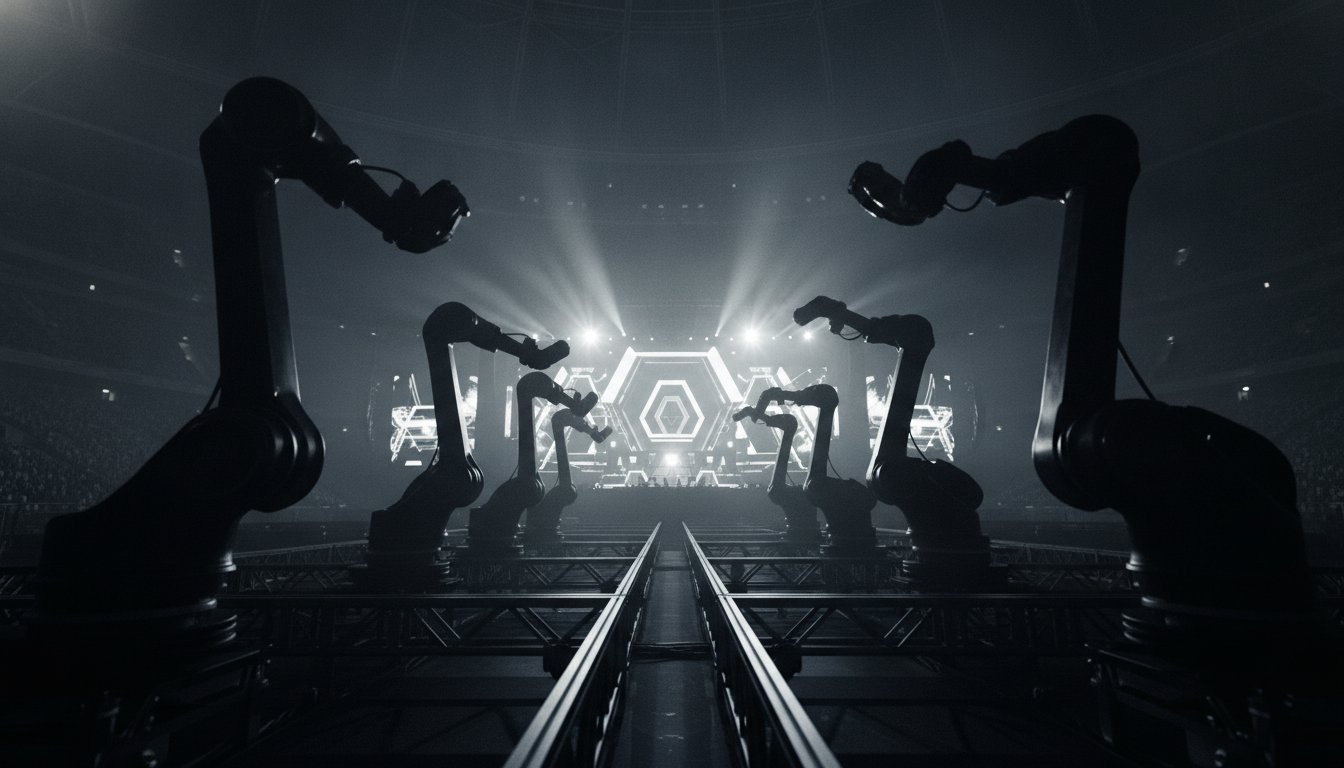
A single mechanical failure during a global broadcast isn't just a technical glitch; it's a reputational crisis. You know that the ambition to create breathtaking moments often sits at odds with the complexity of international logistics and the rigid demands of health and safety. Balancing high-stakes creative vision with the practicalities of automation for stage shows requires more than hardware. It demands a level of composure and technical precision that leaves no room for error or uncertainty on the world stage.
We'll show you how sophisticated stage automation, when paired with elite production management, delivers reliable and safe experiences that enhance the narrative rather than distract from it. This guide examines the implementation of the BS EN 17206:2020 safety standard and prepares you for the upcoming EU Machinery Regulation 2023/1230. You'll discover how to maintain clear financial oversight whilst ensuring your technical systems perform consistently across diverse global climates and prestigious venues. We'll outline the path to achieving a flawless technical execution that satisfies both the creative director and the health and safety inspector.
Key Takeaways
• Understand how modern automation for stage shows has evolved from simple lifts to complex, multi-axis synchronisation that drives global spectacles.
• Identify the critical drive systems and SIL3-rated safety protocols required to protect performers and ensure system reliability during high-profile events.
• Learn the methodology for evaluating ambitious creative concepts against technical feasibility to maintain clear financial oversight.
• Gain insights into the logistics of global deployment, including navigating international borders and adapting to regional infrastructure.
• Discover how expert technical direction translates high-concept vision into tangible, repeatable execution across major international entertainment hubs.
The Role of Automation for Stage Shows in 2026
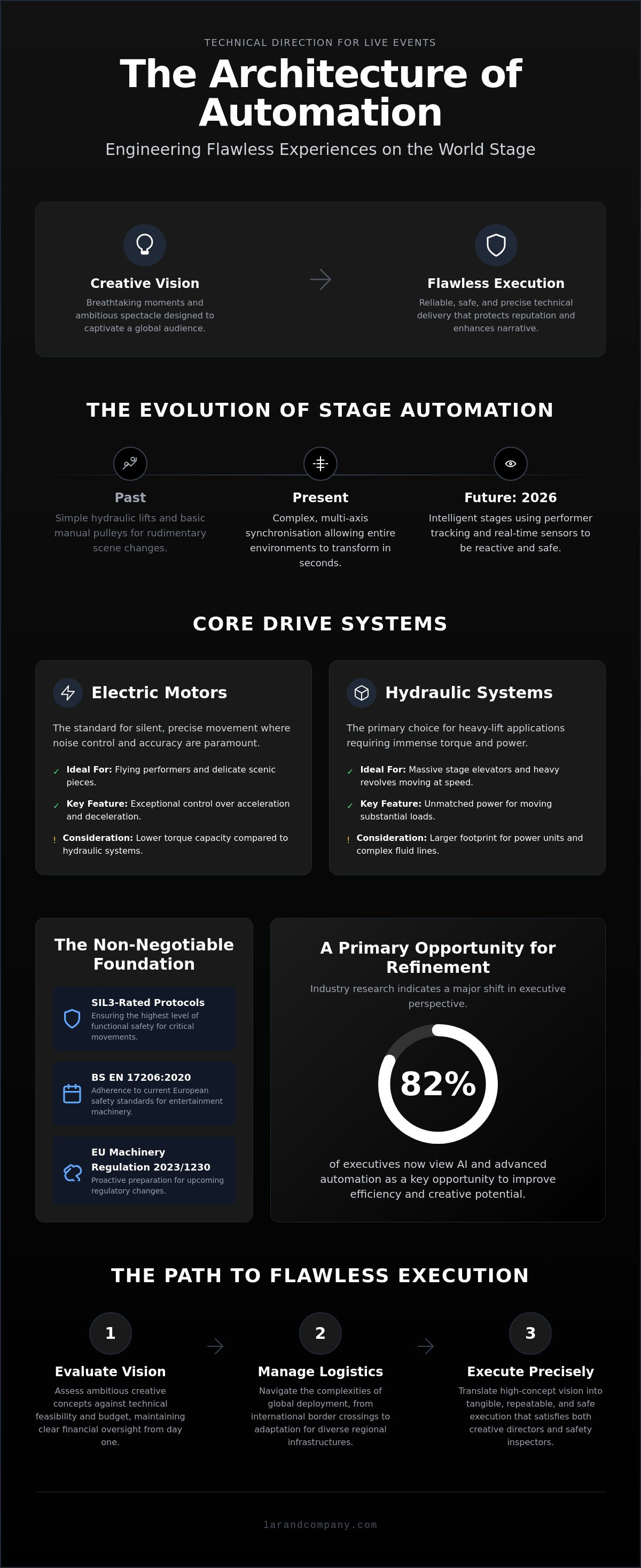
Automation for stage shows is the programmable movement of scenic elements, performers, and equipment. It's the silent engine behind the world's most ambitious productions. We've moved far beyond the era of simple hydraulic lifts and basic pulleys. Today, the standard is complex, multi-axis synchronisation that allows entire stage environments to transform in seconds. By 2026, the industry has shifted toward intelligent stages that don't just follow a script but react to live data. These systems use performer tracking and real-time sensors to ensure that every movement is as safe as it is spectacular.
This level of sophistication is a fundamental pillar of technical production for live events. It requires the seamless integration of show control systems to bridge the gap between lighting, audio, and motion. When execution is flawless, the technology disappears. The audience only sees the narrative. For the producers and stakeholders we partner with, this reliability is the only acceptable outcome for a high-value international project.
From Spectacle to Storytelling
Modern stadium tours and international festivals now view automation as a prerequisite. It's no longer just about the "wow" factor; it's about the rhythm of the performance. Moving scenery enhances the emotional connection by physically altering the audience's perspective. A shifting stage can shrink a vast arena into an intimate space or expand a small platform into a sprawling landscape. This control over physical space dictates the pace of a world-class show. It allows directors to transition between high-energy segments and quiet, narrative moments without breaking the immersion or losing the crowd's attention.
The Scale of Modern Automated Systems
The difference between manual scene changes and high-speed automated transitions is immense. Traditional methods are limited by human speed and safety margins. Modern systems operate at velocities that create a sense of genuine magic, especially in 3D flying effects and immersive environments. Performers move through space with a level of fluidity that manual rigging simply cannot match. Industry research indicates that 82% of executives now view AI and advanced automation as a primary opportunity to refine these efficiencies further. Automation for stage shows is the intersection of mechanical engineering and creative choreography.
Core Technologies Powering Scenic Movement
Modern automation for stage shows relies on a sophisticated hierarchy of mechanical drive systems and digital control layers. Achieving millimetre-precise repeatability across hundreds of performances requires more than just powerful machinery. It demands a deep understanding of physics, engineering, and software logic. Every movement must be predictable. Every stop must be absolute. This certainty is built on the integration of high-resolution encoder data, which provides real-time feedback to the control desk, ensuring that scenic elements are exactly where the narrative requires them to be. For companies developing these high-precision systems, BCM Public Relations offers strategic PR planning to ensure their engineering expertise reaches the right global audience.
The choice of drive system defines the physical capabilities of the stage. Electric motors, hydraulics, and pneumatics each serve a specific purpose within the technical design. While the creative vision dictates what happens on stage, the scenic automation technology selected determines the limits of speed, torque, and noise. For stakeholders, understanding these distinctions is vital for balancing the "wow" factor with the realities of the budget and the venue's infrastructure. If you are planning a high-stakes production, you can view our previous technical projects to see these technologies in action.
Electric Motors vs. Hydraulic Systems
Electric winches are the standard for silent, precise movement. They are ideal for flying performers or delicate scenic pieces where noise would break the audience's immersion. These systems offer exceptional control over acceleration and deceleration ramps. Conversely, hydraulic systems remain the primary choice for heavy-lift applications. When a production requires massive stage elevators or heavy revolves to move at speed, hydraulics provide the necessary torque. The challenge lies in managing the footprint of the power units and the complexity of the fluid lines, especially in temporary touring environments.
Software and Control Integration
The industry is moving toward a unified show control environment. In this model, automation, lighting, and video are no longer separate silos. They are synchronised through a central software interface that manages complex cues with absolute timing. Performer safety is managed through SIL3-rated control systems, which provide the highest level of functional safety currently available in live entertainment. These systems include redundant processors and fail-safe brakes to prevent technical glitches from becoming safety hazards. Real-time tracking systems now allow automated elements to follow performers dynamically, creating a responsive stage environment that adapts to the live energy of the show.
Balancing Creative Vision with Technical Feasibility
Automation is frequently perceived through a lens of apprehension. Stakeholders often view it as a high-risk, high-cost addition that invites potential failure. This perspective is understandable given the stakes of a live broadcast or a high-profile tour. However, the risk isn't inherent to the technology itself; it's a product of how that technology is managed. The tension between artistic ambition and physical limitations is where the most effective engineering happens. Success requires a technical director who can bridge the gap between a creative concept and a tangible execution plan.
A critical phase in the live event creative process is the technical feasibility study. During this stage, we evaluate the engineering reality of a design. We look at floor loadings, power requirements, and the duty cycles of the machinery. Automation for stage shows must be reliable enough to perform identically in London, Los Angeles, or Tokyo. If a vision exceeds the physical capabilities of the equipment or the venue, we find the engineering alternative that preserves the narrative moment without compromising safety or the schedule.
Risk Mitigation and Safety Protocols
Safety is the foundation of every modern spectacle. We implement standardised safety protocols for all automated flying and moving floor sections. This involves daily load testing and sensor verification before every performance. A dedicated automation show-caller is essential for maintaining this standard. They oversee every movement with absolute authority, supported by multi-view camera feeds and real-time data. Fail-safe mechanisms and emergency stop (E-stop) architectures are integrated into the core of the system. These protocols ensure that any deviation from the programmed path results in an immediate, controlled halt.
Financial Oversight of Technical Spends
Managing the financial health of a project is as important as the technical delivery. Budget creep is a common pitfall when the scope of automation for stage shows remains fluid. We prevent this through rigorous production financial management. We help stakeholders evaluate the return on investment for technical assets. Often, sophisticated automation reduces the long-term crew costs associated with manual scene changes. It also increases the overall ticket value by delivering a visual experience that manual rigging cannot achieve. Transparency in technical spending ensures that the production remains viable whilst pushing the boundaries of live entertainment.
Logistics and Global Deployment of Automated Systems
Transporting precision machinery across international borders is a significant logistical challenge. It requires absolute composure. High-value technical assets must arrive in perfect calibration, regardless of the destination. We manage the movement of these systems with a focus on reliability and efficiency. This involves navigating complex customs procedures whilst ensuring that equipment remains protected from the physical stresses of global transit. Every piece of hardware is a critical component of the narrative, and its safe arrival is non-negotiable.
Successfully managing automation for stage shows on a global scale requires more than just technical skill. It demands a deep understanding of regional infrastructure. Automation systems must be adaptable to different power grids and local safety regulations without losing functionality. We ensure equipment reliability in extreme climates, from desert heat to high humidity, by specifying components designed for environmental resilience. This foresight prevents technical failures that could compromise a high-profile performance.
Modular design is essential for the rapid load-in and load-out cycles required by stadium tour management services. Systems are built into tour-ready frames that allow for quick assembly and disassembly. This reduces the time spent on-site and ensures that the technical execution remains consistent across every venue on the tour itinerary. If you require expert oversight for your next international project, discuss your technical requirements with our team.
International Touring Requirements
Managing Carnets and customs for high-value technical assets is a core part of our logistics strategy. We source local technical support and specialised engineers in global hubs like London and Los Angeles to provide on-the-ground expertise when it matters most. Standardising equipment across the tour ensures compatibility and simplifies the replacement of components if required. This global connectivity allows us to maintain the highest standards of technical delivery, regardless of the geographic location.
Site Management and Infrastructure
Preparing the venue is a meticulous process that begins months in advance. We evaluate floor loading capacities and rigging point requirements long before the equipment arrives. Managing the footprint of automation control centres and power distribution is vital for maintaining a safe and efficient backstage environment. Below are five essential site requirements for automated stage shows:
Verified floor loading
Documented capacities for heavy stage machinery and elevators.
Redundant power
Distribution systems tailored to local grid specifications with fail-safe backups.
Defined footprint
Dedicated space for control centres, hydraulic power units, and backstage storage.
Certified rigging
Rigging points with verified weight limits and clear lines of sight for operators.
Climate control
Protection for sensitive electronics and control desks in extreme environments.
Lar&Co: Expert Technical Direction for Complex Automation
Lar&Co is an international practice of show producers. We specialise in the technical delivery, logistics, and planning of complex live events. Our role is to translate an abstract creative vision into a tangible, repeatable execution. With established offices in London and Los Angeles, we provide the global connectivity required for high-stakes projects across multiple continents. We operate as the quiet power behind the scenes, ensuring that every mechanical movement serves the narrative with absolute precision.
Managing automation for stage shows at this level demands a temperament suited for high-value environments. We bring a sophisticated, calm authority to the production process. Our team relies on the gravity of a significant portfolio to establish credibility. We don't just manage hardware; we manage the temperament of the project. This includes maintaining absolute composure whilst navigating the rare and significant challenges inherent in world-class spectacles. We focus on the tangible, reliable execution of complex logistics, allowing high-level stakeholders to remain confident in the project's success.
Integrated Show Production
Success in modern technical production requires the seamless coordination of diverse stakeholders. We oversee every timeline and deliverable, ensuring that automation integrates perfectly with lighting, video, and stage management. This end-to-end oversight is vital for mitigating both technical and financial risk. By maintaining clear financial oversight of technical spends, we prevent budget creep and ensure that multi-million dollar investments are protected. You can view our portfolio of international work to see how we manage these complex dynamics in practice.
A Global Team of World-Class Talent
We leverage a network of elite engineers and programmers to solve bespoke technical challenges. Our presence in major entertainment hubs allows us to deploy cosmopolitan experts who understand local regulations and venue infrastructure. This global reach ensures that automation for stage shows remains consistent, whether the performance is in a prestigious cultural centre or a large-scale civic event. We handle the logistics of technical production so that artists and creators can focus on the performance. If you're preparing a significant international project, contact our team to discuss your next project.
Securing the Future of Technical Excellence
The modern spectacle is defined by its ability to blend high-concept artistry with uncompromising mechanical reliability. We've explored how the integration of SIL3 safety protocols and modular engineering ensures that automation for stage shows remains a dependable tool for global storytelling. Success requires more than just advanced hardware. It demands a technical partner capable of managing international logistics whilst maintaining clear financial oversight of complex technical spends.
Lar&Co brings over 20 years of expertise to the world's most significant live events. With a presence in London and Los Angeles, we are positioned to deliver technical production and site management for multi-million dollar projects across the globe. Our team translates your vision into a tangible reality that performs flawlessly every night, regardless of the venue's location or environmental challenges. We look forward to engineering your next world-class experience.
Contact Lar&Co to discuss your high-profile show production.
Frequently Asked Questions
What is the difference between stage automation and traditional rigging?
Stage automation involves the programmable, motor-driven movement of scenic elements via a computerised control system. Traditional rigging relies on manual counterweight systems or static chain hoists that lack the millimetre precision and synchronised timing of automated winches. Whilst rigging is suitable for fixed scenic pieces, automation allows for complex, multi-axis choreography that technicians can repeat identically every night. This technology transforms the stage into a dynamic environment rather than a static set.
Is automation for stage shows safe for performers and crew?
Automation for stage shows is exceptionally safe when managed through SIL3-rated control systems and rigorous safety protocols. These systems include redundant processors and fail-safe brakes that engage automatically if the software detects a deviation. We implement daily load tests and sensor checks to ensure every movement remains within programmed parameters. Safety is further enhanced by a dedicated show-caller who monitors all motion in real-time, providing an essential layer of human oversight for performer protection.
How much does it cost to automate a scenic element in a live show?
The investment required for scenic automation depends on the complexity of the movement, the weight of the elements, and the required velocity. High-speed flying systems or heavy-lift elevators involve different engineering demands than simple track movements. We focus on providing clear financial oversight to ensure that technical spends align with the production's strategic goals. Evaluating the return on investment involves looking at reduced crew costs and the enhanced visual value of the final spectacle.
Can automation systems be integrated with live music and timecode?
Automation systems integrate seamlessly with live music through SMPTE or MIDI timecode to ensure perfect synchronisation. This allows scenic movements to trigger at exact musical moments, creating a cohesive narrative experience. Modern show control platforms can also utilise real-time tracking data, allowing automated pieces to follow a performer's physical position dynamically. This level of integration removes the margin for human error in timing, ensuring a flawless execution of complex cues during high-profile performances.
What happens if an automated stage system fails during a live performance?
If a system detects a fault, integrated fail-safe mechanisms immediately halt movement in a controlled manner. Technical production teams prepare for these rare events by establishing clear show-stop or limp mode protocols. These procedures allow the performance to continue safely whilst technicians address the issue or bypass the affected element. Redundant hardware and software architectures are standard in our designs to prevent single points of failure from disrupting a live broadcast or tour.
How long does it take to programme automation for a touring production?
Programming a touring production typically requires several weeks of pre-visualisation followed by intensive on-site rehearsals. The duration depends on the volume of cues and the complexity of the synchronisation with lighting and video. We use sophisticated software to simulate movements before the equipment arrives at the venue, which significantly reduces the time needed for physical programming. This preparation ensures that the transition from a creative concept to a functional show is efficient and reliable.
Do I need a special engineer to operate stage automation systems?
Operating sophisticated automation requires specialised engineers and certified programmers who understand the specific logic of the control platform. These professionals manage the daily system checks, maintenance, and live execution of cues. We leverage a network of elite technical talent to ensure that every project is staffed by experts capable of handling high-stakes international environments. Having a qualified team on the ground is the best way to maintain system integrity and performer safety throughout a global tour.
What are the power requirements for large-scale stage automation?
Large-scale automation systems demand significant power, often requiring dedicated 3-phase electricity supplies separate from lighting and audio. The specific load depends on the number of motors and the peak torque required during synchronised movements. We evaluate venue infrastructure months in advance to ensure that local grids can support the technical design. In temporary or outdoor environments, we specify specialised power distribution systems and redundant generators to maintain a stable and reliable energy supply for the machinery.