Automation & Motion Control: 2026 Stage Production Guide
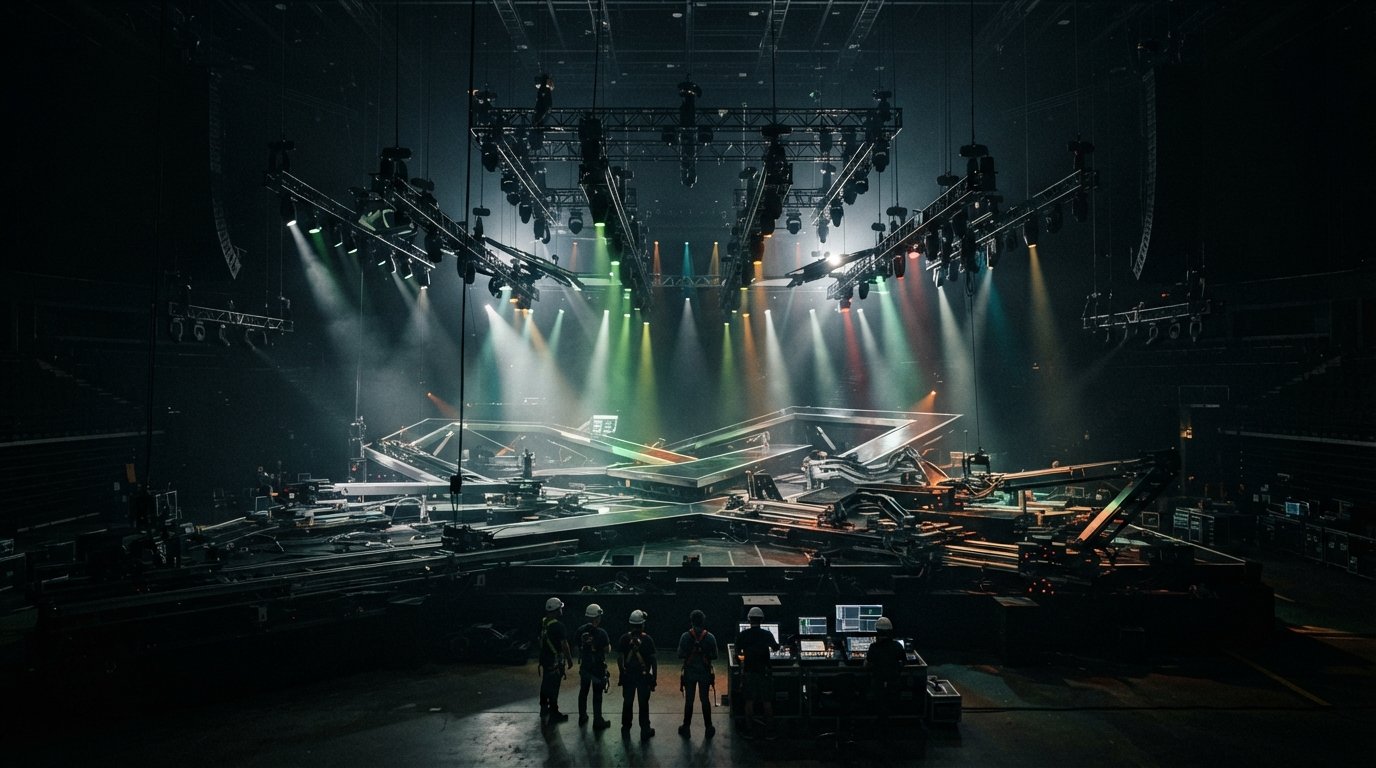
In the high-stakes arena of global touring, the gap between a breathtaking spectacle and a technical catastrophe is measured in milliseconds. As we move into 2026, the implementation of automation and motion control for stage is no longer a secondary luxury; it's the primary engine of modern storytelling. You're likely familiar with the tension that arises when a bold creative vision meets the uncompromising laws of physics. The pressure to deliver a flawless live broadcast whilst managing a multi-million pound international budget is a weight only a few truly understand.
This guide provides the technical clarity and strategic oversight required to transform complex logistics into a seamless, high-impact reality. We'll examine the shift toward SIL3 safety standards, the transition to digital carnet systems, and how to integrate motion tracking with spatial audio. You'll discover how to integrate sophisticated stage automation and motion control to elevate global live experiences with precision and safety. Our focus is on the tangible execution of these complex systems, ensuring your production remains as reliable as it is ambitious.
Key Takeaways
• Distinguish between simple mechanisation and programmable systems to harness the full narrative potential of modern stagecraft.
• Identify the Technical Director’s role in balancing high-concept creative vision with the structural engineering requirements of global venues.
• Implement rigorous safety protocols and SIL3 standards for automation and motion control for stage to ensure flawless execution in high-stakes environments.
• Streamline the movement of complex technical infrastructure across international borders, focusing on key hubs like London, Dubai, and Riyadh.
• Leverage independent production management to maintain financial oversight and technical integrity throughout the lifecycle of a global tour.
The Evolution of Stage Automation and Motion Control
Stage automation is the programmable movement of scenic elements, lighting, and performers. It represents the shift from static stagecraft to a responsive, dynamic environment. For high-tier global events, automation and motion control for stage serves as the backbone of the production, turning a physical structure into a living component of the show. It's the difference between a set that simply exists and one that performs.
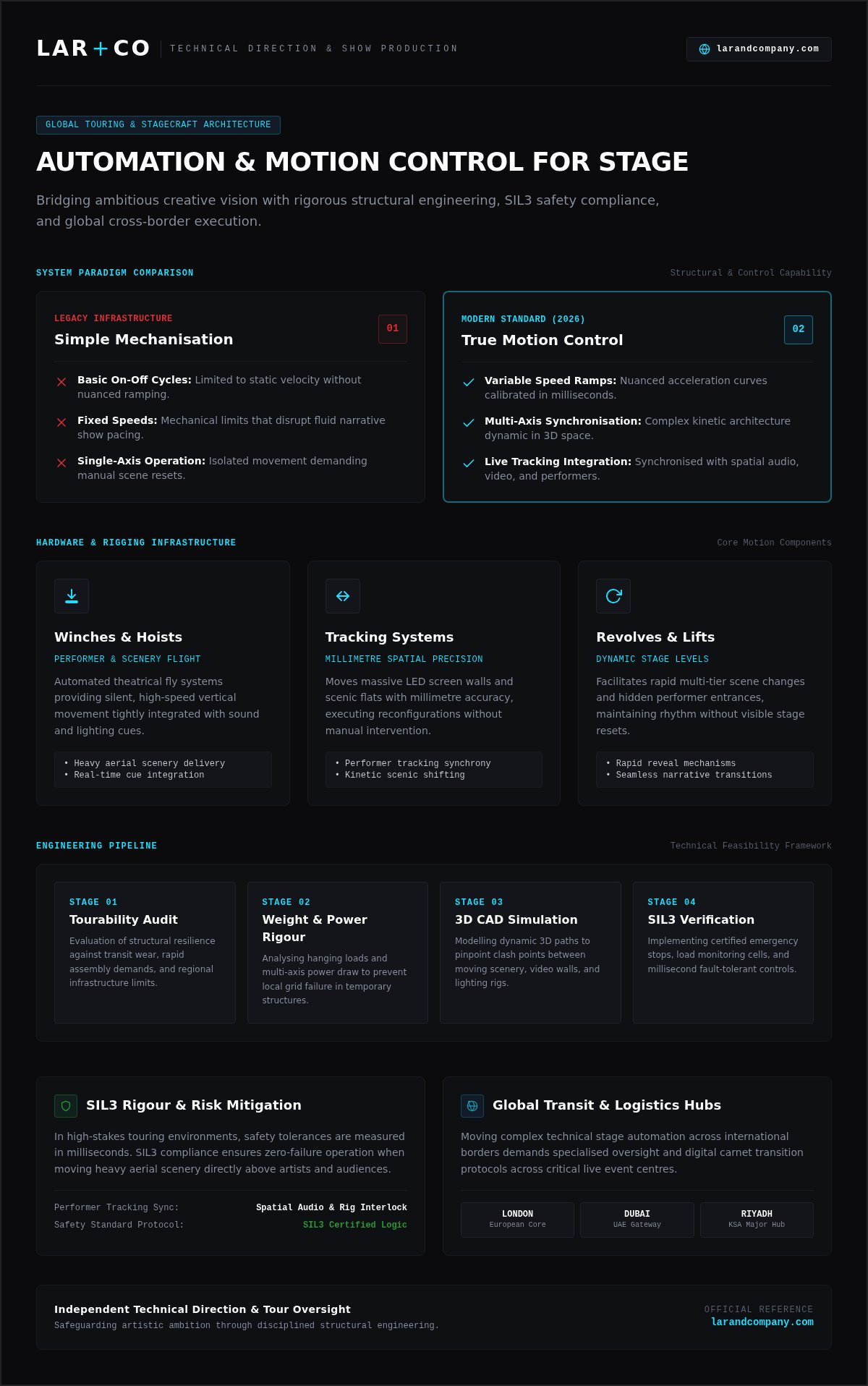
We must distinguish between simple mechanisation and sophisticated motion control. Mechanisation relies on basic on-off cycles with fixed speeds. True motion control provides nuanced variable speeds, precise acceleration ramps, and multi-axis synchronisation. In stadium environments, this level of control isn't a luxury. It's a requirement for safety and visual impact. Modern tours now utilise kinetic architecture, where the stage design physically evolves throughout the performance to maintain visual momentum across vast spaces.
Core Components of a Motion Control System
The technical delivery of these shows relies on specific, high-performance hardware designed for reliability under pressure. Effective systems integrate several key elements:
Winches and hoists
These are the essential tools for performer flying and suspending heavy aerial scenery. Modern automated theatrical fly systems allow for silent, high-speed movement that integrates seamlessly with lighting and sound cues.
Tracking systems
These move massive LED screens or scenic flats with millimetre precision. They allow for complex spatial reconfigurations without manual intervention, often synchronised with performer tracking.
Revolves and lifts
These create dynamic stage levels. They facilitate rapid scene changes and hidden performer entrances, ensuring the show's rhythm is never broken by clunky manual resets.
Automation as a Narrative Tool
Motion is no longer just a technical flourish. It's a narrative device. Sophisticated automation and motion control for stage allows for transitions that are virtually invisible to the naked eye. Instead of traditional scene breaks, the environment shifts around the artist. This creates a sense of fluid storytelling that's vital for high-profile festivals where the attention span of a massive crowd is the most valuable currency.
When we manage projects in diverse locations like Riyadh or London, the technical direction must bridge the gap between this creative vision and engineering reality. You can see how these systems come together in our portfolio of global show production. The goal is always a flawless delivery where the technology disappears, leaving only the impact of the performance. By using movement to guide the audience’s focus, directors can manage complex transitions that feel like integrated choreography rather than mechanical resets.
Technical Feasibility: Bridging Creative Vision and Engineering
Technical feasibility is the rigorous process of aligning artistic ambition with physical laws. In high-stakes production, the Technical Director acts as the essential filter between a creative concept and its tangible execution. They must determine if a design can actually be built, powered, and moved within the constraints of a specific venue or tour schedule. Without this oversight, even the most inspired automation and motion control for stage becomes a liability rather than an asset. It's about protecting the vision by grounding it in reality before the first motor is ever rigged.
Assessing a project begins with the "tourability" of the system. We evaluate whether the equipment can withstand the rigours of international transit and rapid assembly. This involves a deep analysis of weight loads and structural integrity, especially when building within temporary venues in regions like the UAE or Saudi Arabia. Power requirements are equally critical. A massive multi-axis system can easily overwhelm local infrastructure if not managed with precise engineering oversight. We ensure the system is resilient enough to perform flawlessly night after night, regardless of the environment.
The Feasibility Study Process
The study phase transforms abstract ideas into functional blueprints. We use initial CAD modelling and motion simulation to visualise how scenic elements interact in 3D space. This allows us to identify potential "clash points" where moving scenery might intersect with lighting rigs or video walls. By understanding the evolution of stage machinery, we can apply proven mechanical principles to modern, software-driven challenges. This architectural approach is detailed further in our guide to Technical Production for Live Events. It prevents costly on-site adjustments and ensures performer safety through pre-calculated clearances.
Budgeting for Motion Control
Managing the financial landscape of automation requires total transparency and seasoned experience. High capital expenditure is often expected for bespoke builds, but the hidden costs often reside in the operational phase. You must account for specialised operators, maintenance crews, and the significant freight logistics involved in moving heavy racks and motors across borders. Balancing technical ambition with fiscal integrity is a core part of our technical direction service. We prioritise efficient delivery, ensuring that the show remains both spectacular and sustainable throughout its entire global run without compromising on the creative intent.
Managing Risk and Safety in Automated Productions
Safety in live entertainment is often mischaracterised as a hardware feature. In reality, automation is only as safe as the production management infrastructure supporting it. A sophisticated system provides the tools, but the oversight ensures they're used correctly. For any high-profile project, the primary objective is the absolute safety of performers and crew. This requires a culture of composure and precision where technical failure is mitigated through exhaustive planning rather than luck.
Reliable automation and motion control for stage in 2026 relies on SIL3 (Safety Integrity Level 3) rated equipment. This standard is mandatory for complex multi-axis motion and performer flying, ensuring dynamic load peaks don't exceed working limits. We implement redundant systems at every level, including "dead-man" switches that require active operator engagement for any movement to proceed. The producer carries the ultimate responsibility for health and safety management, coordinating large crews to ensure all rigging meets OSHA rigging safety standards and international equivalents.
Safety Protocols and Redundancy
Our protocols rely on a hierarchy of control. This starts with software-based safety zones that prevent scenic elements from entering hazardous areas. We back these up with hardware-based limit switches that act as a final physical barrier. The "Spotter" system remains our most critical layer; no motor moves without a direct line of sight from a qualified professional. E-Stop hierarchies are networked across all consoles, ensuring a single press can halt the entire system across the venue instantly. This combination of digital precision and human oversight creates a fail-safe environment for even the most ambitious choreography.
Contingency Planning for Technical Failure
Technical failure during a live broadcast is a risk that must be managed through proactive design. We develop manual alternatives for show-critical movements, ensuring the narrative remains intact even if a specific component fails. If a motor stalls, the production team must have a rehearsed response to maintain the show's momentum. This level of crisis management is a core component of our approach to Large Scale Event Management. We prioritise the flow of the performance, ensuring that technical issues are resolved behind the scenes without the audience ever noticing a break in the spectacle.
Global Logistics and International Execution
Navigating international borders with multi-million pound technical kits requires a seasoned approach to logistics. In 2026, the rollout of eATA digital carnets across 30 countries has streamlined the movement of technical touring machinery between the UK, EU, and North America. However, the physical reality of moving automation and motion control for stage equipment through hubs like London, Dubai, and Riyadh remains a task of extreme precision. Each territory demands specific customs expertise and a deep understanding of local engineering standards.
Managing temporary venue construction in diverse climates adds another layer of complexity. In the Middle East, extreme heat and sand ingress can compromise delicate electronics and motor drives. We ensure technical consistency across every leg of a global tour by implementing rigorous environmental protection and maintenance schedules. Navigating local regulations in the UAE, Saudi Arabia, and Qatar is not just about compliance; it's about maintaining the show's momentum through meticulous planning.
Site Management for Automated Stages
Effective technical delivery depends on the interface between the touring kit and the local environment. We coordinate directly with local engineers to verify ground-support capabilities and rigging points, especially in greenfield sites where infrastructure is built from the ground up. This level of oversight is a hallmark of Lar&Co’s expertise in Site Management. We bridge the gap between the touring production and the local reality, ensuring the stage is ready for complex automation and motion control for stage before the first truck arrives.
The Cultural Bridge in Technical Delivery
International execution involves managing diverse stakeholders and crews under significant pressure. Professional prestige is maintained through absolute composure and a focus on results. We act as the technical and cultural bridge, translating complex logistics into a flawless show. This requires a cosmopolitan mindset and a commitment to the highest standards of execution. If you are planning a high-stakes international spectacle, consult with our production team to ensure your technical delivery is as flawless as your creative vision.
Lar&Co: Masterful Technical Direction and Show Production
Execution is the only metric that matters in high-profile entertainment. At Lar&Co, we translate ambitious creative visions into tangible, reliable live experiences. Our role is to act as the technical director, bridging the gap between artistic intent and engineering reality. By remaining independent from equipment-led providers, we offer a distinct advantage: our priority is the show's outcome rather than the deployment of specific inventory. This independence allows us to select the most efficient automation and motion control for stage for any given project, ensuring the technology serves the narrative without compromise.
Our portfolio spans decades and continents. We have managed technical direction for iconic musical legends, high-end fashion houses, and massive civic events across the globe. From the complex rigging requirements of major festivals to sophisticated cultural celebrations in the UAE, our team provides the composure required for high-stakes environments. World-class talent and global stakeholders choose us because we manage the rare and significant challenges that define the modern entertainment landscape.
End-to-End Oversight
We provide a comprehensive management structure that begins with initial creative consultancy and extends through to on-site operational control. Managing multi-million pound production budgets requires absolute transparency and fiscal integrity. We ensure every technical decision is backed by rigorous feasibility studies and precise financial oversight. You can learn more about our history and team on our About Lar&Co page. Our process is designed to eliminate technical uncertainty, allowing creative teams to push boundaries with confidence.
Partnering for Excellence
Lar&Co operates as the quiet power behind the scenes for the global elite. We collaborate with luxury sectors and international diplomats to deliver shows that are as secure as they are spectacular. Our commitment to flawless execution is unwavering, whether we're operating in established entertainment hubs or developing infrastructure in emerging markets. With primary offices in London and Los Angeles, we are positioned to lead projects in any time zone. Contact our London or Los Angeles offices to discuss your next production and ensure your technical delivery meets the highest tier of international standards.
Delivering the Future of Live Entertainment
Mastering automation and motion control for stage requires more than sophisticated hardware. It demands a rigorous alignment of creative ambition with engineering reality. We've explored how technical feasibility studies, SIL3 safety standards, and streamlined global logistics form the foundation of a flawless production. In 2026, the complexity of international touring necessitates a partner who can manage these variables with absolute composure.
Lar&Co brings over 20 years of expertise to the world's most significant cultural and commercial stages. With primary offices in London and Los Angeles, we specialise in the end-to-end management of multi-million pound production budgets across diverse international borders. Our role is to ensure your technical delivery is as impactful as your vision, regardless of the location's complexity or the scale of the infrastructure required.
Partner with Lar&Co for your next high-profile production to transform your boldest concepts into tangible, reliable results. We look forward to elevating your next global experience with precision and prestige.
Frequently Asked Questions
What is the difference between stage automation and motion control?
Stage automation refers to the programmable movement of scenic elements, whilst motion control provides the high-precision variable speed and synchronisation required for complex 3D movement. Automation is the broader system that executes cues. Motion control is the specific technology that allows for millimetre accuracy and multi-axis coordination. At Lar&Co, we integrate both to ensure the creative vision is delivered with absolute technical integrity during high-stakes global tours.
How much does stage automation cost for a stadium tour?
Costs for large-scale productions depend entirely on the complexity of the movement and the scale of the infrastructure. Stadium tours often involve multi-million pound technical budgets that require meticulous financial oversight. We don't provide fixed pricing, as every bespoke build is unique. Instead, we focus on cost-effective technical delivery and transparent budget management to ensure your investment translates directly into a flawless audience experience across international borders.
Is stage automation safe for performers?
Automation is exceptionally safe when supported by rigorous production management and SIL3 rated equipment. Performer safety is our primary priority. We implement redundant systems, including hardware-based limit switches and secondary brakes, to meet international safety standards. Our technical directors oversee every move, ensuring that automation and motion control for stage systems operate within strictly defined safety zones to protect every artist and crew member on site.
Can automation be used for temporary outdoor festivals?
Yes, automation is frequently deployed at temporary outdoor festivals, though it requires specialised site management. In locations like Saudi Arabia or the UAE, we must account for extreme heat and sand ingress that can affect motor performance. We design robust environmental protections and coordinate with local engineers to ensure ground-support stability. This ensures that even in greenfield sites, the technical execution remains consistent and reliable throughout the event.
What are the power requirements for a large-scale motion control system?
Power requirements for large-scale systems are substantial and often necessitate dedicated generators or high-capacity venue feeds. A typical multi-axis rig can draw significant current during peak dynamic moves. Our technical production team conducts early feasibility studies to calculate these loads precisely. We manage the interface between the touring kit and local infrastructure in hubs like London or Dubai to prevent power failures that could compromise the show's momentum.
How long does it take to programme an automated stage show?
Programming timelines vary from several weeks of pre-visualisation to multiple days of on-site rehearsals. We use CAD modelling and simulation software to build cues before the physical equipment is even rigged. This reduces on-site pressure and allows for the identification of clash points early. The final duration depends on the show's complexity, but our goal is always to achieve a polished, integrated choreography well before the first audience arrives.
Do I need a specialised operator for stage automation?
You absolutely require specialised operators and technical directors to manage these systems safely. Automation isn't a "set and forget" technology. It demands constant human oversight from professionals who understand the mechanical and software limits of the rig. We provide the technical direction and site management necessary to coordinate these specialists, ensuring that every movement is executed with the professional prestige and composure required for high-tier international projects.
How does automation integrate with timecode and lighting?
Modern systems integrate seamlessly with lighting and media servers using protocols such as PosiStageNet or OSC. This allows automation and motion control for stage to share real-time 3D coordinates, enabling followspots or video content to track moving scenic elements automatically. This level of integrated choreography creates a more immersive experience, as the entire environment responds dynamically to the show's timecode, ensuring every cue is perfectly synchronised across all departments.