Award-Winning Show Production Ideas 2026: Trends Redefining Live Entertainment

The era of relying on towering, static LED video walls to carry an arena performance is over. Audiences and critics have grown weary of flat, formulaic visual backdrops that isolate artists rather than elevate them. For producers seeking award-winning show production ideas 2026, the mandate is clear: live entertainment has abandoned passive digital spectacle in favour of kinetic architecture, spatial audio, and reactive physical environments that command global headlines.
Balancing that artistic ambition with structural reliability is no simple undertaking. Complex digital systems, real-time broadcast capture, and cross-border logistical pressures leave no margin for technical failure or fiscal miscalculation. In this guide, you will discover the cutting-edge creative concepts, kinetic engineering frameworks, and spatial technologies setting the benchmark for elite live productions. We explore how visionary design and disciplined technical production unite to deliver unforgettable, peer-recognised live events.
Key Takeaways
• Explore how award-winning show production ideas 2026 replace flat LED walls with kinetic stages and responsive physical environments.
• Discover the mechanical systems and variable-speed hoists required to execute dynamic scenography without compromising structural safety.
• Learn how real-time rendering engines and spatial tracking eliminate static video loops to create truly interactive visual landscapes.
• Master the four-step framework for balancing 80,000-seat stadium sightlines with high-resolution vertical broadcast capture.
• Understand how unified technical production, site management, and rigorous financial oversight turn radical artistic visions into viable touring realities.
The 2026 Paradigm: Defining Attributes of Award-Winning Show Production
Live entertainment benchmarks have shifted definitively. The era of measuring production value by the sheer pixel count of an LED wall is over. Modern audiences, having grown accustomed to ubiquitous digital screens, crave physical reality. Award panels across the global entertainment sector now scrutinise how deeply a production engages human perception in physical space. For teams developing award-winning show production ideas 2026, the focus has pivoted from flat illumination to structural weight, shadow, and mechanical movement.
Prestigious industry recognition demands an uncompromising balance between artistic intent and invisible engineering. Groundbreaking concepts mean little if they falter under rigorous international touring schedules or fail to meet the strict regulatory frameworks of major metropolitan venues. Environmental accountability, embodied by standards such as ISO 20121:2024, now directly influences peer awards. Productions must demonstrate modular efficiency, responsible power logistics, and rapid strike times alongside visual brilliance.
Criteria That Capture Global Industry Accolades
International award panels evaluate shows through a precise technical lens. Surface-level spectacles are quickly dismissed in favour of holistic operational and creative mastery. Key assessment criteria include:
Spatial Originality
Redefining how physical scale is perceived through contemporary scenography and stagecraft, turning conventional arenas into dynamic, three-dimensional performance volumes.
Narrative Architecture
Ensuring scenic structures, dynamic lighting, and sound reinforcement serve an evolving emotional arc rather than functioning as disjointed technical displays.
Flawless Execution
Realising complex kinetic movements and high-risk rigging safely within strict show timings and load-in windows.
Moving Beyond Flat LED Walls to Spatial Depth
Two-dimensional video backdrops have created visual fatigue. When an entire arena tour relies on a singular flat screen behind the performers, the staging feels detached, planar, and synthetic. Award-winning show production ideas 2026 counter this by incorporating architectural depth directly into the performance area.
True depth relies on physical presence. Designers achieve this by sculpting stages with layered geometric levels, transparent mesh materials, and automated physical portals. Intelligent lighting fixtures cut across tangible textures, producing natural shadows and tangible volume that digital displays cannot simulate. When structural physical elements blend with kinetic engineering, the stage ceases to be a distant frame. It transforms into an immersive, living environment enveloping both artist and audience.
Kinetic Architecture and Responsive Scenography for Modern Stages
Executing such kinetic movements demands uncompromising mechanical discipline. High-speed multi-axis movements introduce substantial dynamic weight displacement, meaning static load assessments aren't enough. Production riggers must calculate real-time shock loads and establish redundant, automated fail-safe braking protocols to ensure artist and crew safety throughout every structural transition.
Automated Overhead Kinetic Sculptures and Ceilings
Deploying high-speed motion-controlled hoists allows arena ceilings to morph into undulating architectural landscapes. Variable-speed winches sync lighting pods directly to musical transients, creating visceral physical pulses above the crowd. Managing mechanical motor noise is paramount in sensitive acoustic settings. Drawing on principles reflected in MIT Spatial Sound Lab research, technical directors isolate motor frequencies to prevent low-end hums from bleeding into sensitive vocal mics whilst maintaining continuous kinetic motion overhead.
Dynamic Floor Systems and Transformational Staging
At stage level, kinetic engineering delivers dramatic narrative reveals. Concentric rotating turntables, scissor lifts, and subterranean performer elevators establish shifting focal points across the arena floor. These staging components rely on modular deck systems engineered for rapid assembly across tight touring schedules. Tactile, matte-finish deck coatings eliminate slip hazards for artists while concealing complex automation tracks and mechanical guides from audience sightlines.
Material Innovation: Weight Reduction and Sustainable Rigging
Heavy physical sets strain arena roof capacities and inflate freight emissions. Forward-looking productions tackle this by replacing heavy steel frameworks with aerospace-grade composites, carbon fibres, and bespoke architectural tensile fabrics. These materials cut dead-hang rigging weight by up to forty per cent, accelerating load-ins and shrinking road freight footprints. How creative direction for live shows integrates these sustainable choices from day one determines whether a bold concept survives budget and freight constraints. For producers evaluating award-winning show production ideas 2026, reviewing our recent technical production portfolio demonstrates how robust engineering brings radical scenography to life safely.
Real-Time Spatial Technologies vs Passive Video Spectacle
Pre-rendered video playback no longer suffices on the international stage. Audiences instantly recognise static visual loops running on predetermined timecode. Modern award juries deliberately favour shows where the visual environment acknowledges spontaneous artist behaviour. By migrating from fixed video files to real-time generative engines such as Unreal Engine 5 and Notch, producers create living digital worlds that breathe alongside the performance. When an artist lingers on a thrust stage or changes tempo, the environment adapts instantly.
This agility requires formidable infrastructure. Media servers running platforms like Disguise Designer r32.0 must process uncompressed video streams, tracking telemetry, and generative shaders with sub-frame latency. In harsh touring climates across desert amphitheatres or open-air stadiums, technical teams maintain strict thermal management and redundant SMPTE ST 2110 IP video networks to guarantee continuous operation without frame drops.
Performer Tracking and Reactive Lighting Environments
Award-winning show production ideas 2026 rely on continuous spatial awareness. Ultra-wideband beacons and optical tracking cameras continuously map performer coordinates across the stage deck. This spatial data drives automated follow-spots with surgical precision, eliminating manual follow-spot towers and human error.
Dynamic visual effects respond directly to talent movement across hundreds of square metres. Dancers drag particle simulations across stage surfaces, whilst guitar solos trigger procedural lighting bursts. Safety remains paramount. Tracking software incorporates automated failover routines: if an optical sensor loses line of sight, the lighting console instantly falls back to pre-programmed tracking cues without visible disruption.
Volumetric Holographics and Spatial Projection Mapping
Modern visual design extends far beyond flat displays. Pairing high-lumen laser projectors with specialised transparent mesh scrims generates true volumetric depth, creating three-dimensional scenic illusions visible to the naked eye. This evolution links back to the foundational principles of theatrical production and stage machinery, where physical space and optical perspective converge to manipulate perception.
Outdoor civic celebrations and festival stages push these boundaries further by mapping natural rock faces, historic facades, and sculptural proscenium arches. Dynamic warping software corrects for irregular surfaces in real time, turning immovable landscape features into digital canvases. Review our analysis of technical production for live events to explore high-lumen infrastructure. When physical architecture and reactive graphics align seamlessly, the resulting spectacle sets the benchmark for award-winning show production ideas 2026.
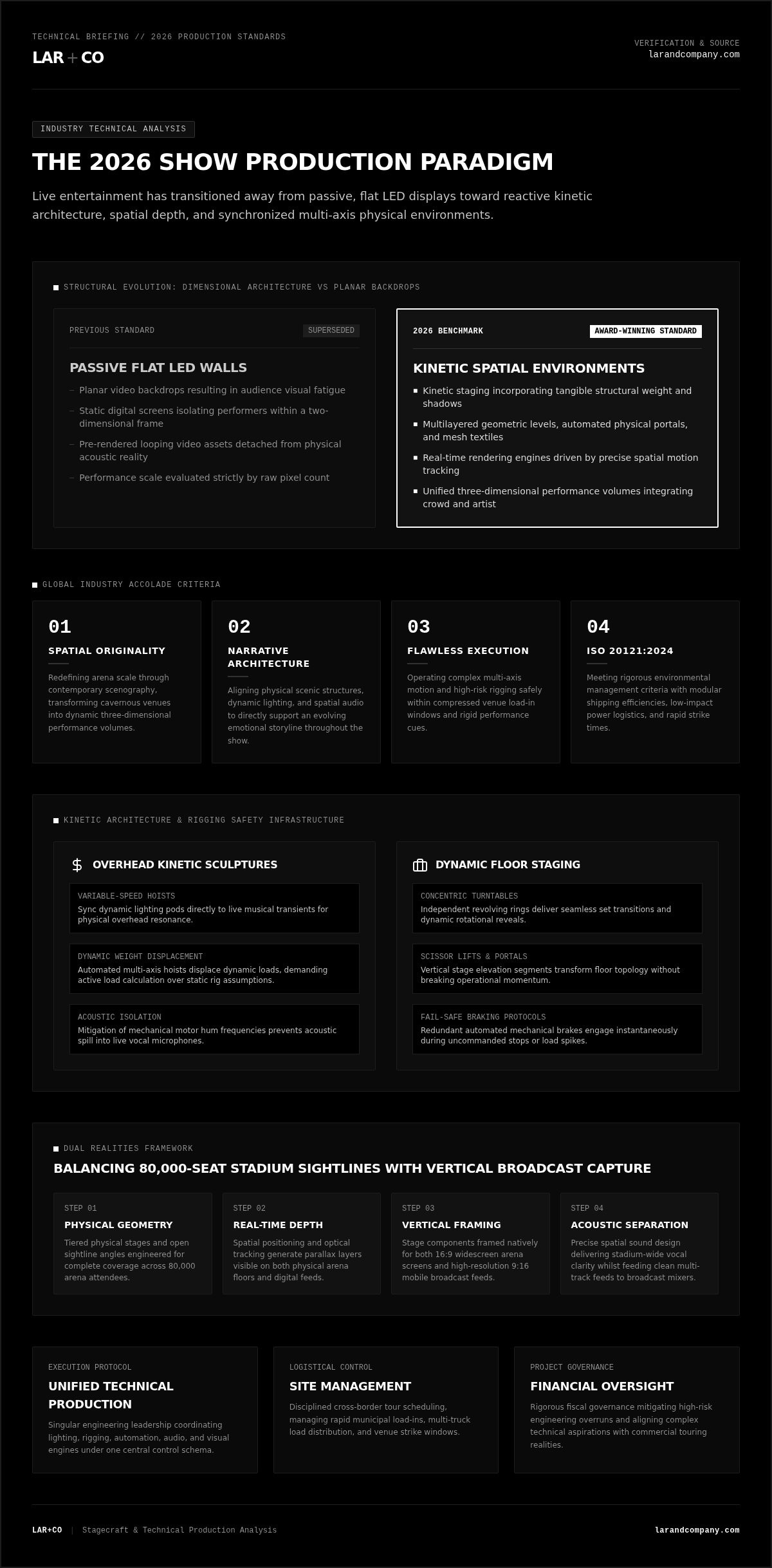
Designing for Dual Realities: Stadium Intimacy and Broadcast Scale
Modern live spectacles rarely exist for the in-room audience alone. Over 123 million hybrid and multi-platform live production events were executed across 2025, cementing simultaneous venue staging and 4K HDR broadcast capture as an essential discipline. Award-winning show production ideas 2026 must deliver deep emotional intimacy for 80,000 spectators in tiered stadium seats while translating seamlessly to millions watching on cinematic broadcast feeds and vertical social streams.
Reconciling these distinct visual demands requires a disciplined four-step design sequence:
Volumetric Pre-Visualisation
Stress-testing sightlines, camera tracks, and focal lengths simultaneously within synchronized digital twin software during early pre-production.
Dynamic Sensor Alignment
Calibrating automated key lights and scenic contrast ratios to camera sensor response curves rather than relying solely on human vision.
Non-Intrusive Capture Routing
Mapping dynamic cable-cam, spider-cam, and rail dollies along dead-space trajectories to protect tier-seat sightlines.
Acoustic Zone Isolation
Deploying object-based spatial audio processing to deliver pinpoint acoustic imaging across stadium bowls without acoustic spill.
Sightline Integrity and Unobtrusive Camera Choreography
Dynamic camera movements cannot compromise the live attendee experience. Production teams position spider-cams and high-speed rail tracks along sightline channels above audience eye levels. Using semi-permeable LED mesh backdrops lets stage lighting pierce through to the live crowd while maintaining solid visual contrast on broadcast monitors. Staging geometries naturally guide the human eye to central performers whilst providing clean compositional frames for automated broadcast dollies.
Broadcast Colour Science and High-Dynamic-Range Lighting
Spatial Audio Arrays: Personalising Stadium Scale
Vast stadiums often suffer from echo anomalies and phase cancellation under traditional left-right stereo reinforcement. Award-winning show production ideas 2026 resolve this with object-based spatial audio platforms like L-Acoustics L-ISA and d&b Soundscape. By localising sound objects to the artist's physical stage coordinates, spectators in the upper tiers perceive the acoustic energy as originating directly from the performer. For producers managing high-stakes stadium tours or civic broadcasts, contact our global team to align your broadcast capture and venue engineering into one unified production.
From Concept to Reality: Operational Delivery and Project Oversight
Unexecuted concepts win no accolades. The true discipline of show production lies in translating audacious sketches into structurally sound, flawlessly timed reality. Award-winning show production ideas 2026 demand an integrated workflow where creative direction, technical production, site management, artist liaison, and financial management operate as a single machine. When these disciplines remain siloed, ambitious designs disintegrate under the weight of unforeseen structural loads, blown budgets, or compromised site safety.
Structured fiscal oversight liberates creativity rather than restricting it. Multi-million-pound productions require rigorous contingency mapping and real-time cost tracking from inception. Proactive financial management prevents panicked mid-production cuts, ensuring that artistic investments translate directly into tangible stage value without compromising safety margins or technical integrity.
Unifying Technical Logistics and Creative Direction
Bridging imaginative design with physical execution begins months before physical build schedules. Engineering teams conduct finite element analysis and stress tests within digital CAD environments to confirm structural load tolerances before fabrication. Maintaining transparent communication between scenic carpenters, software programmers, lighting directors, and head riggers eliminates costly site revisions. Discover how a dedicated global show production agency orchestrates these multi-stakeholder workflows into a unified delivery pipeline.
Navigating Unconventional Global Sites and Regulatory Landscapes
Elite live entertainment frequently ventures beyond purpose-built arenas. Constructing temporary mega-venues across remote desert plateaus, protected historic city plazas, and rural greenfield locations introduces severe logistical friction. Ground load-bearing limits, extreme heat dissipation for sensitive servers, and sovereign compliance frameworks demand experienced operational leadership. Production teams must secure municipal sign-offs, fire safety approvals, and crowd egress certifications across international borders without delaying show schedules. See how large scale event management oversees complex civil infrastructure under demanding local regulations.
The Role of Independent Production Practice
Delivering ambitious productions requires seasoned leadership that functions as the steady force behind the scenes. Bringing over two decades of global show production, technical direction, and multi-million-pound fiscal governance across the UK, US, UAE, Saudi Arabia, and Qatar, Lar&Co aligns visionary concepts with unflappable on-site execution. Independent production management ensures transparent supplier procurement, prioritising structural reliability over vendor allegiances. Explore our past portfolio of landmark spectacles on the Lar&Co Work page to see how disciplined project oversight transforms radical staging concepts into world-class entertainment.
Realising the Next Era of Global Live Entertainment
The standard for live spectacle has permanently shifted. Delivering award-winning show production ideas 2026 requires moving past passive screen content into the realm of dynamic kinetic architecture, real-time spatial reactivity, and acoustic precision. Staging must captivate stadium crowds while translating effortlessly to high-definition global broadcast feeds. Yet visionary concepts only succeed when supported by uncompromising engineering, strict regulatory compliance, and transparent financial stewardship.
With dual hubs in London and Los Angeles, Lar&Co brings over two decades of global show production, technical direction, site management, and multi-million-pound fiscal governance to international concert tours, cultural celebrations, and high-profile civic spectacles across the UK, US, and Middle East. We turn complex staging ambitions into seamless, reliable live realities. Explore high-profile production partnerships with Lar&Co and establish the benchmark for your next global production.
Frequently Asked Questions
What makes a live show production award-winning in 2026?
Premier industry accolades evaluate structural originality, narrative cohesion, and operational precision rather than passive visual scale. Today, award-winning show production ideas 2026 centre on kinetic architecture, tactile spatial depth, and reactive environments that interact with performers in real time. Winning projects demonstrate seamless harmony between creative direction, invisible engineering, and strict environmental accountability, proving that radical scenographic ambition can be executed safely under demanding tour schedules.
How do producers integrate sustainability into award-calibre show designs?
Producers embed sustainability directly into structural engineering and logistical planning, aligning projects with the ISO 20121:2024 standard. They substitute heavy structural steel with lightweight aerospace composites and modular tensile fabrics to reduce touring freight volumes. In addition, production teams replace diesel generators with hybrid battery storage systems and specify low-draw, flicker-free LED fixtures. This disciplined approach slashes road freight emissions whilst reducing dead-hang weights in historic or restricted venues.
Can kinetic staging be deployed reliably on fast-paced arena and stadium tours?
Yes, provided mechanical systems are engineered with modular transport frames and pre-rigged automation tracks. Incorporating award-winning show production ideas 2026 means using variable-speed hoists, automated mobilators, and integrated console ecosystems like TAIT Navigator with built-in collision-avoidance software. Pre-rigging kinetic elements in unified touring dollies speeds up daily load-ins, while rigorous fail-safe braking protocols ensure structural reliability across multi-date arena routings without risking venue curfews.
What is the difference between creative direction and show production management?
Creative direction defines the overarching artistic vision, emotional tone, set geometry, and visual narrative of a performance. Show production management serves as the operational bridge that turns that artistic concept into a viable physical reality. It encompasses technical production, site management, artist liaison, scheduling, and multi-million-pound financial oversight. Production managers coordinate engineers, suppliers, and regulatory bodies to deliver the creative vision safely on time and within budget.
How do production teams balance live audience sightlines with complex broadcast camera tracks?
Balancing live sightlines with multi-camera capture requires early volumetric pre-visualisation using synchronized digital twins. Production engineers map high-speed spider-cams, cable-suspended rigs, and low-profile rail dollies along dead-space sightline corridors above audience eye lines. Staging designs often incorporate semi-permeable LED mesh backdrops and elevated thrusts. This allows live stadium attendees to enjoy unhindered views while camera operators capture dynamic, cinematic tracking shots for 4K HDR live streams.
What are the biggest technical risks when incorporating real-time spatial computing into live shows?
The primary hazards involve network latency, tracking occlusions, and thermal throttling in harsh outdoor environments. Real-time rendering pipelines demand robust optical or ultra-wideband tracking sensors paired with low-latency media servers running SMPTE ST 2110 IP networks. If a performer steps outside the sensor field, systems can stutter. Elite production teams mitigate this risk by programming instantaneous, automated failover states that revert to pre-rendered lighting and visual cues without audience detection.
How do producers manage high-profile live builds in unconventional international locations?
Successfully staging productions in remote deserts across Saudi Arabia, the UAE, or historic public squares in the UK requires seasoned site management and local regulatory acumen. Producers conduct comprehensive ground-bearing assessments, design independent power microgrids, and construct climate-controlled technical enclosures for sensitive hardware. Dual operational hubs in London and Los Angeles provide continuous cross-border coordination, ensuring structural approvals, civil crowd safety authorisations, and customs clearance align perfectly with load-in deadlines.