Benefits of an Integrated Show Production Team

A show can have exceptional creative, technical and operational specialists and still lose momentum when they are working to different briefs. The benefits of an integrated show production team come from connecting those disciplines through shared decisions and clear accountability, not simply placing them under one roof.
Separate specialists bring valuable expertise. But when responsibilities overlap, timelines diverge or a creative decision has technical consequences, unclear ownership can slow delivery. Integration helps teams address those connections earlier, while clear roles protect specialist input and keep the right people involved.
This article sets out the practical advantages and trade-offs of an integrated approach, and how to judge whether it suits a production’s scale and complexity. You’ll learn what to assess in a production partner, from how they align the brief and define decision-making to how they coordinate creative intent with technical and operational delivery. For high-profile live productions, that alignment can turn separate workstreams into one coordinated delivery plan.
Key Takeaways
• Understand the benefits of an integrated show production team, and how shared objectives can connect creative, technical and operational decisions.
• Map how production choices affect delivery, so dependencies between creative plans, technical requirements and site operations are visible early.
• Compare integrated and separate production structures against your event’s complexity, accountability needs and specialist input.
• Assess your outcomes, decision-makers and stakeholder interfaces before selecting a production model.
• See how Lar&Co’s international experience and production disciplines can bring a complex live brief into one coordinated plan.
Benefits of an integrated show production team: why alignment matters
A live show depends on decisions that affect one another. A creative choice may alter technical requirements, which can in turn shape the site plan, schedule and delivery. If each discipline works to a different brief or timeline, gaps can emerge between responsibilities, even when every specialist is capable.
An integrated team coordinates those disciplines around shared objectives, plans and decision-making. The benefits of an integrated show production team include clearer ownership, joined-up planning and fewer avoidable coordination gaps. Rather than passing decisions between disconnected workstreams, the team can see how one choice affects the next.
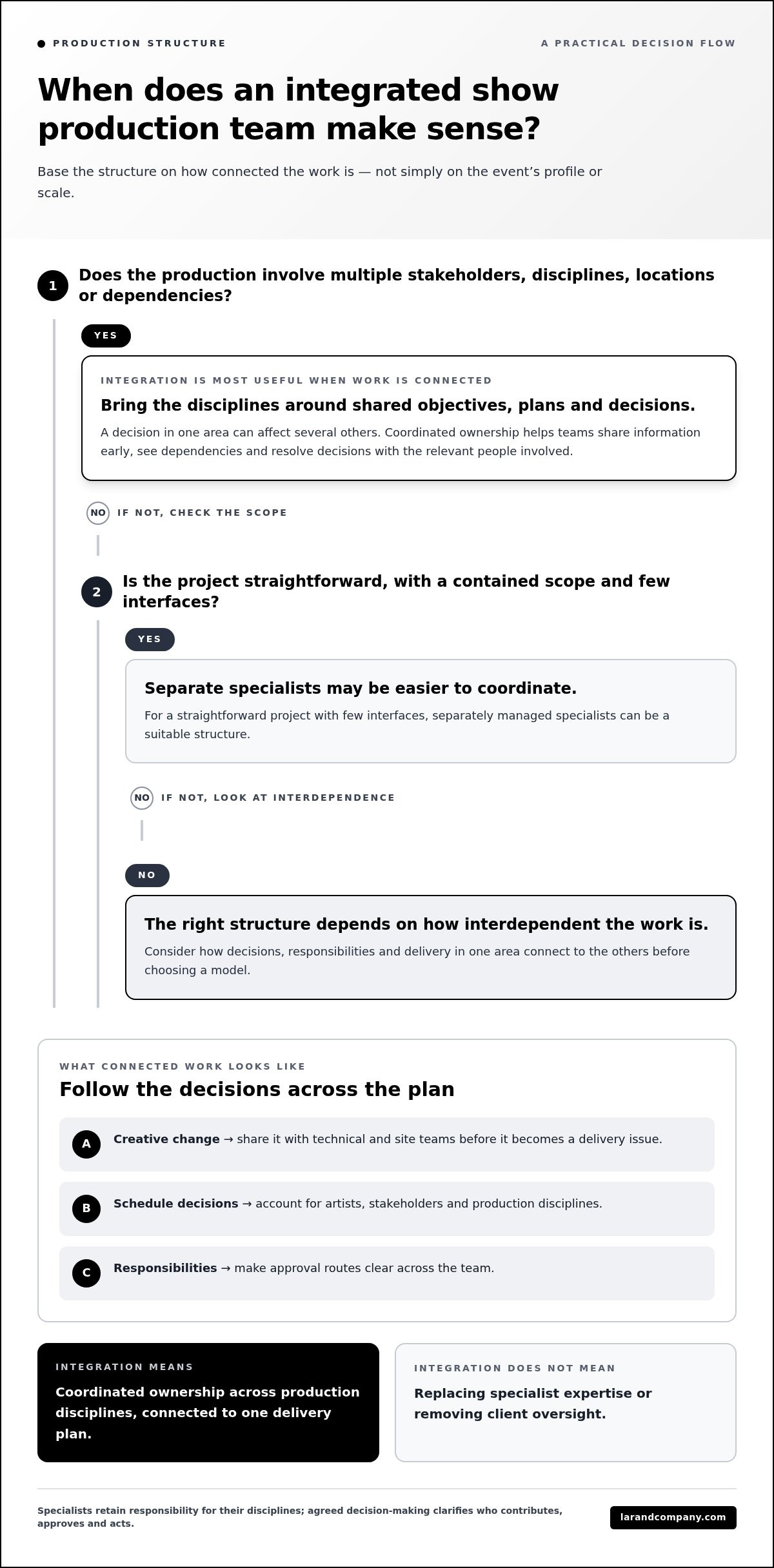
Integration doesn’t mean replacing specialist expertise or removing client oversight. Specialists retain responsibility for their disciplines, while agreed decision-making clarifies who contributes, who approves and who acts. The client remains involved in setting priorities and making key decisions.
What does an integrated show production team bring together?
Production management connects the brief to the schedule, stakeholders and delivery plan. Creative direction shapes the experience and its intent. Technical production translates that intent into requirements for staging, lighting, sound and other production elements, whilst site management considers how the plan will work in the venue or location. Each discipline brings a distinct perspective to the same production.
Artist liaison and financial management also connect to the wider plan. Artist requirements can affect schedules and delivery, while financial oversight keeps decisions visible against the project’s agreed priorities. The value lies in sharing relevant information early, not in asking one person to hold every detail.
• A change to the creative plan is shared with the technical and site teams before it becomes a delivery issue.
• Schedule decisions account for the needs of artists, stakeholders and production disciplines.
• Responsibilities and approval routes are clear across the team.
This cross-functional approach has a parallel in the Integrated Product Team model, which brings relevant functions together to coordinate work towards shared objectives. In show production, the practical focus is on connecting decisions and delivery across the disciplines involved.
When does integration matter most?
Integration is most useful when a production has multiple stakeholders, disciplines, locations or dependencies. A change in one area may affect several others, so teams need clear ways to share information and resolve decisions. This is particularly relevant to complex live experiences, where creative ambition, technical delivery and site operations must remain aligned.
For a straightforward project with a contained scope and few interfaces, separately managed specialists may be easier to coordinate. The right structure depends on how interdependent the work is, not simply on the event’s profile or scale.
Integration means coordinated ownership across production disciplines, with specialists and client decision-makers connected to one delivery plan.
How an integrated show production team connects decisions to delivery
Integration becomes practical through a sequence that carries the brief into delivery and review. The aim isn’t to add process for its own sake. It’s to make decisions, dependencies and responsibilities visible to the people whose work they affect. That is where the benefits of an integrated show production team take shape: in the connections between stages, not simply in the number of disciplines involved.
Align on objectives.
Agree what the production needs to achieve, which priorities should guide decisions and who has authority to approve changes.
Develop the production plan.
Translate the brief into scope, milestones and connected workstreams. Identify where creative, technical and site decisions depend on one another.
Coordinate delivery.
Use a shared schedule and agreed communication rhythm to track progress, surface changes and involve the relevant decision-makers.
Review outcomes.
Compare delivery with the original objectives and capture what should inform future planning.
This sequence gives each discipline a point of connection to the wider plan. For example, a creative decision about the look or layout of a stage may affect technical requirements and the site plan. Sharing the decision while the plan is developing gives those teams the chance to assess its implications together, rather than discovering the dependency after other work is under way.
From creative intent to an executable production plan
Production management turns the brief into a working structure: scope, milestones, responsibilities and workstreams. Creative direction sets the intended experience; technical production considers how that intent can be delivered. Keeping both in dialogue allows ideas and practical requirements to inform one another as the plan develops, while preserving the purpose of the creative brief.
A technical production plan should make the relationship between creative requirements and delivery requirements clear. For example, when a proposed design changes, the relevant teams need to understand which parts of the technical or site plan may also need to change.
How shared ownership supports decisions
Shared ownership still needs named decision-makers. The team should know who leads each workstream, who approves a change and how an unresolved decision is escalated. Regular communication gives disciplines a consistent opportunity to raise dependencies, while a shared schedule records what has changed and which parts of the plan may be affected.
Shared planning makes cross-discipline dependencies easier to manage because the people affected can see changes in the same delivery picture. It doesn’t remove uncertainty or guarantee a particular result; it gives the team a clearer basis for responding when priorities or plans shift.
These practices are relevant across complex live productions, from tours and festivals to corporate events. Lar&Co’s show production work brings creative, technical and operational disciplines together around a project brief.
Integrated versus separate show production teams: compare the trade-offs
Neither structure is right for every production. The choice depends on how closely the workstreams affect one another, how decisions are governed and how much coordination the client is prepared to manage. The benefits of an integrated show production team matter most when a decision in one discipline can alter another team’s plan. With clearly bounded scopes, separate specialists may be a straightforward fit.
| Consideration | Integrated team | Separate specialists |
|---|---|---|
| Coordination | Disciplines can plan against shared milestones and exchange relevant information through an agreed process. | The client or a designated lead aligns schedules, information and dependencies between suppliers. |
| Accountability | Responsibilities and decision routes can be mapped across workstreams, with a lead coordinating interfaces. | Each supplier owns its defined scope; responsibility at the boundaries needs to be agreed. |
| Specialist input | Specialists contribute within a connected plan, retaining discipline-specific expertise. | The client can appoint specialists directly for discrete requirements and scopes. |
| Client interface | A coordinated production interface can simplify how the client follows cross-discipline matters. | The client may need to connect multiple teams and reconcile different updates or priorities. |
Where an integrated model can add value
Shared schedules and consistent project information help make dependencies visible. If a creative revision affects technical planning or site requirements, the relevant teams can consider it as part of the wider production, rather than treating it as an isolated request. Clear ownership also helps stakeholders understand who is responsible for assessing an impact and bringing the decision to the right people.
Fewer hand-offs may simplify coordination, but they don’t guarantee faster delivery or lower costs. The value is a clearer view of how the work connects. Integration also needn’t limit client choice or control of creative decisions. It concerns how disciplines coordinate and who manages their interfaces; the client can retain approval authority, and specialists can advise within their areas of expertise.
What to weigh against a fragmented structure
Separate suppliers can work well when their scopes are distinct and dependencies are limited. This structure offers direct choice over individual appointments, but the client may take on more of the work of aligning schedules, resolving overlaps and sharing decisions across teams. Consider that coordination effort alongside the advantages of appointing specialists separately.
An integrated lead can provide a central point for coordinating specialists without replacing their expertise. The key is to define the boundaries: who owns each discipline, which decisions require client approval, and how changes are communicated. Assess the number of interfaces and the level of interdependence before choosing. A contained scope may favour separate appointments; connected workstreams may benefit from an integrated structure.
How to assess whether an integrated show production team fits your event
The benefits of an integrated show production team depend on the shape of the project. Before choosing a structure, assess how closely the work is connected, where decisions sit and how many stakeholders need to stay aligned. This grounds the choice in the production’s actual demands, rather than assuming one model suits every event.
Use this sequence to evaluate the fit:
Define the outcomes.
Set out what the production must achieve and which priorities should guide decisions.
Map the dependencies.
Identify which creative, technical, operational and financial decisions affect one another.
Assess governance.
Name decision-makers and approval routes, and decide who will coordinate communication across the client organisation.
Select the structure.
Choose integration where workstreams have frequent dependencies; consider separate scopes where responsibilities are distinct and contained.
The point is to understand the interfaces. A production with several independent work packages may not need the same coordination structure as one where a creative change affects the site plan, schedule and multiple stakeholders.
Questions to clarify before setting the production structure
Start by tracing decisions, not drawing an organisation chart. Ask where approvals cross disciplines, who can authorise scope changes and who communicates those decisions to the wider team. Consider whether stakeholders share a view of objectives and progress, or whether each group is working to separate priorities.
• Which decisions span creative, technical, operational or financial workstreams?
• Who owns approvals, scope changes and communication between client teams?
• Are there multiple locations, venues or stakeholder groups to coordinate?
International delivery adds another layer. A production involving London, Los Angeles or the Gulf region may need to account for different locations, local operating requirements and teams working across distinct contexts. For projects spanning the UK, USA, United Arab Emirates, Saudi Arabia or Qatar, consider how local delivery and central planning connect, and how those factors affect information-sharing and decision ownership.
Signs the team structure needs stronger integration
Look for patterns that point to coordination gaps, rather than treating each issue as an isolated delay. Repeated hand-offs, conflicting schedules and uncertainty over who resolves shared dependencies can suggest the structure isn’t connecting the work effectively. So can workstreams that use different objectives or lack a shared view of progress.
These signs don’t automatically mean every discipline must be brought into one structure. They indicate a need to review where ownership sits and how decisions travel between teams. For productions spanning countries or multiple delivery contexts, a global show production approach offers relevant context for considering those interfaces.
For a project brief involving connected disciplines, discuss your show production requirements with Lar&Co and consider the structure that best fits the work.
How Lar&Co brings show production disciplines together
Integration is a working approach, not simply a list of services. Lar&Co is an international show production practice with over 20 years of experience in complex live entertainment projects. It connects the disciplines a brief requires, so creative direction, technical production and site management can be considered in relation to one another as the production develops.
That connection matters when creative intent has practical implications. A change to the experience may affect technical plans or site management. Show production provides the wider frame for coordinating those interdependencies. Financial management and artist liaison can also be part of the project plan, connecting financial oversight and artist requirements with relevant delivery decisions. Each discipline retains its own expertise whilst contributing to a shared view of the work.
A coordinated practice for international live experiences
With primary offices in London and Los Angeles, Lar&Co works across live entertainment, tours, festivals, cultural celebrations and corporate events. International projects can involve different locations, stakeholders and operating contexts. A coordinated production approach helps keep the brief in view as teams consider how decisions in one workstream relate to others across the project.
The Lar&Co project portfolio shows the practice’s work across these formats. It provides context for the range of productions involved, without suggesting that every project calls for an identical team structure. The disciplines brought together, and the way they relate, depend on the brief and its delivery requirements.
Experience grounded in a connected production practice
Founded in 2005 and formerly known as LarMac, Lar&Co brings an established history to complex live entertainment. Its experience spans international formats, supported by a practice that connects show production, technical production, site management and creative direction with financial management and artist liaison where relevant to the brief.
For stakeholders considering a production partner, the useful question is how those disciplines will relate to the project’s objectives, decision-makers and delivery structure. The Lar&Co company background offers further context on its experience and international practice.
The benefits of an integrated show production team depend on the production. Some projects need close coordination across disciplines; others may be served by clearly separated scopes. Integration is not a universal prescription. It is a considered way to connect the work where the brief, complexity and stakeholder interfaces call for it.
For a live production with connected creative, technical and operational requirements, discuss your project with Lar&Co.
Set the production structure around the brief
The next step is to turn your production priorities into a clear conversation about how the work should be organised. Consider where decisions overlap, which stakeholders need to be involved and how much coordination your team wants to manage directly. This gives you a practical basis for deciding whether an integrated approach fits, rather than choosing a structure by default.
The benefits of an integrated show production team are strongest when connected disciplines need to act on a shared understanding of the project. The structure should support the creative ambition and the realities of delivery, while leaving room for client oversight and specialist judgement. A well-framed discussion can clarify where responsibilities belong before those decisions become harder to change.
Lar&Co brings an international perspective to complex live production. If you’re shaping a project and want to explore how its production disciplines could work around your brief, discuss your live production requirements. A clear starting point can help set the whole team on a considered path forward.
Frequently Asked Questions
What is an integrated show production team?
An integrated show production team brings separate specialists into a coordinated working structure; it isn’t a single generalist doing every job. For example, a creative decision about a performance sequence can be considered alongside its technical and site implications by the relevant specialists. The benefits of an integrated show production team come from connecting expertise and responsibilities, so decisions are understood in context whilst specialists retain ownership of their disciplines.
Is an integrated show production team better than hiring separate specialists?
Neither model is automatically better; the right fit depends on scope, dependencies and governance. Separate specialists can suit a contained brief with clear boundaries, such as a defined creative commission with few links to other work. Integration may be more useful when decisions regularly cross disciplines. Consider who will align schedules, resolve overlaps and communicate changes, then choose the structure that fits the project and the client team’s capacity.
Can an integrated production team work alongside an in-house event team?
Yes. An integrated production team can coordinate production work whilst the in-house event team retains client-side ownership. For example, the client team may set priorities and approve key decisions, while production leads coordinate specialist input and report how decisions affect delivery. Agreeing responsibilities at the outset helps avoid duplicate instructions and gives internal stakeholders a clear route to raise changes without losing oversight of the event.
When should a show producer join an event project?
Bring a show producer in while the brief and delivery structure are still being shaped. Early involvement allows the team to clarify objectives, identify the disciplines needed and establish who makes decisions before plans become difficult to change. For example, a proposed change in format can be assessed for its effect on scope and other workstreams. The producer can then help turn the agreed direction into a coordinated production plan.
Does an integrated production team remove the need for specialist suppliers?
No. Integration coordinates specialists; it doesn’t replace the expertise they bring. A production may still need distinct creative, technical, site, financial or artist-liaison input. The integrated structure provides a way to connect that work, clarify interfaces and communicate relevant changes. A specialist remains responsible for discipline-specific judgement, whilst the wider team considers how that contribution relates to the brief and other parts of delivery.
How does an integrated team support an international live event?
An integrated team can provide a shared production framework across locations, helping the client align objectives, responsibilities and communication between local and central stakeholders. For an event spanning the UK, USA, United Arab Emirates, Saudi Arabia or Qatar, teams can map which decisions are shared and which depend on the location. This supports clear coordination without assuming each place has identical operating requirements or delivery arrangements.
What should a client expect from the first production planning conversation?
Expect a practical discussion about the event’s objectives, scope, stakeholders and decisions that could affect more than one workstream. Be ready to outline what success means to the client, who approves changes and which teams are already involved. The producer can use this information to identify key dependencies and areas needing further definition. The conversation should establish a basis for planning, not require every detail to be settled immediately.