Branded Live Experience Production: From Brand Promise to Live Delivery

A spectacular event can still fail to express the brand behind it. Branded live experience production starts with a practical question: what should the audience understand or feel, and what needs to happen on site to make that experience possible? Without a clear answer, creative ideas can pull in different directions as stakeholders make decisions about content, suppliers, schedules and technical requirements.
The goal isn’t simply to make an event impressive. It’s to make each element serve the same idea, from creative direction and audience journey to site operations. When those parts work together, the experience feels purposeful rather than like a series of disconnected moments.
This article explains how to turn a brand objective into a live concept, connect creative choices with technical and operational planning, and assess a production partner’s fit. It also sets out what to look for in a delivery plan, so responsibilities and approvals are clear before plans become difficult to change. Lar&Co brings more than 20 years of experience across tours, festivals, cultural celebrations and corporate events, with capabilities spanning show production, technical production, site management and creative direction.
Key Takeaways
• Turn the brand objective into a clear audience promise before shaping the live concept.
• Use branded live experience production to connect creative ambition with technical and operational planning.
• Compare partners by how clearly they define creative, site, financial and delivery responsibilities.
• Agree approval routes and change decisions early, so delivery stays aligned as plans develop.
• Assess how a production partner’s experience and capabilities match the scale and complexity of your brief.
What Branded Live Experience Production Delivers for a Brand
An event can carry a logo and still feel disconnected from the brand. Branded live experience production starts with the objective, the audience and the setting. It brings creative direction, show production, technical planning and site operations together, so what people see, hear and do expresses a clear idea.
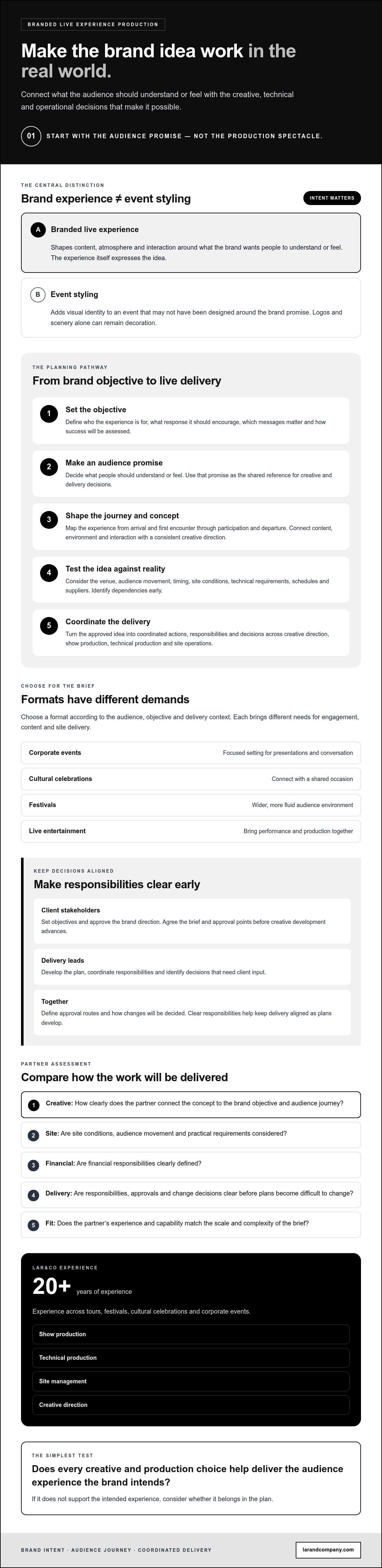
Branded experience production turns a brand promise into a coherent audience journey; event styling adds visual identity to an event that may not have been designed around that promise. The difference is intent. A branded experience shapes content, atmosphere and interaction around what the brand wants people to understand or feel. Logos alone can’t do that. Without a connecting idea, signage and branded scenery remain decoration.
This approach sits within experiential marketing of a brand, where audiences encounter a message through live interaction. Production makes the concept workable in a real environment, accounting for timing, space, technical requirements and how people move through the experience.
What makes a live experience meaningfully branded?
Start with the objective, then decide what the audience should take from the interaction. Is the aim to introduce an idea, deepen an existing relationship or create a shared moment? The answer should shape the audience journey, content and setting. Test each production choice against that intent: if it doesn’t help deliver the intended experience, consider whether it belongs in the plan.
For example, a hypothetical product reveal could invite guests to explore a feature through a guided demonstration. The room layout and show sequence would make that interaction easy to follow. The brand would be expressed through the experience itself, not only through visual identity.
Which live formats can support a brand experience?
Corporate events can provide a focused setting for presentations and conversation. Cultural celebrations can connect a brand with a shared occasion, while festivals create a wider, more fluid audience environment. Live entertainment formats can bring performance and production together to create a collective moment. Each format has different requirements for audience engagement, content and site delivery.
Choose a format according to the audience, objective and delivery context, including the venue, scale and technical requirements. A production partner may work across several formats, but assess its experience against the needs of your specific brief. Lar&Co’s portfolio spans corporate events, cultural celebrations, festivals and concert tours, demonstrating experience across varied live environments without suggesting that every format serves the same brand purpose.
How Branded Live Experience Production Turns an Idea into Delivery
A strong production process makes the route from brand ambition to live delivery clear. It begins with a brief, tests the idea against audience needs and practical conditions, then turns the approved concept into coordinated work. Define who makes each decision: the client sets objectives and approves the brand direction, while delivery leads develop the plan and identify decisions that need client input.
Production connects creative intent with operational execution by turning the approved idea into coordinated decisions, responsibilities and actions. That connection helps protect the central idea as details develop. It also gives teams a shared reference point when schedules, site conditions or stakeholder views change.
From brand brief to audience journey
Establish who the experience is for, what response it should encourage, which messages matter and how success will be assessed. Then map the audience journey, from arrival and first encounter to participation and departure. Creative direction gives these moments a consistent character, so content, environment and interaction feel connected rather than like separate contributions.
Agree the brief and approval points before creative development advances. A concise record of the objective, audience and measures of success gives client stakeholders and delivery teams the same criteria for assessing new ideas. For practical guidance on maintaining a consistent brand identity, consider how the brand should appear across every audience touchpoint.
From approved concept to show-ready plan
Once the concept is approved, identify what it requires in practice. Technical production must be considered alongside site conditions, schedules, content, suppliers and decision-makers. Check dependencies early: a creative element may rely on particular site access, technical provision or timing. Raise feasibility questions before teams commit to delivery, rather than waiting until the plan is under pressure.
Assign an owner to each decision, define who approves changes and make handovers explicit. The client retains authority over brand intent and approvals; production leads coordinate the agreed plan and communicate when a change affects other work. This protects the experience while keeping responsibilities clear.
For projects where creative direction, technical production and site management need to work together, Lar&Co’s production practice is one example of these capabilities within a coordinated delivery approach.
How to Compare Branded Live Experience Production Partners
The right partner depends on the brief, not on the most impressive-sounding promise. For branded live experience production, assess whether the team can connect creative direction to technical planning, site delivery and financial oversight. Ask for evidence of relevant capability, then check how the proposed roles fit the project’s scale, locations and complexity.
Which capabilities should the brief require?
Set out the work the project needs before comparing proposals. A production plan should show how the client, venue and delivery stakeholders will coordinate, and who owns each decision. Use this framework to compare responsibilities:
| Capability | What to assess |
|---|---|
| Strategic | How the team interprets the objective, audience and measures of success. |
| Creative | How creative direction connects the brand idea to the audience journey and content. |
| Technical | How technical requirements and dependencies are identified and planned. |
| Site | How site conditions, schedules and stakeholder responsibilities are coordinated. |
| Financial management | How costs, assumptions and changes are tracked and reported. |
Request relevant portfolio examples and ask what the partner was responsible for. Experience across corporate events, festivals, cultural celebrations or live entertainment can show familiarity with different delivery contexts, but it shouldn’t be presented as proof of branded activation work unless it was. Lar&Co’s event production portfolio spans varied live formats.
How can you test fit before appointing a partner?
Separate evidence from assurances. A team can share sample planning documents, role descriptions, reporting formats or examples of how it assesses feasibility. Claims such as “seamless delivery” are harder to evaluate before the project is defined. Ask what the team would need to confirm before committing to a proposed approach.
• Who leads the production plan and communicates with the client, venue and delivery teams?
• How are approvals, change requests and their effects on other work recorded?
• What financial reporting will be provided, and who reviews changes?
• Which responsibilities sit outside the proposed scope?
Distinguish production management from equipment supply and talent booking. These are separate requirements, so confirm who is responsible for them rather than assuming they are included. A useful guide to choosing a show production partner should help you compare roles, communication structures and boundaries, not just creative credentials. The strongest fit is the team whose evidence and proposed responsibilities match the brief.
How to Protect Brand Consistency and Manage Delivery Risk
Production brings creative, technical and operational teams together, but unclear responsibilities can pull the experience in different directions. In branded live experience production, consistency comes from giving everyone an agreed reference point and defining how changes are reviewed before they affect delivery.
Keep the brand experience coherent across delivery teams
Start with an approved creative brief that records the audience, brand objective, key messages and intended experience. Use it to assess production choices as they arise. Audience-facing content, the environment and show moments should reinforce one another. If a proposed change improves one element but weakens the overall idea, the team needs a way to flag the conflict before it reaches the audience.
Set approval points and decision owners early. The client should know which decisions require brand approval, while production leads coordinate delivery within the agreed direction. Establish an escalation route for changes that affect the experience, schedule or responsibilities. This allows routine decisions to move forward without leaving significant creative choices unresolved.
Plan for changing conditions without losing control
Every project has its own dependencies, such as venue access, the show schedule, supplier inputs or decisions from multiple stakeholders. Record them in the plan, note what each one affects and clarify who will monitor it. For large-scale event management, coordinating these moving parts is central to keeping delivery aligned with the approved experience.
Contingency planning doesn’t mean predicting every problem. It means considering credible changes, documenting workable options and assigning someone the authority to decide between them. For example, if a schedule change affects a key audience moment, teams should know who assesses the impact and who approves an alternative. Record the decision and tell everyone whose work is affected.
Define success measures before delivery begins. These might relate to attendance, participation, message understanding or another objective relevant to the brief. Measures provide a basis for review, but they can’t guarantee how audiences will respond. After the event, compare outcomes with the original objectives and record what should inform future planning.
For complex projects, a coordinated plan can bring creative direction, technical production and site management into focus. Include the venue and delivery context in your planning, particularly for projects in the UK, USA, United Arab Emirates, Saudi Arabia or Qatar, where location-specific requirements need to be considered.
How Lar&Co Connects Brand Ambition with Live Production
A suitable production partner should show how its capabilities match the brief, not simply present a list of services. For branded live experience production, assess whether creative direction, show production, technical production and site management can work together around the project’s objectives and delivery context.
A production practice built around complex live work
Founded in 2005, Lar&Co brings more than 20 years of experience across concert tours, festivals, cultural celebrations and corporate events. Its primary offices are in London and Los Angeles, supporting an international practice across varied live formats. This portfolio demonstrates breadth of production experience, not a claim that every project was a branded activation.
Each capability has a practical role. Creative direction can establish the intended character of an experience; show production can coordinate how it unfolds; technical production can translate creative requirements into a workable plan; and site management can connect that plan to the live environment. The right combination depends on the brief. Explore Lar&Co’s live experience portfolio and learn more about Lar&Co’s international practice to assess the work in context.
What to include when approaching a production partner
A considered brief helps a prospective partner understand both the ambition and the operating conditions. Include the essentials, even if some details are still being developed:
Brand objective and audience
what the experience should communicate and who it is for.
Format and locations
the intended live setting and any confirmed locations.
Timing and constraints
key dates, known site conditions and dependencies.
Decision-makers
who owns the brief, approvals and important changes.
Support required
where creative direction, technical production, show production, site management, financial management or artist liaison may be needed.
Share what is confirmed and mark what remains open. This helps the production team identify questions, test feasibility and define responsibilities before plans are treated as final. It also gives both sides a clearer basis for discussing scope, communication and next steps. For a project in the UK, USA, United Arab Emirates, Saudi Arabia or Qatar, specify which locations are involved and what is known about each site, so the delivery approach can be considered in context.
Lar&Co’s global show production approach can be assessed against the locations and delivery requirements of your brief.
Turn the Brand Promise into a Live Experience
A distinctive live experience starts with a clear brand objective, then carries that intent through creative decisions, technical planning and site delivery. The right production partner helps keep those elements connected, with clear responsibilities and approval points as the plan develops. That is the foundation of effective branded live experience production: a considered idea matched by a practical route to delivery.
Lar&Co was founded in 2005 and brings more than 20 years of experience to an international portfolio spanning tours, festivals, cultural celebrations and corporate events. With primary offices in London and Los Angeles, the practice brings show production, technical production, site management and creative direction together to support complex live work.
Before approaching a production partner, bring together your objective, audience, format and known constraints. A clear brief gives the team a stronger basis for assessing what the experience needs and how to deliver it.
Frequently Asked Questions
What is branded live experience production?
Branded live experience production plans and delivers an in-person or hybrid experience designed to express a brand through a real-world audience encounter. It connects the brand purpose and creative idea with the audience, venue, programme, technical requirements and operational plan. The format can vary. What defines it is a clear brand objective, not simply the presence of a logo. Production turns that objective into a coordinated, workable experience.
What is the difference between a branded event and a brand activation?
The terms can overlap, but a branded event often centres on a gathering or programme shaped around a brand, while a brand activation tends to focus on direct audience interaction or response. Either can serve a brand objective. Before choosing a label or format, define who the experience is for, what you want the audience to take away and how you’ll assess success. Those decisions help guide the production approach.
How do you choose a branded live experience production company?
Start with your objective, audience, locations and project complexity. Then assess whether each company can connect creative direction with technical production, site management, stakeholder coordination and financial management where needed. Ask for relevant portfolio examples and clarify who owns decisions, approvals and delivery responsibilities. For work in the UK, USA, United Arab Emirates, Saudi Arabia or Qatar, also ask how the proposed team will coordinate the specific locations and project requirements.
When should a brand involve a live experience production partner?
Involve a production partner while the concept and brief are taking shape, especially if the project has multiple stakeholders, complex sites or international delivery. Early input can surface feasibility questions before plans become fixed. The right timing depends on the project. Be clear about which decisions are already made, what remains open and which capabilities you need. Then agree responsibilities and approval points before detailed delivery planning begins.
How do you measure the success of a branded live experience?
Define success against the brand and audience objectives before delivery. Relevant measures could include attendance, participation, audience feedback or campaign-specific indicators, depending on the experience and available data. Decide how information will be collected, who is responsible for reporting it and when results will be reviewed. Avoid relying on one measure as proof of overall impact. Interpret the findings in context, against the original brief and intended audience response.
What does a show production partner manage for a branded live experience?
The scope depends on the brief. Show production can coordinate people, schedules, stakeholders and deliverables from concept through completion. A project may also need technical production, site management, creative direction, financial management or artist liaison. Agree which responsibilities the partner owns, which remain with the client and how approvals work. Don’t assume equipment rental or talent booking is included. These are distinct requirements and should be confirmed separately.
Can branded live experiences be delivered across multiple countries?
Yes, a live experience can be planned for international delivery, but the approach depends on each location, venue, partner and format. For projects spanning the UK, USA, United Arab Emirates, Saudi Arabia or Qatar, clarify how creative intent, stakeholder decisions and operational planning will stay aligned across locations. Ask prospective partners for relevant international experience and their proposed coordination structure. Confirm location-specific requirements with appropriate local specialists rather than assuming one plan applies everywhere.
Discuss your live experience with Lar&Co and explore how its production capabilities could fit your brief.