Challenges of Multi-Country Event Tours: A Practical Guide
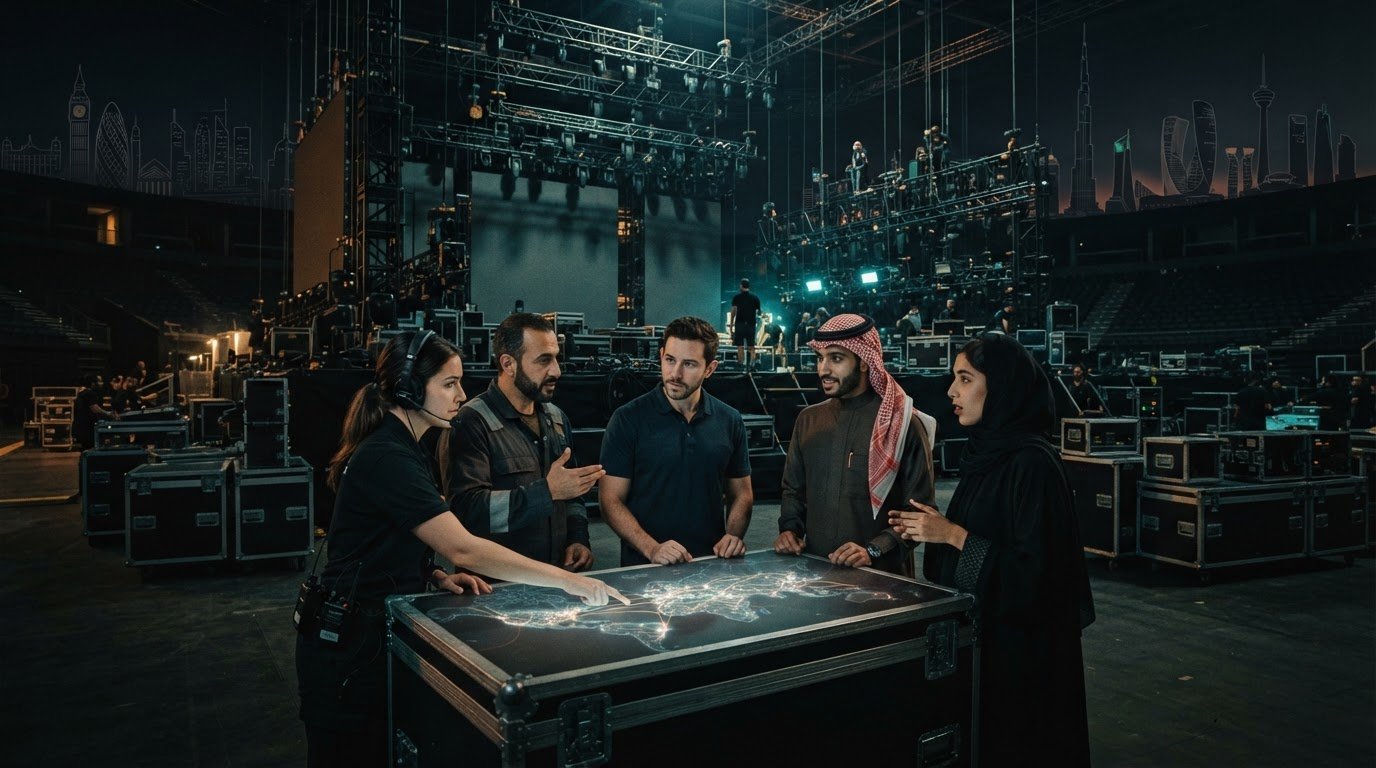
A tour can be consistent in intent and still change at every border. The challenges of multi-country event tours emerge when permissions, schedules and equipment movements meet different venue conditions, suppliers and working practices. A production brief that seems clear at home can be interpreted differently on the ground, while a change in one market can unsettle the budget or timing of the next.
That complexity is real, but it doesn’t mean every stop must be reinvented. The strongest approach protects the elements that define the show, then adapts delivery to local realities. This guide explains where cross-border tours commonly become difficult and how to anticipate pressure points before they disrupt a performance. It also shows how to distinguish fixed standards from local decisions, and how clear ownership, financial oversight and communication keep teams aligned. With more than 20 years in international live entertainment, Lar&Co brings an integrated production perspective to planning across markets, connecting creative intent with technical delivery and on-site decisions.
Key Takeaways
• See why connected event dates need a shared creative and operational brief, not simply a repeated show plan.
• Identify where local permissions, working practices, venues and suppliers can create risk, and build local review into planning.
• Compare creative, technical, staffing and decision-making needs to decide what stays standard and what adapts.
• Address the challenges of multi-country event tours with a staged framework that assigns an owner and required information to each decision.
• Bring production, technical, site and financial decisions together so teams can turn tour-wide strategy into coordinated delivery.
Why multi-country event tours are harder than repeating one show
Delivering one audience experience across several countries means coordinating creative, technical and operational decisions across different teams, venues and timelines. A multi-country event tour is a connected series of event dates that shares creative intent and operational objectives, even as parts of its delivery change from market to market.
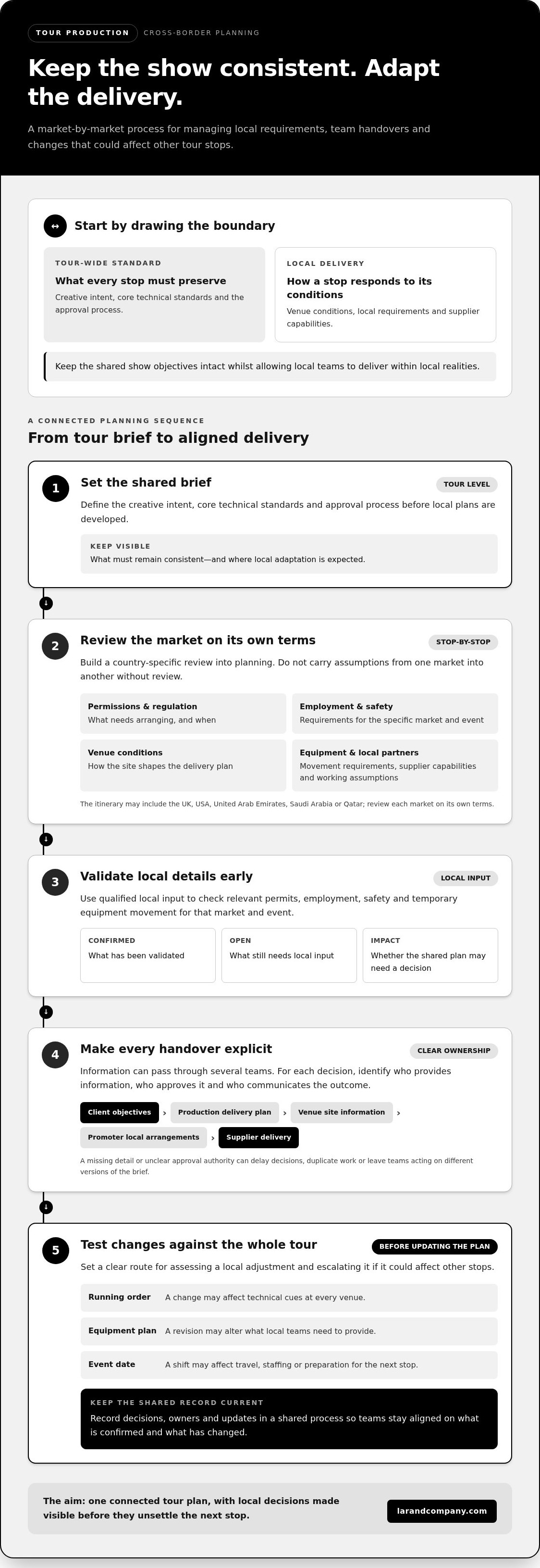
The distinction matters. Each stop is not an isolated event, because decisions made for the tour can create dependencies across its schedule. A change to the running order may affect technical cues at every venue. A revised equipment plan could alter what local teams need to provide. If one date shifts, the change may affect travel, staffing or preparation for the next stop.
What makes a multi-country tour different from a series of local events?
A local event team can make decisions around a single brief and date. A tour must also protect the links between stops. Some decisions belong at tour level: the show’s creative intent, core technical standards and approval process. Others are market-specific, such as how venue conditions or a local supplier’s capabilities affect delivery.
Concert tour is a useful starting point for understanding the format, including the use of separate local production crews in different geographical regions. That arrangement can extend a tour’s reach, but it also makes clear briefs and decision routes essential.
Tour complexity is the work of keeping shared show objectives intact whilst coordinating different local conditions, teams and timelines.
Which challenges are most likely to affect delivery?
The pressure points usually sit where one part of the plan depends on another. Requirements vary by country, venue and project, so don’t treat assumptions that hold in one market as universal.
Regulation and permissions
Local requirements can affect what needs to be arranged and when. Build a country-specific review into planning rather than relying on a generic checklist.
Equipment movement
Equipment plans connect technical choices with schedules and delivery arrangements. Include the relevant requirements for each market in the production plan.
Local delivery partners
Suppliers and crews may interpret the brief differently or work to different assumptions. Define what must remain consistent and where local adaptation is expected.
Communication
An unclear decision owner or late change can leave teams working from different versions of the plan. Record decisions, owners and updates in a shared process.
These challenges are manageable when teams make assumptions visible, assign responsibility for each decision and agree how a market-level change is escalated if it could affect other stops. For a tour running through the UK, USA, United Arab Emirates, Saudi Arabia or Qatar, review each market on its own terms rather than carrying assumptions across borders. Clear ownership helps teams identify what needs local input and keep the wider tour aligned.
How local requirements and production interfaces create tour-wide risk
A tour-wide brief meets different operating environments at every stop. Permissions, employment arrangements, safety expectations, venue conditions and supplier capabilities can vary by country and project. The challenge isn’t simply to identify each difference. It’s to understand how local decisions affect the show’s shared creative and technical plan.
Validate requirements early with qualified local input. Permits, employment, safety and temporary equipment movement all need consideration for the specific market and event. A generic assumption can leave a gap in the plan; an unchecked local detail can also affect schedules, responsibilities or delivery elsewhere on the tour. The relevant countries depend on the itinerary, so don’t apply a rule from one market to another without review.
Separate local requirements from tour-wide standards
A local requirement shapes how a stop is delivered; a tour-wide standard defines what every stop must preserve. For example, the production team may set a consistent creative or technical objective, whilst the local plan accounts for the venue’s conditions and the capabilities of its suppliers. Defining that boundary gives local teams room to deliver without quietly changing the show’s intent.
Record each local validation, its owner and any impact on the shared plan. A stop-by-stop record should make clear what has been confirmed, what remains open and whether an adjustment at one venue needs a tour-level decision.
Where handovers between teams can break down
Information often moves through several hands: the client sets the objectives, the production team translates them into a delivery plan, the venue provides site information, the promoter coordinates local arrangements and suppliers deliver specific elements. A missing detail or unclear approval authority can interrupt that chain. Work may be duplicated, decisions delayed, or different teams may act on different versions of the brief.
Make the interfaces explicit. For each decision, identify who supplies the information, who approves it and who communicates the outcome. Set a clear route for changes, including how a local adjustment is assessed for effects on other stops. This matters when technical plans meet venue limitations or locally supplied equipment. A focused technical production process helps teams clarify those requirements before they become on-site issues.
The challenges of multi-country event tours become more manageable when local knowledge is connected to central production oversight. Lar&Co’s show production team brings creative intent, technical planning and on-site decisions into one coordinated approach.
Standardised production or local adaptation: what should a tour compare?
A tour needs enough consistency to feel like one coherent experience, and enough flexibility to work in each venue and market. Neither identical production at every stop nor a wholly local approach suits every show. The useful question is what each element protects, and whether it can be adapted without weakening the audience experience or creating avoidable delivery risk.
Use this comparison to decide where to set a shared standard and where to plan for local variation:
| Area | Keep consistent | Adapt locally |
|---|---|---|
| Creative | Audience promise, core creative intent and essential show moments. | Elements shaped by the venue or local context, provided the central vision remains clear. |
| Technical delivery | Critical cues, show outcomes and the principles that protect reliable execution. | Specific equipment choices and implementation, according to venue infrastructure and technical conditions. |
| Staffing | Key responsibilities, communication expectations and the knowledge required for each role. | The mix of touring and local crew, shaped by local capabilities and the production plan. |
| Decision-making | Approval principles, escalation routes and who owns tour-wide decisions. | Local decisions within agreed boundaries, with a clear route for raising wider impacts. |
What should stay consistent across every tour stop?
Protect the audience promise, the show’s core creative intent, critical cues and approval principles. These give every market a shared reference point. A clear brief, cue documentation and defined sign-off process help touring and local teams deliver the same essential experience without relying on interpretation alone. A coherent vision is central to creative direction for live shows.
Consistency doesn’t mean every technical specification must be identical. Different venues may require different solutions to achieve the same show outcome. Set the required result and the boundaries for change, then record the decisions.
What should adapt to the local market?
Plan for differences in venue infrastructure, local crew capabilities, supplier arrangements and relevant requirements. Make adaptation deliberate: identify the constraint, assess its impact on the creative and technical plan, assign an owner and approve the change before it becomes a last-minute compromise.
A practical test helps: retain a shared standard when it protects intent, safety or interoperability; adapt the method when local conditions require it. This distinction makes the challenges of multi-country event tours easier to manage, because teams can see which changes are acceptable and which need tour-wide approval.
A practical framework for managing multi-country tour challenges
A useful framework turns a complex tour into a sequence of owned decisions. At each stage, teams should know what must be decided, who is accountable and what information is needed to proceed. Fit the process to the tour rather than imposing fixed deadlines or a universal checklist.
Build a single source of truth before confirming local plans
Keep the approved brief, version-controlled schedule, responsibilities and approval routes in one shared source. Record assumptions that local teams still need to validate, and make unresolved decisions visible with a named owner and escalation path. This prevents a provisional detail from being mistaken for an agreed delivery commitment.
Set the tour-wide brief.
Decide the audience experience, creative intent and essential production outcomes. The show producer or tour production lead owns the brief and needs the creative direction, event objectives and agreed approval principles.
Map each stop.
Decide what needs local validation and where adaptation may be required. The production lead coordinates this with the local event or venue lead, using venue information, supplier capabilities, schedule assumptions and relevant local input.
Confirm the production plan.
Decide how the shared show outcomes will be delivered at each venue. The technical production lead owns the technical plan, drawing on venue conditions, equipment requirements, crew responsibilities and approved local adjustments.
Review readiness and rehearse.
Decide whether the venue, technical, staffing and schedule dependencies are sufficiently resolved to proceed. The accountable production lead brings together updates from the relevant venue, technical and local teams; rehearsal then tests the agreed plan and surfaces remaining gaps.
Review each stop and control change.
Decide whether a proposed change can be approved locally or needs tour-level sign-off. The designated change owner records the reason, decision, approver and impact on later stops, including schedule, technical, staffing and financial implications.
Track readiness from stop to stop
Readiness reviews should expose dependencies before they become delivery issues. Keep a concise status for each stop: confirmed, still to validate, or requiring a decision. If a local change is proposed, assess its effect on later venues before approval, update the shared record and communicate the revised plan to affected teams. This is particularly valuable on large-scale routes; stadium tour management services offer related considerations for coordinating production at scale.
Clear ownership and financial oversight help teams assess the consequences of changes rather than treating each stop in isolation.
How integrated show production brings a multi-country tour together
Across a tour, creative, technical, site and financial decisions are connected. A change to the show design may affect equipment needs. A venue condition may call for a different technical approach, with consequences for staffing or the budget. Integrated show production gives these decisions a joined-up view, so each can be considered in context rather than managed in isolation.
Why one joined-up production view matters
A lead production team can maintain visibility across markets and disciplines, connecting the creative brief to technical planning, site requirements and financial oversight. That view helps teams understand which choices are fixed, which can adapt locally and who has authority to approve a change. It also makes dependencies easier to track: a local adjustment can be assessed for its effect on later stops before teams update plans and communicate decisions.
Clear accountability is the bridge between strategy and execution. Creative direction defines the experience the tour is intended to deliver. Technical direction and site management translate that intent into plans for each venue, whilst financial management keeps the implications of proposed changes visible. Local coordination then connects those plans to the teams delivering each event. This joined-up approach is especially valuable for the challenges of multi-country event tours, where a decision in one market can have wider consequences.
Lar&Co is an international show-production practice with more than 20 years of experience in high-profile live entertainment, including concert tours, festivals, cultural celebrations and corporate events. Its global team works across international projects. Explore Lar&Co’s international show-production work for examples of its portfolio.
What to prepare before a production conversation
A clear starting brief helps make the first discussion focused and practical. Bring the information already available, and flag what still needs local validation. Useful points include:
Tour objectives
the intended audience experience and essential creative outcomes.
Markets and formats
countries on the route, event types and known venue details.
Constraints and dependencies
confirmed schedules, technical considerations, staffing assumptions and open questions.
Decision-making
key stakeholders, approval authority and the route for escalating changes.
The aim isn’t to have every local detail resolved before production planning begins. It’s to make assumptions visible, identify the decisions that need ownership and establish where local input is required.
Build a tour that holds together across every market
The challenges of multi-country event tours are easier to manage when the production approach is clear: protect the creative intent and essential show standards, then adapt delivery to local requirements. A shared brief, defined decision owners and a consistent change process help teams see how decisions at one stop may affect the next.
Joined-up production connects creative direction, technical planning, site conditions and financial oversight. It gives local teams room to deliver effectively whilst keeping the wider tour aligned. That balance turns cross-border complexity into a series of visible, manageable decisions.
Founded in 2005, Lar&Co brings more than 20 years of live entertainment production experience to an international practice with primary offices in London and Los Angeles. A tour spanning the UK, USA, United Arab Emirates, Saudi Arabia or Qatar benefits from a plan that accounts for each market while keeping the show’s essential outcomes clear.
Frequently Asked Questions
What are the biggest challenges of multi-country event tours?
The biggest challenges are coordinating local requirements, venues, suppliers, teams and schedules without losing the show’s shared intent. These factors are connected: a change in one market can affect technical plans, staffing, budgets or later tour stops. Clear ownership, early local review and a reliable change process help teams see dependencies and decide what needs tour-wide approval before a local adjustment creates wider disruption.
How do you keep a touring show consistent across different countries?
Define the essential audience experience and creative intent, then document the show elements that must remain consistent. These might include critical cues, approval principles and the required outcome of a technical element. Give local teams clear guidance on what can adapt to the venue or available crew, and record approved changes. Consistency comes from protecting shared outcomes, not assuming every production detail can be identical at every stop.
Why do event production requirements vary between countries?
Requirements vary because countries and individual venues can have different permissions, employment practices, safety expectations, infrastructure and supplier capabilities. A tour visiting the UK, USA, United Arab Emirates, Saudi Arabia or Qatar should treat each stop as its own planning context, not assume one market’s arrangements apply elsewhere. Use qualified local review to validate project-specific requirements, then connect the findings to the tour-wide production plan.
How can a production team manage last-minute changes during an international tour?
Use a defined change process with a named decision owner. Record what has changed, why, who approves it and which teams need the update. Before confirming a local adjustment, assess its effect on technical delivery, staffing, schedule and later stops. Keep the current brief and schedule in a shared, version-controlled source so touring and local teams work from the same approved information.
How do you balance local suppliers with a consistent tour production?
Set clear standards for the show’s essential outcomes, responsibilities and communication, then plan how local suppliers can meet them within each venue’s conditions. Share the production brief and identify which decisions they can make locally and which need tour-level approval. Review capabilities and assumptions early. This creates space for local expertise without leaving the interpretation of the show’s core requirements open-ended.
What should be planned before a multi-country event tour begins?
Establish the tour objectives, creative brief, event formats, countries, schedule assumptions and decision-making structure. Map the venue, technical, staffing and supplier information needed for each stop, and assign an owner to validate outstanding details locally. Set out approval routes and a process for assessing changes across the full itinerary. Keep open questions visible so provisional assumptions aren’t mistaken for confirmed plans.
When should a show producer be involved in an international tour?
Involve a show producer while the tour’s objectives and delivery approach are being shaped, before key assumptions become difficult to change. Early production input can connect creative intent with technical feasibility, venue conditions, local coordination and financial oversight. Lar&Co is an international show-production practice founded in 2005, with more than 20 years of live entertainment experience and primary offices in London and Los Angeles.
Planning a multi-country tour? Discuss your production brief with Lar&Co to bring creative direction, technical production, site management and financial oversight into one coordinated plan.