Contingency Planning for Large Outdoor Events: A Practical Checklist
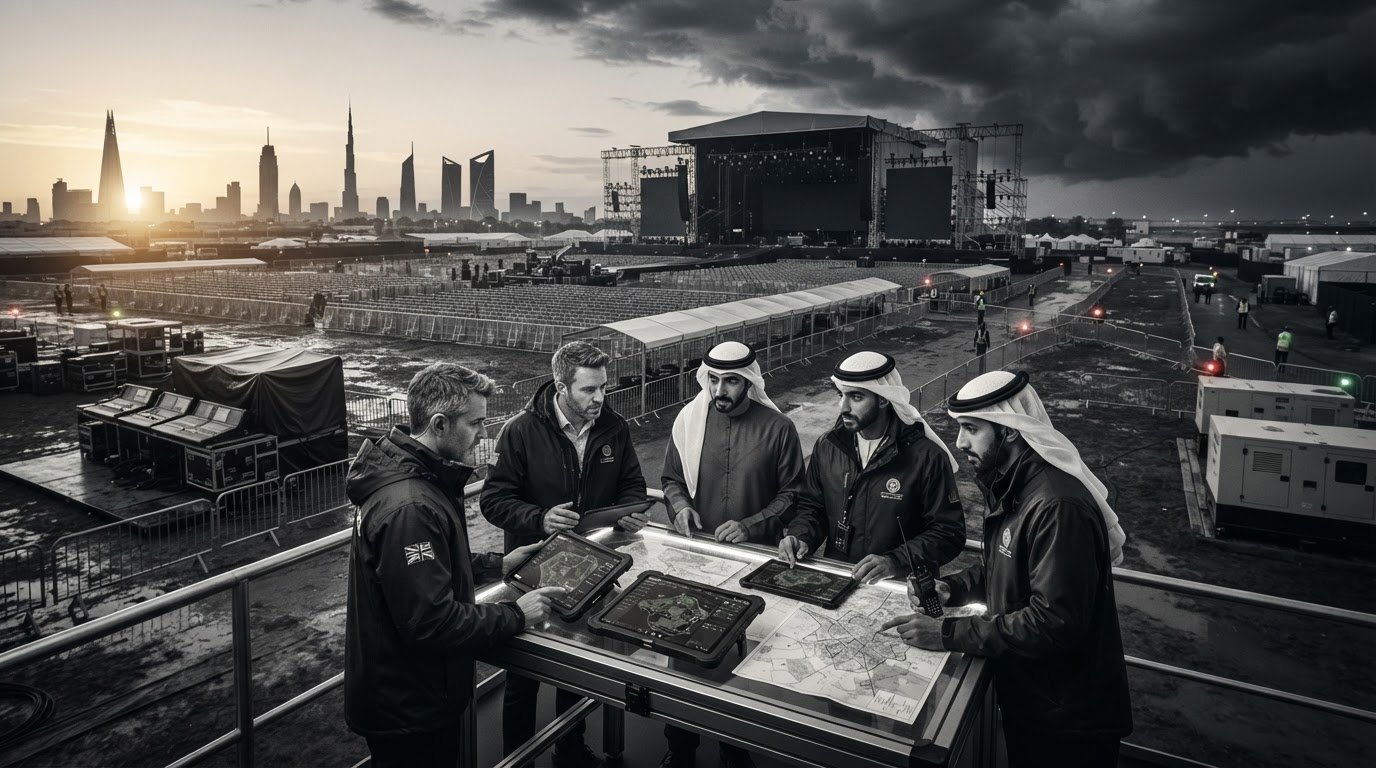
A weather forecast is not a contingency plan. Conditions can shift, ground can become unsafe and suppliers may need to change course. Contingency planning for large outdoor events turns those possibilities into decisions your team can make before pressure builds, with clear ownership and practical action triggers.
The challenge is deciding who has authority to act, how teams and suppliers will stay aligned, and which responses suit your venue and local requirements. A generic checklist cannot make those decisions for you, but a structured process can help you make and test them before event day.
This practical checklist will help you prioritise credible, event-specific risks, assign decision-makers and prepare workable alternatives. It covers triggers for changing conditions, communication between stakeholders and details to adapt to your event’s scale, site and operating context. The result should be a plan your team can use, not simply file away.
Key Takeaways
• Build your risk register around the venue, programme and operating conditions, rather than relying on a generic hazard list.
• Make contingency planning for large outdoor events actionable by linking each scenario to a trigger, decision-maker, response and update channel.
• Test whether fallback options are workable with the people, time, infrastructure and supplier commitments available.
• Check local requirements and venue conditions for the specific event, and revisit the plan when key details change.
• Connect production, technical and site decisions so the contingency plan can be applied consistently across teams.
Contingency planning for large outdoor events: what the plan must do
Outdoor conditions and operational dependencies can change during delivery. A shift in weather may affect the ground, structures, power, access routes and programme at once. A useful plan helps the team make connected decisions before uncertainty turns into confusion.
For contingency planning for large outdoor events, define the plan as an agreed set of triggers, decisions, owners and fallback actions. It should sit within the wider event process. The Event management overview, for example, identifies contingency and emergency planning as part of managing an event.
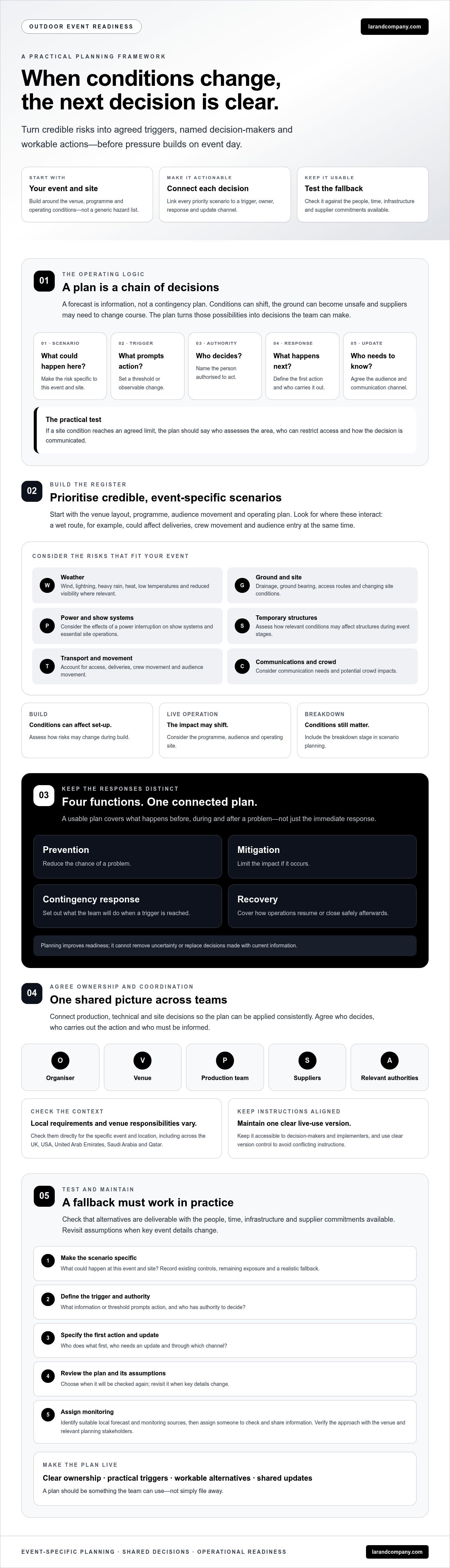
Keep four functions distinct. Prevention reduces the chance of a problem; mitigation limits its impact if it occurs. A contingency response sets out what the team will do when a trigger is reached. Recovery covers how operations resume or close safely afterwards. These steps improve readiness, but they cannot remove uncertainty or replace decisions made with current information.
A usable event contingency plan turns a credible risk into a clear decision, an owned action and a message everyone can act on.
Which events and stakeholders need a shared plan?
The level of detail should reflect the event. Audience scale can affect access and crowd movement. A complex site may have several operating zones, while a tightly timed programme can make even a short interruption consequential. Consider how these elements interact, not only as separate risks.
Involve the organiser, venue, production team, suppliers and relevant authorities where appropriate. Agree roles and approval routes for this event, including who can make a decision, who carries it out and who must be informed. Check local requirements and venue responsibilities directly, as these vary by location, including across the UK, USA, United Arab Emirates, Saudi Arabia and Qatar.
What makes a contingency plan operational rather than theoretical?
Every priority risk needs a named owner and a practical response. Replace “monitor conditions” with a defined threshold or observable change, the person authorised to act and the next instruction. For example, if a site condition reaches an agreed limit, specify who assesses the area, who can restrict access and how the decision is communicated.
Keep a concise live-use version that matches the master plan. Make it accessible to the people making and implementing decisions, and use clear version control so teams are not working from conflicting instructions.
Use this quick check for each priority scenario:
Risk
What could happen at this event and site?
Trigger
What information or threshold prompts action?
Decision-maker
Who has authority to decide?
Action
What happens first, and who does it?
Communication
Who needs an update, and through which channel?
Review
When will the plan and its assumptions be checked again?
Build an outdoor event risk register around credible scenarios
A risk register is useful only if it reflects the site and the event that will actually take place. Start with the venue layout, programme, audience movement and operating plan. A copied list of hazards can miss where those elements meet, such as a wet access route affecting deliveries, crew movement and audience entry at the same time.
For contingency planning for large outdoor events, consider severe weather, ground conditions, power, temporary structures, transport, communications and crowd impacts. Make scenarios specific: heavy rain could leave a particular route unusable; a power interruption could affect show systems and essential site operations. Record existing controls, the exposure that remains and a fallback that can realistically be delivered.
Risk priorities depend on the site, programme and conditions, not on a standard list of hazards.
Which weather and site risks deserve explicit scenarios?
Assess wind, lightning, heavy rain, heat, low temperatures and reduced visibility where they are relevant to the event. Consider how conditions may affect drainage, ground bearing, access routes and temporary structures. Assess how those conditions could change during build, live operation or breakdown, as the impact may differ at each stage.
Identify suitable local forecast and monitoring sources, then assign someone to check and share the information. The right source and monitoring approach depend on location and event context, so verify them with the venue and relevant planning stakeholders. Do not rely on a forecast alone: connect each scenario to site observations and a defined response.
How should teams prioritise and assign risks?
Use a consistent likelihood and consequence method selected by the event’s competent planning team. Apply it across scenarios so the team can compare priorities, while recording why a risk has its rating. There is no universal score that fits every site or programme.
For each high-priority scenario, name one accountable owner and list the supporting teams. Cross-check interfaces between production, site management, suppliers and venue operations. A power issue, for instance, may involve technical systems, supplier responsibilities and site access. Clarify who assesses the impact and coordinates the agreed fallback.
Scenario
Describe a credible event-specific risk.
Controls and exposure
Record what is already in place and what remains.
Priority and owner
Apply the agreed method and name one accountable lead.
Fallback
Set out a feasible alternative and the teams needed to deliver it.
Review the register when the site plan, programme, suppliers or conditions change. For complex live projects, Lar&Co’s show production work includes coordinating stakeholders and deliverables from concept through delivery.
Set decision triggers, authority and communication before event day
Monitoring only helps if it leads to a decision people understand and can carry out. For contingency planning for large outdoor events, map the chain in advance: information is checked, the authorised person assesses it, a decision is issued, teams act and the action is recorded. The record should capture the time, information considered, decision, owner and updates sent.
Agree who can pause an activity, change the programme or initiate a wider response. These may be separate decisions with different approval routes. Name deputies too, and make sure the relevant venue, production and supplier teams know who takes over if a lead is unavailable.
How do you define clear triggers without relying on guesswork?
Set measurable or observable conditions with input from competent specialists and relevant authorities. Avoid copying universal weather thresholds: what is appropriate depends on the event, site, structures and local requirements. Verify the chosen trigger and response with the people responsible for those conditions.
For every trigger, state who monitors it, how often, which source or observation they use and where they record it. Include an escalation step for uncertain, conflicting or unavailable information, such as seeking confirmation from the agreed specialist or authority before proceeding with the relevant activity.
Who communicates decisions to crews, suppliers and audiences?
Name the decision lead, deputies and update channels for operational teams, suppliers and the audience. Prepare short messages for likely changes, such as a delay, programme adjustment, shelter instruction or evacuation direction. Keep messages direct, consistent and appropriate to the people receiving them.
Check that communication methods are accessible to the event audience and account for language needs. If an instruction changes, identify who issues the revised message and how teams confirm it has reached the right people. Record when the message was sent and through which channel.
A simple decision record can use these fields:
Scenario and trigger
What has changed, and what condition prompts review?
Decision-maker
Who can pause, adapt or escalate?
Immediate response
What instruction is issued, and who carries it out?
Update channel
How will crews, suppliers and audiences be informed?
Log
Where are the decision, timing and follow-up recorded?
Rehearse the route so the team can test whether information reaches the decision-maker and instructions reach those who need to act. For broader operational context, consult a published guide to large-scale event management alongside this event-specific process. Check the guide’s location and details against your organisation’s source materials before linking to it or relying on it.
Use this checklist to test fallback plans, suppliers and local requirements
A fallback is useful only if it can be delivered under the conditions that trigger it. In contingency planning for large outdoor events, test each alternative against the people, time, infrastructure and supplier commitments available. If a response depends on a route, power source or space that may be affected by the same scenario, it is not a reliable fallback.
Work through the plan in sequence. Confirm the credible scenarios, name an owner for each, set the agreed trigger, identify a practical alternative, specify how teams will communicate and set a date to review the details. Check that supplier roles and commitments match the response in the plan.
How should you test plans before the audience arrives?
Run a tabletop exercise using a realistic scenario. Take the team through the sequence: what information arrives, who assesses it, who decides, which instruction follows and how the change reaches affected teams. Use the exercise to test contact routes, handovers, infrastructure dependencies and assumptions about supplier response.
Record every gap, assign someone to resolve it and set a review point. Retest material changes, especially if they affect access, technical dependencies or who has authority to act.
Confirm scenarios
Are they credible for this site and programme?
Check ownership and triggers
Are leads, deputies and decision points understood?
Test alternatives
Are people, time, infrastructure and supplier commitments available?
Verify communications
Can the right teams receive and act on updates?
Set review dates
When will changes to the site, programme or supplier arrangements be checked?
What should organisers verify with the venue and local stakeholders?
Confirm site access, venue operating procedures, emergency arrangements and interfaces with relevant authorities. Check permit, safety and reporting requirements with appropriate competent advisers for the event location. For events in the UK, USA, United Arab Emirates, Saudi Arabia or Qatar, verify local procedures with qualified local stakeholders rather than assuming a process used elsewhere will apply.
Infrastructure deserves particular scrutiny. A change of location or operating mode may depend on power, access, structures or technical capacity. Review these dependencies with the relevant production and venue teams, and consult a technical production guide for broader context when assessing them.
For complex live events, Lar&Co’s show production, technical production and site management can help connect operational dependencies across stakeholders. Prepare your event requirements and open planning questions for a production discussion.
Put the contingency plan into live operations with a production partner
A contingency plan must work alongside the event, not sit apart from it. Production management can connect creative intent with technical dependencies, site operations and stakeholder decisions. If a programme change affects technical requirements or site access, the teams responsible for those workstreams need a shared view of the implications and next steps.
This coordination matters when an event involves multiple stakeholders, temporary infrastructure or complex site interfaces. A production partner can help keep decisions connected across workstreams, but does not replace the responsibilities of the venue, relevant authorities or competent specialists. Keep each party’s role and approval route clear.
Lar&Co’s show production, technical production and site management support complex live entertainment projects. You can review Lar&Co’s event production work for relevant examples.
When does an event benefit from integrated production oversight?
Consider integrated oversight where a programme relies on several suppliers, temporary infrastructure or a site with interdependent operating areas. A schedule change, for instance, may affect technical requirements, crew movement and venue operations. Coordinated production management helps teams understand those connections and route decisions to the right owners, while preserving the venue’s and authorities’ separate responsibilities.
Review the plan as the programme, site, suppliers or forecast changes. A response that was feasible during planning may no longer fit if an access route, delivery arrangement or technical dependency has changed. Keep the current version clear, and make sure the relevant teams know where to find it.
What should you prepare before discussing production support?
Bring together the event brief, draft schedule, venue information and known operational constraints. Summarise the priority scenarios, existing plans, named decision-makers and unresolved dependencies. This gives the production team a practical basis for understanding how the event is intended to run and where coordination needs further attention.
Event context
Share the brief, programme and site information.
Planning status
Note current scenarios, responses and review dates.
Open questions
Identify unclear approvals, supplier commitments and dependencies.
With more than 20 years of experience in live entertainment projects, Lar&Co brings show production, technical production, site management and stakeholder coordination to complex event delivery. For contingency planning for large outdoor events, a focused discussion can start with the event’s scale, site and planning needs.
Make your event plan ready for delivery
Effective contingency planning for large outdoor events is specific to the site, programme and people responsible for decisions. Prioritise credible scenarios, set clear triggers and owners, and check that each fallback is practical with the time, infrastructure and supplier commitments available.
Keep the plan active as conditions change. Review it when the programme, site, suppliers or forecast shifts, and make sure updates reach the teams who need to act. This supports calm, coordinated decisions without replacing the responsibilities of venues, authorities or specialists.
Lar&Co is an international show production practice with more than 20 years of experience delivering complex live entertainment projects, and primary offices in London and Los Angeles. Its show production, technical production and site management capabilities connect operational decisions across stakeholders and deliverables.
Before speaking with the production team, gather your event brief, venue details and priority planning questions. Discuss your event production requirements with Lar&Co.
Frequently Asked Questions
What should a contingency plan for a large outdoor event include?
It should connect credible event risks to clear triggers, decision-makers and practical response actions. Include the information or condition that prompts review, who has authority to decide, what teams do next, how updates are shared and where decisions are recorded. Also document fallback options, relevant supplier roles and review dates. For contingency planning for large outdoor events, tailor this information to the venue, programme and audience rather than relying on a generic template.
How do you prepare for bad weather at an outdoor event?
Identify weather scenarios relevant to the site, such as wind, lightning, heavy rain, heat, low temperatures or reduced visibility. Check how each could affect structures, ground conditions, access, power and audience movement. Agree who monitors suitable local forecasts and site conditions, then set event-specific triggers and responses with competent specialists and relevant authorities. Avoid assuming one weather threshold applies everywhere. Test that alternatives, such as changing activity or restricting an area, are feasible.
Who is responsible for activating an event contingency plan?
The event team should agree this in advance. Name the person authorised to make each decision, such as pausing an activity or changing the programme, and identify a deputy if that lead is unavailable. Some actions may require coordination with the venue or relevant authorities, so record approval routes and responsibilities clearly. Suppliers and crews should know who issues instructions. A production partner can help coordinate information across workstreams, but does not replace other parties’ responsibilities.
How often should an outdoor event contingency plan be reviewed?
Review it at agreed planning milestones and whenever a material detail changes. Revisit the plan if the programme, site layout, supplier arrangements, forecast or local operating information shifts. Confirm that named owners, contact routes and fallback assumptions are still valid, and update the live-use version when needed. Set review dates so checks do not depend on memory. The appropriate schedule depends on the event and its planning process, rather than a universal interval.
How can event organisers test a contingency plan before the event?
Run a tabletop exercise based on a plausible scenario and walk through the response in sequence. Check who receives the information, who decides, how instructions reach crews and suppliers, and whether the fallback can be delivered with available people, time and infrastructure. Test contact routes and handovers. Record gaps, assign corrective actions and retest material changes. The exercise should reveal unclear roles or impractical assumptions, not simply confirm that a written plan exists.
Do outdoor event contingency plans differ between countries?
Yes. Venue procedures, authority interfaces and local permit, safety and reporting requirements can vary by location and event type. For events in the UK, USA, United Arab Emirates, Saudi Arabia or Qatar, verify the relevant arrangements with the venue and qualified local stakeholders. Do not transfer another country’s procedure without checking its suitability. Keep the event’s operational response aligned with local requirements, and seek appropriate specialist advice where needed.