Crisis Management for Events: Busting the Myths of High-Stakes Production
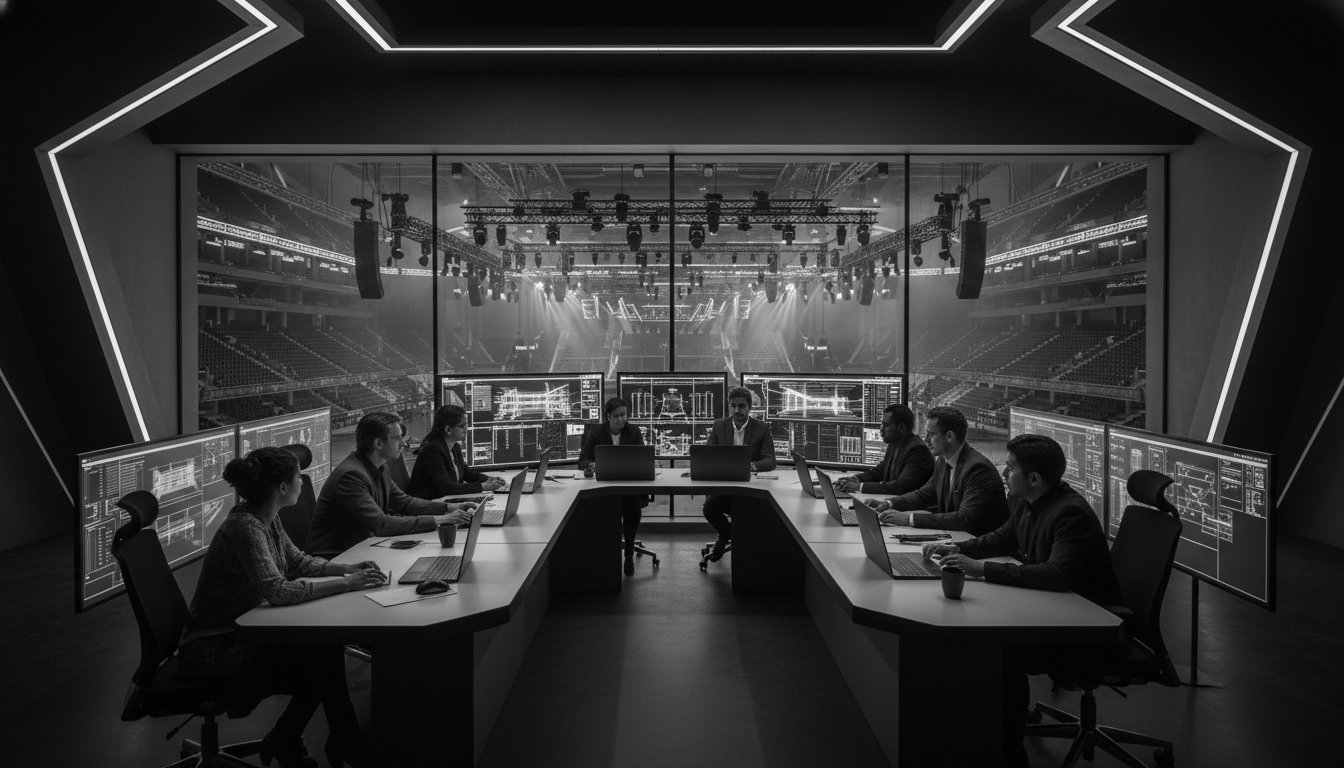
A flawless live experience is never an accident; it is the result of an invisible technical architecture that ensures the audience remains unaware of any friction. Real crisis management for events is not about reacting to a catastrophe after it happens. It is the quiet, sophisticated process of absorbing risk before it reaches the stage. Whilst most contingency plans are static documents that fail under pressure, elite show production requires a dynamic framework designed for the complexities of global projects and shifting international regulations.
You likely recognise the weight of managing international stakeholders across time zones or the high-stakes pressure of delivering in regions like the UAE and Saudi Arabia, where local compliance is non-negotiable. This article explores why traditional safety frameworks often buckle and how to architect resilience into your technical production. We will examine the essential difference between a safety officer and a production crisis lead, and why a proactive approach is the only way to protect your reputation. From the implications of Martyn's Law to navigating the HSE's £188 per hour Fee for Intervention, this is how you ensure the show goes on regardless of the disruption.
Key Takeaways
• Redefine crisis management for events as a proactive technical architecture that absorbs risk before it ever reaches the audience.
• Learn how technical production and site management build redundancy into complex stage designs to mitigate critical failure points.
• Recognise why traditional insurance cannot protect your global reputation and how to pivot strategically during unforeseen disruptions.
• Establish a "Decision Circle" to ensure a single source of truth and rapid response across multiple international time zones.
• Align high-tier global entertainment standards with specific local regulations in regions such as the UAE and Saudi Arabia.
Beyond the Emergency Exit: Reimagining Crisis Management for Events
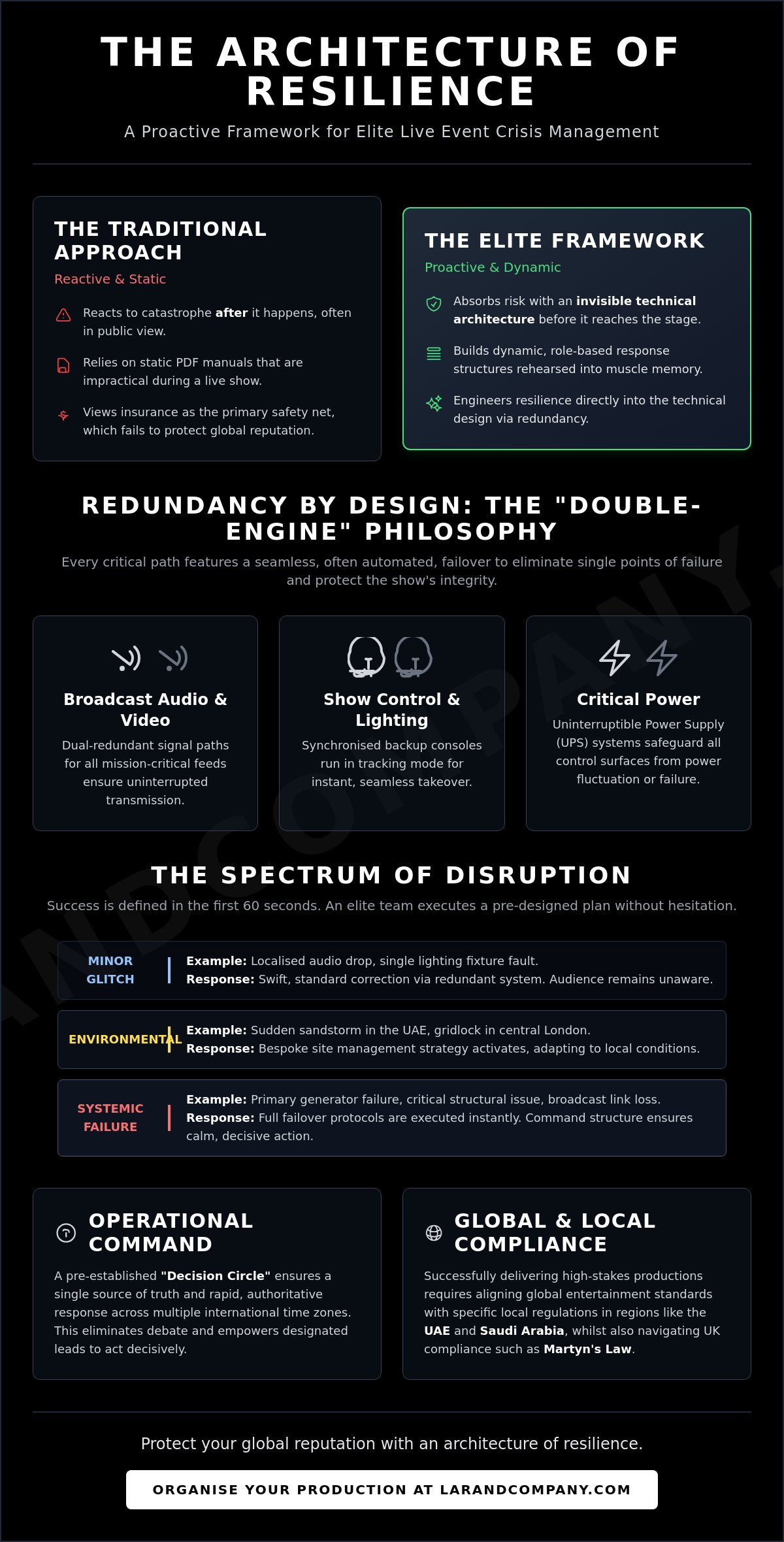
At the highest tier of global show production, crisis management for events is defined as the proactive absorption of disruption whilst maintaining absolute show integrity. It is not a reactive scramble to fix a mistake; it is a silent technical architecture that ensures the audience never perceives a deviation from the script. Whilst standard corporate meetings might view risk through the lens of a failed projector, high-profile productions manage risks that threaten global reputations and civic pride. The stakes are vastly different when a broadcast reaches millions or a head of state is in attendance.
For an elite production partner, this discipline is a core pillar of the work. We treat risk as a tangible variable within the logistics of a project rather than an abstract fear. Applying established crisis management principles allows a team to protect the "wow moment" from technical or environmental interference. Protecting a brand's international standing requires a temperament that is sophisticated, calm, and focused on immediate results. This understated authority is what allows a show to continue flawlessly, even when the behind-the-scenes reality is shifting.
The Spectrum of Event Disruption
Disruption exists on a scale. A minor technical glitch, such as a localised audio drop, requires a swift but standard correction. Systemic failures, however, demand a different calibre of response. Consider the environmental variables of a large-scale project. A sudden sandstorm in the UAE desert presents a different set of failure points than the logistical gridlock of central London during a civic parade. Each requires a bespoke site management strategy that accounts for local conditions and infrastructure limitations.
The first 60 seconds of any disruption are the most critical. This brief window dictates whether a situation remains an internal technical adjustment or evolves into a public failure. Success depends on the team's ability to identify the root cause instantly and execute a pre-designed redundancy plan without hesitation. In high-stakes environments, there is no room for debate; there is only the execution of the plan.
Why Traditional Planning Falls Short
Static PDF manuals are ineffective during a live broadcast. No lead producer has the time to consult a 50-page document whilst a stage lift is malfunctioning or a weather front is moving in. Modern large scale event management requires dynamic, role-based response structures that empower specific individuals to act. These structures must be rehearsed until they become muscle memory for the entire technical production team. Operational calm is the defining characteristic of an elite production team that maintains control when the stakes are highest.
The Architecture of Resilience: Technical Production as Risk Mitigation
Resilience is engineered. It isn't a matter of hope. True crisis management for events begins at the drafting board, long before the first truck arrives on site. This approach treats technical direction as a primary form of risk mitigation. We identify systemic failure points during the design phase. We architect solutions that absorb disruption without a ripple. By the time the build begins, the technical architecture is already resilient to most common failure modes.
Redundancy by Design
We operate under a "Double-Engine" philosophy. This ensures that every critical path—from audio and lighting to primary show power—features a seamless failover. Sophisticated technical production for live events leverages automation to eliminate the risk of human error during high-pressure transitions. Elite production requires specific technical standards:
• Dual-redundant signal paths for all broadcast audio and video.
• Synchronised backup lighting consoles running in tracking mode.
• Uninterruptible Power Supply (UPS) systems for all critical control surfaces.
Consider a recent high-profile broadcast where a silent switchover to backup power saved the production. The audience remained entirely unaware. This is the standard. It requires a deep understanding of signal flow and the ability to integrate secondary systems that activate instantly.
Site Management and Environmental Intelligence
Global projects often encounter extreme conditions. Navigating the unique climate risks of Saudi Arabia or Qatar requires specialised site management expertise. This is the foundation of event health and safety management. It involves more than just safety officers on the ground. It requires managing the unseen infrastructure: temporary power grids, waste logistics, and crew welfare in remote desert locations. A well-structured Event Emergency Action Plan provides the necessary framework for these complex builds.
Effective crisis management for events also relies on engineering-grade logistics. In unconventional or remote locations, the margin for error is non-existent. Financial management plays a critical role here too. We architect budgets to include buffer resources. This provides the flexibility to save a show at the eleventh hour if local conditions or regulations shift. This financial foresight allows for the rapid deployment of additional crew or equipment without compromising the project's viability. For those overseeing high-value international projects, our portfolio of global works illustrates this level of composure and technical precision in action.
Myth vs Reality: Why Your Contingency Plan Might Fail
A common misconception in high-stakes production is that a comprehensive contingency plan guarantees success. It doesn't. Whilst a document provides a baseline, it cannot account for the fluid nature of live environments. Many organisers believe that "insurance covers everything." This is a dangerous fallacy. Insurance may compensate for the financial loss of a cancelled venue, but it cannot restore the reputational damage of a public failure on a global stage. Reputation is uninsurable. Protecting it requires a shift from passive planning to active risk absorption.
Another myth suggests that cancellation is the only response to severe weather or systemic technical failure. Elite producers don't just fold; they pivot. Through sophisticated technical production and site management, we build the capacity to adapt the show in real time. Similarly, the "more staff" approach often backfires. In a crisis, a bloated team leads to the "too many cooks" problem, where communication breaks down and decision-making stalls. Effective crisis management for events relies on a lean, high-calibre command structure where every individual knows their specific role.
We must also differentiate between Paper Safety and Operational Safety. Paper safety is about compliance and ticking boxes to satisfy local regulations. Operational safety is the actual ability to execute under pressure. It's the difference between having a manual and having the temperament to lead a team through a technical blackout without losing composure.
The Fallacy of the Checklist
A checklist is a starting point, not a solution. For a global tour with unique logistical hurdles, a static list cannot replace the intuitive expertise found in an international practice of show producers. Every territory, from London to Riyadh, presents distinct challenges that no generic template can predict. A plan is a map; crisis management is the ability to drive when the road disappears.
Reactive vs Proactive Management
The distinction between damage control and risk absorption is fundamental. Proactive crisis management for events integrates financial management during pre-production to ensure buffer resources are available. This prevents "panic spending" when a solution is needed immediately. It also involves the artist liaison team managing expectations early, ensuring that if a schedule shifts, the talent remains aligned with the production's goals.
| Feature | Reactive (Damage Control) | Proactive (Risk Absorption) |
|---|---|---|
| Primary Goal | Stopping the bleed | Maintaining show integrity |
| Financial Impact | Unplanned emergency costs | Pre-allocated buffer resources |
| Outcome | Visible disruption | Invisible resolution |
Operational Command: Organising a Global Response Team
Managing a multi-million pound production is not a democracy. High-stakes crisis management for events requires a rigid command structure designed to function under extreme pressure. We organise this through a Decision Circle. This lean group holds the final authority on show-stop vs. show-go decisions, preventing the paralysis that occurs when too many stakeholders weigh in during a critical window. To maintain clarity across global time zones, we establish a Single Source of Truth. This centralised communication log ensures that teams in London, Los Angeles, and Doha are aligned on the same data at all times.
The technical feasibility of the creative design must undergo rigorous Stress Tests during pre-production. We push systems to their breaking points to identify where the architecture might fail. During the live performance, we deploy Shadow Teams at critical infrastructure points. These specialist engineers monitor primary systems and are prepared to take control instantly if a fault is detected. Once the project concludes, we conduct a post-event debrief. We transform near-misses into future standard operating procedures, ensuring that our technical production framework constantly evolves.
Communication Protocols for Global Stakes
Clarity is the priority when managing a 200-person international crew. We use direct, minimalist language to eliminate ambiguity. This is supported by a No-Blame culture. Psychological safety is essential for rapid crisis resolution; team members must feel confident reporting a technical fault immediately without fear of reprisal. When managing stakeholders from different regions, the Global Briefing serves as the touchstone. It provides a concise, functional overview of the status, ensuring everyone understands the operational reality regardless of their location.
The Role of the Show Producer in a Crisis
The show producer acts as the calm centre of the production. They maintain absolute composure whilst navigating logistical chaos. Their role is to translate the creative vision into a tangible technical reality, even when the original plan is no longer viable. This requires a sophisticated temperament and the ability to make decisive calls that protect the show's integrity. Effective artist liaison is a critical part of this process. We ensure that talent and their representatives remain informed and confident during high-pressure logistical shifts, maintaining a professional atmosphere behind the scenes. If you are architecting a high-value international project, contact our production team to discuss a resilient framework for your event.
Understated Authority: How Lar&Co Navigates High-Profile Challenges
Lar&Co operates at the intersection of technical precision and global diplomacy. Our reputation isn't built on self-promotion; it's anchored in the gravity of our portfolio. When executing crisis management for events on a global scale, we rely on the experience gained from navigating the world's most significant cultural and civic projects. With operational centres in London and Los Angeles, we act as a bridge for global entertainment standards. This international presence allows us to translate complex creative visions into reliable, tangible results across multiple territories. Our team understands that high-stakes production requires a temperament that remains unflappable regardless of the challenge.
An international practice requires more than just logistical skill. It demands a deep understanding of production nuances in both Western and Middle Eastern markets. We've spent decades refining our approach to site management and technical production in regions like the UAE, Saudi Arabia, and Qatar. We understand the local regulations, the environmental challenges, and the specific cultural expectations that define success in these areas. Effective crisis management for events in these regions requires a cosmopolitan expert who is well-connected and unflappable. We don't just solve problems; we absorb risk before it reaches the spotlight.
Meticulous Attention to Detail
Our 20 years of expertise allows us to see around corners. We identify potential failure points before they manifest on stage. This foresight is a result of having managed high-stakes projects ranging from prestigious fashion houses to iconic musical legends. Beyond technical execution, we prioritise financial integrity. Transparent reporting and disciplined financial management ensure that every project remains viable, even when faced with unforeseen logistical shifts. This business culture is focused on execution and results. You can explore our portfolio of international works to see the scale and quality of the experiences we deliver.
Partnering for Absolute Composure
Lar&Co is the quiet power behind the scenes. We're comfortable operating at the highest levels of entertainment and diplomacy. Elite partners choose us for their most complex, high-value projects because they value our absolute composure under pressure. We don't just manage a show; we architect a resilient environment where the creative vision can flourish without interruption. This temperament is what distinguishes a standard production firm from an elite international partner. Our voice is one of understated authority. We rely on the results we've achieved for the world's most demanding clients. If you're planning a rare and significant challenge, contact our team to discuss the meticulous delivery of your next global experience.
Architecting Resilience for the Global Stage
True resilience is the result of technical precision and a sophisticated command structure. We've explored how moving beyond static checklists allows for the proactive absorption of risk. Effective crisis management for events ensures that the audience's experience remains uninterrupted, regardless of the logistical or technical challenges occurring behind the scenes. It's about maintaining absolute show integrity through engineering-grade redundancy and a lean, decisive leadership circle.
Protecting a global reputation requires more than just insurance; it demands a partner who understands the nuances of international delivery. With over 20 years of expertise in high-profile live entertainment and global offices in London and Los Angeles, Lar&Co specialises in complex international logistics and site management. We provide the quiet power required to navigate the world's most significant cultural and civic events with absolute composure. Ensure your creative vision is supported by a foundation that cannot fail.
Secure the composure of your next global production with Lar&Co
Frequently Asked Questions
What is the most common crisis in large-scale event production?
Technical failures, specifically in power and signal flow, remain the most frequent disruptions. These are often caused by environmental factors or human error during complex builds. Effective crisis management for events mitigates these risks by identifying potential failure points during the technical production phase. By architecting redundant systems, we ensure that a failure in one component does not lead to a total show stop, maintaining the integrity of the live experience.
How do you manage event safety in remote locations like the Saudi desert?
Managing safety in remote desert locations requires rigorous site management and engineering-grade logistics. We focus on environmental intelligence, such as monitoring heat and sandstorm patterns, whilst ensuring robust temporary infrastructure. This includes establishing dedicated power grids and crew welfare centres. Success in these regions depends on a deep understanding of local regulations and the ability to maintain operational calm in unconventional environments where the margin for error is non-existent.
When should an event be cancelled versus postponed during a crisis?
The decision to cancel or postpone depends on the immediate threat to life and the long-term impact on show integrity. If a systemic failure or extreme weather poses an unmanageable safety risk, cancellation is necessary. However, sophisticated production teams often pivot to a modified show format or a delayed start. This decision is made by the lean Decision Circle to ensure a rapid, authoritative response that protects both the audience and the brand's global reputation.
What is the difference between a health and safety officer and a crisis manager?
A health and safety officer focuses on regulatory compliance and physical protection, whilst a crisis manager ensures show continuity and reputational safety. Whilst the safety officer monitors risks such as crowd density or structural stability, the crisis lead manages the technical and logistical response to a disruption. Both roles are essential, but the crisis manager holds the authority to translate the creative vision into a new technical reality during a live emergency.
How does technical redundancy help in event crisis management?
Technical redundancy acts as the primary risk absorption layer in event crisis management. By architecting dual-redundant signal paths and synchronised backup consoles, we ensure that technical glitches remain invisible to the audience. This Double-Engine philosophy allows for a silent switchover to backup power or audio systems. It eliminates the need for reactive damage control by building resilience directly into the fabric of the stage design and technical architecture.
How do you communicate a crisis to high-profile artists or VIP stakeholders?
Communication with VIP stakeholders must be direct, minimalist, and delivered through a trusted artist liaison. We provide a concise briefing that focuses on the operational reality and the proposed solution rather than the technical minutiae of the failure. Maintaining a professional atmosphere behind the scenes is critical. This approach ensures that high-profile talent remains confident in the production team's ability to manage the shift, preventing panic and protecting the relationship.
Why is financial oversight considered part of crisis management?
Financial oversight is a proactive tool that prevents panic spending during a disruption. By architecting budgets with pre-allocated buffer resources, we maintain the flexibility to deploy additional crew or equipment at the eleventh hour. This financial discipline is a core part of crisis management for events. It allows the production lead to make decisive, high-value calls without being hindered by immediate budgetary constraints, ensuring the show goes on regardless of the cost of the resolution.
How often should an event crisis management plan be updated?
A crisis management plan should be an iterative document updated after every project debrief. Static manuals quickly become obsolete in the fast-paced world of international show production. We treat every near-miss as a learning opportunity to refine our standard operating procedures. This constant evolution ensures that our technical and logistical frameworks remain resilient against emerging risks, such as new cybersecurity threats or changes to international safety legislation like Martyn's Law.