Crowd Flow Planning for Large Events: A Practical Guide
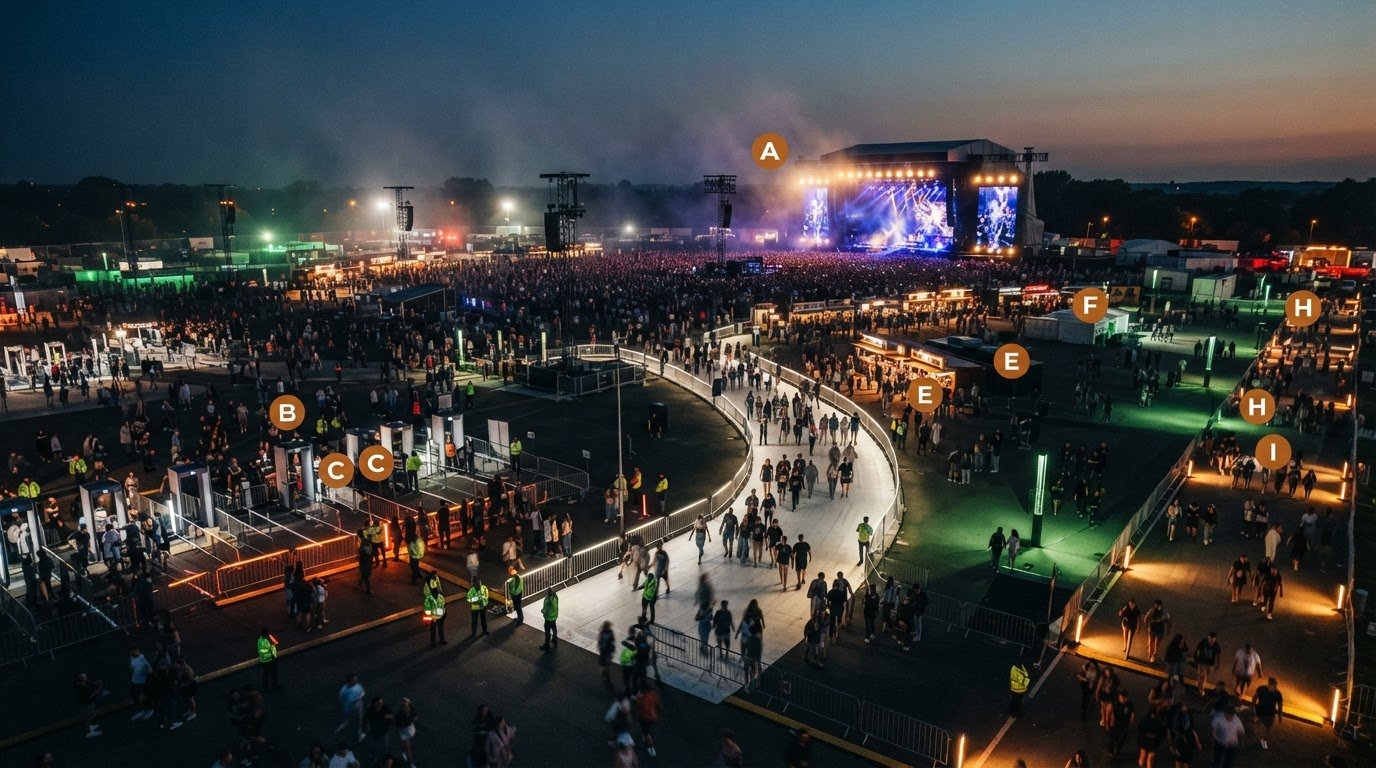
A site plan can look clear on screen and still fail when crowds move at once. Crowd flow planning for large events must account for more than entrance locations: arrival surges, concession queues, show timings and departures all compete for space. If these movements aren’t considered together, queues can converge and turn a workable layout into a bottleneck.
Entry, concessions and exits each have different demands, but attendees experience them as one continuous journey. When site, technical and show operations are planned separately, teams can respond to the same pressure in conflicting ways.
This guide explains how to plan, test and manage movement from arrival to departure. You’ll learn how to map attendee journeys, identify pinch points before event day, assess the effect of layouts and show timings, and align teams around clear operational decisions. The aim is an event-specific plan that works on site, not just on paper.
Key Takeaways
• Plan movement as a journey through the whole site, not as separate entrance, amenity and exit problems.
• Use a clear mapping sequence to trace attendee routes, spot conflicts and test layout changes before event day.
• Match each crowd-flow measure to its pressure point, and account for the operational trade-offs it creates.
• Prepare teams to walk routes, rehearse key movements and share responsibility for monitoring pressure points.
• Effective crowd flow planning for large events connects show timings, technical layouts and audience routes through coordinated site management.
Why crowd flow planning matters at large events
Crowd flow planning is the planned movement of people through an event site and its surrounding approaches, from arrival and entry to circulation, exit and onward travel. It connects the physical layout with how attendees are expected to move at different points in the event.
Capacity is only one part of the picture. It describes how many people a space is intended to accommodate, but not how quickly they arrive, where they pause, which routes they choose or whether two streams of movement will cross. A gate may be able to process arrivals steadily while the approach outside fills with people waiting to be searched or regroup with friends. A broad route can also become constrained when queues, production activity or a popular attraction take up space along its edges.
Effective crowd flow planning for large events considers movement across time as well as space. The aim isn’t to push the greatest possible number of people through each point. It’s to make routes safe, legible and workable throughout the attendee journey, including accessible routes and the transition from the event site to surrounding transport and public areas.
That requires an event-wide view. The principles of crowd analysis offer a useful foundation for considering how people gather and move. For event planning, those observations need to be considered alongside the site layout, operational activity and programme that shape audience behaviour.
Where congestion develops across the attendee journey
Pressure can begin before attendees reach the gates. Transport approaches, drop-off points and pedestrian routes may bring separate groups together. Inside the site, entry checks, searches, amenities and concessions can create queues that spill into circulation routes. At exits, people may converge on the same paths or onward-travel points, especially when they leave at a similar time.
Queues, crossings and attractions can compete for the same space. A queue that bends across a main route affects people who aren’t joining it; a crossing near an amenity can slow both streams. Pinch points emerge where separate flows converge, compete for space or pause in a shared route. Look for these interactions rather than assessing each area in isolation.
Why the show schedule changes movement patterns
Movement isn’t always steady. Doors opening, a headline performance beginning, an intermission and closing time can each create a predictable wave. Attendees may move towards a stage before a set, seek amenities during a break or head for exits together at the end. These short surges place different demands on routes than general circulation between programme moments.
A shared operating picture helps production, venue and site teams anticipate these changes. Show timings affect when people move; technical layouts and site operations affect which routes remain available. If teams plan around different assumptions, a programme change or late adjustment can create pressure elsewhere. Coordinated planning links audience movement to the schedule and the spaces that support the show.
How to map crowd movement across the event site
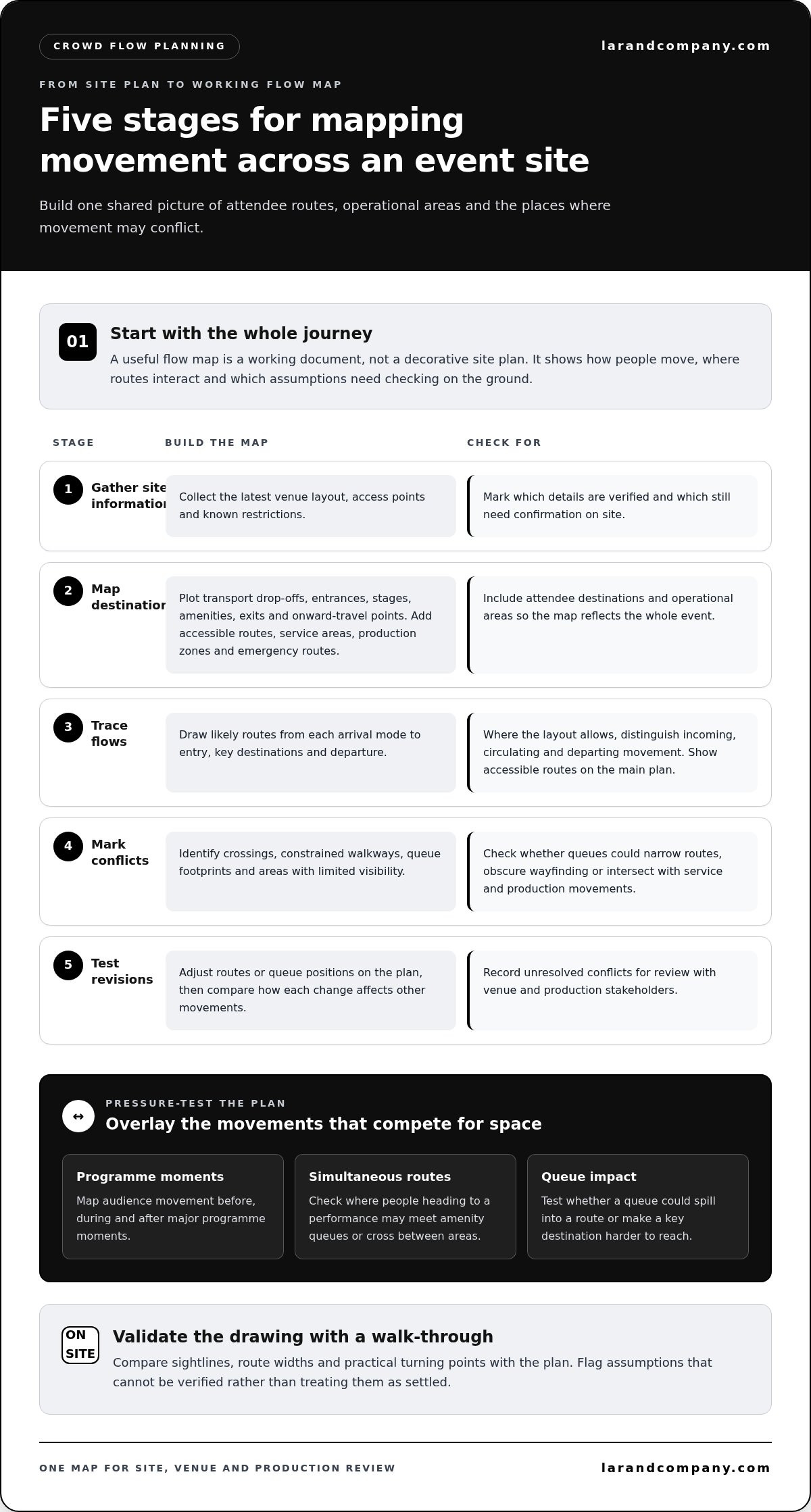
A useful flow map is a working document, not a decorative site plan. It should show how people move, where routes interact and which assumptions need checking on the ground. For crowd flow planning for large events, build the map in stages so site, venue and production stakeholders can review the same picture.
Build the flow map from real destinations and routes
Start with a scaled site plan and mark the places attendees, staff and suppliers need to reach. Include transport drop-offs, entrances, stages, amenities, exits and onward-travel points, alongside accessible routes, service areas, production zones and emergency routes. Use the venue’s current plans as your base, then validate uncertain details with an on-site walk-through.
1. Gather site information.
Collect the latest venue layout, access points and known restrictions. Mark which details are verified and which still need confirmation on site.
2. Map destinations.
Plot attendee destinations as well as operational areas. Include toilets, concessions, viewing areas, production compounds, service access and emergency routes so the map reflects the whole event, not only public-facing spaces.
3. Trace flows.
Draw likely routes from each arrival mode to entry, key destinations and departure. Where the layout allows, distinguish incoming, circulating and departing movement. Show accessible routes as part of the main plan, not as an afterthought.
4. Mark conflicts.
Identify crossings, constrained walkways, queue footprints and areas with limited visibility. Check whether a queue could narrow a route, obscure wayfinding or intersect with service or production movements.
5. Test revisions.
Adjust routes or queue positions on the plan, then compare how each change affects other movements. Record unresolved conflicts for review with venue and production stakeholders.
Test the plan against peaks and competing movements
Overlay expected audience movement before, during and after major programme moments. For example, mark where attendees may travel towards a performance while others queue for amenities or cross between areas. Check whether queues could spill into a route or make a key destination harder to reach. A plan that works during steady circulation may behave differently during a concentrated arrival or departure.
Use the walk-through to compare sightlines, route widths and practical turning points with the drawing. Flag any assumption that can’t be verified rather than treating it as settled. OSHA’s crowd management guidelines, written for retail settings, can offer useful prompts on planning, staffing and communication. Event routes must still follow the applicable venue plan and jurisdictional requirements.
Keep a brief change log: note the conflict, proposed revision, who needs to review it and what remains unresolved. This makes decisions visible across teams and helps prevent a local adjustment from creating a new issue elsewhere. When site layout and show operations need close coordination, bring those planning conversations together as part of the production process.
Which crowd-flow measures suit different event pressure points?
A useful intervention addresses the cause of congestion, not just its visible symptom. A longer queue, extra staff or a one-way route may help in one location and create difficulty elsewhere. In crowd flow planning for large events, compare each option with the pressure point, its effect on other routes and the teams needed to put it into practice.
Choose an intervention by the congestion pattern
Start by identifying what is constraining movement. If entry queues spill into a walkway, clarify the queue footprint and review the entry process. If crossing streams conflict, consider separating routes or adjusting movement timing where feasible. If demand for amenities is uneven, distributing facilities and improving wayfinding may help attendees see their options before joining a queue.
| Measure | Suitable condition | Operational trade-off | Coordination need |
|---|---|---|---|
| Timed arrival messaging | Arrival demand can be spread across a defined period. | Messaging may not change travel choices; instructions need to remain clear and consistent. | Align attendee communications with entry arrangements and transport information. |
| Defined queue footprint and entry process | Queues are obstructing circulation or approaching crossings. | Queue space uses land that may serve another purpose; the layout must preserve accessible routes. | Coordinate queue positions with venue operations, entry teams and the site plan. |
| Route separation or revised movement timing | Two streams repeatedly intersect at a constrained point. | A longer or less direct route can affect wayfinding and journey time. | Agree changes with teams responsible for audience routes, operations and the programme. |
| Distributed amenities and phased release | Demand clusters around a small number of facilities or departure routes. | Distribution needs clear directions; phased release can affect the audience’s exit experience. | Link facility locations and release decisions to show timings and onward travel. |
Balance throughput, accessibility and the audience experience
Moving people faster isn’t automatically a better outcome. If destinations aren’t clear, a higher pace can lead to hesitation, wrong turns and new queues at decision points. Wayfinding should explain where a route leads, not simply tell people to keep moving. Check how a proposed change affects arrival, views of the show and access for operational teams.
Keep accessible routes continuous and legible. They shouldn’t become overflow space for queues or a convenient place to redirect general movement. Review any route change against the applicable venue plan and local requirements. A barrier may define a queue, but it can also narrow a walkway. Extra staff can help communicate a revised route, but can’t resolve a layout conflict on their own.
Record the reason for each measure, its trade-off and the team responsible for coordinating it. This helps event stakeholders choose a proportionate response and review whether it remains workable alongside the programme and site operations.
How to prepare, rehearse and adapt the crowd-flow plan
A crowd-flow plan needs to work for the people delivering it, not only those who drew it. Review it with venue and operational stakeholders, walk the routes, brief crews, rehearse key movements and monitor conditions during the event. This sequence makes crowd flow planning for large events a shared operating process, with clear responsibility for observing pressure points and communicating changes.
Brief teams and rehearse the attendee journey
Walk the attendee journey with venue, site, production and front-of-house representatives. Check route names, decision points, queue locations and how audience messages will be delivered. A route that seems clear on a plan may be difficult to recognise on site, particularly where technical infrastructure or temporary activity changes sightlines.
Before the event, agree who observes each pressure point, who receives reports and who can approve operational changes. Define triggers and escalation routes with the venue and relevant safety leads, using their event-specific procedures rather than assumed thresholds. Brief crews on the reporting line and how to distinguish an observation, such as a queue obstructing a route, from an instruction to alter movement.
Rehearse planned audience movements where practical, including arrival, transitions between areas and departure. Record issues as they arise, assign them for review and update the controlled site plan so every team is working from the same version.
Monitor live conditions and manage changes
During delivery, watch for queue build-up, obstructed routes, attendee confusion and changes in where people pause. These conditions can shift as the programme progresses. Use agreed communications channels to pass concise observations to the responsible teams, then confirm any approved change and make sure affected crews receive the same instruction.
Show infrastructure can shape the routes available to attendees. Technical production teams should therefore be part of the review when equipment positions, cable routes or programme timings may affect circulation. The wider context of large-scale event management matters too: crowd movement depends on how site operations, venue arrangements and the show work together.
Pre-event checklist
• Venue, site, production and front-of-house stakeholders have reviewed the plan.
• Key attendee routes have been walked and practical adjustments recorded.
• Crews know route names, audience messages and reporting lines.
• Observation responsibilities, escalation routes and change approvals are agreed.
• The controlled plan reflects rehearsal changes and is available to relevant teams.
How integrated show production supports crowd flow
Audience routes don’t operate separately from the show. A stage position can redirect movement; technical infrastructure can narrow a route; a programme change can shift when people arrive, circulate or leave. Crowd flow planning for large events is strongest when these decisions are considered together, rather than handled as isolated site, production or venue tasks.
Coordinate crowd routes with show and site operations
Review audience routes alongside production access, temporary infrastructure and programme timings. A route that works during general circulation, for example, may become constrained when a technical team needs access or equipment is positioned nearby. A change to performance timing may also shift audience movement. Joint review helps teams identify these interactions before they create competing demands on the same space.
Site management provides a coordination point for turning the agreed plan into operational delivery. It brings venue, production and site stakeholders around a shared layout, tracks changes that affect movement and keeps the current plan aligned with decisions across departments. Show production and technical production contribute the schedule and infrastructure picture; site management connects those elements to the practical use of the event space. This coordination supports crowd movement planning without replacing venue or safety responsibilities.
Keep ownership clear. If a proposed change affects an audience route, production access or show timing, the relevant teams should review the same information before it is put into practice. This reduces the risk of one department solving a local issue at the expense of another part of the operation.
Move from planning principles to project delivery
Early coordination gives teams time to compare the site layout with the production schedule, identify dependencies and resolve conflicts while plans can still be adjusted. Site-specific planning then translates those decisions into routes, access arrangements and responsibilities crews can follow. Clear ownership carries the plan through rehearsals and live delivery, when conditions may call for a considered operational response.
Lar&Co provides show production and site management for complex live entertainment, including concerts, festivals and cultural celebrations. Its work brings production planning and site operations together across projects in the UK, USA, United Arab Emirates, Saudi Arabia and Qatar, where venue arrangements and local requirements need to inform event-specific plans. Explore Lar&Co’s international live event production work for context on the range of projects it delivers.
In brief: effective crowd flow depends on coordinated decisions across schedule, layout, infrastructure and site operations. Make the plan specific to the event, give teams clear ownership and review changes across departments before they affect the attendee journey.
Make movement part of the next production decision
Bring crowd movement into early production conversations, while there’s still room to align the programme, site layout and technical requirements. Treat crowd flow planning for large events as an operational design choice, not a final check. With clear ownership and joined-up decisions, teams can create a more legible attendee journey and adapt the plan as the event takes shape.
Lar&Co brings more than 20 years of experience delivering complex live entertainment, with an international portfolio spanning tours, festivals and cultural celebrations. Its show production, technical production and site management capabilities connect planning with delivery. Discuss your live event production requirements and take the next step towards a coordinated event plan.
Frequently Asked Questions
How early should crowd flow planning begin for a large event?
Begin crowd flow planning alongside site and programme development, before routes, temporary infrastructure and audience destinations become fixed. The right timing depends on the event’s complexity, venue constraints and local approval processes. For an event in the UK, United States, United Arab Emirates, Saudi Arabia or Qatar, account for the relevant venue and jurisdictional review. Revisit the plan as attendance assumptions, layouts and schedules develop, rather than treating an early draft as final.
Can crowd flow be managed without using barriers?
Yes. Barriers are one possible control, but they may not suit every space or movement pattern. A clearly designed route, well-placed information, staff guidance or programme timing changes may address the issue more effectively. For example, directing attendees to a less-used entrance can ease a queue without adding physical divisions. Assess each measure against the venue layout, accessibility needs and approved safety arrangements before putting it into operation.
How can organisers estimate when the busiest crowd surges will happen?
Build estimates from several sources: ticketing and arrival information, transport patterns, programme timings, observations of the venue and records from comparable events. A late-running performance, for instance, may shift departures and onward travel from the original schedule. Treat each estimate as a planning input, not a guarantee. Record the assumptions behind it, then revisit them as event details change or better information becomes available.
What should organisers do if a planned route becomes unavailable during an event?
Use a pre-agreed contingency route and communications procedure, and coordinate the change through the responsible venue and event leads. An improvised diversion can send people into another queue, crossing or operational area. Before redirecting attendees, clarify which route is available, how it will be communicated and which teams need to act on the decision. Any response must follow the event’s approved safety arrangements and applicable local requirements.
How can crowd flow planning support attendees with accessibility needs?
Include accessible routes, viewing or service destinations, clear information and suitable queue arrangements from the outset. Check that routes remain usable when temporary structures, queues or production activity are in place, and make information available in formats attendees can understand. Review the plan with relevant venue stakeholders and avoid assuming that one arrangement meets everyone’s needs. The appropriate route and facilities will depend on the event, venue and audience.
Should large events use one-way pedestrian routes?
One-way routes can reduce opposing movement in some layouts, but they may lengthen journeys or concentrate people at a different point. Before adopting one, consider how attendees will reach key destinations, whether the route can accommodate expected movement, and how it affects egress and accessibility. Check the whole site, including return journeys and areas where routes meet. A one-way system is an option to assess, not a default solution.
How often should a crowd-flow plan be reviewed?
Review the plan whenever a material change affects the site, schedule, expected attendance, transport access or operating arrangements. Build review into planning, repeat it after site walk-throughs, and update it if rehearsals expose a conflict. Keep one controlled version so teams can distinguish current instructions from superseded drafts. Distribute approved updates to everyone whose work or audience messaging is affected, and record what changed and who authorised it.