Event Ideas to Impress C-Level Executives: 2026 Guide
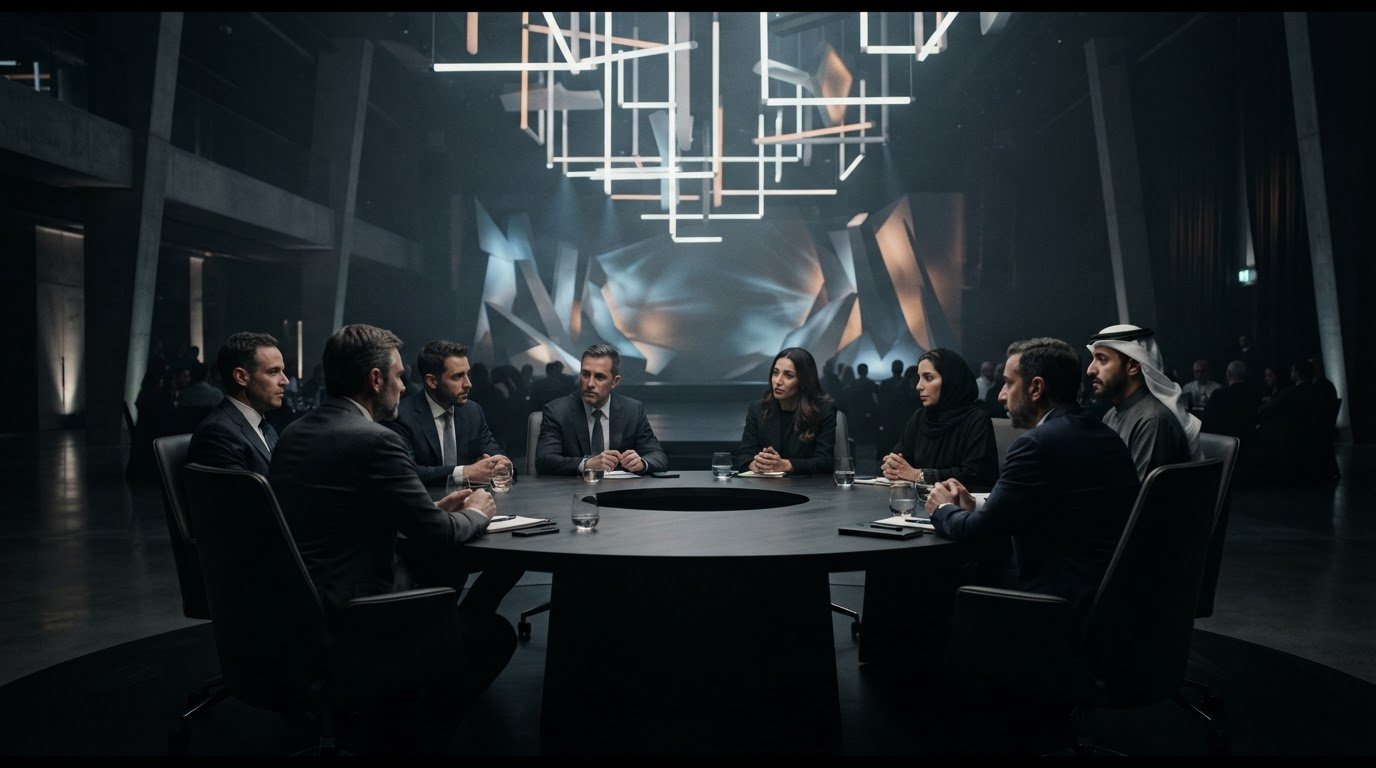
The most impressive executive event may be the one that knows when to end. The best event ideas to impress C-level executives do more than entertain: they create space for strategic decisions, peer exchange or a distinctive cultural experience, while respecting senior leaders’ time. Scale alone won’t make an event relevant.
A memorable format needs a clear purpose, a considered pace and delivery that feels effortless to guests. Behind the scenes, stakeholders, venue requirements and production needs must align. That balance turns an ambitious concept into an executive-worthy experience.
This guide compares formats such as roundtables, summits and curated cultural gatherings, assessing each against its purpose, audience and desired outcome. You’ll learn how to shape a concept around executive priorities, set expectations and plan for delivery. Lar&Co brings more than 20 years of experience in high-profile live entertainment, corporate events and cultural celebrations, where creative direction and precise production help bridge the gap between idea and execution.
Key Takeaways
• Choose event ideas to impress C-level executives by matching the format to a clear business purpose and the audience’s expectations.
• Compare leadership summits, strategy reveals, cultural experiences, immersive showcases and purpose-led gatherings by participation, production needs and location flexibility.
• Build an executive-ready brief around the objective, attendees, experience, constraints and decision-makers before committing to a concept.
• Test feasibility early, including venue, schedule, stakeholder and budget considerations, to reduce pressure during delivery.
• Creative direction, technical production, site management and financial oversight can help turn a promising concept into a coordinated event.
What makes an event idea impressive to C-level executives?
Senior leaders bring high expectations to a high-profile event. They want a clear reason to attend, a purposeful use of limited time and assured delivery. A striking venue or headline performance may draw attention, but neither can compensate for an event that lacks relevance or is poorly paced.
An impressive executive event connects a clear business purpose with an experience suited to its audience, then delivers that experience with care and precision. The concept might support strategic discussion, introduce a new direction or strengthen relationships. Its value lies in how well the format serves that aim, not in how lavish it appears. No event format can guarantee business results, but sound planning can make the purpose and experience coherent.
Event management is commonly framed as applying project-management principles to the planning and delivery of events. For executive gatherings, that means treating the creative concept and its practical execution as parts of one plan.
What do senior leaders expect from a high-profile event?
Start with the people in the room and the reason they are gathering. Consider their seniority, available time, familiarity with one another and desired level of participation. A peer discussion calls for a different pace from a formal announcement or cultural programme. A clear purpose helps attendees understand why they are there, while concise, well-paced content respects their attention.
Expectations aren’t uniform. Sector, culture, location and relationships between attendees all shape what feels appropriate and valuable. A gathering for established partners may invite open exchange; an event for a wider leadership group may need more structure. Confirm these details with stakeholders before settling on a format.
How can an event feel memorable without becoming a gimmick?
Give the creative idea a credible role. A distinctive setting can make a cultural celebration feel rooted in its location; an immersive showcase can help bring a strategy or product story to life. In each case, the experience should reinforce the objective rather than distract from it. The setting, content and atmosphere all need a reason to be there.
Novelty alone isn’t proof of engagement or commercial impact. Ask whether the idea helps guests understand, discuss or remember something relevant. Then check whether the schedule, site and production requirements support that experience. Strong concepts feel distinctive because each element serves a purpose.
Five event formats that can engage and impress executive audiences
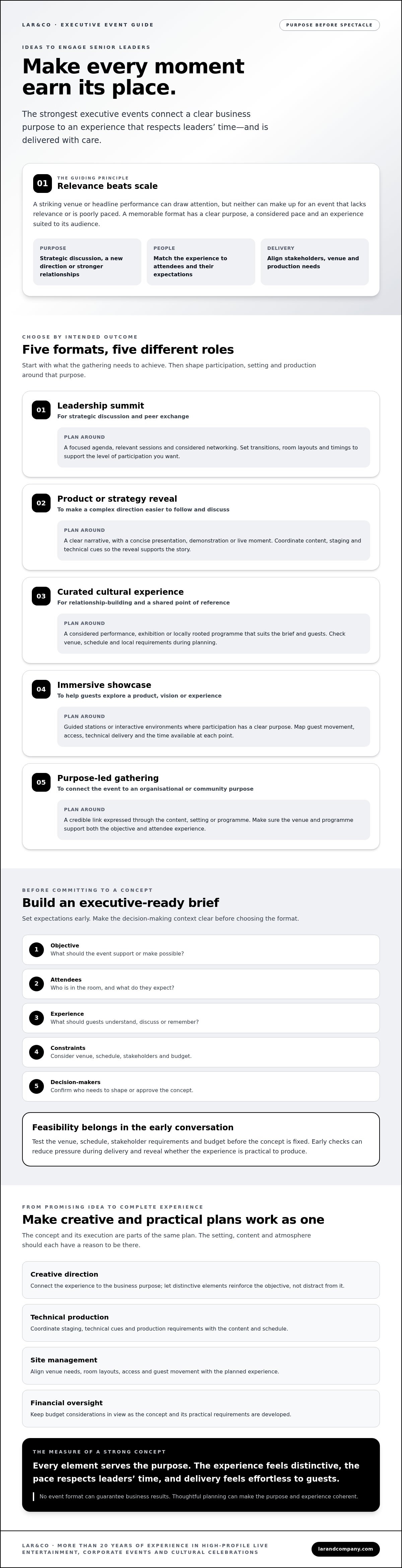
The strongest event ideas to impress C-level executives start with the intended outcome, not the spectacle. These five formats can be adapted to the audience, setting and business purpose. For each, define the role of the guest experience and resolve practical production needs early.
Leadership summit.
Best suited to strategic discussion and peer exchange. A focused agenda, relevant sessions and considered networking give leaders room to contribute. Plan transitions, room layouts and timings around the level of participation you want.
Product or strategy reveal.
Use a clear narrative to make a complex direction easier to follow and discuss. A concise presentation, demonstration or live moment can bring the message to life. Coordinate content, staging and technical cues so the reveal supports the story.
Curated cultural experience.
A performance, exhibition or locally rooted programme can support relationship-building and create a shared point of reference. Choose cultural elements with care and ensure they suit the brief and guests. Check venue, schedule and local requirements during planning.
Immersive showcase.
Guided stations or interactive environments can help guests explore a product, vision or experience. This format works best when participation has a clear purpose. Map guest movement, access, technical delivery and the time available at each point.
Purpose-led gathering.
Connect the event to a credible organisational or community purpose through its content, setting or programme. Make the link clear without turning it into a gesture for appearance’s sake. Consider how the venue and programme support the objective and attendee experience.
Which event ideas suit leadership alignment and strategic discussion?
A leadership summit or strategy reveal may suit an event focused on shared understanding or discussion. Shape the summit around a small number of purposeful sessions, with time for considered networking. For a reveal, use a carefully ordered narrative to help leaders engage with the direction and raise questions. These formats can support alignment, but they can’t guarantee agreement or better decisions.
Which formats create a distinctive shared experience?
A cultural celebration, immersive showcase or live performance can give guests a memorable shared moment when it serves the brief. Balance the central experience with opportunities to connect, and make participation feel natural. The right setting depends on local context, not assumptions about a city or its audience. In the UK, USA, United Arab Emirates, Saudi Arabia and Qatar, research the specific venue, cultural context and practical requirements for the location.
Lar&Co’s experience spans corporate events and bespoke cultural celebrations. Creative direction and production help connect a concept to its delivery. Explore Lar&Co’s production work for examples of its event experience.
How to compare executive event ideas before choosing a concept
The most spectacular concept isn’t automatically the most relevant. Compare event ideas to impress C-level executives against the purpose, audience and delivery conditions in the brief. A format that suits a focused leadership discussion may be wrong for a product reveal. There’s no single best choice for every executive audience.
Choose the concept that best serves the audience and objective, not the one that relies on novelty alone. Use this comparison as a starting point, then test each option against your specific requirements.
| Format | Primary objective | Participation | Production complexity | Location flexibility |
|---|---|---|---|---|
| Leadership summit | Strategic discussion and peer exchange | High, through sessions and discussion | Moderate, depending on programme and room set-up | High, if the venue supports focused conversation |
| Product or strategy reveal | Present a direction, offer or vision | Moderate, through questions or demonstrations | Moderate to high, depending on staging and technical cues | Moderate, shaped by venue and presentation needs |
| Curated cultural experience | Relationship-building and shared context | Low to moderate, depending on programme | Variable, based on venue and cultural elements | Moderate, with local research essential |
| Immersive showcase | Explore a product, story or vision | High, through guided or interactive elements | High, with guest flow and technical needs to coordinate | Moderate, depending on space and set-up |
| Purpose-led gathering | Connect the event to an organisational or community purpose | Variable, based on the programme | Moderate, depending on format and partners | High, if the setting supports the purpose |
Which criteria should shape the shortlist?
Assess strategic fit first. Then consider audience profile, timing, accessibility and the experience guests should have. Identify venue constraints, technical requirements, stakeholder approvals and delivery conditions before advancing a concept. Separate essentials from enhancements: a clear message or suitable access may be non-negotiable, while an additional performance may be optional.
How should teams balance ambition, feasibility and value?
Map each concept’s dependencies before committing. An immersive showcase may demand more technical coordination and site planning than a discussion-led summit. Ask who must approve decisions, what needs to be in place and where schedule or budget pressures could emerge. Financial management and transparent budget oversight help stakeholders understand trade-offs without losing sight of the intended experience. Retain elements that serve the objective; refine those that add complexity without clear value.
How to turn a promising event idea into a credible executive brief
A strong concept needs a clear route from intention to delivery. Before committing, define the objective, understand the attendees, shortlist suitable formats, test feasibility and agree how delivery will be assessed. This sequence keeps event ideas to impress C-level executives grounded in the brief, rather than letting production decisions lead the process.
What should an executive event brief include?
Make the brief concise enough to support decisions, but specific enough to guide planning. Set out:
Purpose and business context
why the event is taking place and what it needs to communicate or enable.
Audience
who is attending, their relevant needs and the level of participation expected.
Experience and core message
what guests should encounter, understand or have the opportunity to discuss.
Location and timing
the preferred setting, schedule and any confirmed constraints.
Stakeholders and approvals
who owns decisions, who needs to contribute and who signs off changes.
Success measures
practical indicators of delivery against the brief, such as whether planned sessions ran as intended or key content was presented.
Measures should reflect what the event team can assess. They can help evaluate delivery and attendee experience, but shouldn’t be presented as proof that the event will achieve wider business outcomes.
How can a concept be tested before production begins?
Review the creative proposal alongside site, technical and operational realities. A reveal that depends on precise lighting and presentation cues, for example, needs suitable venue infrastructure, a workable schedule and agreement on who supplies and approves the content. Technical production, site management and stakeholder coordination all affect whether the intended experience can be delivered as planned.
Test the concept in a practical sequence:
• Check venue suitability, access, technical requirements and guest movement.
• Identify dependencies, risks, decision deadlines and the people responsible for resolving them.
• Confirm local venue, cultural, accessibility and operational requirements with relevant parties. Mark anything not yet confirmed for verification.
• Separate essential production needs from optional enhancements, then review the plan against the available budget and approvals.
These checks are most useful while the concept can still be adjusted. Lar&Co’s technical production and site management capabilities can help connect the creative proposal to conditions on the ground.
Why expert show production turns an executive event idea into a complete experience
A strong concept is only the beginning. For an executive event to feel seamless to guests, its creative direction, technical production and site management need to work as one plan. Show production connects those elements, translating the intended experience into a schedule, production requirements and coordinated delivery.
That connection matters when an event involves multiple stakeholders, a detailed programme or a distinctive setting. Creative choices affect technical needs; technical choices affect the site plan and schedule. Clear responsibilities help keep decisions moving, while financial management gives stakeholders visibility over budget considerations and trade-offs. The aim is not complexity for its own sake, but disciplined delivery of the agreed experience.
What does an experienced production partner bring to the process?
A production partner can help develop a concept, clarify what it requires and coordinate delivery through the services agreed for the project. Technical production considers how the creative direction will work in practice, while site management addresses the event environment and on-site coordination. Artist liaison may also be relevant when a programme includes performers. Together, these capabilities help bridge an ambitious idea and an executable plan.
Lar&Co is an international show production practice with more than 20 years of experience across high-profile live entertainment, corporate events and cultural celebrations. Its work spans London and Los Angeles, as well as an international portfolio. Explore Lar&Co’s event production work to see the range of its experience.
When should an organisation speak to a show producer?
Speak to a producer early if the concept involves several decision-makers, locations or production requirements. Early discussion gives the team a chance to understand the objective, assess the scope and identify dependencies while the format can still be refined. It also helps establish which decisions need to be made, by whom and when.
For event ideas to impress C-level executives, production planning should support the purpose, not simply add technical scale. Share the event objective, audience, preferred experience, location and known constraints. From there, the production team can discuss the fit and requirements involved.
Turn the right concept into a confident experience
The strongest event ideas to impress C-level executives are built around a clear purpose, a well-understood audience and delivery that respects their time. Choose the format that fits the brief, not simply the one that makes the biggest impression on paper. Then test its practical requirements before fixing the concept.
A credible executive brief gives the production team a clear starting point: the objective, attendee experience, location, constraints and decision-makers. Early coordination across creative direction, technical production and site management connects the ambition to the realities of delivery. Success measures should assess how well the event meets its brief, without promising wider business results.
Lar&Co brings more than 20 years of experience delivering complex live entertainment projects. With primary offices in London and Los Angeles, its capabilities include show production, technical production, site management and creative direction. If you’re planning an executive event in the UK, USA, United Arab Emirates, Saudi Arabia or Qatar, share your objective, audience and known constraints with the Lar&Co team to discuss your brief.
Frequently Asked Questions
What type of event impresses C-level executives most?
No single format impresses every executive audience. A leadership summit may suit peer discussion, while a product reveal can focus attention on a new offer or direction. Start with the reason leaders are being brought together, then choose a format that respects their time and invites the right level of participation. The best event ideas to impress C-level executives connect that purpose to a well-considered guest experience and confident delivery.
How do you make a corporate event memorable for senior leaders?
Make the experience distinctive for a reason. A considered setting, well-paced programme or relevant cultural moment can give guests something meaningful to share and remember. Keep the event focused, with space for conversation and no unnecessary transitions. Check that each creative element supports the objective and suits the audience. A memorable experience comes from coherence and attention to detail, not simply from adding more spectacle.
Can an executive event be engaging without a celebrity speaker?
Yes. A celebrity speaker is only one possible element, and isn’t essential to audience engagement. A well-facilitated discussion, thoughtful demonstration, live performance or interactive showcase can give attendees a reason to participate. When relevant topics such as workplace culture or strategic vision are central to the agenda, organisers can explore Keynotes that focus on substance rather than star power. Choose based on what guests need to understand, discuss or experience. If the programme includes performers, consider artist liaison and technical requirements early, so their contribution is integrated into the event rather than feeling like a separate attraction.
How do you choose between a leadership summit and a product launch?
Choose a leadership summit when the priority is strategic discussion, peer exchange or exploring a shared challenge. A product launch is better suited to presenting an offer, demonstration or announcement. Consider whether attendees should mainly contribute to a conversation or take in a clear message. That distinction can shape the agenda, venue and production approach. If both aims matter, decide which is primary before combining formats.
How can you tell whether an event idea is too ambitious?
An idea may be too ambitious if essential venue, technical or operational requirements remain unclear, or if its dependencies cannot be resolved within the available schedule, budget or approval process. Test the concept against the site, attendee movement, production needs and decision deadlines. Separate must-haves from optional enhancements. If removing an elaborate element leaves the core purpose intact, reconsider whether its added complexity is justified.
When should a show producer be involved in planning an executive event?
Bring a show producer into the conversation while the concept is still taking shape, especially if it involves multiple stakeholders, locations or complex technical and site requirements. Early input can help test feasibility and clarify production needs before decisions become difficult to change. Lar&Co is an international show production practice with more than 20 years of experience in complex live entertainment projects, with primary offices in London and Los Angeles.