Event Management Skills for Confident High-Stakes Planning
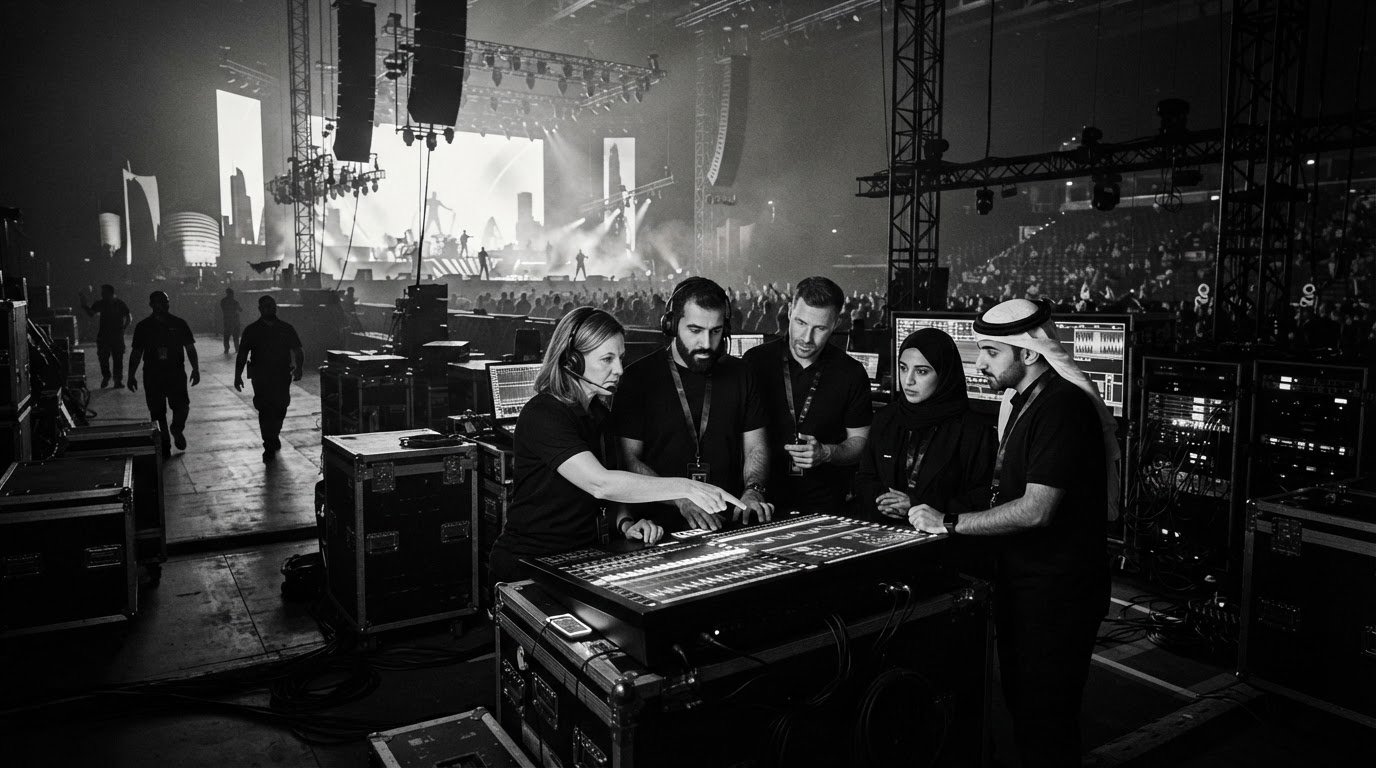
The defining skill in high-stakes event management is not simply keeping to a schedule. It is making sound decisions when people, priorities and production depend on one another. Strong event managers combine risk planning, stakeholder alignment, budget and resource control, clear communication, supplier coordination and calm problem-solving. They also turn near misses into practical improvements.
That breadth matters. A plan can look complete on paper and still falter if responsibilities are unclear, a supplier dependency shifts or a stakeholder’s needs are missed. Confidence comes from connecting the moving parts before they become urgent.
This guide explains which event management skills help teams plan for risks, align goals and resources, coordinate suppliers and learn from near misses. You’ll see how to apply them throughout the planning process, from setting clear objectives and assigning responsibilities to preparing for disruption and reviewing the outcome. The focus is practical: keeping decisions, people and production working towards the same result.
Key Takeaways
• Build risk planning into the event brief, then define clear triggers, decision-makers and first actions for priority scenarios.
• Use a structured review to examine objectives, timing, guest feedback and near misses while details are still fresh.
• Set objectives, audience and key messages before shaping the guest list, budget and task ownership.
• Map vendor dependencies against the production timeline so changes in one area don’t catch other teams unprepared.
• Strengthen delivery through stakeholder awareness, concise communication and calm decisions when plans shift.
1. Early risk planning during event concept development
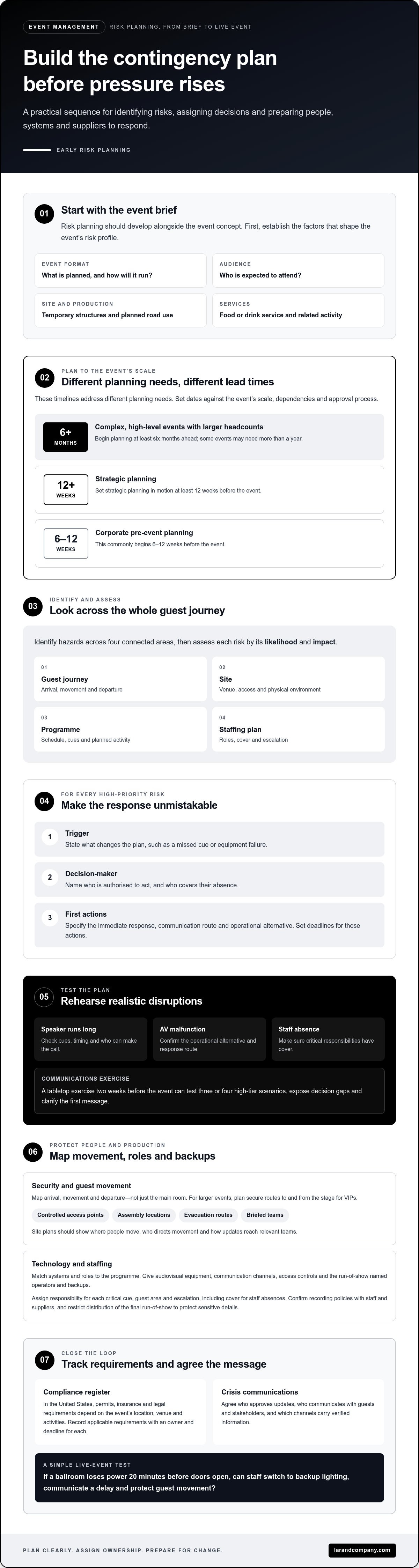
For high-stakes event management, risk planning starts with the event brief and develops alongside the concept. In the United States, permits, insurance and legal requirements depend on the event’s location, venue and activities. Record applicable requirements in a compliance register, with an owner and deadline for each. Consider the event format, expected audience, temporary structures, planned road use and any food or drink service.
Build the corporate event checklist around decisions that shape the risk profile. Complex, high-level events with larger headcounts should begin planning at least six months ahead; some may need more than a year. Corporate pre-event planning commonly begins 6-12 weeks before the event, with strategic planning at least 12 weeks before it. These timelines serve different planning needs, so set dates against the event’s scale, dependencies and approval process.
How do you assess risks and create a contingency plan? Identify hazards across the guest journey, site, programme and staffing plan, then assess their likelihood and impact. For each high-priority risk, define its trigger, the decision-maker and the first actions. Set deadlines for those actions and rehearse realistic scenarios, such as a speaker running long, an audiovisual malfunction or staff absence.
Trigger
State what changes the plan, such as a missed cue or equipment failure.
Decision-maker
Name the person authorised to act and the person covering their absence.
First actions
Specify the immediate response, communication route and operational alternative.
Security planning should map guest arrival, movement and departure, not just the main room. For larger events, plan secure routes to and from the stage for VIPs. Include controlled access points, assembly locations and evacuation routes in site plans; brief relevant teams on who directs movement and how updates reach them. A ballroom losing power 20 minutes before doors open is a useful test: can staff switch to backup lighting, communicate a delay and protect guest movement?
What technology and staffing are needed to run a high-stakes event? Match systems and roles to the programme: audiovisual equipment, communication channels, access controls and a run-of-show all need named operators and backups. Assign responsibility for each critical cue, guest area and escalation, including cover for staff absences. Confirm recording policies with staff and suppliers, and restrict distribution of the final run-of-show to protect sensitive details.
How should organisers manage crisis communications and reputational risk during an event? Agree who approves updates, who communicates with guests and stakeholders, and which channels carry verified information. A tabletop exercise two weeks before the event can test three or four high-tier scenarios, expose decision gaps and clarify the first message before pressure rises.
Permits, insurance coverage and legal obligations vary with the event’s location, venue and activities. Assess the format and audience, temporary structures, road use, and food or drink service. Then assign each applicable requirement an owner and deadline in the compliance register.
2. Post-event reviews and learning from near misses
A strong review turns an event into evidence for the next decision. Reconvene core stakeholders within 48 hours, while details remain fresh. Include people responsible for programme delivery, site operations, security, guest experience and communications. Ask each person to distinguish direct observations from assumptions. That discipline helps the team identify what happened, why it happened and what should change.
Use a consistent review agenda rather than relying on an informal conversation. Assess whether the event met its stated objective, where timing slipped, whether there were security concerns and whether guest feedback matched the intended tone. Compare the final run-of-show with actual timings. If a speaker overran, for example, establish whether the cause was a late start, an unclear cue or a missing timekeeper. Assign an owner and a practical action to each finding.
Near misses deserve the same attention as visible failures. A guest queue that briefly blocked an access route, a delayed technical cue or a staff member covering an unassigned role can reveal weak controls. Record what happened, the surrounding conditions, the response and the potential consequence. Do not treat a fortunate outcome as proof that the plan worked. Ask which barrier prevented escalation and whether it would hold again.
Record
Capture the time, location, people involved and operational impact.
Analyse
Separate the immediate cause from contributing factors, such as unclear ownership or a late change.
Act
Name the responsible person, set a deadline and update the relevant procedure.
Gather attendee input within a day or two, while impressions remain clear. Send a post-event survey within 48 hours, with focused questions on access, communication, programme flow and overall satisfaction. Keep responses tied to decisions: if guests report confusion at arrival, compare their comments with signage, steward positions and entry timings. A concise survey is more useful when each answer can inform a specific adjustment.
Separate immediate review from fuller post-event reporting. Complete operational follow-up during the first 1-2 weeks after the event, then consolidate attendance, engagement and satisfaction measures. Track those results against the original objective, not just the planned schedule. If the event aimed to strengthen relationships, assess relevant attendee feedback and agreed follow-up actions alongside attendance.
For events intended to drive lead conversion, renewal or product adoption, schedule follow-up at 30 and 90 days after the event. Compare outcomes with the event’s stated aims and record what changed between those checkpoints. Thank-you notes should go within 24 to 48 hours after the event. Close the review by sharing decisions, owners and deadlines, so lessons lead to changes before the next event happens.
3. Strategic goals, guest lists, budgets, and timelines
Start with the decision the event must support. Before choosing a venue or format, define its objective, target audience and key messages. A leadership gathering might aim to align executives around a strategic change. A product launch might introduce a new offer to selected guests. Make the intended outcome specific enough to guide later choices and measure results.
Build the guest list around that objective. Identify whose presence supports the desired outcome, then group invitees by role, relationship or access needs. For a private leadership event, distinguish decision-makers from contributors and essential operational contacts. This gives the planning team a clear basis for invitations, seating, access arrangements and communications. It also keeps attention on guests who advance the event’s purpose.
Translate the objective into a budget and a task plan. Forecast costs against the required programme, venue, production, staffing and guest experience. Set aside 10% to 15% of the event budget for contingencies, then define who can approve its use. Track commitments as well as payments: an unrecorded supplier change can affect both the available funds and the delivery plan.
Objective
State the outcome and the evidence that will show whether the event achieved it.
Budget
Assign each cost to a category, owner and approval step; reserve contingency funds.
Responsibility
Name one accountable person for every key task and deadline.
A financial event project plan should show key tasks, due dates and the person responsible for each. Work backwards from the event date, placing approvals before commitments and delivery milestones. Smaller high-level events with 20 to 50 guests can often be organised within six to eight weeks. The schedule still depends on venue, programme and stakeholder decisions, so identify dependencies before setting internal deadlines.
Make the timeline useful in practice. Mark when the guest list closes, invitations go out, suppliers need final information and leadership approvals are due. If a board retreat depends on executive diaries, treat attendance confirmation as a critical task, not an administrative detail. A missed decision can affect venue capacity, catering and the programme at once.
Review the plan at each major decision point. Compare the current budget with approved commitments, check whether the guest mix still serves the objective and flag tasks at risk of delay. Financial management brings these threads together, connecting resource decisions with delivery priorities. This discipline helps teams respond to change without losing sight of the event’s strategic purpose.
4. Vendor coordination and production dependencies
A production schedule works only when each supplier understands what must happen before their work can begin. Create a dependency map linking venue access, staging, power, audiovisual systems, transport and programme cues. Name an owner for every hand-off. If a lighting test depends on the stage build, record completion of the build as a prerequisite, not an assumption.
Set vendor milestones early. One event timeline places vendor coordination 8-10 weeks before the event; another recommends coordinating logistics and vendors 4-6 weeks beforehand. Treat these as planning stages, not competing deadlines: establish responsibilities and dependencies first, then resolve operational details closer to delivery. For a corporate event, confirm speakers’ availability and technical requirements 6 weeks before the event.
Give each supplier a shared production brief covering the event format, access arrangements, delivery windows, technical specifications and escalation contact. Use a single version-controlled schedule so changes reach every affected team. If a speaker’s presentation changes, for example, the production team can assess the impact on playback, lighting cues and stage timing before doors open. Record who approves changes and how updates reach on-site staff.
Transport needs the same coordination. Map arrival points, vehicle access, guest entry and equipment movement between unloading and the event space. For a public event, separate guest flows from supplier deliveries wherever the venue layout allows. If a VIP arrival coincides with a loading window, set a clear sequence and communication route. Build the schedule around venue restrictions and programme needs, rather than treating arrival as a single time on a spreadsheet.
The World Cup illustrates how event delivery can depend on organisations beyond the core production team: organisers may engage football clubs for stadiums and government agencies for security resources. Identify external dependencies, their decision-makers and the information each needs. Confirm which team owns each approval, access requirement or operational hand-off.
Before delivery
Match supplier deadlines to venue access and technical setup.
During delivery
Use one control point to communicate schedule changes and confirm their impact.
For speakers
Align arrival, rehearsal, presentation files and stage cues with the run-of-show.
On site, hold a production briefing against the current schedule. Confirm who can authorise a change, which teams need to know and how the change affects other tasks. A clear dependency map shows what is complete, what remains outstanding and where a delay could spread. That visibility helps teams protect the public-facing programme while maintaining control of operational details.
5. Event management skills
High-stakes events need more than a strong schedule. Essential skills include judgement, stakeholder analysis, clear communication, financial awareness and calm operational leadership. Together, they help teams protect the audience experience while keeping delivery aligned with the event’s purpose. A capable manager sees when one decision affects several teams and makes the consequences clear.
What types of events require high-stakes event management? Events with sensitive stakeholders, complex production, public visibility or little tolerance for disruption may need this approach. Examples include leadership meetings, major product launches, diplomatic gatherings and large public events. Scale alone does not determine complexity: a 60-person leadership retreat can carry distinct reputational or strategic risks.
Stakeholder analysis is a core skill. Identify who can influence the event, who it affects and whose needs shape its success. Prioritise those stakeholders and communicate progress against clear expectations. At a high-stakes meeting, observe who commands attention, whom others defer to and which ideas gain support. Listening before intervening helps a manager understand the room’s dynamics.
Communication must work under pressure, too. Concise updates help teams distinguish confirmed decisions from emerging issues. If tension rises during a meeting, a well-timed pause can give participants room to absorb a point. A leader can then refocus the discussion on a shared objective, invite a quieter stakeholder to contribute or clarify the decision needed.
Judgement
Weigh urgency, impact and available options before committing to a response.
Coordination
Make responsibilities and hand-offs visible across teams.
Adaptability
Adjust delivery when conditions change without losing sight of the event’s purpose.
Learning
Treat near misses as evidence of where a process needs improvement, not as proof that failure was inevitable.
How do event management companies compare for high-profile or mission-critical events? Assess how clearly each can connect strategic goals, financial decisions, production dependencies and on-site responsibilities. Look for a coherent approach to decision-making, communication and learning from disruptions, rather than judging capability by event scale alone. For a programme involving 2,000 attendees across multiple venues, coordination across locations is a key test.
Ultimately, strong managers turn pressure into clear priorities. They listen, make decisions at the right level, communicate changes and keep the audience’s experience in view. To discuss the delivery needs of a complex live event, start a conversation with Lar&Co.
Lar&Co: Show Production
Lar&Co supports complex live events through Show Production, Technical Production, Site Management and Creative Direction. These offerings suit projects where creative intent, technical delivery and site operations must work together as one production. Turn to Lar&Co when an event’s scale or profile calls for coordinated production planning, from shaping the show to managing its on-site delivery. Clear roles and joined-up decisions help teams keep the audience experience and operational requirements in view. For a high-profile event with multiple production dependencies, this is a practical next step after defining its goals, risks and responsibilities. Contact Lar&Co to discuss your event.
Set the standard for your next event
The next step is to turn the event’s ambitions into a brief that gives every decision a clear purpose. Define what success should look and feel like for your audience, then align the experience, production and operational priorities around that intention. This is where high-stakes event management moves from preparation to considered delivery: not by removing every variable, but by giving the team a shared direction when circumstances change.
When creative vision and complex delivery must come together, Lar&Co brings together Show Production, Technical Production and Site Management. These disciplines support different parts of the work, from shaping the show to coordinating its technical and site requirements. Start with a focused conversation about your event’s goals, audience and production demands.
Contact Lar&Co to plan your event. A clear brief is the beginning of a confident, well-executed experience.
Frequently Asked Questions
What Skills Are Required For Event Management?
Event managers need organisation, communication, judgement, negotiation and financial awareness. The most effective professionals connect these skills rather than relying on one strength. A last-minute programme change, for example, calls for calm decision-making, clear supplier communication and an understanding of its budget impact. Cultural awareness also matters when guests, speakers and teams bring different expectations to an event.
What are the Essential Steps in the Event Management Process?
Start by defining the event’s purpose and the audience it must serve. Develop a brief, confirm the format, then map the people, approvals and resources needed to deliver it. Coordinate planning, production and guest communications around shared decisions. After the event, assess whether the experience met its intended purpose and record improvements. Use the brief as the reference point when priorities compete.
What is high-stakes event management?
High-stakes event management is the structured planning and delivery of events where disruption could have serious operational, reputational or audience consequences. It brings decision-making, production and stakeholder needs into one coordinated approach. A televised cultural celebration, for instance, may require precise timing and consistent messaging across multiple teams. The defining factor is the consequence of failure, not simply the event’s size.
What are the essential steps for planning a high-stakes event?
Translate the purpose into a brief that identifies the audience, desired experience and decisions requiring approval. Establish who owns each workstream and how teams will communicate changes. Build the programme around venue and production requirements, and test transitions before event day. Keep a clear record of decisions and their owners so new team members can understand why plans were made.
What security, crowd-control, and emergency-response measures are required?
Measures should reflect the venue, audience profile, event format and applicable local requirements. Plan how people enter, move through and leave each space, including accessible routes and emergency exits. Establish who can pause activity, who communicates instructions and how staff escalate an incident. For a public event, brief stewards on their positions and use clear signage to direct guests without obstructing emergency routes.
How much does high-stakes event management cost, and what drives the price?
The price depends on the project and is provided after a quote request. Key cost drivers include the event format, venue needs, production complexity, programme, staffing and delivery schedule. A multi-site event has different coordination demands from a single-venue gathering. A defined brief helps establish which elements are essential, where resources are needed and how changes may affect the overall production plan.
How do venue, weather, accessibility, and local regulations affect event planning?
Each factor affects how guests and teams use the site. In the UK, United States, United Arab Emirates, Saudi Arabia and Qatar, organisers need to account for relevant local authority and venue requirements. Assess access routes, transport, shelter, power and the needs of guests with disabilities. For an outdoor event, define how the programme, guest movement and site operations will adapt to changing weather.
What metrics should be used to evaluate the success of a high-stakes event?
Choose measures that reflect the event’s stated purpose, rather than relying on attendance alone. A leadership gathering might assess whether participants reached agreed decisions; a public launch might examine audience understanding and follow-up actions. Also record programme deviations, operational issues and how quickly teams resolved them. Compare the evidence with the original brief, then assign owners to any improvements needed for future events.