Event Supplier Fails: A Practical Response Plan

A failed supplier doesn’t automatically put the whole event at risk. The first move isn’t to rush into a replacement. Establish exactly what has failed, when the impact begins and which show moments depend on that supplier. If you’re deciding what to do when your event supplier fails, protect the critical path before committing to a substitute.
The pressure to act is immediate, but replacing a supplier without understanding schedule, technical and site dependencies can create further disruption. Keep safety, budget, contractual exposure and stakeholder confidence in view, and distinguish urgent failures from issues that can be managed within the existing plan.
This guide sets out a practical response: verify the situation, assess what’s affected and prioritise the elements the event cannot proceed without. You’ll learn how to compare replacing a supplier with adapting the plan or escalating the issue, while keeping relevant contract terms and financial implications in view. The focus is on coordinating stakeholders, timelines and workable alternatives, then using the experience to strengthen resilience for future events.
Key Takeaways
• When deciding what to do when your event supplier fails, bring the right people together for a focused fact-finding huddle and record what is confirmed.
• Map dependencies to identify which deliverables sit on the critical path, then distinguish essential outcomes from production choices that can change.
• Compare a workaround, replacement, reduced scope, postponement or cancellation against feasibility, timing, safety and impact.
• Use a clear sequence of decisions and communications, with one lead authorised to prevent conflicting instructions and commitments.
• Turn the incident review into owned actions, stronger milestones and proportionate contingency plans for critical deliverables.
Supplier Fails: Establish the Facts First
A missed milestone is a warning, but it isn’t proof on its own that a supplier can’t deliver. Before changing the plan, establish whether the work is delayed, partly complete or confirmed as unavailable. If you’re deciding what to do when your event supplier fails, start with a clear picture of the failure, not the pressure to find a replacement.
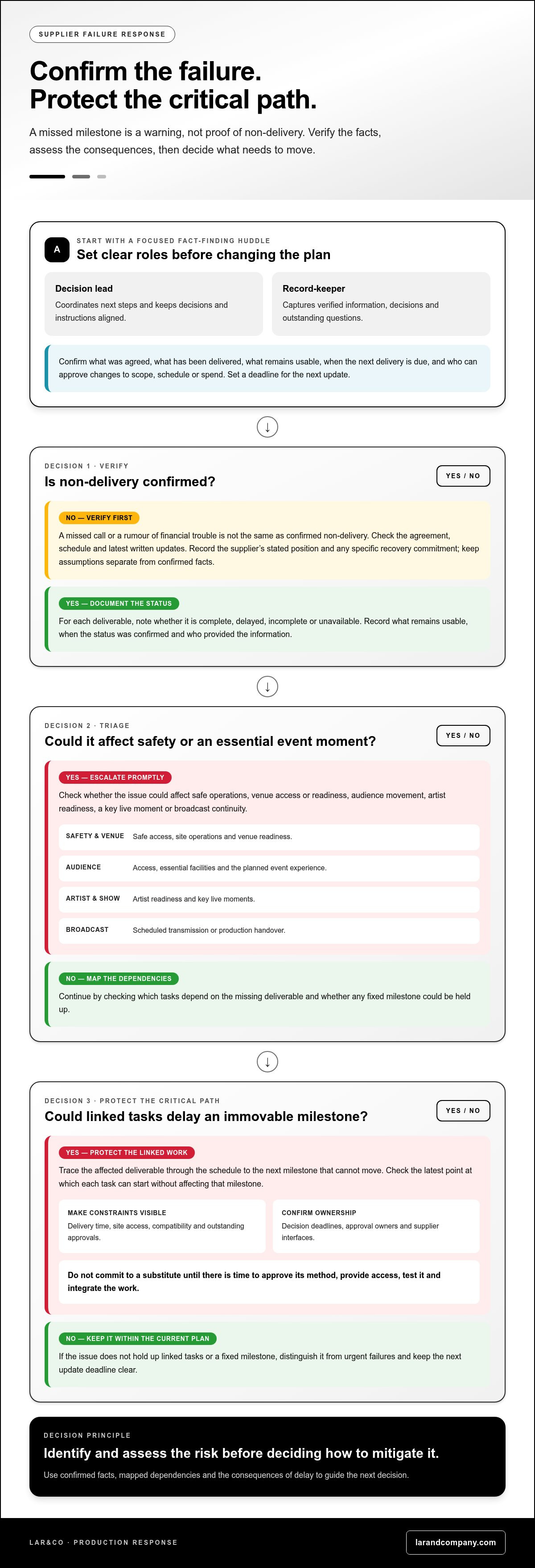
Bring the relevant production leads together for a focused fact-finding huddle. Assign one decision lead to coordinate next steps and one record-keeper to capture verified information, decisions and outstanding questions. Confirm what was agreed, what has been delivered, what remains usable, when the next delivery is due and who has authority to approve changes to scope, schedule or spend. Set a deadline for the next update so the team knows when the facts will be reviewed again.
Check immediate implications before exploring alternatives. Could the issue affect safe operations, venue access, audience movement, artist readiness or broadcast continuity? A concern that touches safety or an immovable show moment needs prompt escalation. Keep the response disciplined: a supply chain risk management approach begins with identifying and assessing the risk before deciding how to mitigate it.
How do you confirm that an event supplier has actually failed?
Separate what’s known from what’s assumed. A missed call or a rumour of financial trouble isn’t the same as confirmed non-delivery. Check the agreement, schedule and latest written updates, then record the supplier’s stated position and any specific recovery commitment. Note which deliverables are complete, delayed, incomplete or unavailable, when each status was confirmed and who provided the information.
Before changing the production schedule, ask the lead responsible for the affected area to verify dependencies. A late technical file, for example, may affect a rehearsal or systems test even if the equipment or crew is already on site. Record the link between the missed item and the next task it could hold up, along with the latest point at which that task can start without affecting a fixed milestone.
Which event deliverables need immediate escalation?
Prioritise issues by consequence and timing, not by how loudly they’re being reported. Safety-critical and venue-critical functions come first, followed by time-sensitive elements that affect the show or its audience. Map each affected deliverable against the production schedule and identify the next milestone that cannot move.
Safety and venue
assess any issue that could affect safe access, site operations or venue readiness.
Audience
escalate impacts on access, essential facilities or the planned event experience.
Artist and show
flag anything that could compromise artist readiness or a key live moment.
Broadcast
assess whether a delay could interrupt a scheduled transmission or production handover.
This triage gives the decision lead a sound basis for the next step. It also keeps updates consistent: teams can act on confirmed facts, while unresolved questions remain clearly marked for follow-up.
Protect the event critical path before choosing a replacement supplier
Once the failure is verified, resist the urge to replace the supplier immediately. First identify the critical path: the linked tasks whose delay could affect essential event delivery. A substitute may be technically capable but still unusable if there’s no time to approve their method, provide access, complete a test or integrate their work with other teams.
This is the practical answer to what to do when your event supplier fails: understand what the missing deliverable holds up, then protect the outcomes that matter most. A production schedule is more than a list of dates. It shows sequence, dependencies and decision points. Review it alongside the build plan, rehearsals and show-call milestones before changing scope.
How can you identify the show’s critical path?
Start with the latest agreed production schedule. Ask the relevant technical and site leads which tasks depend directly on the failed deliverable, then trace those dependencies through to the next immovable milestone. For example, a delayed technical design approval may affect equipment preparation, installation, testing and rehearsal. Replacing the original supplier won’t solve the problem if there isn’t enough time for those linked steps.
Mark the deadline for each decision and the consequence of missing it. Include approval owners, supplier interfaces and site access windows. This makes the real constraint visible: the issue may be delivery time, access, compatibility or an approval that’s still outstanding. Check that the schedule reflects the latest confirmed information, rather than relying on assumptions carried forward from an earlier plan.
What should remain protected when scope has to change?
Separate must-deliver outcomes from production choices and enhancements. Protect safe operations, audience experience and essential creative intent wherever practicable. Then identify what can be simplified without undermining the core show. A scenic detail might be reduced, for instance, while keeping the stage configuration needed for performers and technical operations.
Before changing scope, map who needs to approve the change and which other teams it affects. A revised lighting plan may alter power requirements, rigging, cueing or rehearsal time. Technical direction and site management help bring these operational dependencies into view, so a proposed alternative is assessed as part of the whole production rather than in isolation. For further context on contingency planning, North Carolina State University’s Enterprise Risk Management Initiative outlines the value of preparing for disruption in advance.
Keep the decision anchored to feasibility, not preference. If an alternative can’t be approved, accessed, installed and tested in time, it isn’t a workable recovery option. Lar&Co’s show production work reflects the coordination required to connect creative intent with technical and site realities.
Replace, adapt or cancel: compare event supplier recovery options
Once the critical path is clear, compare recovery options against the same measures: feasibility, time, quality, safety, cost exposure and effect on essential outcomes. The best answer to what to do when your event supplier fails may be a replacement, but only if the work can be completed and integrated in time. A substitute’s headline capability doesn’t prove they have the capacity, approvals, access or technical compatibility your production requires.
| Option | Best considered when | Key test |
|---|---|---|
| In-house workaround | The team can safely absorb a defined part of the work. | Are skills, capacity and authority available without compromising other tasks? |
| Replacement supplier | The failed scope is essential and there’s time to integrate a substitute. | Can delivery, access, approvals, testing and sign-off fit the schedule? |
| Reduced scope | Core outcomes can be preserved with a simpler approach. | Does the change maintain safe operations and essential creative intent? |
| Postponement | A critical requirement can’t be met on the current date, but later delivery may be viable. | Can stakeholders, venue and schedule be realigned? |
| Cancellation | Safe or essential delivery conditions can’t be met through a workable alternative. | What do the relevant agreements, policies and governing rules say? |
When is a replacement supplier a realistic option?
Assess the exact failed scope, not a supplier’s general offer. Confirm the remaining lead time, crew and equipment requirements, site access, approvals and technical interfaces. Then allow for onboarding, installation or delivery, testing and sign-off. A replacement can appear capable yet still be unworkable if one of these steps misses a fixed rehearsal, build or show-call milestone.
Compare the replacement against the same written requirements as the original scope. List what must be delivered, what can be adapted, who will approve the work and which interfaces need to be coordinated. For broader event-planning context, you can consult professional event resources to sit alongside your operational assessment.
When should you adapt scope, postpone or cancel?
Reduce scope when the essential experience remains safe and deliverable, and the revised plan has clear approval. Consider postponement or cancellation if critical safety or delivery conditions can’t be met. Before deciding, review the applicable contract and insurance terms, and seek appropriate advice where needed. Rights, exclusions and consequences vary by agreement and jurisdiction.
For wider operational context, explore Lar&Co’s show production work, where schedule, technical and site considerations meet in complex live projects.
A step-by-step event supplier failure response for the production team
A clear sequence keeps recovery decisions controlled and prevents several teams from issuing conflicting instructions. Give one person authority to lead the response and assign one person responsibility for the shared status log. The log should show the decision, owner, deadline, current status, assumptions and outstanding risks, so the production team works from the same record.
Stabilise
address any immediate safety or operational concern and pause instructions that could create conflicting commitments.
Verify
record the supplier’s confirmed position and the deliverables affected.
Assess
identify schedule impacts, dependencies and the deadline for choosing a response.
Decide
select an authorised recovery option and record why it is workable.
Communicate
issue consistent updates through named points of contact.
Document
retain relevant decisions, communications, revised commitments and supporting records.
Review
assess the result and assign actions to reduce the risk of a repeat failure.
What should the first response meeting cover?
Keep the meeting focused on the failure, affected deliverables, immediate mitigations and the deadline for a decision. Bring in production, technical, site, finance and client decision-makers as relevant to the issue. Before closing, name the action owner, confirm who can approve changes and set the next review point. The meeting is there to align decisions, not to generate parallel conversations with suppliers.
For complex productions, one decision lead should control revised instructions to the affected supplier. Other team members can gather information and assess impacts, but they should route proposed changes through that lead. This prevents conflicting scope, schedule or budget commitments.
How should you communicate the recovery plan?
Tell each affected stakeholder what’s confirmed, what remains uncertain, what action is under way and when the next update will come. Be precise without promising an outcome that hasn’t been secured. Give every supplier one authorised point of contact, and circulate approved changes in a form the team can refer back to.
Track revised commitments and budget impacts in the same controlled record, with finance involved where appropriate. Keep any attempt to recover costs or make an insurance claim subject to the relevant contract, policy wording and applicable advice. The terms and processes can vary, so preserve records and avoid presenting a particular outcome as assured.
Lar&Co provides production management that coordinates stakeholders, timelines and deliverables. Contact Lar&Co about production management.
Prevent repeat supplier failures with stronger production oversight
A supplier incident is only useful as a lesson if it changes how the next production is managed. Review where warning signs, dependencies or decision routes were unclear, then turn those findings into actions with named owners and review dates. The aim isn’t to eliminate every risk. It’s to make critical dependencies visible and give the team a workable response if a supplier can’t deliver.
What belongs in a practical supplier contingency plan?
Keep the plan focused on critical deliverables. For each one, record who owns the dependency, what milestone could be affected, what event triggers escalation and which alternatives could realistically protect essential delivery. A backup option should be more than a name on a list: note the conditions that would make it workable, such as access, approvals or time for testing.
Build these checks into the production schedule and risk register, then revisit them as the event develops. A plan made during early planning may no longer fit once the venue, schedule or technical design changes. Agree in advance who raises an issue, who makes the decision and who communicates approved changes. That clarity reduces delay when pressure rises.
How can experienced production oversight support recovery?
Integrated production management connects stakeholders, schedules and deliverables from concept through completion. Technical direction can assess whether a proposed alternative will work with the production design and its interfaces. Site management brings access, sequencing and on-site constraints into the same decision. Financial oversight helps track commitments and budget implications alongside operational choices.
For international events, include local delivery conditions, time-zone differences and relevant contract terms in the planning picture. A schedule that works in one location may depend on different access arrangements or approval routes elsewhere. This matters for productions in the UK, USA, United Arab Emirates, Saudi Arabia and Qatar, as well as other international locations. Contractual and insurance implications vary by agreement and jurisdiction, so treat them as project-specific considerations rather than assumptions.
Lar&Co has more than 20 years of experience in complex live entertainment, with an international portfolio spanning tours, festivals, cultural celebrations and corporate events. Explore Lar&Co’s project portfolio to see the range of work. For a complex live project, Lar&Co’s show production, technical direction, site management and financial oversight bring creative and operational considerations into one coordinated plan.
When considering what to do when your event supplier fails, strong oversight makes the response more structured. Clear dependencies, decision ownership and proportionate alternatives help protect essential delivery and leave the next production better prepared.
Build resilience into the next production
A supplier failure calls for clear priorities, not a rushed replacement. Verify what has happened, protect the event’s critical path, then choose the recovery option that best preserves essential outcomes. A single decision lead and a reliable status record help keep teams aligned as plans change.
Knowing what to do when your event supplier fails is also a matter of preparation. Use the incident review to clarify dependencies, decision owners and escalation routes before the next production begins. The right production oversight brings technical, site and financial considerations into one coordinated view.
Lar&Co brings more than 20 years of experience across complex live entertainment projects, with an international practice based in London and Los Angeles. Its capabilities span show production, technical direction, site management and financial oversight. For production support across the UK, USA, United Arab Emirates, Saudi Arabia and Qatar, discuss your event with Lar&Co.
With a clear plan and experienced coordination, your team can face disruption with greater control and keep the focus on delivering a considered event.
Frequently Asked Questions
Is an event supplier legally responsible if they fail to deliver?
Possibly, but responsibility depends on the contract, the circumstances, applicable law and any relevant insurance terms. Keep the agreement, written changes, delivery records and communications together, then seek advice from a qualified professional in the relevant jurisdiction. A missed commitment doesn’t automatically mean reimbursement or a particular remedy is guaranteed. In parallel, stabilise event operations and maintain a separate, factual record of the potential contractual issue.
What should I do first when an event supplier cancels?
Confirm the cancellation and identify exactly which deliverables are affected. Then establish the next critical deadline, appoint one decision lead and bring in the production and technical leads who understand the dependencies. If you’re asking what to do when your event supplier fails, compare feasible options before committing: a replacement, an in-house workaround, reduced scope, postponement or cancellation. Record decisions centrally, and assess schedule, access, safety and technical compatibility first.
Can you replace an event supplier at short notice?
Sometimes, but a replacement is useful only if it can deliver the required scope within the time available. Assess capacity, crew and equipment needs, site access, approvals, technical integration and testing against the production schedule. A similar service description doesn’t establish that the supplier can meet your event’s specific requirements. If the work can’t be onboarded and signed off in time, consider a controlled scope change or another recovery option.
What should an event supplier contingency plan include?
Include critical deliverables, dependency owners, milestone dates, decision triggers, escalation routes and workable alternatives. Distinguish essential outcomes from elements that could be adapted, and set review points against the live production schedule so the plan stays current. For events in the UK, USA, United Arab Emirates, Saudi Arabia or Qatar, account for local operating conditions and have relevant contract or insurance questions reviewed for the applicable jurisdiction.
How do you recover money from an event supplier that failed?
Start by gathering the contract, invoices, agreed scope, correspondence and a dated record of what was delivered or missed. Review relevant cancellation, remedy and insurance terms, then seek qualified advice for the governing jurisdiction. Financial recovery isn’t assured and may depend on the facts and agreement. Keep this assessment distinct from urgent production decisions, so the team can protect event delivery whilst documenting potential losses accurately.
Should you cancel an event if a key supplier fails?
Not automatically. First assess whether the supplier’s role is essential to safe, viable delivery and whether a credible alternative or reduced scope is possible. Consider the schedule, audience impact, venue requirements and stakeholder commitments. If essential conditions can’t be met, postponement or cancellation may be the responsible choice. Record the reasons, the options considered and who authorised the decision, alongside any relevant contract or insurance considerations.
How can event organisers reduce the risk of supplier failure?
Identify critical suppliers and dependencies early, set clear milestones and monitor delivery against the production schedule. Agree escalation routes and practical fallback options before they’re needed, and review contract and insurance arrangements with jurisdiction-specific advice where appropriate. Regular coordination across production, technical and site teams can surface emerging issues sooner, though no plan removes every uncertainty. For complex live events across the UK, USA and Gulf region, integrated production oversight can align stakeholders, technical delivery and financial tracking.