Financial Risk Management for Live Events: A Producer’s Strategic Framework

A multi-million pound production budget is a liability until it's anchored by a rigorous framework. In the high-stakes world of global entertainment, creative brilliance alone cannot safeguard a project against the sudden collapse of a currency or an unforeseen technical overrun. Effective financial risk management for live events is the quiet power that ensures a vision reaches the stage without compromising the bottom line.
You likely recognise that managing international tours across London, Los Angeles, and emerging markets requires more than just a spreadsheet; it demands absolute composure amidst volatility. This article provides an elite framework to master these fiscal complexities and mitigate risks across global territories. We will explore how to achieve total transparency in vendor reporting, manage exchange rate fluctuations, and protect your margins whilst maintaining the highest production standards. By integrating technical direction with financial oversight, you can ensure that every pound spent serves the creative intent without exposing the project to unnecessary fiscal danger.
Key Takeaways
• Identify the critical distinction between standard event insurance and a comprehensive strategy for financial risk management for live events.
• Anticipate and neutralise the primary fiscal vulnerabilities of international production, including currency volatility and vendor insolvency.
• Implement a robust contingency framework and tiered approval process to protect production margins during complex technical builds.
• Master the complexities of cross-border tax requirements and real-time reporting to maintain total fiscal transparency across multiple territories.
• Leverage centralised financial oversight from global entertainment hubs to ensure absolute integrity throughout the project lifecycle.
The Evolution of Financial Risk in Large-Scale Show Production
In the context of elite entertainment, the definition of success has expanded. It's no longer enough to deliver a visually stunning performance; the production must also be a model of fiscal discipline. Traditional Risk management often focuses on safety protocols or site logistics, yet the most profound threats to a project's viability are often economic. Production financial risk is the systematic mitigation of variables that threaten a project’s solvency and delivery. This shift marks a transition from reactive budget tracking to a proactive, strategic fiscal defence.
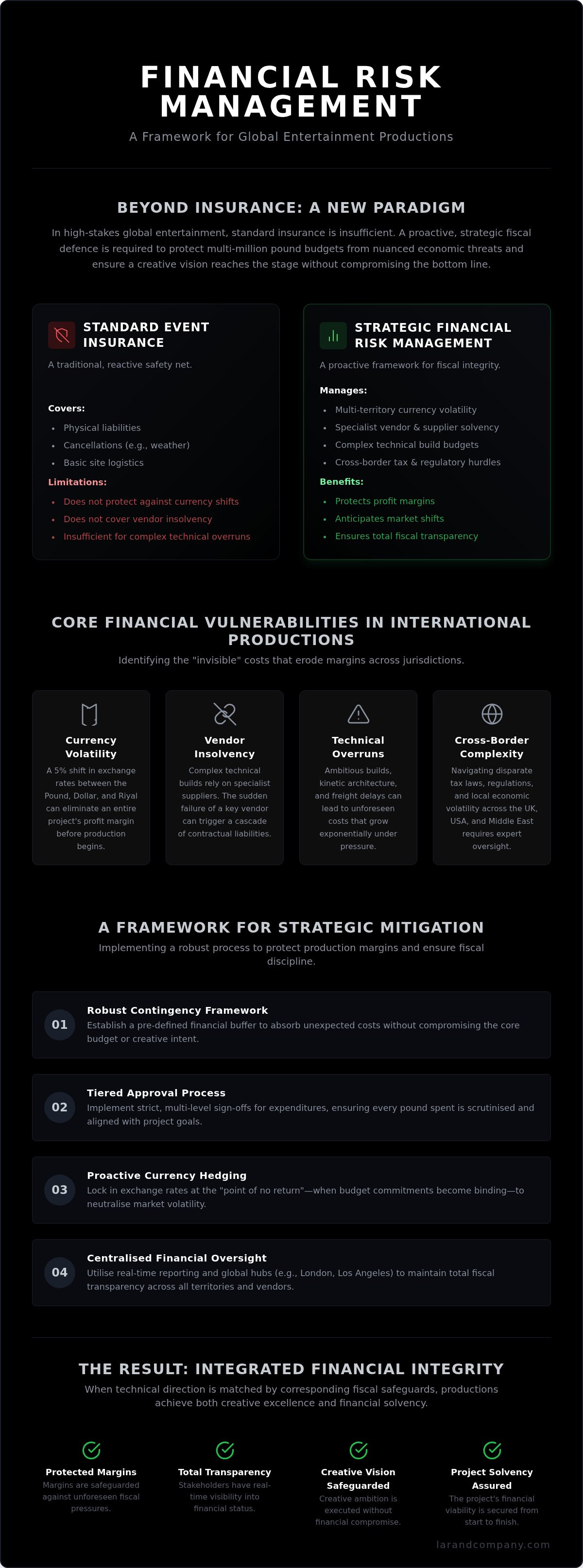
Standard event insurance policies remain essential for covering physical liabilities or cancellations due to weather. However, they're insufficient for high-profile productions where the risks are more nuanced. They don't protect against currency fluctuations during a multi-territory tour or the sudden insolvency of a specialist technical vendor. Modern financial risk management for live events addresses these gaps by establishing a framework that anticipates market shifts before they impact the bottom line. It's about protecting the margin without stifling the creative ambition.
The Complexity of Multi-Million Pound Budgets
Managing the scale of modern stadium tours or bespoke cultural celebrations requires an unflappable temperament. As technical builds become more ambitious, incorporating kinetic architecture and immersive digital environments, the potential for budget overruns grows exponentially. In the 2026 entertainment landscape, stakeholders expect total transparency and a level of precision that mirrors the complexity of the technical direction itself. High-value projects demand a culture focused on execution, where every technical innovation is matched by a corresponding fiscal safeguard.
Global Reach and Local Volatility
Operating across the UK, USA, and Middle East introduces layers of local volatility that can destabilise even the most robust plans. Each region carries its own geographic signature, from the regulatory environment of London to the rapid expansion of the Saudi Arabian entertainment sector. An international practice with a presence in major hubs like London and Los Angeles provides the necessary bridge to navigate these regional gaps. By understanding the financial nuances of different territories, producers can implement financial risk management for live events that is both global in scope and locally informed. This ensures that complex international works remain fiscally sound, regardless of the territory's economic temperament.
Identifying Core Financial Vulnerabilities in International Events
Identifying fiscal vulnerabilities requires a forensic approach to the production timeline. In global entertainment, the most significant threats often lie at the intersections of different jurisdictions. Effective financial risk management for live events must account for the "invisible" costs that erode margins. These include technical logistics and site management overheads that are frequently underestimated during initial creative pitches. Precision is paramount; a minor oversight in temporary venue construction or a delay in technical freight can trigger a cascade of contractual liabilities.
The Global Association of Risk Professionals emphasises that sophisticated risk intelligence is vital for managing such volatility. For the modern producer, this means moving beyond simple spreadsheets to a model of strategic fiscal defence. This involves vetting every vendor for fiscal stability and ensuring that procurement processes remain transparent, even amidst the pressure of a rapid build.
Currency and Exchange Rate Volatility
Shifts in the value of the Pound, Dollar, and Riyal can compromise a tour's viability before the first truck is loaded. When budgets are set in one currency but expenses are incurred in another, a five per cent market shift can eliminate the entire profit margin. Producers must identify the "point of no return." This is the moment budget commitments become legally binding and deposits are paid. Currency hedging is no longer an optional luxury; it's a fundamental tool for locking in costs. By fixing exchange rates early, you protect the creative vision from the temperament of global markets.
Contractual and Procurement Risks
Supplier and vendor insolvency remains a tangible threat in the post-2025 economy. Technical builds are increasingly complex, often relying on a narrow pool of specialist vendors for kinetic stages or bespoke lighting arrays. If a key supplier fails, the cost of a last-minute replacement is often catastrophic. Meticulous technical direction acts as a safeguard here. By integrating financial oversight with technical planning, producers ensure that procurement is transparent and vendors are verified. This prevents the opaque processes that often lead to budget overruns in high-stakes environments. If you are managing projects across these complex territories, understanding the underlying fiscal architecture is essential for maintaining absolute composure and project integrity.
Strategic Mitigation: Protecting Production Margins
Protecting the financial integrity of a high-profile show requires more than just careful accounting; it demands a defensive architecture. Once vulnerabilities are identified, the focus must shift to active mitigation. Implementing a rigorous framework for financial risk management for live events ensures that the creative vision is never compromised by fiscal instability. This process begins with the establishment of a clear contingency reserve, typically set at 10-15% of the total production budget. This is not a floating fund for creative expansion. It's a strategic buffer designed to absorb the shocks of technical complexities, supply chain shifts, and the unforeseen temperament of international logistics.
Execution remains the priority. To maintain control over multi-million pound budgets, producers should implement several key fiscal safeguards:
Tiered Approval Processes
Establish clear thresholds for budget variations. Minor adjustments may be handled at the site management level, whilst significant shifts require senior production sign-off.
Milestone-Based Payments
Avoid front-loading contracts. Link payments to tangible technical deliveries to ensure vendor accountability throughout the build.
Escrow Utilisation
For global tours involving multiple territories, using escrow services can protect both the production and the suppliers, ensuring funds are available and secure.
Integrated Artist Liaison
Financial creep often originates in the rider. By involving artist liaison teams in the budget framework, producers can manage expectations and costs before they escalate.
Contingency Planning for the Unforeseen
A robust financial architecture must account for Force Majeure events in a way that goes beyond standard legal clauses. This involves identifying the specific costs associated with potential delays and building them into the cash flow. It's also vital to distinguish between creative changes and technical necessities. Creative evolution is a choice; technical failure is a risk. By separating these in the reporting, you maintain a clear view of the project's fiscal health even during rapid-response site management.
The Value of Specialist Financial Oversight
Independent financial management provides a level of objectivity that is often lost when budget oversight is handled by the same team driving the creative vision. This separation reduces conflicts of interest and ensures that every technical feasibility study is grounded in fiscal reality. Integrating these disciplines allows for a more polished, professional execution. For those seeking a deeper understanding of these structures, our analysis of Production Financial Management explores how to maintain this balance in high-stakes environments. Ultimately, the goal is to provide the quiet power behind the scenes that allows the show to flourish without fiscal distraction.
Meticulous Fiscal Oversight and Real-Time Reporting
Real-time visibility is the foundation of financial risk management for live events. In high-velocity environments, waiting for month-end reports is a liability. Clarity is the priority. Producers need instant access to commit versus actual data, whilst maintaining a clear view of the overall margin. This allows for absolute composure when managing sudden shifts in technical requirements or site logistics. Transparent dashboards provide the clarity required to make informed decisions under pressure. It's about moving the conversation away from abstract estimates toward the tangible, reliable execution of complex logistics.
Managing the fiscal landscape of the Middle East requires specific expertise. Cross-border productions in the UAE, Qatar, and Saudi Arabia involve complex tax requirements and evolving regulations. By 2026, these markets will demand even greater precision in reporting. Audit-ready documentation ensures that high-profile stakeholders remain confident in the project's integrity. It's about maintaining a drumbeat of success through rigorous detail. This level of oversight protects the creative vision by ensuring that regulatory hurdles never become operational delays.
Tools for Modern Financial Management
Cloud-based tracking connects global production teams in London and Los Angeles with site management on the ground. Automation reduces human error in ledger management, ensuring that every pound and riyal is accounted for. Standardising these reporting formats is essential for international investors who require a clear, functional view of their capital. This efficiency suggests a business culture focused on execution. Modern financial risk management for live events relies on these digital frameworks to bridge the gap between creative ambition and fiscal reality. By using tools that prioritise clarity over decorative prose, producers can maintain a rapid, high-momentum rhythm throughout the project lifecycle.
Fiscal Integrity and Stakeholder Trust
Meticulous detail fosters trust. When a creative team knows the budget is stable, they can focus on delivering a flawless show. The psychological impact of financial certainty shouldn't be overlooked; it allows for bolder creative risks because the floor is secure. This quiet power behind the scenes is what separates elite productions from the rest. Our history of managing complex international works demonstrates that budget discipline is the catalyst for creative excellence. To ensure your next global project is anchored by this level of precision, you can contact our financial management team to discuss your specific requirements.
Lar&Co: Integrating Financial Integrity into Global Execution
Lar&Co operates at the intersection of creative ambition and fiscal reality. With over 20 years of experience in complex global projects, our practice provides the stability required for multi-million pound productions. We don't just track costs; we engineer financial security. By maintaining offices in London and Los Angeles, we offer a dual-hub oversight that is essential for navigating the high-stakes world of international entertainment. This geographic footprint allows us to implement financial risk management for live events with absolute composure, regardless of the territory's economic temperament.
Our commitment to transparent procurement and meticulous detail defines our service. In an industry where technical builds can easily exceed their initial estimates, Lar&Co acts as the quiet power ensuring fiscal integrity. We verify every vendor and scrutinise every line item. Effective financial risk management for live events is not a back-office function; it's a defensive strategy that protects the creative vision from the first site visit to the final load-out. This level of precision is why the world’s most significant cultural celebrations and high-tier fashion houses trust our practice.
A Global Practice for High-Stakes Projects
Translating a vision into a reliable financial plan requires a deep understanding of production mechanics. Whether managing the logistics of a "long stay" residency or a stadium-scale world tour, our team integrates technical direction with financial oversight. We ensure that technical feasibility studies are always grounded in budgetary reality. This prevents the friction that often occurs when creative desires clash with fiscal constraints. We account for every variable, from local labour laws in the UAE to the specific technical requirements of bespoke kinetic stages. This thoroughness ensures that margins are preserved whilst maintaining the highest tier of creative quality. You can view our Work Portfolio to see how we maintain this balance across diverse, high-profile international works.
Partnering with Lar&Co
Choosing a production partner is about more than just capability; it's about temperament. Lar&Co projects an image of international sophistication and seasoned expertise. We are comfortable operating at the highest levels of diplomacy and entertainment, providing the unflappable support needed during high-velocity budget shifts. Our role is to remain the invisible foundation that allows iconic musical legends and global brands to shine. We provide a bridge between the abstract nature of creative direction and the tangible, reliable execution of complex logistics. To discuss the financial architecture of your 2026 production, please contact our London or LA offices. We are ready to bring two decades of global dominance to your next project.
Securing the Global Production Lifecycle
Mastering financial risk management for live events requires a shift from reactive accounting to proactive fiscal architecture. Precision is the priority. By integrating technical direction with real-time reporting, producers can protect their creative vision against the temperament of global markets. We've explored the necessity of robust contingency frameworks, the importance of centralised oversight from London and Los Angeles, and the value of transparent vendor procurement in maintaining profit margins.
Lar&Co brings over 20 years of international expertise to the world’s most significant cultural celebrations. With a specialised focus on multi-million pound budget management, we provide the quiet power needed to ensure every project remains fiscally sound and creatively uncompromised. Our team manages the complexities of global tours and high-stakes events with absolute composure. This allows you to focus on the execution of a flawless production.
The future of entertainment demands this level of precision. Secure your production’s fiscal future with Lar&Co and ensure your next project is built on a foundation of absolute integrity.
Frequently Asked Questions
What are the most common financial risks in international show production?
The most significant risks include currency volatility, supplier insolvency, and unforeseen technical overruns. These variables can destabilise a project's solvency if they aren't identified during the initial planning phase. Addressing these challenges requires a comprehensive framework for financial risk management for live events that prioritises transparency and vendor verification across all global territories.
How does currency fluctuation impact a global concert tour budget?
Currency fluctuations can eliminate a project's profit margin if expenses are incurred in a different currency than the primary budget. For global tours, a shift of even five per cent in the value of the Pound or Riyal can lead to significant deficits. Producers mitigate this risk through early currency hedging and fixing exchange rates at the moment budget commitments become legally binding.
Why is independent financial oversight necessary for large-scale events?
Independent oversight ensures objectivity and reduces potential conflicts of interest between creative ambition and fiscal reality. By separating budget management from show production, stakeholders receive transparent, audit-ready reporting. This structure fosters trust amongst investors and ensures that technical feasibility studies are always grounded in tangible financial data rather than abstract estimates.
What is the difference between event insurance and financial risk management?
Event insurance is a reactive tool covering physical liabilities or cancellations, whilst financial risk management is a proactive strategy for project solvency. Insurance won't protect against currency shifts or the failure of a key technical vendor. A strategic framework anticipates these economic variables to preserve margins and ensure the reliable execution of complex logistics throughout the project lifecycle.
How can producers maintain creative quality whilst managing strict budgets?
Maintaining quality requires strategic fiscal defence and the early integration of technical direction. By vetting vendors and managing procurement meticulously, producers can allocate funds where they have the most visual impact. This approach allows for creative evolution within a defined buffer; it ensures the show remains polished without risking budget overruns or compromising the project's bottom line.
What role does technical direction play in financial risk mitigation?
Technical direction provides the feasibility data required to prevent budget creep during complex builds. By assessing the kinetic or immersive requirements of a show early on, technical directors identify potential fiscal pitfalls before they escalate. This integration ensures that procurement remains cost-effective and technical innovation serves the project's financial integrity rather than causing unpredictable expenditure.
How should contingency funds be structured for stadium-scale events?
Contingency funds for stadium-scale events should be structured as a ring-fenced buffer, typically between 10-15% of the total production budget. This fund is not for creative expansion; it is for absorbing shocks from technical failures or logistics shifts. Implementing tiered approval processes ensures these funds are only accessed for genuine technical necessities and unforeseen operational requirements.
What are the tax implications for live events in the UAE and Saudi Arabia?
Navigating the tax landscape in the UAE and Saudi Arabia requires an understanding of VAT regulations and cross-border payment requirements. By 2026, these territories will demand even more rigorous, audit-ready reporting for international works. Producers must ensure their financial risk management for live events accounts for these local fiscal nuances to avoid operational delays, penalties, or unforeseen withholding taxes.