Health and Safety Compliance for UK Festivals: A 2026 Checklist

A festival safety plan can be complete on paper and still fall short when conditions change on site. That’s the central challenge in health and safety compliance for UK festivals: turning legal duties into controls that teams and contractors can deliver, then revisiting decisions as the event evolves. If you’re unsure which requirements apply, or whether the paperwork reflects what’s happening on the ground, that concern is well founded.
This checklist sets out a practical sequence for organising duties, assessing risks and coordinating delivery. It distinguishes the core legal framework, including the Health and Safety at Work etc. Act 1974 and the Management of Health and Safety at Work Regulations 1999, from supporting industry guidance such as The Purple Guide. The Guide’s medical chapter was updated in January 2026, a reminder that event planning needs to keep pace with current guidance.
From risk assessment and control measures to contractor briefings, records and escalation routes, the focus is on making responsibilities clear and information usable. The result is a more coherent link between the safety plan and decisions made across a live festival site.
Key Takeaways
• Identify which legal duties apply to your event, and distinguish them from guidance that supports good practice.
• Build your risk assessment around the actual site, programme and operating conditions, with clear owners for each control.
• Link each safety document to the on-site action it is meant to support; paperwork alone doesn’t show that controls are working.
• Use a phased readiness checklist to track checks, completion status, escalation routes and record locations from build through breakdown.
• Effective health and safety compliance for UK festivals depends on clear responsibilities and reliable information flowing between production, site teams and stakeholders.
Health and safety compliance for UK festivals: what organisers must bring together
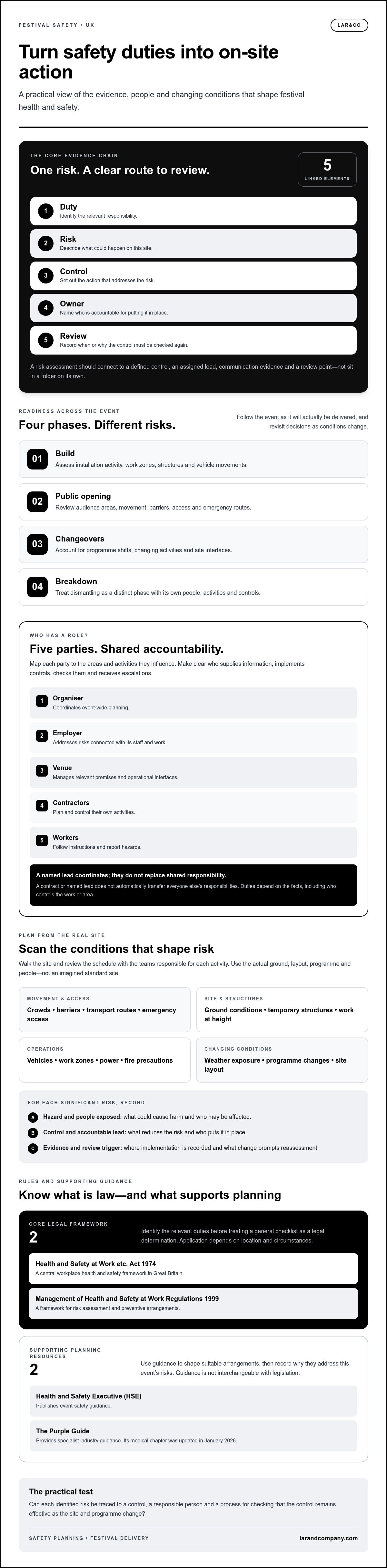
Health and safety compliance for UK festivals means meeting the duties that apply to the event through suitable planning, risk controls, clear communication and ongoing review. It is not a single document or a sign-off. The practical test is whether each identified risk connects to a control, a responsible person and a process for checking that the control remains effective as the site and programme change.
Start with a one-page evidence chain: duty → risk → control → owner → review. For example, a risk identified in a site assessment should lead to a defined control, an assigned lead, a record of how it was communicated and a review point. This makes gaps easier to spot than a folder of documents considered in isolation. It also places safety within the wider event management process, alongside logistics, permissions, security and emergency planning.
Which UK rules and guidance should festival organisers understand?
The Health and Safety at Work etc. Act 1974 is a central framework for workplace health and safety in Great Britain. The Management of Health and Safety at Work Regulations 1999 provide a framework for risk assessment and preventive arrangements. Their application depends on the event’s location and circumstances, so identify the relevant duties before treating a general checklist as a legal determination.
Separate these requirements from resources that help put them into practice. The Health and Safety Executive (HSE) publishes event-safety guidance; The Purple Guide provides specialist industry guidance. Both can inform planning, but guidance is not interchangeable with legislation. Use it to shape suitable arrangements, then record why those arrangements address the risks of this specific event.
Who has a role in festival health and safety?
Responsibilities sit across the delivery structure. The organiser coordinates event-wide planning; an employer addresses risks connected with its staff and work; a venue manages relevant premises and operational interfaces; contractors plan and control their own activities; and workers follow instructions and report hazards. The exact duties depend on the facts, including who controls the work or area. A contract or named lead does not automatically transfer everyone else’s responsibilities.
Map each party against the areas and activities they influence. Set out who supplies information, who implements each control, who checks it and who receives an escalation. Where relevant to the event, engage the local authority and Safety Advisory Group (SAG) early. A SAG can provide a forum for public-safety coordination, but its involvement does not replace the duties of organisers, employers or other responsible parties.
Name a safety lead to keep information moving and actions visible. Treat that role as a coordination point, not a substitute for shared accountability. This clear chain of duty, risk, control, owner and review gives teams a practical foundation for the site-specific assessment that follows.
Build a festival risk assessment around the real UK site and programme
A useful assessment follows the event as it will actually be delivered, not an imagined standard site. Map the ground, access points, stages, audience areas, vehicle routes and work zones against the programme and the people who will use them. Include the build, public opening, changeovers and breakdown. Each phase brings different activities, interfaces and risks.
Use a repeatable sequence: identify hazards, assess who could be harmed and how, select proportionate controls, assign an accountable lead, then review the assessment when conditions or plans change. For example, a festival on sloping ground with vehicle movements near an audience route needs controls based on that layout, not a generic assumption about level, segregated areas. This site-specific approach is central to health and safety compliance for UK festivals.
Which festival hazards belong in the assessment?
Walk the site and review the schedule with teams responsible for each activity. Consider crowd movement, barriers, temporary structures, vehicles, transport routes and emergency access. Assess weather exposure and ground conditions, alongside power, fire precautions and work at height where relevant. The Purple Guide can inform event-specific planning, but the assessment should reflect the hazards and conditions of this festival.
Keep construction and dismantling distinct from public operation. A structure being installed, a vehicle crossing a work area and a crowd moving through an open site involve different people and controls. Record specialist controls for those activities in the relevant contractor information, and make sure they align with the overall site plan and operating arrangements.
How should controls and responsibilities be recorded?
Maintain a risk register that lets site teams move from identified risk to action. For each significant entry, record:
Hazard and people exposed
what could cause harm and who may be affected.
Control and accountable lead
what will reduce the risk and who is responsible for putting it in place.
Evidence and review trigger
where implementation is recorded and what change should prompt a reassessment.
Cross-reference the register to site plans, contractor method information, emergency arrangements and briefing records. If a vehicle route changes, for instance, update the relevant plan, communicate the change to affected teams and review any connected controls. A completed form is a record of planning, not proof that a barrier is in place or a route remains clear. Check controls on site and capture issues, actions and follow-up.
Production and site management can help keep assessments, schedules and site information aligned as delivery develops. Explore festival and live event work for context on complex production environments.
Compare festival safety documents with the controls they are meant to prove
Documents matter when they connect a decision to action on site. A risk assessment may describe a control, but teams still need to implement it, check it and respond if conditions change. For health and safety compliance for UK festivals, test each key record against the real arrangement it is meant to support. A complete folder is not, by itself, evidence of effective site management.
Does a safety plan make a festival compliant?
No. A plan supports the management of safety; it cannot replace suitable controls or competent implementation. A crowd plan, for example, should match the actual site layout, barrier positions, stewarding arrangements and procedures for responding to changing conditions. Records should show not only that the plan was prepared, but also how relevant teams were briefed, how controls were checked and what happened when a gap was found.
| Document | Control or evidence to compare it with | Accountable lead |
|---|---|---|
| Risk assessment | Controls in place for the identified hazard; review when the activity or conditions change | Lead responsible for the activity or area |
| Site and crowd plans | Current routes, barriers, access points and stewarding arrangements on the ground | Site or crowd operations lead |
| Contractor information | Work methods, work zones and interfaces matching the current schedule and site layout | Contractor lead, coordinated with the relevant site lead |
| Briefing records | Relevant teams receiving current instructions and understanding their responsibilities | Person leading the briefing |
| Inspection and action records | Findings recorded, corrective actions assigned and completion followed up | Inspector and action owner |
Use the table as a working comparison, not a substitute for event-specific judgement. Industry context from the Association of Independent Festivals can help organisers understand the independent festival sector, while the evidence itself needs to relate to the site, programme and teams delivering this event.
What evidence should organisers be able to find quickly?
Keep current risk assessments, site plans, responsible contacts and relevant contractor information accessible to the people who need them. Add briefing records, inspection findings, incident records, corrective actions and key decisions where applicable. Each record should have an owner and a clear version or status, so teams can distinguish current information from superseded drafts.
Set review points according to the risk and the pace of change, rather than relying on an arbitrary fixed interval. A revised layout, severe weather, a new activity, an incident or an inspection finding may require a prompt review. Record what changed, who approved or communicated the response, and whether the control was checked afterwards. The aim is a usable trail from documented intention to current practice.
Pre-opening and live-event festival readiness checklist
A readiness check should move with the event, from build through breakdown. Give every check an owner, a status, an escalation route and a record location. That way, teams can distinguish completed work from open actions and find the latest information quickly. Use the checklist as a live operational tool, not a one-off sign-off.
What should the team check before opening gates?
Before public access, compare the site as built with the current plans and agreed controls. Brief operational leads on how to raise concerns, who can make decisions and how unresolved actions will be handled. For each item, record who checked it, when, the outcome and any follow-up owner.
Build
Check work zones, vehicle routes, temporary infrastructure and contractor activity against the agreed site arrangements. Record defects or incomplete controls and escalate them to the responsible lead.
Pre-opening
Confirm routes, barriers, access arrangements and emergency provisions match the current site plan. Check relevant infrastructure and contractor work areas, then brief operational leads on responsibilities, communications and outstanding actions.
Public operation
Keep reporting channels open for hazards, incidents and near misses. Record operational reviews and assign owners to corrective actions.
Changeover
Recheck affected areas when stages, activities, crews or site arrangements shift. Confirm that revised instructions reach the teams responsible for the next operation.
Breakdown
Review vehicle movements, work zones and access as public areas close and dismantling begins. Apply the relevant controls for the work taking place.
For wider operational context, read this guide to large-scale event management.
How should safety be managed during festival operations?
Set a rhythm for operational reviews that suits the event and its risks. Use clear channels so staff and contractors can report concerns promptly, and make sure reports reach someone able to assess and act on them. Health and safety compliance for UK festivals depends on controls remaining workable as the event unfolds, not simply being recorded in advance.
Pause and review when a material change, incident, adverse condition or control failure could affect safety. For example, a changed route or deteriorating ground may require the team to reassess access and movement arrangements before continuing. Record the decision, the person responsible, actions taken and any further review needed. If a control cannot be put in place or is no longer effective, escalate it through the agreed route rather than marking the check complete.
Clear production and site coordination can help connect schedules, current site information and operational handovers. Discuss festival production coordination with Lar&Co.
Coordinate UK festival compliance through production and site management
Festival safety plans are most useful when they connect to the way the event is produced. Show production, technical production and site management can align schedules, site information, stakeholder communications and operational handovers, so teams are working from a shared picture of the event. This coordination supports health and safety compliance for UK festivals, but it doesn’t replace anyone’s legal duties or certify that an event is compliant.
What does integrated production coordination add?
Creative and technical decisions can affect the site plan and the risks already assessed. A stage layout change, revised performance schedule or new technical requirement may affect access, work areas, vehicle movements or the timing of contractor activity. A clear change-control process gives the relevant leads a chance to consider those effects, update plans and brief affected teams before the change is implemented.
Set out how information moves between the organiser, venue, contractors and operational leads. For each change or issue, establish who records it, who assesses its impact, who makes the decision and how the decision reaches those who need to act. Handover notes should identify open actions and their owners, rather than leaving the next team to reconstruct the current position. For further context on the technical side of live delivery, explore technical production for live events.
Lar&Co’s experience across festivals, concert tours and major cultural and corporate events provides relevant context for complex live production. Its festival and live-event work portfolio shows the range of environments in which production and site coordination take place. Project examples are context, not evidence of a particular safety outcome or regulatory approval.
What are the next steps for an organiser?
Turn the checklist into a project-specific working system. Map responsibilities across the event, identify the documents teams need, set review points suited to the programme and establish how issues will be escalated. Then test whether each control has an owner and whether teams can access the current plan and instructions.
Keep unresolved risks visible. Assign actions and decision-makers, and identify issues that need competent, event-specific assessment before work proceeds. As plans develop, review the effect of changes on schedules, site arrangements and handovers. Clear coordination can make those dependencies easier to manage, while responsibility for meeting applicable duties remains with the relevant parties.
For a discussion about festival production and site management, contact Lar&Co.
Make festival safety part of the delivery plan
Effective health and safety compliance for UK festivals is built through connected decisions: understand the duties that apply, assess the real site and programme, assign owners to controls, and keep records aligned with changing conditions. A plan is only useful when teams can put it into practice, check it and act when something changes.
Production and site management help connect schedules, stakeholders and operational handovers. They support coordination, but don’t replace the legal responsibilities of the parties involved or certify compliance. Lar&Co is an international show production practice founded in 2005, with more than 20 years of experience across complex live entertainment projects. Its capabilities include show production, technical production and site management.
Bring those elements together early, keep responsibilities visible and make review part of the event’s operating rhythm. For a considered conversation about your festival’s production and site management, Discuss production and site management for your festival. Clear coordination gives your teams a stronger foundation for delivering the event with confidence.
Frequently Asked Questions
What health and safety laws apply to festivals in the UK?
The applicable laws depend on the event’s location, activities and working arrangements. In Great Britain, central legislation includes the Health and Safety at Work etc. Act 1974 and the Management of Health and Safety at Work Regulations 1999. Other requirements may also apply, including fire safety and licensing rules. Northern Ireland has a separate legal framework. International teams working across the UK, USA, United Arab Emirates, Saudi Arabia or Qatar should assess each event against local requirements.
Who is responsible for health and safety at a UK festival?
Responsibility is shared according to each party’s role, work and control of the site or activity. Organisers coordinate event-wide arrangements; employers manage risks to their workers; venues oversee relevant premises arrangements; and contractors control their work. Workers also have responsibilities to follow instructions and report hazards. A named safety lead can coordinate information and actions, but appointing one person doesn’t automatically remove other parties’ duties.
Does a festival need a health and safety plan?
Organisers need suitable safety arrangements, but there isn’t one universal plan format that suits every festival. The documents should reflect the event’s risks, responsibilities and operating arrangements, and meet any applicable legal or licensing requirements. A plan is only useful if it translates into controls teams can implement. For example, a crowd plan should match the site layout, barriers and stewarding arrangements, and be reviewed when those arrangements change.
What should a festival risk assessment include?
A festival risk assessment should identify hazards, who could be harmed, the controls needed, who is responsible and how those controls will be reviewed. Base it on the actual site, audience, programme and operating conditions. Include relevant activities across build, public opening, changeovers and breakdown. Consider crowd movement, temporary structures, vehicles, weather, ground conditions, power, fire precautions and emergency access where they apply to the event.
Does the Purple Guide count as UK festival law?
No. The Purple Guide is industry guidance, not legislation. It provides practical material to help event organisers plan for safety, but it doesn’t replace legal duties or establish that a festival is compliant. Use it alongside relevant legislation and HSE guidance, then assess which recommendations suit the specific event. Record the reasoning behind controls and check that the arrangements described in the plan are actually in place on site.
What does a Safety Advisory Group do for a festival?
A Safety Advisory Group (SAG) brings relevant agencies together to discuss public safety at an event. A local group may include local authority, police, fire and ambulance service representatives. For larger festivals, early engagement can help identify issues and coordinate advice on the event’s plans. A SAG’s input is advisory; it doesn’t take over the organiser’s responsibilities or certify that the event meets its legal duties.
How often should a festival risk assessment be reviewed?
Review it at points suited to the event’s risks and whenever circumstances may make it out of date. Triggers include a change to the site layout, programme, activity or operating conditions, as well as an incident, adverse weather or a control failure. Set planned review points across preparation and delivery, but don’t rely on a fixed interval alone. Record what changed, who reviewed it and any actions assigned.