Hidden Costs in Live Show Production: A Producer’s Guide
A production budget can look complete and still leave consequential costs out of view. The hidden costs in live show production often sit between teams, assumptions and changing conditions: a technical requirement that has not been tested, a supplier cost that is not clearly itemised, or a late change that affects several parts of the plan.
A headline figure can provide a useful starting point, but proposals may make different assumptions about scope, delivery and what is included. That makes them difficult to compare and can create pressure as the show approaches. Surface those assumptions early, while there is still time to assess their impact and make informed decisions.
This guide explains where live production budgets can expand, how to test key assumptions before committing, and how to compare production partners on a like-for-like basis. It also sets out a practical approach to recording decisions, managing scope changes and reviewing contingencies. The aim is a clearer view of the full production picture before small gaps become difficult decisions.
Key Takeaways
• Spot hidden costs in live show production by looking beyond headline figures to requirements, dependencies and unclear ownership.
• Assess technical complexity, temporary infrastructure, transport, access and site conditions for early warning signs.
• Use one shared brief to compare proposals, recording exclusions, dependencies, owners and how changes will be handled.
• Keep an assumptions and decisions log with named owners and review dates to support budget control from brief to close of show.
• Align creative, technical and site planning with financial oversight to make interfaces and responsibilities clearer.
Where hidden costs in live show production begin: scope, assumptions and ownership
A headline budget is a starting point, not always a complete picture of what it will take to deliver a show. A cost may be absent because a requirement has not been defined, a dependency sits outside the quoted scope, or nobody has been assigned to confirm it.
Hidden production costs are requirements, dependencies or exposures that are not clearly priced, included or assigned to an owner. Some events involve genuinely unforeseen circumstances. These differ from foreseeable work omitted from the brief, left unclear in a proposal or assumed to be covered by another team. A risk may not be preventable, but unclear scope can often be examined before commitments are made.
Event management involves coordinating elements such as budgeting, logistics and technical requirements. When those elements meet, a decision in one area can affect another. A creative change, for example, may alter technical requirements or site plans. Budgets should reflect those connections as well as individual line items.
How scope gaps create costs before show week
An unclear brief can leave deliverables, responsibilities and revision rounds open to interpretation. A proposal might include a visual concept but not specify the number of revisions, or describe a technical requirement without saying who will confirm it. If stakeholders assume those details are settled, the resulting work may surface later as a change to scope.
Separate confirmed commitments from untested assumptions. Record what is included, what is excluded, what depends on another party and who can approve a change. This gives stakeholders a clearer view of budget exposure before work is authorised, rather than relying on different teams to hold different versions of the brief.
Why cost ownership matters across the production team
Live show delivery crosses creative, technical, site, supplier and client teams. Each interface needs a clear handover: who defines a requirement, who checks it, who confirms its budget impact and who approves proceeding? Without that clarity, two teams may both allow for the same task, or each may assume the other has included it.
For each significant requirement, name one accountable owner and identify any supporting teams. Make dependencies visible, especially where a change in creative direction could affect technical planning or site management. Financial oversight can then connect decisions to scope and budget, rather than treating cost tracking as a separate exercise.
The main hidden cost categories in live show production
The hidden costs in live show production rarely come from one predictable checklist. They emerge where technical plans, site conditions, schedules and supplier assumptions meet. Not every show needs the same infrastructure or crew, so test each category against the brief, venue and delivery plan.
Early verification of dependencies gives the team a clearer view of budget exposure before plans are fixed. Use a simple register to record the cost driver, what could trigger a cost, the early warning sign and the person responsible for checking it.
Technical complexity
Power, rigging, connectivity or equipment interfaces may need further assessment, depending on the production and venue. A late technical specification is an early warning. Assign a technical owner to confirm requirements before design or procurement decisions are locked.
Temporary infrastructure
A venue or outdoor site may require additional temporary facilities or structures. Check what the site already provides, what the plan depends on and who will confirm the requirement. Site management should coordinate this with technical and creative planning.
Access and schedule
Restricted access windows, build sequencing or site constraints can affect how work is delivered. Confirm access information and key schedule dependencies early, with a named production or site owner responsible for resolving gaps.
Transport and supplier terms
Travel, accommodation, delivery, working hours and local crew requirements depend on scope and location. Check each supplier proposal for inclusions, exclusions, assumptions and the process for changes. The supplier owner should clarify any ambiguity before approval.
Location-specific exposure
Currency, tax, insurance and local requirements need qualified, location-specific verification. Assign an appropriate local professional to confirm how these apply to the project. Do not rely on assumptions carried over from another country or event.
Technical, site and schedule dependencies
Check whether the current plan has confirmed the venue’s relevant power, rigging, connectivity and access conditions. These are checks, not universal cost items. If information arrives late, the team may need to revisit design choices, procurement or build sequencing. Record what is confirmed, what remains open and when the responsible owner will review it.
People, suppliers and international delivery
Labour, travel, accommodation and supplier terms vary with project scope and location. Check working hours, local crew assumptions and dependencies between suppliers. For external benchmarks, verify the underlying publisher, date and jurisdiction rather than relying on generic web citations or unverified search results as a cost standard. Lar&Co’s production planning brings these interfaces together. Explore production planning with Lar&Co.
How to compare production proposals without overlooking budget exposure
A lower headline figure does not necessarily mean a more efficient proposal. Its scope may be narrower, key requirements may sit outside the quote, or allowances may rely on assumptions that have not been confirmed. To compare fairly, give each production partner the same brief, delivery requirements and known constraints, then assess what each proposal includes against that shared information.
Questions to ask about inclusions, exclusions and allowances
Check how each proposal defines deliverables, revisions, staffing and production phases. Ask which third-party services or venue requirements are excluded, and what information the proposal assumes will be supplied by others. For a provisional item, establish the basis of the allowance, who will confirm it and when it will be reviewed.
Separate confirmed costs from provisional allowances and unresolved decisions. Do not treat an allowance as a final figure or assume an unpriced requirement is included. Record the change process too: who can request a change, who assesses its impact and who has authority to approve it.
| Comparison point | What to record |
|---|---|
| Scope | Deliverables, revisions, staffing and production phases included |
| Exclusions | Items or services outside the proposal |
| Dependencies | Information, access or third-party input the plan relies on |
| Owner | Person responsible for confirming or resolving each item |
| Confirmation status | Confirmed, provisional or awaiting a decision |
| Change process | How changes are assessed, communicated and approved |
Use the same terms across every proposal. This makes gaps easier to see and gives stakeholders a practical basis for follow-up, rather than comparing figures built on different delivery assumptions.
Assessing production partners beyond the headline budget
Look at how each partner will manage decisions and financial exposure during delivery. Compare reporting cadence, governance, decision rights and change control. Ask how creative direction, technical planning and site requirements will connect to financial oversight, so a decision in one area can be assessed against its wider implications.
Give technical scope close attention. Ask how requirements, interfaces and open questions will be documented and confirmed, and who will communicate their effect on the wider plan. For more context on this area, see technical production for live events. A clear comparison helps distinguish a complete, well-defined proposal from one whose headline figure leaves material assumptions unresolved.
How to control hidden costs from brief to close of show
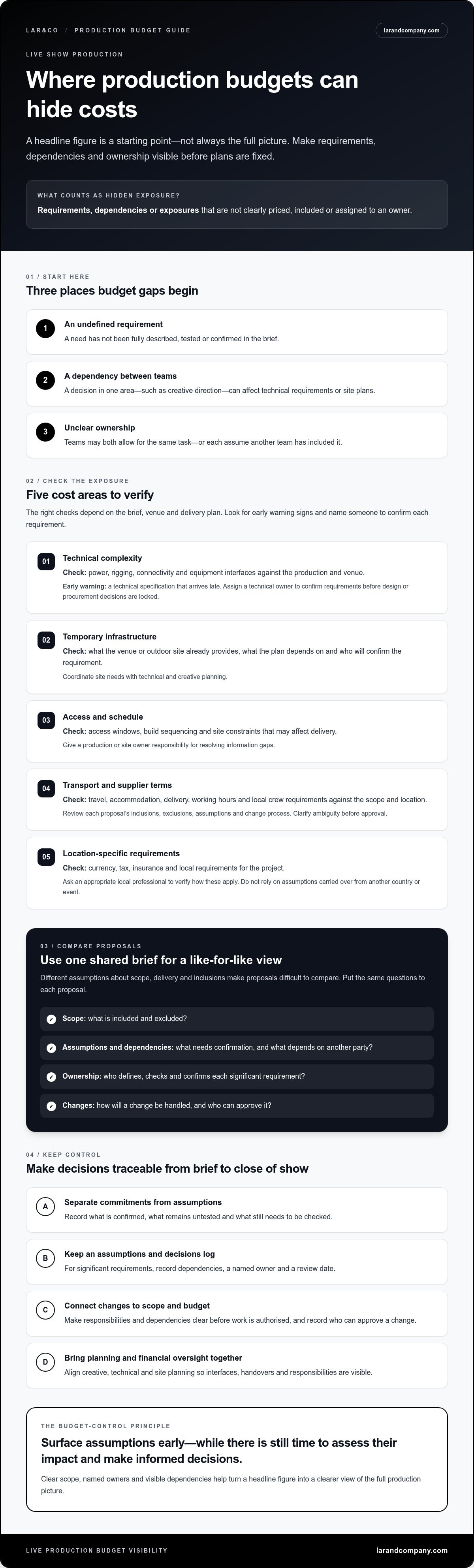
Control depends on a repeatable process, not a single contingency figure. Keep one live assumptions and decisions log alongside the agreed scope baseline. Give every open item a named owner and review date, then update its status as the production moves from brief to delivery.
Budget control depends on timely decisions and named accountability. Use this sequence to keep requirements visible and changes traceable:
Define
Set out the approved scope, delivery assumptions, exclusions and current budget baseline.
Assign
Name an owner for each cost exposure, dependency and unresolved decision.
Validate
Confirm assumptions with the relevant venue, supplier or team, and record the evidence and review date.
Approve
Before accepting a change to scope, schedule or design, document its impact and obtain approval from the authorised decision-maker.
Track
Update commitments, forecasts, decisions and approved changes against the same scope baseline.
Close
Reconcile final supplier information, note outstanding items and record lessons for future productions.
Create a usable risk and assumptions register
Keep the register practical. For each exposure, record the trigger, owner, planned response and confirmation deadline. Review venue, supplier, schedule and location-specific dependencies at agreed project milestones, rather than waiting until delivery. If a key assumption remains unresolved, escalate it before it becomes a fixed commitment or constrains the schedule.
For example, if the plan depends on a supplier confirming a technical requirement, log the confirmation date and the decision that depends on it. This makes the sequence clear: who needs to act, by when and what may need to be reassessed if the answer changes.
Manage changes and close out accurately
Keep proposed changes out of informal approval channels. Record what is changing, why and the assessed effect on scope, schedule and budget before authorisation. Once approved, update the forecast and baseline so the team is working from the same version. At close, reconcile final supplier information against recorded commitments and approved changes, then capture lessons to inform future briefs and assumptions.
A consistent process helps teams identify hidden costs in live show production while there is still time to make informed decisions. Coordinated production and financial oversight can help bring responsibilities and decisions into view.
When integrated show production makes budget risks easier to manage
Budget risks often sit at the points where responsibilities meet. Creative direction may shape technical requirements; technical plans may depend on site conditions; and both can affect the financial picture. Coordinated show production, technical direction, site management and financial oversight help make these interfaces visible, with clearer ownership of decisions and dependencies.
This approach can help teams identify hidden costs in live show production earlier, but it cannot prevent every change or unforeseen event. A production partner provides a route to better coordination, not a guarantee that the scope will remain fixed. The value lies in agreeing how assumptions are checked, decisions are made and impacts are communicated.
Match production support to the complexity of the show
A tour, festival, cultural celebration and corporate event each bring different planning demands. The right mix of production support depends on the brief, delivery model, site and stakeholders. A single operating approach will not suit every project. Consider which interfaces need active coordination and where clear accountability is essential, rather than assuming every production requires the same structure.
International delivery adds another layer of planning. Local conditions and requirements should be verified by appropriate professionals, and decision-making responsibilities should be clear across the teams involved. Lar&Co’s portfolio provides context on its work across live entertainment formats. For more about the practice and its experience, see Lar&Co’s background and experience.
Prepare for a productive production-partner conversation
A focused discussion starts with the information already available. Bring the brief, schedule, venue details, known constraints and a list of unresolved decisions. This gives both sides a basis for identifying what is confirmed, what needs validation and which decisions could affect scope or delivery.
Ask how reporting will work, who can approve changes, how assumptions will be tracked and what impact review happens before a change proceeds. Clarify how creative, technical and site planning connect to financial oversight, and how updates will reach the people responsible for decisions.
With those questions on the table, invite a production partner to review the scope, assumptions and delivery requirements with you. The aim is not to remove all uncertainty. It is to establish a clear process for recognising it, assigning ownership and making informed decisions as the production develops.
Bring greater clarity to your next production
Managing hidden costs in live show production starts with making scope, assumptions and ownership visible. A clear brief helps teams test dependencies before committing, whilst a consistent proposal comparison reveals where inclusions or delivery assumptions differ. As plans develop, a live record of decisions and documented change approvals keeps the budget connected to the agreed scope.
No production partner can prevent every change. Coordinated show production, technical direction, site management and financial oversight can, however, clarify how responsibilities and decisions connect. That clarity gives stakeholders a stronger basis for assessing emerging requirements and deciding how to respond.
Lar&Co is an international show production practice with more than 20 years’ experience and primary offices in London and Los Angeles. If you’re preparing a brief or reviewing delivery requirements, discuss your live show production requirements with the team. A well-informed conversation is a practical first step towards a production plan with clearer scope, ownership and budget decisions.
Frequently Asked Questions
What are hidden costs in live show production?
Hidden costs in live show production are costs or exposures not clearly visible in the initial scope or budget. They may arise from unclear responsibilities, incomplete information, external dependencies or approved changes. These differ from genuinely unforeseeable events: a requirement that could have been identified but was left unconfirmed is not necessarily unexpected. Which exposures matter depends on the production, venue and location, so treat each budget as project-specific.
What costs are often overlooked when planning a live show?
Review scope exclusions, technical dependencies, site access, temporary infrastructure, supplier terms, staffing, travel and schedule changes. This is a checklist, not a claim that every production will incur every item. For example, access arrangements or temporary infrastructure may be relevant at one venue but not another. Confirm requirements and inclusions directly with suppliers, and seek appropriate local advice for location-specific matters before making commitments.
How can I compare live event production quotes fairly?
Issue the same brief and delivery assumptions to each prospective production partner. Compare inclusions, exclusions, responsibilities, dependencies, provisional items and change processes, not just headline totals. A lower figure may cover a narrower scope or leave more assumptions unresolved. Keep questions and confirmations in one comparison document, then check that the chosen proposal matches the delivery plan stakeholders have approved.
Should a live show budget include contingency?
Teams commonly plan for uncertainty, but the right approach depends on the project’s risks, governance and client requirements. Contingency does not replace testing assumptions or defining scope, and there is no single percentage suited to every production. Document what contingency is intended to cover, who can approve its use and how decisions will be recorded. Review assumptions at agreed project milestones so the approach remains relevant as plans develop.
How do production changes affect a live show budget?
A change can affect more than the item being altered. A design revision, for instance, may have implications for technical planning, procurement, labour, schedule or site coordination. The impact depends on the change’s scope and timing. Record each proposal, assess related effects and identify who can approve it. Update the working budget and scope baseline only after the decision and its impact have been documented.
Who is responsible for tracking production costs?
Agree responsibility for each budget area instead of assuming one person owns every cost. A producer or financial lead may coordinate reporting, whilst technical, site, creative and supplier leads confirm their own scopes and commitments. Set out who provides updates, how often they are reviewed and where unresolved issues are escalated. These are practical controls; the specific arrangement should suit the project and its agreed governance.
Do international live shows have additional budget risks?
They may. Depending on the project, location-specific tax, currency, insurance, labour, travel, permitting or supplier considerations may need review. The relevant requirements differ by country and scope, including across the UK, USA, United Arab Emirates, Saudi Arabia and Qatar. Identify questions early, then confirm them with qualified local advisers and suppliers before commitments are made. Do not assume arrangements used in one location apply in another.