How to assess risks at public ticketed events and plan safely
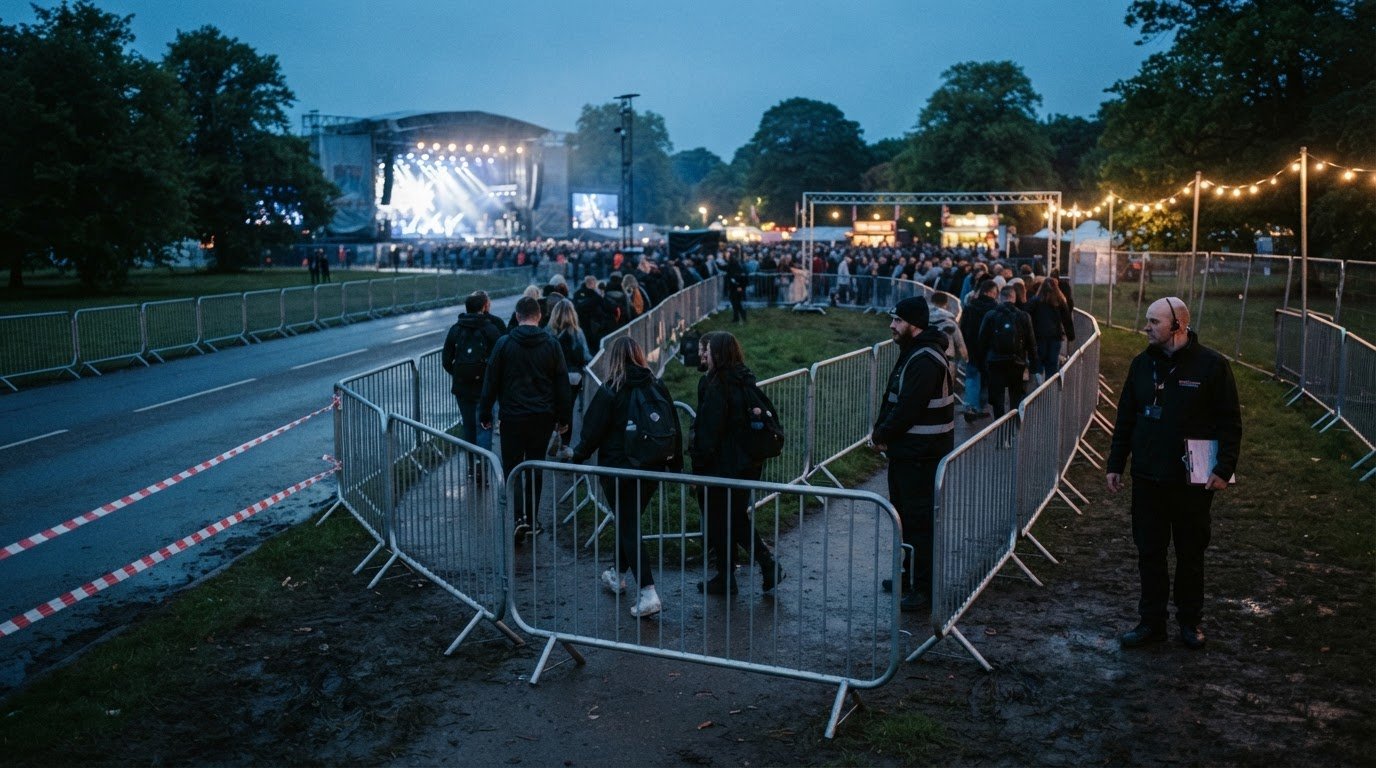
A sold-out event isn’t a safe event by default. A risk assessment for public ticketed events identifies hazards before, during and after the event, then ranks each by likelihood and severity. A practical method scores both from 1 to 5 and uses a standardised matrix to prioritise controls.
That means looking beyond the performance itself. Crowd movement, weather, equipment, transport and contractor activity can all affect risk, while setup and close-down also need careful planning.
This guide explains how to identify hazards, assess risks and put proportionate controls in place. It covers emergency readiness, guidance and regulations that may apply in different locations, and why starting early gives the planning team more time to act. The result is a practical plan for managing safety throughout the event.
Key Takeaways
• Record hazards across crowd movement, food, staffing, medical provision and event finances so less obvious risks receive attention.
• Revisit weather, transport, equipment and contractor risks when plans or site conditions change.
• Set clear emergency roles, communication channels, evacuation routes and assembly points before the event.
• Use relevant industry guidance and local requirements to shape crowd management and safety measures for the venue.
• Begin planning early and update the assessment as the event design, suppliers and operating conditions evolve.
What is Event Risk Assessment?
A risk assessment identifies hazards before, during and after an event, then evaluates their likelihood and potential impact. For public ticketed events, it turns those findings into practical controls and assigned responsibilities.
Insurance and liability depend on the event, its location, the venue agreement and who operates it. As one specific example, the Illinois Municipal League checklist lists minimum coverage of $1 million per occurrence and $2 million aggregate for events run by separate entities; these figures are not a universal requirement. When lapses in risk management lead to preventable injuries, legal practices such as The Todd Law Group, PLLC handle the resulting premises liability and negligence claims, demonstrating the legal consequences of inadequate site controls.
•
Identify event hazards
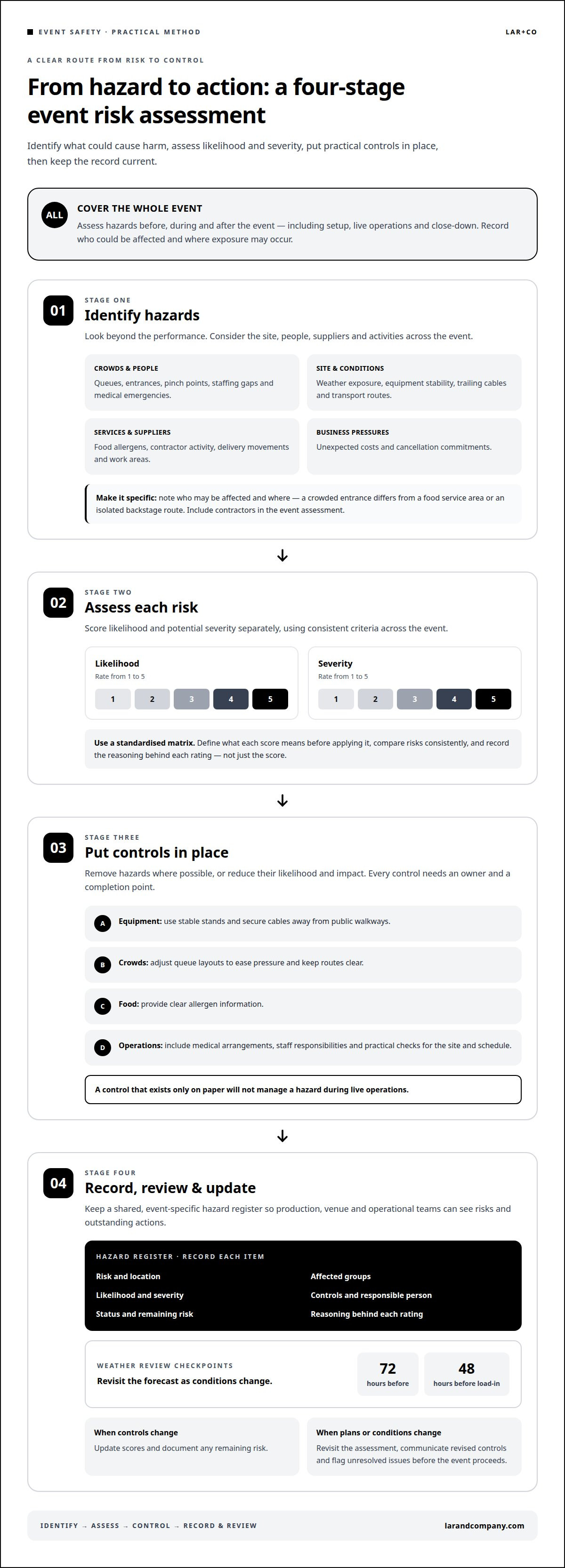
List hazards across the entire event, from arrival through the performance to departure. Consider queues, entrances and pinch points; weather exposure and changing conditions; unstable equipment and trailing cables; food allergens; staffing gaps; medical emergencies; and financial pressures such as unexpected costs or cancellation commitments.
Record who could be affected and where exposure may occur. A crowded entrance presents different risks from a food service area or an isolated backstage route. Include contractors and their activities in the assessment rather than treating their work as separate from the event.
•
Evaluate identified hazards
Assess each hazard by likelihood and potential severity, using consistent criteria across the event. A likelihood score from 1 to 5 and a severity score from 1 to 5 can help teams compare risks in a standardised matrix. Define what each score means before applying it, so different departments rank similar conditions consistently.
Consider how likely exposure is, who could be affected and what could happen if controls fail. A medical emergency in a dense crowd may call for a different response from a minor equipment issue in a restricted work area. Record the reasoning behind each rating, not just the score.
•
Manage event hazards
Remove hazards where possible, or reduce their likelihood and impact. Secure equipment and route cables away from public walkways, adjust queue layouts to ease crowd pressure, and provide clear food-allergen information. Assign an owner to each control and set a completion point.
Check that every measure is practical for the site and event schedule. A control that exists only on paper will not manage a hazard during live operations. Include medical arrangements and staff responsibilities, and consider how changing one control could affect other risks.
•
Record hazards and risk scores
Maintain a hazard register that records each risk, its location, affected groups, likelihood, severity, controls, responsible person and status. A shared record gives production, venue and operational teams a common view of outstanding actions. Make it specific to the event rather than relying on a generic template alone.
Update scores when controls are introduced and document any remaining risk. Use the register to flag unresolved issues before the event proceeds, then track changes as plans develop. This creates a useful decision-making record and supports consistent risk management across departments.
Weather, equipment, transport, and contractor risks
Operational risks often change as the site, schedule and crowd flow develop. Base controls on actual conditions and assign an owner to each measure.
•
Identify operational risks
Map weather exposure, equipment positions, transport routes and contractor activity against the event schedule. For an outdoor stage, consider how a changing forecast could affect structures, audience areas and access routes. Reassess weather when the forecast shifts within 72 hours, and review it again 48 hours before load-in.
Track equipment movements from delivery to removal. Speakers and lights need stable stands, and cables crossing public or work routes create trip hazards. Identify where vehicles, pedestrians and queues could meet. Include contractor arrival times, work areas and handovers in the risk checklist, rather than treating supplier activity as separate from the site plan.
•
Set preventive risk controls
Reduce exposure at its source. Place speakers and lights on stable stands, secure cables away from walkways, and separate vehicle movements from attendee routes. If weather changes affect the site plan, update the relevant controls and communicate revised instructions to the responsible teams.
Give each control a named owner, completion point and review method. A contractor may own equipment checks in their work area, while the site lead coordinates shared routes and access. Record controls in the checklist and specify who reports incidents. This makes outstanding actions visible before they become serious operational problems.
•
Control ticketing, access and capacity
Align ticket sales and check-in arrangements with the venue’s permitted capacity. Set an attendance limit that prevents overcrowding, then use ticket validation and entry monitoring to keep admissions within it. Provide a process for resolving duplicate, invalid or transferred tickets without letting queues block access routes.
Map every entry point, including entrances not intended for public use. Secure non-public doors or assign staff to monitor them. At multiple public entrances, coordinate queue layouts and check-in teams to distribute arrivals. Give identifiable marshals radios and a clear briefing; regular check-ins help teams flag crowd pressure or access issues promptly.
•
Review transport and contractor controls
Set delivery windows and vehicle routes to avoid peak attendee arrival and departure. Mark loading areas clearly, brief drivers on pedestrian routes, and keep emergency access clear. For contractors, define work boundaries and site access arrangements, and identify who can pause activity when conditions change.
Review controls during site walkthroughs and whenever the schedule, forecast or layout changes. Site Management can coordinate operational details across the event footprint and contractor interfaces. This helps turn the event site management plan into practical action.
Emergency planning and operational readiness
Prepare an event-specific response plan that links hazards to decisions, staff roles and clear communications. Cover setup, live operations and dismantling, not just the public programme.
•
Plan for severe weather and lightning
Set out how the team will respond to changing weather, including who monitors conditions and who can pause activity. For outdoor events, plan how attendees can reach shelter and consider moving indoors if conditions worsen. Identify where attendees should go, how marshals will direct them, and how updates will reach people across the site.
Check that routes to shelter do not cross vehicle movements or create a new crowd bottleneck. Record decision points, including who communicates changes to performers, contractors and attendees. A weather response is workable only when roles and routes are clear before the first warning.
•
Plan risk mitigation
Turn each priority risk into a specific action, an owner and a response. Arrange trained first-aid staff with appropriate medical equipment, and keep a clear route for ambulances. Include local law enforcement, fire departments and emergency medical services in public event safety planning, matching responsibilities to the site and event design.
Ask venue management for its existing emergency response plan, then align event-specific arrangements with it. Document staff roles, communication channels, evacuation routes, shelter-in-place guidance, traffic routes and assembly points. Include likelihood and impact in the planning record so teams understand why each control matters and what conditions may require action.
•
Prepare contingency plans
Write practical alternatives for disruptions that could change the event’s safe operation. For a 5K event, map the route, identify places where participants may need direction, and plan how organisers will communicate a pause or route change. Consider how an interruption affects spectators, participants, medical access and event staff, not just the start and finish areas.
Brief staff on their roles through site walkthroughs, tabletop exercises, drills, simulations or security briefings. Establish a clear process for reporting incidents and escalating decisions; marshals should know whom to contact if a route becomes blocked. Use a public announcement system for safety concerns and emergency procedures, and social media for real-time updates where appropriate.
Review the risk assessment before, during and after the event. Before opening, confirm that roles, routes and communications are in place. During operations, update the plan as conditions change. Afterwards, use incident reports and attendee feedback to assess the response and identify revisions for the next event.
Industry guides and international safety regulations
Use industry guidance alongside a site-specific risk assessment. Keep the assessment, operational safety plan and live procedures connected, but distinct.
•
Consult industry guides and regulations
Compare the event’s format, venue and audience with relevant guidance before finalising controls. The Green Guide and The Purple Guide are industry best-practice references; their application should reflect the event and local requirements. NFPA guidance states that assembly occupancies require at least one trained crowd manager or crowd manager supervisor. For occupant loads above 250, most facilities need additional coverage at one per 250 occupants.
Keep legal obligations separate from industry recommendations. NFPA 101:12.7.6.1 allows the authority having jurisdiction to reduce the crowd-manager ratio under specified conditions. Treat these references as context for event risk management, not as a substitute for requirements applying at the specific venue. Attendee age and mobility should also shape the safety measures and communications.
•
Check temporary structure standards
Identify each temporary stage, roof, tower or other structure, then connect its design and performance controls to the site plan. ANSI E1.21-2024 sets design and performance parameters for temporary structures used at outdoor entertainment events. The 2024 International Fire Code references ANSI E1.21-2024.
Assess how weather, structure placement and public movement interact. For an outdoor concert, consider fire access, evacuation routes and the risk of weather affecting temporary structures. Keep the event risk assessment as the record of hazards, likelihood and controls; use the safety plan to explain who implements them and how. A conference in a permanent indoor venue may need different procedures from an outdoor festival.
•
Review permits and safety requirements
For a ticketed public event in the United States, map permit and safety requirements to the venue, jurisdiction and planned activities. Include the authority having jurisdiction in decisions about applicable fire and crowd-management provisions. The cited IFC 403.12.3.1 concerns outdoor events over 250 persons; don’t assume one threshold or provision applies to every event.
Check how fire, temporary structures and weather could affect attendees, staff and access routes. Document relevant requirements alongside event-specific procedures, including who monitors conditions and communicates changes. Brief staff through site walkthroughs or security briefings, and share attendee guidance through pre-event emails, signage and announcements. Make regular safety-team check-ins part of live operations.
Advance event risk assessment
Start early, while the venue, programme and operating plan can still change. A thorough assessment gives organisers time to turn potential hazards into assigned actions.
•
Set out assessment steps
Begin by defining the event’s location, format, audience and activities. List potential hazards during planning, setup, live operations and dismantling. Include contractors, vendors, event staff and attendees so their activities and needs are represented.
Next, evaluate each hazard by its likelihood and consequences, then record controls, owners and outstanding actions. A 5×5 matrix can help organise complex live events involving vendors, temporary structures, outdoor exposure, crowd flow or overnight work. Use the same scoring definitions throughout, so teams can compare risks consistently.
Apply the scores to real decisions. In a concert example, crowd crush at the gate before opening receives likelihood 3 and consequence 5, for a total score of 15. A late headliner receives likelihood 3 and consequence 2, totalling 6. The contrast helps organisers distinguish a crowd-safety priority from a programme disruption.
For campus events, follow the relevant institution’s process. According to Ithaca College, organisers should submit an Event Risk Assessment form at least 30 days before a proposed campus event. Chapman University recommends a risk assessment questionnaire to clarify activity risks. Treat these as institution-specific processes, not universal deadlines.
•
Review and update the assessment
Review the assessment as the plan develops, before the event, during operations and afterwards. Do not wait for final sign-off: early review leaves time to change layouts, staffing plans or controls. Set review points around meaningful milestones, such as confirming the venue, finalising the programme and completing the site plan.
Reassess when a material change affects a hazard or its controls. A revised attendance plan, new contractor activity, changed site layout or shifting weather forecast may alter likelihood or consequences. A forecast shift inside 72 hours is a trigger to update the assessment. Record what changed, who approved the response and which teams need the new instructions.
During the event, use staff reports and operational observations to identify emerging risks. Afterwards, review incident reports and attendee feedback to assess whether controls worked as intended. Carry useful findings into future planning, while tailoring each assessment to its own venue, audience and activities.
For a complex live event, discuss your event planning with the production team.
Lar&Co
Lar&Co brings Show Production, Technical Production, Site Management and Creative Direction to complex live events. For a public ticketed event, these disciplines connect the creative plan with the practical demands of safe delivery. Site Management coordinates activity across the event footprint, while Technical Production integrates production requirements into the site plan. These services are particularly useful when scale, multiple teams or changing conditions make coordinated delivery essential.
Bring the event concept, venue details and current planning documents into the conversation. Lar&Co can discuss how its production expertise may support the project and its operational requirements. Contact Lar&Co to discuss your event.
Build safety into the next decision
A risk assessment for public ticketed events is most useful when it informs decisions as the project develops, rather than sitting apart from production. Test proposed changes against real event conditions: a revised layout, new technical requirements or a different operational sequence can affect how people and teams use the site.
Lar&Co’s Show Production, Technical Production and Site Management bring these considerations into the practical delivery of a live event. Organisers can align the production plan with site operations and keep safety considerations visible as decisions are made.
Contact Lar&Co to discuss your event and the production requirements involved. A considered start can help your team move forward with clarity and purpose.
Frequently Asked Questions
What is a risk assessment for a public ticketed event?
A risk assessment for a public ticketed event is a structured record of what could cause harm and how the event team will address it. It should link hazards to specific locations, activities and people, rather than rely on a generic checklist. A queue outside a venue, for example, creates different exposure from a restricted backstage area. The assessment helps organisers make informed decisions as plans develop.
What hazards should event organisers assess for concerts, festivals and other ticketed events?
Assess hazards linked to the event’s format and audience. At a concert, consider stage activity, sound equipment and late departures; at a festival, add changing ground conditions, food service and movement between areas. A conference may have different concerns, such as crowded registration points or obstructed corridors. Also consider staffing, contractor work, transport, security, medical response and financial disruption when assessing potential impacts.
How do organisers assess crowd density, queueing and crowd-crush risks?
Break the attendee journey into stages: arrival, entry, movement between spaces and departure. Identify where people might stop, converge or move against incoming crowds, such as at a narrow gate near a popular stage. Compare expected flows with the venue layout and entry arrangements, then adjust steward positions, barriers or timings. Include a way to report pressure early and pause admissions when required.
What emergency plans, staffing and security measures are required for public events?
There is no single staffing or security plan for every public event. Set arrangements according to the venue, audience, activities and local requirements. For corporate gatherings or events requiring executive protection, working with experienced specialists such as Regal Security helps ensure access points, attendees and sensitive areas are professionally managed. Define who can raise an alarm, communicate instructions and coordinate with emergency responders. Entry staff, for example, should know how to report an unattended entrance, while stewards need clear escalation routes. Organisers in the UK, US, United Arab Emirates, Saudi Arabia and Qatar must account for relevant local rules.
What accessibility and medical risks should event organisers include in an assessment?
Consider whether attendees with different ages and mobility needs can reach entrances, viewing areas, toilets and safe locations without avoidable obstacles. A temporary cable route or steep approach can affect access as well as create a trip hazard. Assess how someone can request assistance and how staff will communicate during disruption. Medical planning should account for the event layout and keep responder access practical, rather than focusing only on first aid.
Who is responsible for event safety: the organiser, venue, vendors or security contractor?
Responsibility is shared across the organisations involved, with each needing clear duties for its own activities and interfaces. The organiser coordinates the event-wide plan; venue management contributes knowledge of the site and its procedures; vendors and contractors manage risks arising from their work; and security teams follow agreed operational instructions. Set these boundaries in writing before delivery. For example, identify who controls a shared loading area and who communicates a closure.
How should event risks be scored, prioritised and documented in a risk assessment matrix?
Score likelihood and consequence using definitions the whole planning team understands, then use the combined result to prioritise action. A matrix can show which risks need immediate controls and which need monitoring. Record the hazard, affected people, existing measures, action owner and remaining risk. For example, a high consequence score may warrant stronger controls even when an incident seems less likely. Revisit the assessment when circumstances or controls change.