How to Produce a Legendary Event: A Practical Guide
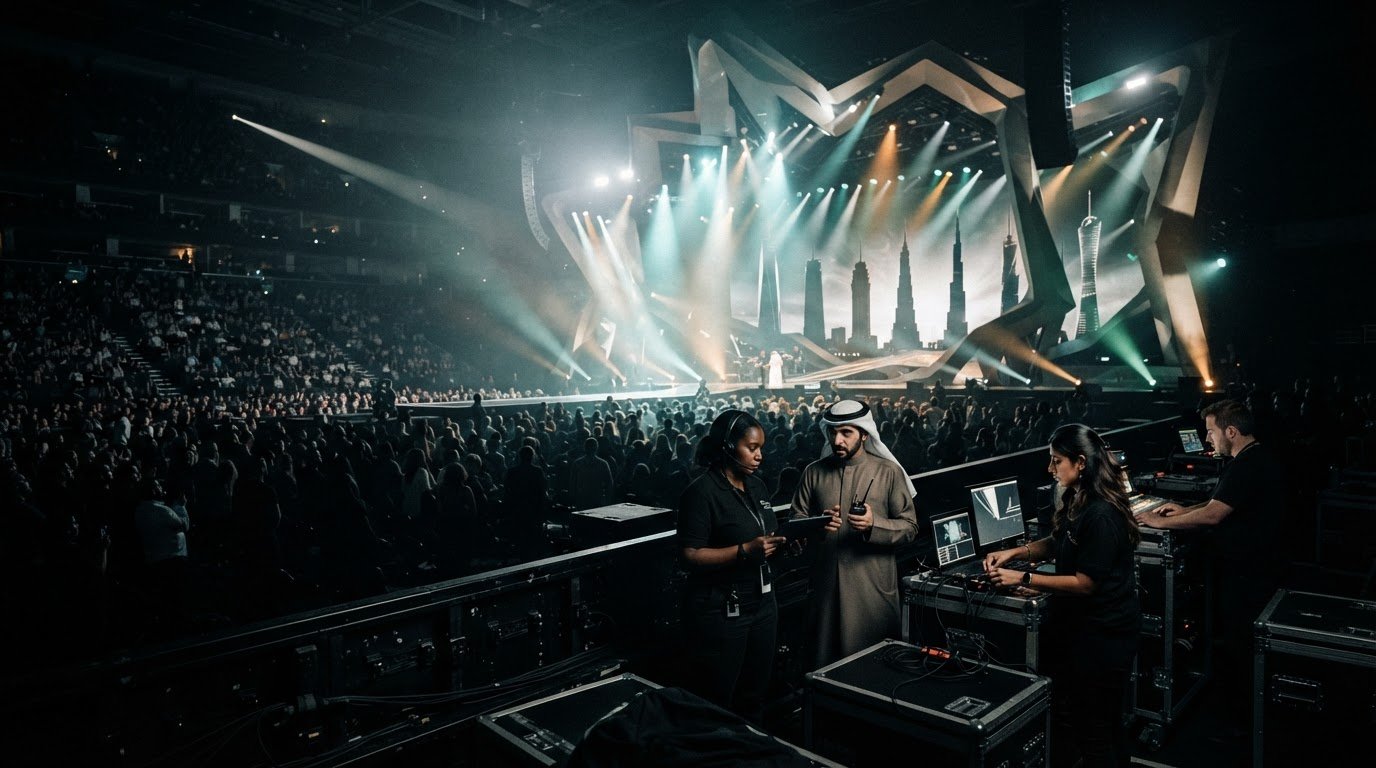
What makes an event legendary: the spectacle, or the way every detail serves a clear purpose? Knowing how to produce a legendary event means looking beyond a striking stage or headline moment. The challenge is to turn an ambitious idea into an experience that feels coherent to its audience and can be delivered with precision.
Creative ideas can lose their force when they aren’t connected to practical decisions, while spectacle alone can leave the question of impact unanswered. The strongest productions bring purpose, audience experience and execution into alignment.
This guide explains how to define a distinctive ambition, shape the experience around your audience and translate creative choices into a disciplined production plan. It also covers how to assess success against clear objectives, not spectacle alone. Lar&Co, “Producers of Live Entertainment”, works across varied contexts, from Gorillaz - House of Kong and Gucci Cosmos to the UAE’s 50th National Day Celebration. The examples underline a central principle: scale and style may differ, but coherence connects an idea to its delivery.
Key Takeaways
• Learn how to produce a legendary event by defining success through audience meaning and purpose, not scale or spectacle alone.
• Turn a central creative idea into an audience journey, from arrival to the final moment.
• Assess event concepts for distinctiveness, audience value and practical feasibility before committing to delivery.
• Follow a clear planning sequence, with key decisions and outputs at each stage, from objectives to evaluation.
• See how Lar&Co, “Producers of Live Entertainment”, connects creative direction with technical production and site management.
How to Produce a Legendary Event Starts with a Clear Ambition
Before choosing a venue, format or headline moment, decide what the event must mean. The first step in understanding how to produce a legendary event is to set an ambition that gives every creative and practical decision direction. Without it, a programme can become a collection of impressive elements that never quite add up to a meaningful experience.
Start with three questions: who is the event for, what should they feel, and why are you bringing them together? Make the answers specific enough to guide choices, but broad enough to leave room for creative interpretation. A launch might aim to make its audience feel part of a brand’s next chapter. A cultural celebration might bring people together around a shared identity.
What does legendary mean in live entertainment?
A legendary live event is a distinctive, audience-relevant experience whose creative idea remains coherent from its purpose through to its final moment.
This definition puts lasting significance ahead of sheer scale. A large production, elaborate staging or famous performer can attract attention, but none guarantees that an event will matter to the people in the room. An experience earns its place in memory when its details express a recognisable point of view and give the audience a reason to care.
Test the idea from the audience’s perspective. Could guests describe what made the event different? Did the atmosphere, content and format feel connected to its purpose? If removing a spectacular element leaves the event’s meaning unchanged, that element may be decoration rather than a defining choice.
Set the event’s purpose before shaping its format
Be clear about what the host wants to achieve and whom the event needs to serve. “Raise awareness” or “make an impact” are starting points, not working objectives. Name the audience and the intended response: what should people understand, feel or be moved to do after attending?
Then turn the ambition into a focused set of creative and practical objectives. These might include communicating one central message, creating opportunities for artists and audiences to connect, or making the experience work for guests throughout their visit. Objectives should help the team make decisions, not simply describe an aspiration.
Purpose
What is the host seeking to achieve?
Audience
Whose needs, interests and expectations should shape the experience?
Feeling
What should guests carry with them afterwards?
Evidence
What observable response would indicate that the event served its purpose?
These answers form a brief the creative and production teams can use to assess ideas. Event management principles encompass planning, execution and evaluation. A clear ambition connects those stages to the event’s intended value. Lar&Co, “Producers of Live Entertainment”, has worked on varied productions, including the UAE’s 50th National Day Celebration. The context differs from a brand experience or festival, but the starting point is the same: define what the gathering is for before deciding what it should look like.
Build the Event Around One Idea, One Audience and a Clear Experience
A clear ambition gives the event direction. The next task is to turn it into an idea that people can recognise across the programme, setting and details of their experience. This is where creative direction becomes practical: it gives the team a shared basis for deciding what belongs, what needs refining and what might distract from the event’s purpose.
Turn the event concept into a coherent narrative
Describe the central idea in plain language. A useful concept should fit into a sentence that the whole team can understand and apply. Avoid relying on production jargon or a mood board alone. The idea needs to explain why the event exists and what should make it distinct for its audience.
Then give the idea tangible expression. The setting can establish its character, the programme can develop it, and visual choices can make it recognisable. These elements don’t need to repeat the same message literally. They should feel as though they belong to the same world. Test each choice against the concept: does it deepen the experience, help the audience understand it or serve a practical need? If not, reconsider its role.
For more on shaping a unified vision into creative choices, explore creative direction for live shows. The principle applies across formats, from concerts to brand experiences. Lar&Co’s work includes Creamfields and Gucci Cosmos, two different live contexts that show why a production concept must suit the event rather than follow a universal formula.
Design for the audience’s full journey
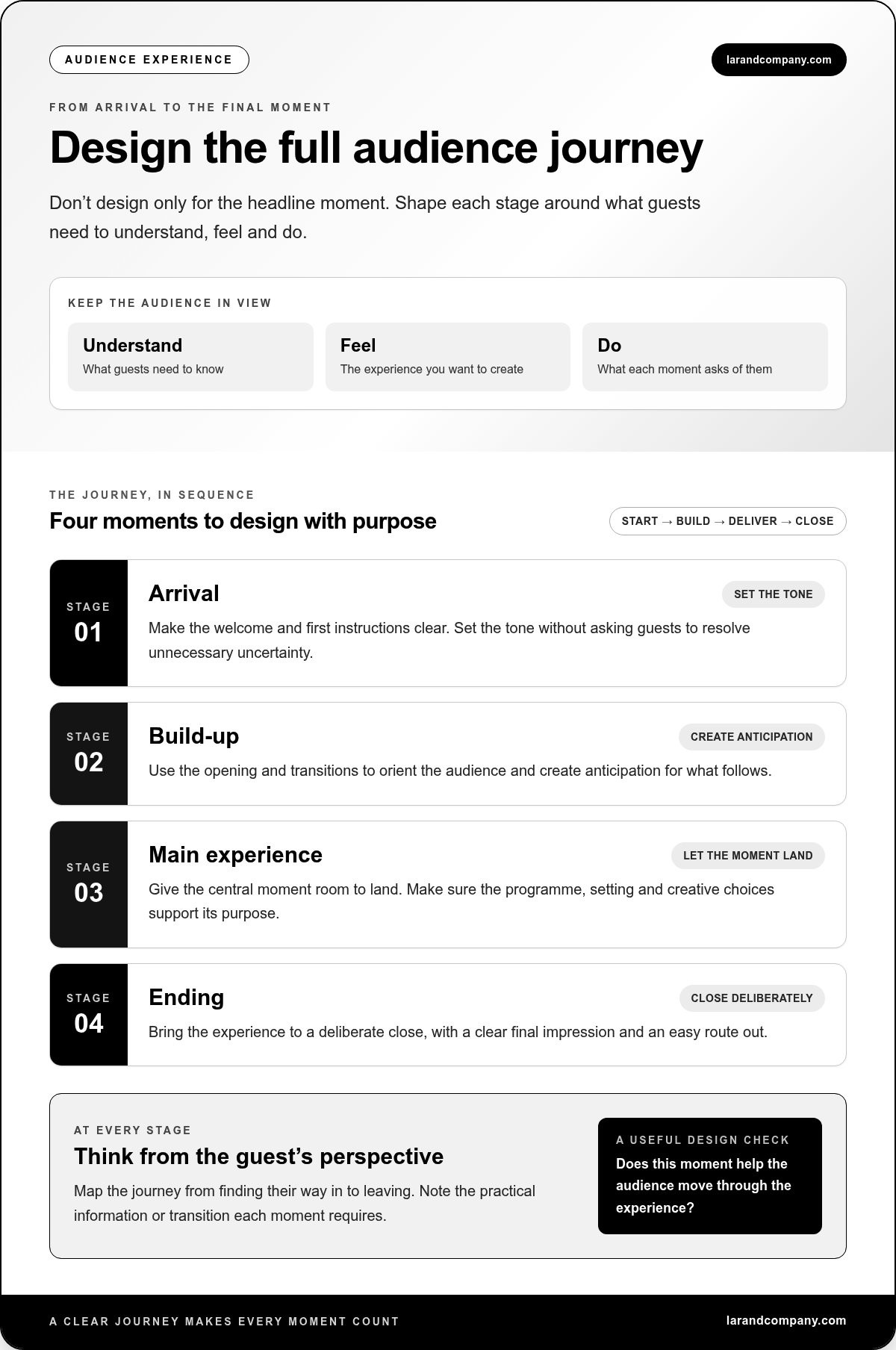
Don’t design only for the headline moment. Consider what guests need to understand, feel and do at each stage, from finding their way in to leaving. Map the journey in sequence, noting the audience’s perspective and the practical information or transition each moment requires.
Arrival
Make the welcome and first instructions clear. Set the tone without asking guests to resolve unnecessary uncertainty.
Build-up
Use the opening and transitions to orient the audience and create anticipation for what follows.
Main experience
Give the central moment room to land. Make sure the programme, setting and creative choices support its purpose.
Ending
Bring the experience to a deliberate close, with a clear final impression and an easy route out or into the next activity.
Rhythm matters. A sequence of high-intensity moments can blur together, while a pause or change in pace can renew attention. Build contrast deliberately: anticipation before a reveal, energy followed by reflection, or a moment of release after sustained focus. Transitions are part of the experience, not empty space between headline acts. They help guests follow the story and give important moments their proper weight.
As you refine the journey, keep the audience’s needs in view and test whether each part supports the central idea. Explore Lar&Co’s live production work to see the range of contexts in which creative ambition meets live delivery.
Make Ambition Deliverable: Balance Distinction with Production Reality
A distinctive idea doesn’t need maximum scale or a constant succession of spectacular moments. It needs choices that matter to the audience and can be delivered as intended. If you’re learning how to produce a legendary event, treat production reality as part of creative development, not a restriction to consider after the concept is set.
Choose ideas for meaning, not spectacle alone
Assess each proposed moment against the event’s purpose. Ask what it gives the audience, how distinctly it expresses the idea and what it adds to the experience. A signature moment earns its place by bringing those elements together. An elaborate feature that adds complexity without strengthening the concept may be less valuable than a simpler, better-integrated choice.
Coherence makes spectacle meaningful; spectacle alone can’t make an event coherent.
Use a simple comparison before committing to creative elements. These questions are prompts for discussion, not a scoring system. Judge each idea in the context of the event.
Audience value
Does this help guests understand, feel or participate in something meaningful, or is it mainly there to impress?
Distinctiveness
Does it express the event’s point of view, or could it be added unchanged to almost any occasion?
Feasibility
Can the team deliver it within the site, schedule and operational conditions? What dependencies does it introduce?
Purpose
Does it advance the event’s central reason for bringing people together, or compete with it for attention?
Consider a striking visual feature. It may support a concept if it helps the audience understand the setting or marks a meaningful shift in the programme. If it serves no clear audience or purpose, it could create additional technical and operational demands without adding corresponding value. Keep signature moments. Refine or remove the rest.
Connect creative choices to production planning
Every creative decision has practical consequences. A staging idea can affect sightlines, access and site requirements. A programme change may alter timings, transitions and coordination between performers and technical teams. Exploring these dependencies early gives the team room to adapt an idea before it becomes difficult to change.
Bring creative, technical and operational perspectives into concept development from the outset. Together, the team can identify what needs to be in place, which choices depend on one another and where a different approach could preserve the intended experience. This isn’t about reducing ambition. It’s about giving ambition a workable route to delivery.
For a closer look at how technical decisions support live experiences, explore technical production for live events. Lar&Co provides event production, technical production and site management, connecting creative ambitions with practical planning.
How to Produce a Legendary Event: A Practical Planning Sequence
A strong concept becomes deliverable when decisions are made in a useful order and shared across the people responsible for the work. This sequence turns ambition into a plan while keeping creative intent connected to schedule, site, technical and financial considerations. For broader operational context, explore large-scale event management.
Define the objectives.
Decide what the host needs the event to achieve, who it needs to serve and what evidence will help show whether it did so. The host or event owner sets priorities with input from the creative and production leads. The output is an agreed brief covering objectives, audience needs, scope and decision-making roles. This gives the team a reference point when competing requests arise.
Shape the concept.
Turn the brief into a creative direction that can guide the programme, setting and audience experience. The host, creative lead and key production stakeholders agree the core idea and identify the choices that express it. The practical output is a concept plan that distinguishes essential elements from options, so later decisions don’t blur the event’s intent.
Test feasibility.
Examine how the concept interacts with the site, technical requirements, schedule and financial parameters. Creative, technical and site leads identify dependencies together. A staging choice may affect access and timing, while a programme change may require different coordination. Record decisions to resolve, assumptions to test and adjustments that could preserve the intended experience.
Plan delivery.
Convert agreed decisions into milestones, workstreams and clear ownership. Production leads coordinate the schedule, site planning, technical delivery and financial management. The host retains responsibility for approvals within the agreed decision structure. The output is a shared production plan showing what must happen, who owns each action and how workstreams depend on one another. Keep the central objectives visible as the detail grows.
Evaluate the event.
Review the experience against measures chosen before delivery, not just attendance or visual impact. The host and relevant project leads gather information that reflects the original objectives, such as audience responses or whether key messages were understood. The output is a concise evaluation recording what served the purpose, what fell short and what the team should carry forward.
Protect the idea through delivery and review
Plans will change as decisions meet practical conditions. A shared brief and visible objectives help the team assess those changes consistently: does the adjustment protect the audience experience, preserve the event’s purpose and remain workable? Keep approvals, responsibilities and dependencies clear, so a change in one area doesn’t create confusion elsewhere.
Clear objectives set the direction, coordinated delivery carries the idea into the room, and meaningful review shows what the experience achieved. This is a practical foundation for anyone learning how to produce a legendary event. Lar&Co’s production management brings together the coordination of stakeholders, timelines and deliverables from concept through to completion.
Lar&Co Live Entertainment: From Ambition to Delivery
Lar&Co describes itself as “Producers of Live Entertainment”. Its work spans concerts, festivals, brand experiences and cultural celebrations, where creative ambition must carry through into a considered live experience. The production process connects an idea to the decisions that shape how an event is made: creative direction gives it a point of view, while show and technical production, site management and financial management support the planning and coordination behind delivery.
A production practice across live-event contexts
Every context brings its own audience, purpose and creative demands. A festival, a brand experience and a cultural celebration don’t call for identical approaches. The production process starts by understanding what the event needs to express, then aligning creative and practical decisions with that intent. This requires coordination across disciplines, from shaping the experience to planning the site and technical delivery.
Lar&Co’s work includes Adele World, Creamfields and Gucci Cosmos. These examples represent different live-event contexts, not identical formats or production requirements. The Lar&Co live-event portfolio shows the range. For organisations developing a significant experience, the starting point is the event itself: its audience, its purpose and the idea that should guide its choices.
As plans develop, creative direction helps maintain a recognisable thread, while technical production and site management connect that direction to the conditions of live delivery. Show production brings programme and performance requirements into the planning picture. Financial management keeps decisions connected to the project’s financial framework. Artist liaison supports coordination with artists as part of the wider production. Each discipline has its own focus; their value comes from working towards a shared brief.
Take the next step with a clear event ambition
Before discussing delivery, prepare a short statement of what you want the event to achieve. Name the audience, the purpose and the central idea. Note what you want guests to understand, feel or remember, and identify any fixed parameters that will shape planning. You don’t need every detail resolved. A clear starting point gives the first production conversation substance and helps distinguish essential decisions from details that can develop later.
This is a considered way to approach how to produce a legendary event: pair a distinctive ambition with the disciplines needed to realise it. The right plan won’t impose a formula on every event. It will connect the specific creative idea to practical decisions, keeping the intended experience in view as work progresses.
If your organisation is shaping a significant live experience, explore Lar&Co’s production work across festivals, concerts, brand experiences and cultural celebrations.
Give Your Event Ambition Its Next Step
Turn your ambition into a brief that can guide real decisions. Write down who the event is for, what it should mean to them and the central idea you want them to experience. Add the practical parameters that will shape development, then use the brief to begin conversations about creative direction and delivery. A clear starting point gives the work room to develop without losing its purpose.
For Lar&Co, “Producers of Live Entertainment”, the portfolio spans concerts, festivals, brand experiences and cultural celebrations. Listed examples include Gorillaz - House of Kong, Adele World and the UAE’s 50th National Day Celebration. Each is a distinct context for live production, and a reminder that ambition should lead the format, not the other way round.
Knowing how to produce a legendary event begins with a meaningful idea and continues through the choices that bring it to life. Take your next step with Lar&Co: Explore Lar&Co’s live-entertainment production work.
Frequently Asked Questions
What makes an event legendary rather than simply successful?
A legendary event leaves its audience with a distinctive memory connected to why they gathered. Success might mean meeting the host’s immediate aims; lasting significance comes when guests can recall a particular moment, idea or feeling and explain why it mattered to them. Ask attendees what they would tell someone who wasn’t there. Their answers can reveal whether the event made a genuine impression.
Can a small event be legendary without large-scale production?
Yes. A smaller gathering can be memorable through intimacy, relevance and deliberate attention to its guests, rather than scale. A discussion for a specialist audience, for instance, might give participants meaningful access to a speaker or more time for exchange. The production choices should suit the format: a carefully considered room layout or well-paced programme may serve the purpose better than an elaborate stage.
How do you create a memorable audience experience?
Give people a reason to engage, not just a sequence of things to watch. Consider where guests can participate, what they need to know at each point and how they can move through the event. Test the plan from a guest’s perspective, including finding the entrance, understanding the programme and knowing what happens after the final session.
How early should event production planning begin?
Begin planning as soon as the event has a defined purpose and a decision-maker who can clarify priorities. The right lead time depends on the event’s scope, site, programme and the number of parties involved; no single planning window suits every production. Starting early gives the team more opportunity to identify dependencies, coordinate stakeholders and address practical questions before they constrain creative or operational choices.
How do you balance creative ambition with practical delivery?
Pair each major creative proposal with a delivery conversation. Ask what it requires from the site, programme, technical approach and team coordination, then decide whether those requirements serve the intended experience. For events in the UK, USA, United Arab Emirates, Saudi Arabia or Qatar, plan around the specific venue and stakeholders involved rather than assuming arrangements in one location transfer unchanged to another.
What should an event brief include?
An effective brief records the event’s purpose, intended audience, desired response, scope and central creative thought. It should also name who approves key decisions, identify known constraints and state how success will be reviewed. For example, if the aim is to help guests understand a new initiative, define what understanding would look like and how the host will gather feedback. This keeps the brief useful beyond the initial creative discussion.
How can you measure whether an event achieved its purpose?
Choose measures that match the stated objective before the event takes place. If the aim is to encourage discussion, attendance alone won’t show whether conversation happened; feedback or participation records may offer more relevant evidence. If the purpose is to communicate information, consider how to assess what guests understood. Compare the findings with the original aims, note gaps and use those observations to inform future decisions.