How to Set Weather Triggers for an Outdoor Festival

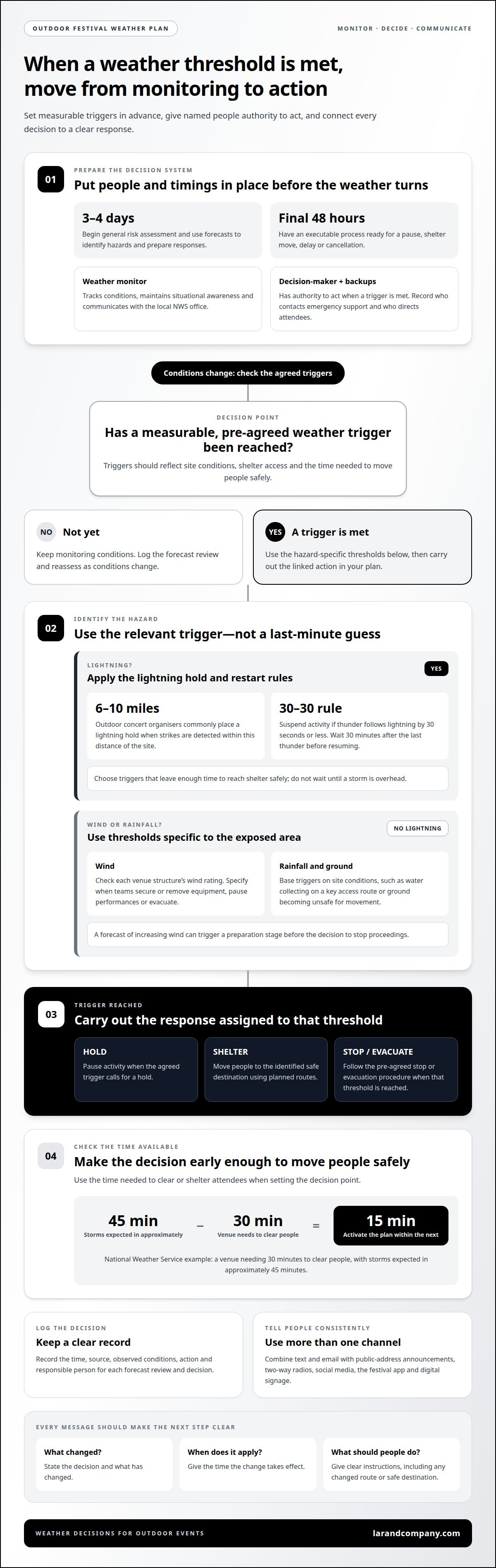
A forecast is only useful when it changes a decision. Effective weather contingency plans for outdoor festivals assign a weather monitor and decision-maker, then set clear thresholds for holding, sheltering or stopping the event. Begin general risk assessment 3-4 days ahead and have an executable process for decisions and public notices in place by the final 48 hours.
Weather can change quickly, so monitoring alone isn’t enough. Effective weather contingency plans for outdoor festivals specify who makes decisions, what conditions trigger action and how instructions reach people on site.
This guide explains how to monitor conditions, set measurable triggers and prepare responses to heat, lightning, flooding and storms. It also covers protecting attendees and staff, coordinating vendors and sharing clear updates. Use these principles to build plans around timely decisions, not last-minute guesswork.
Key Takeaways
• Start assessing weather risks 3-4 days ahead, then have clear decision and communication procedures ready by the final 48 hours.
• Assign a weather monitor and a decision-maker, with backups, so forecasts lead to timely action.
• Set measurable thresholds for holds, shelter and cancellation, based on the time your site needs to move people to safety.
• Prepare distinct responses for heat, lightning, flooding and storms, with safe destinations and accessible routes identified in advance.
• Give vendors and guests consistent updates through more than one communication channel, including clear instructions when plans change.
Communicating consistently with vendors and guests
Prepare a weather message for each decision, from a routine delay to an emergency evacuation. Assign who approves and sends it, and which channels will carry it.
•
Notify Attendees of Logistical Changes
Send logistical updates by text and email, not only on social media. State what has changed, when it takes effect and what attendees should do next. If rain changes parking or entry routes, name the new route and direct people to signs or staff. Repeat the same instruction on site through the public-address system, festival app and digital signage.
•
Coordinate Weather Updates with Stakeholders
Give staff, vendors and event partners a shared update schedule and an agreed message for each weather scenario. Prepare short scripts for delays, shelter instructions and cancellations, and identify who can approve each message. Give emergency managers direct access to notification systems so urgent updates do not wait for an intermediary.
• Give each vendor a weather contact and a written fallback plan. Specify alternate setup locations, available power and planned changes to tents or flooring if the ground becomes wet. For example, a food stall moved from a waterlogged area needs a confirmed location and a clear restocking route. Tell vendors how updates will arrive and how to acknowledge changes.
• Build redundancy into emergency communications. Combine text and email with public-address announcements, two-way radios and social media, and assign someone to coordinate the festival app and digital signs. Keep wording consistent across channels, and ensure team leads know where to find the latest instruction. Don’t rely on mobile phones alone for reunification, as service may fail after a weather emergency.
Arrange an indoor backup venue where possible, and decide in advance whether a rain date or rescheduling is workable. Tell attendees how postponement or cancellation decisions will be announced, and make the policy clear before the event.
Insurance cover varies by policy. Before signing, review which weather events are covered, cancellation and interruption terms, premiums and the claims process. The policy wording determines which losses qualify and what evidence a claim requires.
How can I monitor weather conditions effectively for my outdoor event?
For an outdoor event, turn forecasts into pre-agreed decisions, with named people responsible for monitoring conditions and taking action.
Planning costs depend on the site, hazards, staffing and required resources; the price is set through a quote. Publish refund, postponement and rescheduling terms before ticket sales, and prioritise attendee safety if extreme weather forces cancellation.
• Start monitoring forecasts 3-4 days ahead. The National Weather Service provides a 7-day summary forecast when you enter the event location on its Forecast Points page. Use it to identify hazards and prepare responses, not to make a final decision too early.
By the final 48 hours, have an executable process for a pause, shelter move, delay or cancellation. At a remote outdoor event, download radar apps in advance or assign someone to monitor conditions, since mobile coverage may be unreliable.
• Name a weather monitor and a decision-maker, with backups. The National Weather Service recommends a weather liaison who maintains situational awareness, communicates with the local NWS office and supports or activates the response plan.
Give the decision-maker authority to act when a trigger is met. Record who contacts emergency support and who directs attendees, so a forecast update does not leave responsibilities unclear.
• Set lightning triggers before opening. Outdoor concert organisers commonly place a lightning hold when strikes are detected within 6-10 miles of the site. The National Weather Service’s 30-30 rule advises suspending activity when thunder follows lightning by 30 seconds or less, then waiting 30 minutes after the last thunder before resuming.
Choose triggers that reflect shelter access and the time needed to move people safely. A hold must leave enough time to act, rather than waiting until a storm is overhead.
• Set wind and rainfall thresholds for each exposed area. Check each venue structure’s wind rating, and specify when teams secure or remove equipment, pause performances or evacuate. Base rainfall triggers on site conditions, such as water collecting on a key access route or ground becoming unsafe for movement.
Make every threshold measurable and link it to an action. For example, a forecast of increasing wind can trigger a preparation stage before the decision to stop proceedings.
• Log each forecast review and decision, including the time, source, observed conditions, action and responsible person. These records help teams track changing conditions and explain why a hold or cancellation occurred.
Use the time needed to clear or shelter attendees when setting the decision point. In the National Weather Service’s example, a venue needing 30 minutes to clear people, with storms expected in approximately 45 minutes, should activate its plan within the next 15 minutes.
For complex sites, integrate weather decisions into the wider festival production plan.
Costs vary with the site’s hazards, staffing and required resources; a quote determines the price.
Heat, lightning, flooding, and storm safety
Build the response around the site’s hazards, available shelter and the time needed to move people safely. Keep separate procedures for routine rain and severe weather.
•
Secure Temporary Structures in Wind
Secure temporary structures for the strongest wind conditions expected during the event, and follow the venue’s rules for staking or concrete weights. Set a clear action for each wind trigger: inspect, reinforce, secure or remove exposed equipment. Tents, stages and rigging may not withstand a sudden 50 mph gust, so don’t treat a structure as shelter simply because it has a roof.
Secure lightweight items, such as promotional flags and fabric banners, so they cannot become airborne hazards. High-quality soft signage and event materials from specialists like Zodiac Event Displays are designed to withstand outdoor conditions, but on-site teams must still identify who can stop activity and clear an affected area if conditions worsen.
•
Provide Shade and Hydration for Heat Safety
Place shade and hydration stations where attendees and staff can reach them without crossing vehicle routes or blocking exits. Provide enough water, and consider a cooling station with fans and cold water in hot weather. A misting tent or other cooling centre can offer another place to cool down.
Include staff in the heat plan. Tell stewards where to find water, shade and cooling areas, and ensure at least one event staff member is trained in first aid for weather-related emergencies, including heat stroke.
•
Address Lightning, Flooding and Storm Safety
Identify where attendees should go during flooding or a severe thunderstorm, then brief staff so they can direct people there. Emergency shelters should accommodate everyone attending. Keep routes clear, and consider how wet or muddy ground affects people using wheelchairs, walkers or prosthetics.
The National Weather Service Event Ready guidance recommends adding a 25% safety factor when calculating evacuation or sheltering time. Apply that allowance to the site’s actual movement plan, not just the distance to shelter.
•
Educate the Public on Weather Safety
Explain emergency procedures before the event and repeat them at entry points, on screens and in public announcements. Give direct instructions, such as which shelter to enter and which route to follow, rather than broad warnings about severe weather. Staff and vendors need the same directions as attendees.
Run a briefing or drill so teams can practise directing people to shelter. For example, walk the route from a performance area to the designated safe location and identify obstructions before gates open.
Heat-index monitoring and heat protocols
Use heat-index monitoring to connect changing conditions with clear operational steps. Keep forecast data, observations at the venue and response messages aligned.
•
Use Weather APIs for Real-Time Monitoring
Set up a weather feed to display conditions relevant to the site, including heat index, temperature and humidity. Link each measure to a planned action, such as opening a cooling area or adjusting the programme. The feed supports decisions but does not replace the event’s agreed safety procedures.
Record the source and update time beside each reading. If a feed stops updating, switch to a named backup source and alert the weather monitor. An outdated dashboard reading can create a false sense of certainty as conditions change.
Test the message linked to each trigger before the event. For example, a heat alert should identify who approves the response, which team receives it and what action is expected on site.
•
Monitor Weather at the Venue
Compare forecast information with conditions across the festival site. A paved queue, shaded entrance and exposed performance area can feel different under the same regional forecast. Ask the monitoring team to observe where attendees gather, rather than relying on one convenient point.
Record the location and time of each observation. A reading near a shaded control point may not represent an open audience area. Compare venue observations with the wider forecast, and escalate when conditions in a busy area differ from the plan’s assumptions.
Include ground conditions in the same review. Rain may leave a route muddy or waterlogged even as conditions elsewhere improve. This affects where staff can direct people and which areas remain suitable for queues or activities.
•
Track Forecasts for Changing Conditions
Set a regular review rhythm and increase monitoring as event conditions change. Compare each new forecast with the previous one, noting shifts in heat, wind, rain or storm risk. The National Weather Service is available 24/7 to assist event weather liaisons.
Set a staged heat response before the event: monitor, prepare, act and review. Link each stage to an operational change, such as checking water points, opening shade or adjusting an exposed activity. Base decision criteria on the site and its planned response, not an arbitrary figure.
After each review, send one concise message to the relevant team. State the current conditions, the action in force and when the next review will take place. This creates a usable record and connects the heat protocol to live monitoring.
Measurable weather triggers and action thresholds
A useful trigger links a defined weather condition to a specific action, owner and decision time. Set thresholds in advance, then match them to the site’s capacity and response plan.
• Define each hazard and the conditions that require action. The National Weather Service Event Ready Guide recommends identifying relevant hazards and the magnitude that would require a response. For example, specify what rainfall means for a particular area: water reaching a marked point, a route becoming impassable or standing water affecting equipment.
Pair every threshold with an instruction. “Monitor heavy rain” is too vague; “close the low-lying route when water reaches the marked boundary” gives staff a clear decision.
• Calculate the time needed to protect people before setting a trigger. Include how long it takes to alert attendees, clear exposed areas and reach shelter. A site that needs 25 minutes to move attendees into shelter needs a different decision point from a smaller site that can clear exposed areas quickly.
Work backwards from the hazard’s expected arrival, allowing enough time for people to move safely. The trigger must leave time to act, not simply announce that conditions are worsening.
• Build stages between routine monitoring and evacuation. A prepare-to-hold stage gives teams time to pause entrances, secure equipment and ready shelter before an evacuation call. Define who activates each stage and what changes operationally, so “prepare” prompts a clear response rather than uncertainty.
For vendors, specify when to protect stock, stop service or move from an exposed setup. Link each action to the same threshold used by the event team.
• Set separate thresholds for holding, resuming and cancelling. Define which severe conditions require a pause, what conditions allow activity to restart and when the event must end. Include acceptable rainfall levels and the resulting steps for equipment protection and audience safety.
Make cancellation criteria clear before the event. Explain how decisions will be communicated and what happens if the event is postponed or cancelled, including the applicable ticket policy.
• Put each trigger, action, decision-maker and backup on a concise operational card. Test the sequence with a scenario: a forecast worsens, the monitor reports that a threshold is met, and the decision-maker orders a hold. Record the decision time and confirm staff and vendors receive the same instruction.
For production planning that connects weather thresholds with site operations, discuss your event requirements.
Lar&Co
Lar&Co brings weather decisions into the wider planning and delivery of live events. Its Site Management and Technical Production connect operational thresholds with site activity, production requirements and clear team responsibilities. This is especially useful for festivals with complex infrastructure, several operating areas or multiple teams that need to act in sequence.
Creative Direction and Show Production can also help keep programme decisions aligned with the event’s operational response. The aim is a joined-up plan, where weather triggers support practical decisions about activity, people and production rather than sitting apart from them.
Contact Lar&Co to discuss your festival’s production and site requirements.
Carry the plan into your next festival
Treat weather contingency plans for outdoor festivals as a working framework, not a document that ends when the gates close. After each event, review how decisions translated into action across the site. Consider where teams needed clearer authority, where instructions were difficult to follow and whether the response matched conditions on the ground.
Use those observations to refine the next edition’s operational design. A change to a stage layout, audience route or vendor area can alter how a weather response works, even if the forecast procedure stays the same. Build this review into event planning so lessons inform decisions before production details are finalised.
The result is a plan shaped by the realities of your event, and better integrated with its wider delivery. For support planning your festival, contact Lar&Co to plan your festival.
Deliberate review and clear ownership help your next event move forward with greater operational clarity.
Frequently Asked Questions
What are the key components of a weather contingency plan for outdoor concerts?
A concert plan needs hazard triggers, decision authority, actions and a way to record each decision. Add a scenario matrix linking conditions to operational consequences: for example, high winds may affect stage activity differently from audience access. Include restart criteria, cancellation procedures and a post-event review. Use that review to identify impractical responses and carry the lessons into the next event plan.
What should be included in shelter plans for outdoor events?
A shelter plan should identify destinations, routes, capacity and the staff responsible for directing people. Confirm that shelters can accommodate attendees, staff and vendors who need protection, not just the audience. Map accessible routes from key areas, including stages, food areas and entrances. Explain what happens if the primary shelter is unavailable, and use the same place names on signs and in staff instructions.
What should an outdoor festival weather contingency plan include?
Include procedures for monitoring, decision-making, shelter, evacuation, event pauses and cancellation. Make the plan usable on site with a concise trigger-to-action table, named authorities for each response and clear arrangements for accounting for people afterwards. Plan how to protect equipment and resume operations when conditions improve. For example, after rain, inspect the site before reopening muddy routes or restarting activities.
When should an outdoor festival pause, evacuate, or cancel for lightning?
Pause activity when lightning poses a risk to exposed areas, then direct people to appropriate shelter. Evacuate when the site’s lightning response requires people to leave those areas, and cancel if safe shelter or continued operation cannot be maintained. Base the decision on the event layout, available shelter and time needed to move attendees. A lightning distance alone should not replace a practical assessment of site conditions and safety.
What are wind-speed safety limits for festival stages, tents, and temporary structures?
There is no single wind-speed figure that suits every stage, tent or temporary structure. Set limits for each structure using its design information, installation conditions and venue requirements. Specify the action for each limit, such as securing equipment, stopping activity or clearing an area. Wind exposure can vary across a site, so the monitor should report conditions where structures and audiences are located.
How should festivals prepare for extreme heat, cold, heavy rain, and flooding?
Match resources to each hazard. For heat, provide drinking water, shade and cooling areas; for cold, plan suitable warm-up options and monitor heating arrangements. Heavy rain calls for protected equipment, drainage checks and usable walkways. For flooding, identify higher safe areas and routes that avoid low ground. Never operate a generator indoors, and monitor oxygen levels if using portable heaters or fire pits.
What are the evacuation and shelter requirements for outdoor events in the United States?
Plan for the venue, event size, accessible movement routes and applicable local requirements. Emergency shelters should accommodate everyone attending, and evacuation routes should remain clear and accessible. Set decision times based on how long movement takes across the actual site, including slower routes or crowded areas. Coordinate the plan with venue procedures and local emergency arrangements, then brief staff on their roles.
How should festival organisers communicate weather alerts and evacuation instructions to attendees?
Give clear, direct instructions that state the action, destination and route. Prepare separate messages for a hold, shelter move, evacuation and cancellation, and use consistent place names in announcements. Combine channels so people can receive an alert even if they miss a stage announcement. During an evacuation, tell attendees what to do next and position staff to guide them at junctions, entrances and other decision points.