Large Scale Event Production Companies: A Guide to Global Excellence in 2026

The greatest risk in commissioning a world-class live event isn't the headline act cancelling or the weather turning. It's choosing a production partner who treats your multi-million pound vision as a purely technical exercise. When the stakes are this high, large scale event production companies that excel on a global stage are defined not by their equipment lists, but by their management discipline: the rigorous oversight of logistics, finance, creative vision, and international risk.
If you've ever faced the prospect of delivering a landmark show in an unfamiliar territory, you'll know the particular anxiety it carries. The fear of logistical failure abroad, budgets spiralling without clear reporting, vendors who can execute a cue sheet but can't shape a moment; these are the pressures that separate a forgettable event from a genuinely significant one.
This guide examines what separates elite production partners from the rest, and what you should demand from any agency managing your most important work. From the disciplines of show production and site management to the often-overlooked craft of financial oversight, here is what global excellence looks like in 2026.
Key Takeaways
• The defining difference between a technical vendor and a true production partner lies in management discipline — covering creative vision, logistics, and financial oversight in equal measure.
• Elite large scale event production companies are evaluated not by their equipment catalogues, but by their global footprint, specialist expertise, and proven ability to manage international risk.
• Transparent financial reporting is one of the most overlooked safeguards in high-value event commissioning — this guide explains what rigorous fiscal oversight should look like in practice.
• Delivering a world-class event follows a structured roadmap, from early-stage creative consultancy and feasibility studies through to full technical direction and site management.
• With 20 years of expertise and offices in London and Los Angeles, Lar&Co offers a model of international production practice built for the highest-profile live entertainment commissions.
Defining Large Scale Event Production in 2026
Large-scale event production is not a technical exercise. It is the integration of creative vision, engineering precision, and global logistics into a single, coherent experience. Understanding that distinction is the starting point for any serious commissioning decision in 2026.
At its core, event management at the highest level demands far more than the coordination of equipment and crew. It requires a governing intelligence: a production partner who holds the artistic, operational, and financial threads simultaneously, and who understands that each decision in one domain has consequences in the others.
The Shift from Technical Vendor to Production Partner
Hiring a "gear house" made sense when shows were simpler. It no longer does. The complexity of modern international productions — spanning multiple territories, live broadcast requirements, and culturally specific audience expectations — demands a different kind of partner entirely.
The distinction matters. A technical vendor delivers equipment and crew against a specification. A production partner shapes the specification itself. The Producer sits at the intersection of artistic direction and physical execution, translating a creative brief into a buildable, deliverable reality. They manage the relationship between storytelling and technology, ensuring that the staging, lighting, and sound don't simply function correctly but serve the emotional intent of the show.
This is precisely where large scale event production companies of genuine standing separate themselves from the market. The question isn't whether they can run a cue sheet. It's whether they can build the show that makes the cue sheet worth running.
Identifying High-Stakes Complexity in Modern Shows
Scale introduces a particular kind of pressure. A 70,000-seat stadium show and a bespoke cultural celebration in the Gulf carry entirely different challenges, yet both demand the same rigour. Consider what's at stake in a live broadcast environment: a single unresolved technical issue becomes a permanent record. There is no second take.
The shows that define careers and reputations share common characteristics:
Immersive, technology-integrated design
that responds to audience behaviour rather than simply filling a stage
Cultural sensitivity
baked into the production framework from the earliest planning stages
Meticulous attention to detail
across every vendor relationship and technical dependency
International logistics discipline
that anticipates risk rather than reacting to it
Show Production, as a discipline, is the end-to-end oversight of live entertainment experiences, from initial concept to final strike. It is the framework within which every other production decision is made, and it's the standard by which the best in the industry are measured.
Evaluating Capabilities of Elite Production Agencies
Not all production agencies operate at the same altitude. The gap between a competent regional supplier and a genuinely elite international practice becomes visible the moment complexity enters the equation: a multi-territory tour, a broadcast-critical cultural celebration, a stadium show in a market where the infrastructure doesn't yet exist. At that level, the evaluation criteria shift entirely.
Large scale event production companies of genuine standing are defined by three things: where they operate, what they specialise in, and who they deploy. Geography matters because production is irreducibly local. Specialisation matters because a team that has delivered concert tours, festivals, and high-profile corporate events develops a different quality of instinct than one that has done only one of those things. And talent matters because no system, however well designed, outperforms the people running it.
Lar&Co's dual presence in London and Los Angeles isn't incidental. These remain the two cities where the most significant live entertainment decisions are made, where the highest-calibre creative and technical talent is concentrated, and where the industry's most demanding clients commission their most important work. Operating from both simultaneously signals something about the scale of ambition a practice is built to serve.
Creative Direction vs. Technical Execution
The most important question an elite agency answers isn't "can we build this?" It's "should we build this, and if so, how?" Creative direction at the highest level begins with a client's vision and moves through a rigorous feasibility process: structural engineering constraints, local permitting requirements, load-in timelines, and the physical realities of a given site. The creative and the technical are not sequential; they're simultaneous. A stage design that can't be safely constructed is not a design at all. Discover our work across global stages to understand what this integration looks like in practice.
Global Reach and Regional Logistics
Delivering in the UK, the USA, and across the Middle East, including the UAE, Saudi Arabia, and Qatar, requires more than a passport and a freight forwarder. Each market carries distinct regulatory frameworks, union structures, climate considerations, and cultural protocols that directly affect production decisions. Building a temporary stage in a Gulf desert environment presents challenges that no amount of European experience automatically prepares a team for. Local knowledge, embedded within the production structure rather than bolted on as an afterthought, is the difference between a smooth build and a crisis managed in real time.
UK productions
demand familiarity with local authority licensing, heritage site restrictions, and established union agreements
US productions
require navigation of state-by-state permitting, IATSE labour structures, and broadcast compliance standards
Middle East productions
call for sensitivity to cultural protocols, extreme climate logistics, and rapidly evolving infrastructure landscapes
Site management sits at the centre of all of this. It's the discipline that translates every upstream decision, creative, financial, and logistical, into a physical reality on the ground. Without rigorous site management, even the most considered production plan unravels under the pressure of a live build.
Managing Multi-Million Pound Budgets and Risks
Financial oversight is where the most consequential failures in live entertainment occur. Not on stage, not during the build, but in the weeks and months prior, when budgets drift without rigorous reporting structures in place and procurement decisions are made without the discipline that multi-million pound commissions demand. For large scale event production companies operating at the highest level, fiscal management isn't a back-office function. It's a core competency.
Fiscal Transparency in Production Management
Managing a complex international production budget requires absolute composure and accuracy at every stage. The challenge isn't simply tracking spend; it's maintaining a live, accurate picture of financial exposure across multiple vendors, territories, and currencies simultaneously, and presenting that picture clearly to senior stakeholders who need to make decisions in real time.
Rigorous financial oversight in production management typically encompasses:
Detailed budget architecture
built from the earliest feasibility stage, not retrofitted once contracts are signed
Real-time financial reporting
that gives clients and executive stakeholders an accurate view of committed spend, projected costs, and variance at any given moment
Transparent procurement processes
that document vendor selection rationale and cost benchmarking, particularly critical for international tours where local market rates vary significantly
Production management fees
structured to align with budget adherence and project outcomes, not simply hours logged
Cost-effective procurement on a global scale requires more than negotiating individual supplier contracts. It demands a production partner with established international vendor relationships, the leverage that comes from sustained volume, and the judgement to know when a lower quote carries a higher risk. Learn about our practice and the financial management discipline that underpins every commission we carry.
Mitigating Risk in High-Profile Environments
Financial risk and operational risk are inseparable. A contingency plan that isn't costed is not a plan. The most experienced production teams build crisis management frameworks before the first site visit, not after the first problem surfaces.
Health and safety across large event crews, complex rigging configurations, and temporary structures in varied international environments carries both moral and legal weight. Rigorous risk assessment, properly resourced and documented, protects artists, crew, and clients alike. It also protects budgets; an unmitigated safety incident on a high-profile production carries costs that no contingency fund can fully absorb.
For a deeper examination of how financial management functions within the full production cycle, Production Financial Management for High-Profile Live Entertainment sets out the principles in detail. The short version: financial discipline and creative ambition aren't in tension. Properly managed, one enables the other.
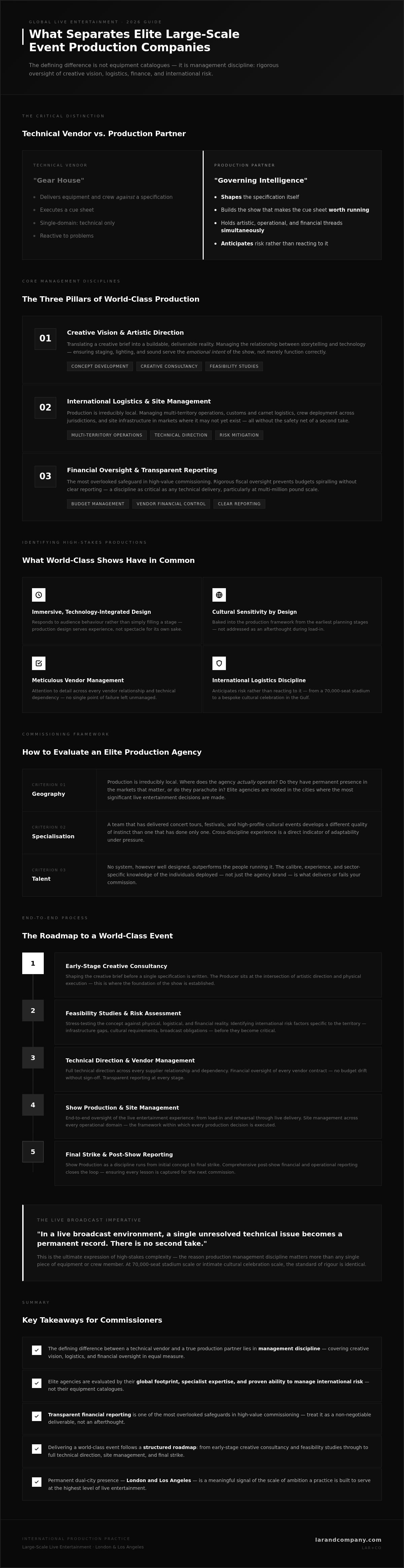
The Roadmap to Executing a World-Class Event
Every landmark show follows a logic. Not a formula, but a sequence of decisions that compounds in complexity as the build date approaches. Understanding that sequence is what separates large scale event production companies that deliver under pressure from those that merely survive it.
From Concept Design to Technical Feasibility
The earliest phase is where the most consequential decisions are made, and where the least experienced partners tend to rush. Concept development isn't a creative indulgence; it's a risk management exercise. A production partner worth commissioning will interrogate a creative brief against physical reality from day one: what does this site actually permit, structurally and legally? What are the load-bearing constraints, the sightline requirements, the local authority conditions? Artistic direction and engineering reality aren't sequential disciplines. They're simultaneous ones.
Site surveys follow concept development, not the other way around. A site survey conducted before a design is locked can reshape the entire creative approach, saving weeks of revision and significant budget exposure. For productions in unconventional locations, from coastal headlands to desert plateaux to protected heritage sites, this discipline is non-negotiable. For a fuller examination of how this process operates across high-profile commissions, Large Scale Event Management: A Guide to High-Profile Show Production in 2026 covers the management framework in detail.
Financial planning runs in parallel throughout. Budget architecture built at the feasibility stage, rather than retrofitted once contracts are signed, gives stakeholders a defensible cost picture before commitments are made. Procurement decisions taken early, with full market awareness, consistently outperform those made under schedule pressure.
Site Management and Temporary Infrastructure
The build phase is where ambition meets consequence. Managing the operational control of a complex temporary venue, whether a 60,000-capacity festival site or a bespoke cultural celebration in the Gulf, requires a command structure that is both rigorous and adaptive. Logistics, security, technical dependencies, and supplier schedules must be coordinated across a single operational framework, not managed as parallel workstreams that meet only at the point of failure.
Artist liaison sits within this structure, not outside it. In a touring environment, the relationship between production management and artist teams directly affects show quality. Call times, hospitality requirements, technical riders, and stage changeovers all carry consequences for the audience experience. Managing those relationships with precision and discretion is a craft in its own right.
Post-show, financial reconciliation closes the loop. Every vendor invoice, every variation order, every currency movement on an international commission requires documented resolution. It's the phase most clients never see, and the one that determines whether a production partner has truly delivered.
Speak to Lar&Co about your next commission and understand how this roadmap applies to your specific production requirements.
Lar&Co: The International Practice for High-Profile Shows
In a sector where many claim global reach, Lar&Co operates as an international practice defined by its presence in the world's most influential entertainment hubs. With 20 years of expertise, formerly as LarMac, our evolution to Lar&Co reflects a commitment to more integrated, high-stakes show production. Operating from offices in London and Los Angeles, we provide the level of meticulous attention to detail that high-profile commissions require. This geographic footprint is not just about office locations. It's about being embedded in the networks of talent and technology that define excellence for large scale event production companies.
Our approach relies on the gravity of our portfolio to establish credibility. We don't rely on overt promotion. Instead, we offer a sophisticated, calm, and highly confident temperament required to manage high-value international projects. We position ourselves as the quiet power behind the scenes, comfortable operating at the highest levels of entertainment and diplomacy, from prestigious cultural fairs to large-scale civic events.
Our Portfolio: A Legacy of Global Excellence
Our work exists at the intersection of diverse elite sectors. We've managed the complexities of stadium tours for musical legends whilst simultaneously delivering the precise, aesthetic demands of high-tier fashion houses. This versatility is built on a foundation of professional prestige and a commitment to understated authority. Our international reach allows us to translate a creative vision into a tangible reality in any territory, ensuring consistency of quality regardless of local challenges. For those specifically focused on the unique demands of global touring, our guide on Stadium Tour Management Services: Delivering Excellence at Scale in 2026 provides further insight into our operational standards.
How We Organise Complex International Projects
We move the conversation away from abstract creativity and toward the tangible execution of complex logistics. Every project we undertake is managed through a dedicated framework of end-to-end oversight. This includes technical production, site management, and artist liaison, all delivered with absolute composure. We don't just plan shows. We build the infrastructure that allows them to exist in any territory, from the UK and USA to the rapidly developing landscapes of the UAE, Saudi Arabia, and Qatar.
Our team handles the cross-border challenges that often compromise lesser productions. We ensure the creative vision remains intact through every border crossing and site build. This project-based management style prioritises clarity and impact over decorative prose, reflecting a business culture focused on execution and results. The scale of your ambition requires a partner who treats risk with the same seriousness as artistry. Contact our global team to discuss how we can bring our practice to your next high-profile production.
Choosing the Right Partner for What Comes Next
The difference between a production that merely functions and one that defines a career comes down to the partner behind it. Large scale event production companies operating at the highest level share three qualities: a management discipline that holds creative, logistical, and financial threads simultaneously; genuine international reach built on embedded local knowledge; and the composure to deliver when the stakes are at their highest.
Lar&Co brings 20 years of international expertise to every commission, with offices in London and Los Angeles at the centre of the world's most significant live entertainment decisions. From high-stakes cultural celebrations in the Gulf to broadcast-critical stadium productions, the practice is built for exactly the kind of work that can't afford to be managed by anyone other than the best.
Your next landmark show deserves that standard. Contact Lar&Co to discuss your high-profile production and bring the right expertise to the work that matters most.
Frequently Asked Questions
What defines a large scale event production company?
A large scale event production company is defined by its capacity to hold creative, logistical, and financial oversight simultaneously across complex, high-stakes commissions. It's not about equipment or crew size. It's about the governing intelligence that shapes a production from earliest concept through to final strike, ensuring every decision in one domain is understood in terms of its consequences for the others.
The distinction from a regional supplier or technical vendor is significant. Elite practices operate across multiple territories, manage international vendor relationships, and deploy specialists who can navigate broadcast requirements, cultural protocols, and temporary infrastructure challenges without losing sight of the artistic brief.
How do production companies manage international logistics for tours?
International logistics management begins long before any freight moves. Elite production companies build territory-specific risk frameworks that account for regulatory requirements, union structures, customs compliance, and climate conditions in each market. Established vendor relationships in key territories are essential; they provide both leverage and reliability that no last-minute local procurement can replicate.
The critical discipline is anticipation rather than reaction. A production team that has delivered in the Gulf, the UK, and North America simultaneously understands that each market has distinct operational rhythms. Embedding that local knowledge within the production structure, rather than outsourcing it, is what keeps international tours on schedule and on budget.
Why is financial oversight critical in multi-million pound show production?
Budget drift is the most common failure mode in high-value productions, and it almost always begins before the build. Without rigorous financial architecture established at the feasibility stage, committed spend accumulates faster than reporting structures can track it. By the time a variance becomes visible, the options for correcting it are significantly reduced.
Proper financial oversight means maintaining a live, accurate picture of exposure across multiple vendors, currencies, and territories at any given moment. It means procurement decisions are documented and benchmarked, not made under schedule pressure. For senior stakeholders, that transparency isn't a courtesy; it's a prerequisite for informed decision-making throughout the production cycle.
What is the difference between a technical director and a show producer?
A technical director is responsible for the safe and accurate delivery of the technical specification: rigging, power, audio, lighting, video, and the engineering decisions that underpin them. It's a role defined by precision and domain expertise. A show producer operates at a different altitude, holding the relationship between the creative vision and the physical execution of the entire production.
The producer translates a client's brief into a buildable, financeable, deliverable reality. They manage the interplay between artistic intent and structural constraint, between budget and ambition, between vendor schedules and show-day requirements. Both roles are essential; confusing them is where productions begin to lose coherence.
How do large scale production companies ensure site safety for major festivals?
Site safety at major festivals is a structured discipline, not a checklist completed at the point of build. Rigorous risk assessment begins at the feasibility stage, covering temporary structure engineering, crowd management frameworks, emergency access routes, and supplier safety compliance. Every dependency in the production chain carries a safety implication, and experienced companies document those implications before the first vehicle arrives on site.
Health and safety across large event crews and complex rigging configurations carries both moral and legal weight. The most experienced production teams understand that an unmitigated safety incident doesn't just carry human cost; it carries financial and reputational consequences that no contingency fund fully absorbs. Safety planning and budget planning are, in practice, the same conversation.
What role does creative consultancy play in technical event production?
Creative consultancy at the highest level isn't a preliminary phase that hands off to a technical team. It's an ongoing dialogue between artistic ambition and physical reality. A production partner providing genuine creative direction will interrogate a brief against site constraints, structural load limits, local authority conditions, and budget parameters from the very first conversation.
The value of this integration is measurable. A stage design conceived without reference to engineering reality generates revision cycles that consume both time and budget. Creative consultancy that operates in parallel with technical feasibility produces designs that are both artistically coherent and deliverable, which is the only standard that matters when the build date is fixed.
How do you choose the right partner for an international stadium tour?
The right partner for an international stadium tour is evaluated on three criteria: genuine multi-territory experience, a management structure capable of holding creative and financial oversight simultaneously, and a track record in comparable environments. References from past clients matter, but so does understanding how a practice is organised internally and who specifically will lead your commission.
Ask whether local knowledge in each tour territory is embedded within the production structure or sourced reactively. Ask how financial reporting is structured and at what frequency. Ask who holds ultimate accountability when a vendor fails to deliver. Large scale event production companies that answer those questions with specificity and composure are the ones worth commissioning for work that can't afford to be managed by anyone other than the best.
What are the benefits of hiring an international practice like Lar&Co?
Hiring an international practice with offices in both London and Los Angeles means accessing a team that's embedded in the networks where the most significant live entertainment decisions are made. That geographic presence isn't symbolic; it translates directly into talent access, vendor relationships, and regulatory familiarity across the markets that matter most to high-profile commissions.
With 20 years of expertise across concert tours, cultural celebrations, and major festivals in the UK, USA, and across the Middle East, Lar&Co brings a depth of institutional knowledge that a regionally focused supplier simply can't replicate. The practice is built for commissions where creative ambition, financial complexity, and international logistics all converge, and where the margin for error is effectively zero.