Managing International Stakeholders for Events: The Producer’s Strategy

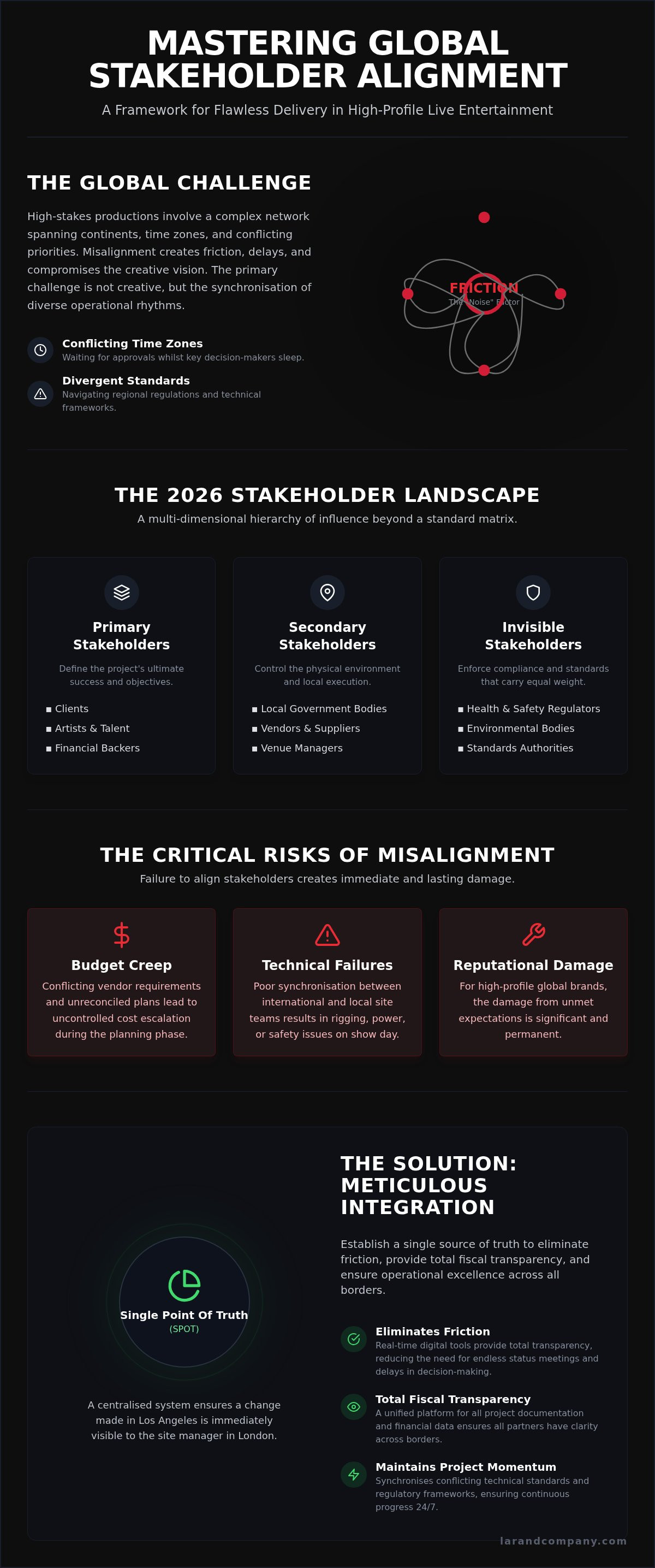
A global production is only as stable as its weakest point of contact. When you're managing international stakeholders for events, the primary challenge isn't the creative vision. It's the synchronisation of diverse operational rhythms. You've likely felt the friction of waiting for approvals whilst a key time zone sleeps. Conflicting regional standards often cause delays. This is the noise that threatens prestigious projects.
High-stakes execution requires absolute composure and a single point of truth. This strategy will help you master global stakeholder alignment to ensure flawless delivery for high-profile live entertainment. You'll learn how to reduce friction in the decision-making process and maintain total fiscal transparency across borders. We'll examine how to turn complex cross-border logistics into a seamless, rhythmic success.
Key Takeaways
• Define the 2026 stakeholder landscape by categorising interests from global investors to local site authorities.
• Understand why standard communication protocols fail when managing international stakeholders for events and how to adapt to regional decision-making behaviours.
• Synchronise conflicting technical standards and regulatory frameworks across unconventional global locations to maintain project momentum.
• Establish a single point of truth to eliminate friction and provide total fiscal transparency for high-profile partners.
• Utilise strategic presence in major international hubs to ensure 24/7 stakeholder coverage and operational excellence.
The Complexity of Managing International Stakeholders for Events
The global stage in 2026 is crowded. Managing international stakeholders for events now involves a network that spans continents and conflicting priorities. It's no longer just about the client's brief. It's about investors, site authorities, and the technical teams on the ground. High-profile live entertainment requires a level of sophistication that standard corporate meetings simply don't demand. In this environment, a producer must act as the quiet power. You're the one who translates high-level ambition into tangible, reliable execution.
Effective Stakeholder management is the difference between a cohesive show and a diluted vision. When multiple parties pull in different directions, the creative core suffers. This is the noise factor. It's the accumulation of conflicting interests that threatens to compromise the project. A producer's strategy must filter this noise. You ensure the original intent remains intact whilst every logistical requirement is met. Managing international stakeholders for events is about protecting the project's integrity against the weight of its own scale. You're the central node. Every decision passes through you.
Identifying the Key Players in Global Production
Primary stakeholders include the clients, artists, and financial backers. Their expectations define the project's success. Secondary stakeholders are the local government bodies, vendors, and venue managers who control the physical environment. In 2026, invisible stakeholders carry equal weight. These include international health and safety regulators and environmental bodies enforcing new sustainability directives. Each group requires a specific communication rhythm. You must categorise these players early to avoid reactive management. A clear hierarchy of influence ensures that critical decisions aren't delayed by minor parties.
The Risks of Stakeholder Misalignment
Failure to align these parties leads to immediate friction. Budget creep often occurs when conflicting vendor requirements aren't reconciled during the planning phase. If the London office isn't synchronised with the LA team, technical failures follow. Poor communication between site teams results in rigging or power issues that can't be fixed on show day. For high-profile events, the greatest risk is reputational. When expectations aren't met, the damage to a global brand is permanent. You can view our previous global project portfolio to see how we mitigate these risks through meticulous stakeholder integration and a single point of truth.
Mapping and Categorising Global Stakeholder Interests
A standard 2x2 matrix isn't enough for high-tier show production. You need a multi-dimensional approach that accounts for regional nuances and diverse time zones. Managing international stakeholders for events at this scale means tracking how power shifts across borders. In some territories, the technical director holds the final word on safety. In others, local site authorities dictate the entire production schedule. You must map these dynamics before the first flight is booked to avoid reactive management.
Categorising by Operational Impact
Effective mapping divides stakeholders by their functional role and their ability to stop the project. Strategic stakeholders define the objective and the financial parameters. They're your primary point of contact for the "why" of the project. Technical stakeholders manage the "how," including rigging, lighting, and automation teams. Local stakeholders are often the most overlooked but hold the most power over the "where." They control permits, site access, and regional safety compliance. Each category requires a different engagement strategy.
The challenges of international stakeholder management often stem from misjudging cultural influence. A stakeholder with high influence but low formal power can still halt a production if they feel unheard. This is particularly true in regions with high cultural emphasis on relationship-building. Misjudging local influence is a common error when managing international stakeholders for events. You must assess these players based on their local standing and historical connectivity, not just their job title.
The Communication Hierarchy
Information overload is a significant risk for global productions. You must establish clear reporting lines to prevent "email fatigue" amongst global teams. Use a Single Point of Truth (SPOT) for all project documentation. This ensures that a technical change made in Los Angeles is immediately visible to the site manager in London. Digital production tools provide real-time transparency. They eliminate the need for endless status meetings and reduce friction in the decision-making process. This level of clarity is essential for Large Scale Event Management where every minute counts. If you require an elite partner to centralise your global logistics, get in touch with our team.
Navigating Cultural Diplomacy and Communication Rhythms
Standard communication protocols often collapse under the weight of global complexity. Managing international stakeholders for events requires more than a shared language. It requires an understanding of the unspoken rules that govern professional interaction. In the UK, decision-making often relies on polite consensus and subtle cues. The USA typically favours a direct, high-momentum approach where speed is a primary metric. Conversely, in the Middle East, progress is built on deep-rooted relationships and a strict respect for hierarchy. If you ignore these nuances, you risk project paralysis.
Hierarchy and the concept of "face" are critical. In many cultures, a public challenge to a senior stakeholder's authority doesn't just cause tension; it can halt a production entirely. Producers must navigate these waters with absolute composure. Whilst one office sleeps, the show must continue its momentum. By leveraging offices in major hubs like London and Los Angeles, we maintain a 24/7 presence. This ensures stakeholders are supported regardless of their geographic location or local time zone.
Adapting the Communication Style
Negotiating high-stakes contracts requires a fluid communication style. You must know when to be direct and when to employ diplomatic tact. The producer acts as the essential cultural bridge between a global creative vision and local operational realities. Cultural diplomacy in production is the art of aligning vision with local custom. This alignment prevents misunderstandings that could otherwise delay critical decision-making or lead to technical friction on site. It's about ensuring every party feels heard without compromising the project's core objectives.
Managing Stakeholder Expectations Across Borders
Aligning a creative vision with local sensitivities is a delicate balancing act. What works for a high-end fashion house in Paris may require adjustment for a civic event in a different region. You must ensure the "wow moment" translates effectively across diverse audience demographics without causing offence. Handling conflicting deadlines between international vendors is equally vital. A vendor in one region may have different public holiday schedules or working hours. Meticulous planning ensures these discrepancies don't impact the final delivery. Every stakeholder must feel their local context is respected whilst the global standard of the show is maintained. This level of detail is what defines an elite partner in international show production.
Operational Excellence: Technical and Regulatory Alignment
Execution is the only metric that matters. Managing international stakeholders for events requires reconciling diverse engineering standards into a single, cohesive plan. Power requirements in Riyadh differ from those in London. Rigging safety factors in the EU must be harmonised with local site conditions. The producer is the arbiter of these standards. You must ensure that every vendor, regardless of their origin, adheres to the highest tier of technical delivery. This is the foundation of Technical Production for Live Events.
Total fiscal and operational transparency is non-negotiable for high-profile partners. Managing international stakeholders for events involves more than just logistics; it requires rigorous production financial management. Every technical decision must be backed by clear budgetary data. When technical standards are aligned, friction in the decision-making process vanishes. You provide a single point of truth that protects both the creative vision and the client's investment.
The 5-Step Alignment Process
Step 1: Audit local technical and safety regulations.
Identify regional requirements for power, rigging, and structural engineering early.
Step 2: Harmonise vendor contracts to a single production standard.
Ensure all parties work to the most stringent safety and quality benchmarks.
Step 3: Conduct multi-stakeholder feasibility workshops.
Bring technical leads together to resolve conflicts before equipment arrives on site.
Step 4: Implement a centralised risk management and contingency plan.
Prepare for regional variables such as extreme weather or supply chain delays.
Step 5: Execute with a unified on-site management team.
Maintain a clear command structure to handle real-time adjustments with absolute composure.
Managing Local Authorities and Site Logistics
Unconventional global locations present unique challenges. Securing permits for temporary venue construction in desert environments or dense urban centres requires a sophisticated approach to diplomacy. You aren't just a producer; you're a partner to local civic and government bodies. Trust is the currency of site management. By building strong relationships with local authorities, you ensure smoother site access and faster regulatory approvals. Health and safety management amongst large, diverse event crews is paramount. Clear communication of safety protocols ensures that every member of the team, from local labourers to international specialists, operates under the same high standard. If you require an elite partner to manage your next high-stakes global production, contact our production team.
The Lar&Co Approach: Meticulous Stakeholder Integration
Lar&Co operates as the quiet power behind the scenes. Managing international stakeholders for events requires an unflappable temperament and a seasoned perspective. We rely on over 20 years of expertise to handle high-stakes, high-value projects with absolute composure. Our offices in London and Los Angeles provide 24/7 coverage. This geographic presence ensures constant project momentum. Whilst one team closes for the day, the other takes the lead. This seamless transition is essential for complex global projects where time is a critical resource.
Our portfolio demonstrates our international reach. We've managed everything from iconic stadium tours for musical legends to bespoke cultural celebrations for high-end fashion houses. We don't just manage logistics. We protect the creative vision from the noise of conflicting interests. Our team comprises world-class talent capable of managing every meticulous detail. We focus on tangible, reliable execution rather than abstract ideas. Every project is a drumbeat of success. We deliver results.
A Single Point of Accountability
Clients prefer a single practice for end-to-end oversight. This model provides a single point of truth for all project parties. It reduces the burden on the event owner. You gain professional prestige and absolute composure in the face of rare challenges. We take total ownership of the production category. Managing international stakeholders for events is simplified through our single point of truth model. This definitive approach ensures that every stakeholder, from local authorities to global investors, is aligned. Our strategy eliminates the communication breakdowns that often plague international shows. You can discover our portfolio of work to see the scale of our previous projects.
Collaborating with Lar&Co
Integrating our producers into your project is a streamlined process. We move the conversation toward reliable execution. Our role is to maintain the creative core whilst managing the logistical periphery. We handle the friction of decision-making so you don't have to. Our practice provides a versatile and high-tier cultural authority across multiple elite sectors. We're comfortable operating at the highest levels of entertainment and diplomacy. If you're ready to master the complexities of global stakeholder alignment, contact our team in London or LA. We're prepared to handle your most significant challenges with efficiency and results. We deliver flawless execution for high-profile live entertainment.
Mastering the Global Production Rhythm
The complexity of high-stakes live entertainment requires more than just logistical skill. It demands a sophisticated approach to managing international stakeholders for events. By establishing a single point of truth and navigating the nuances of cultural diplomacy, you protect the creative core of your project. Operational excellence is achieved when technical standards and regional regulations are synchronised into one authoritative timeline.
Success on this scale relies on the temperament of a seasoned expert. With over 20 years of expertise and offices in major global entertainment hubs like London and Los Angeles, Lar&Co provides the 24/7 momentum necessary for flawless execution. We've built a proven track record with iconic global brands and artists by remaining the quiet power behind the scenes. Our focus is on the tangible, reliable execution of your most significant challenges.
If you're ready to align your global vision with tangible results, Contact Lar&Co to discuss your international show production requirements. We'll handle the noise of stakeholder management so you can focus on the performance. Your next world-class experience begins with meticulous integration.
Frequently Asked Questions
How do you manage international stakeholders across different time zones?
We manage time zones by leveraging our primary offices in London and Los Angeles to provide 24/7 stakeholder coverage. This ensures constant project momentum as one team takes over whilst the other closes for the day. We utilise a single point of truth for all documentation to prevent information silos. This rhythmic approach ensures that every decision is visible in real time. It eliminates the delays often associated with global production timelines.
What are the most common challenges when managing stakeholders for global events?
The most frequent obstacles include communication breakdowns across time zones and conflicting technical standards between regions. Many producers also struggle with cultural misunderstandings that delay critical decision-making. These issues often lead to budget creep or technical friction on site. Managing international stakeholders for events requires an unflappable lead who can reconcile these diverse interests. Our strategy focuses on reducing this friction through meticulous stakeholder integration and clear, direct reporting lines.
How do you handle conflicting regulations between different countries for a stadium tour?
We resolve regulatory conflicts by auditing local technical and safety requirements during the earliest planning phases. Our team harmonises vendor contracts to a single production standard that meets or exceeds the most stringent regional rules. This process is vital for stadium tours where equipment moves between diverse legal jurisdictions. We conduct multi-stakeholder feasibility workshops to address these complexities. This proactive alignment ensures the show remains safe, compliant, and on schedule.
Why is a stakeholder matrix important for high-profile show production?
A bespoke stakeholder matrix is essential for categorising power and influence within a multi-region show. It identifies which parties define the strategic objectives and which control the local site access. This clarity is vital when managing international stakeholders for events at a global scale. Without this mapping, high-profile projects risk being diluted by the noise of conflicting interests. Our matrix provides a clear hierarchy that streamlines the decision-making process for everyone involved.
How can a show producer help in maintaining the creative vision amongst many stakeholders?
The producer acts as the central node in the stakeholder web, filtering logistical noise to protect the creative vision. We translate high-level ambition into tangible execution whilst managing the creative direction. This involves balancing the artistic requirements of the talent with the practical constraints of the venue and budget. By maintaining absolute composure, we ensure that the original intent of the show remains intact. Our role is to be the quiet power behind the scenes.
What role does cultural diplomacy play in event stakeholder management?
Cultural diplomacy is the art of aligning a project's vision with local customs and professional hierarchies. It plays a critical role in relationship building, particularly in regions like the Middle East where respect for hierarchy is paramount. Understanding the difference between direct and indirect communication prevents project paralysis. We act as a cultural bridge to ensure that global creative goals are met whilst respecting local sensitivities. This sophisticated approach establishes trust with all parties.
How do you ensure financial transparency with international vendors?
We maintain fiscal integrity through a centralised financial management model that provides total transparency. Every procurement decision is backed by clear data and reported through our single point of truth system. This ensures that international vendors adhere to the agreed production budget and standards. We provide regular, detailed financial reporting to keep all stakeholders informed. This level of oversight reduces the risk of budget creep and ensures cost-effective delivery for high-profile projects.
Can Lar&Co manage stakeholders for events in the Middle East?
Yes, Lar&Co has extensive experience in the Middle East, with coverage including the United Arab Emirates, Saudi Arabia, and Qatar. We specialise in managing the complex logistics of desert music festivals and large-scale civic events in these regions. Our team understands the specific regulatory and cultural requirements of the Middle Eastern market. We provide the same level of understated authority and professional prestige that we bring to our London and Los Angeles projects.