Mastering Tour Routing and Logistics for High-Profile Global Shows
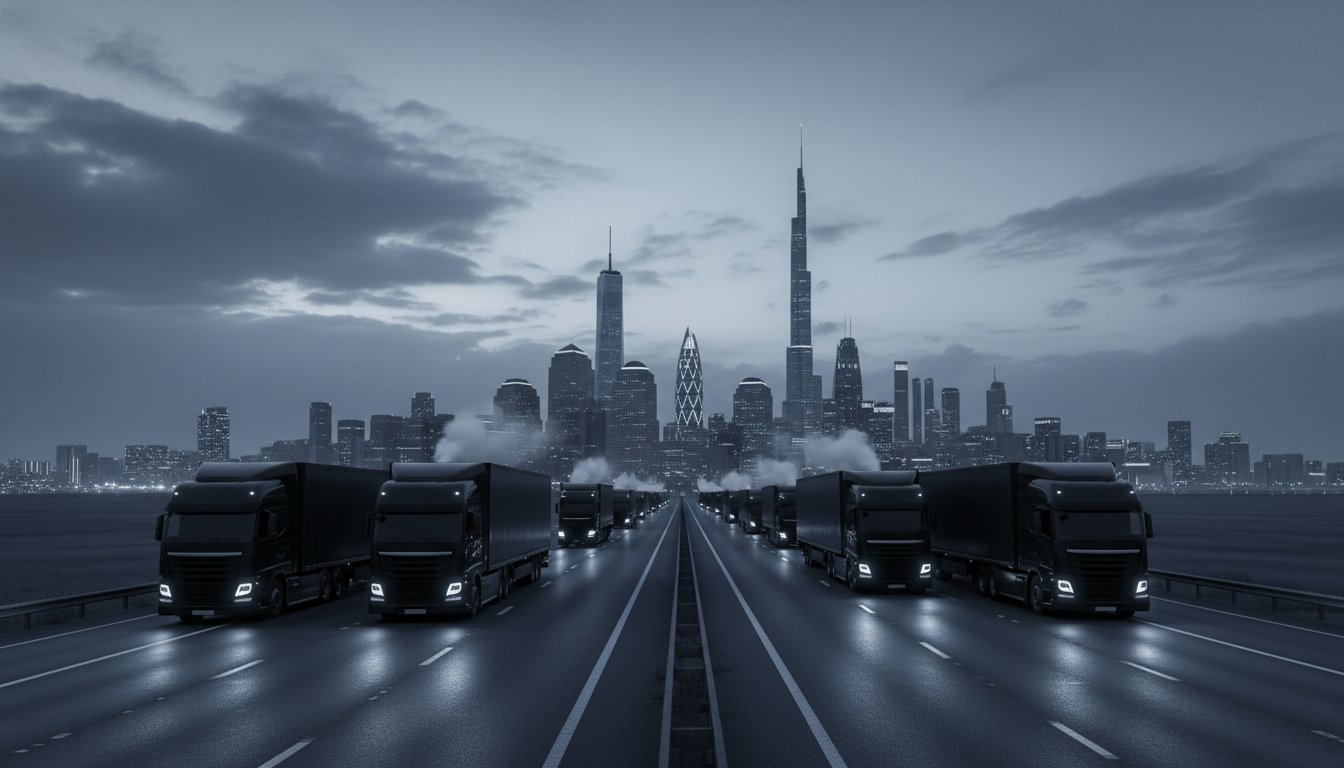
A world-class production is not won on the stage. It is secured in the silence between cities. For those managing high-profile global shows, the complexity of tour routing and logistics represents the difference between a seamless execution and a costly technical failure. You understand that the pressure of international movement is relentless. Between the 11-hour driving limits in the US and the mandatory second-generation smart tachographs required in the EU by July 2026, the margin for error has never been thinner.
It's a challenge that demands absolute composure and a sophisticated approach to time management. We'll show you how to architect an itinerary that is both financially viable and operationally flawless. You'll learn how to organise your technical requirements whilst navigating regulatory hurdles, ensuring driver compliance, and eliminating the risk of talent burnout. This guide explores the tangible steps required to transform a list of dates into a resilient, high-tier global operation.
Key Takeaways
• Distinguish between artist travel and production freight to protect the financial viability of your global show.
• Evaluate linear and hub-and-spoke models to choose the most efficient routing structure for your specific itinerary.
• Master the complexities of tour routing and logistics by aligning technical requirements with international driver compliance.
• Learn how to organise a global itinerary by establishing anchor dates and performing technical feasibility audits.
• Discover how to integrate logistics into show production as a creative constraint that drives high-tier execution.
Defining Tour Routing and Logistics in the High-Stakes Entertainment Sector
High-profile entertainment is an exercise in scale. Whilst the audience sees a seamless performance, the reality behind the curtain is a complex orchestration of movement. Tour routing and logistics is the discipline of mapping this movement. It ensures every asset, from the lead performer to the last lighting truss, arrives exactly when required. This is the quiet power that sustains the spectacle.
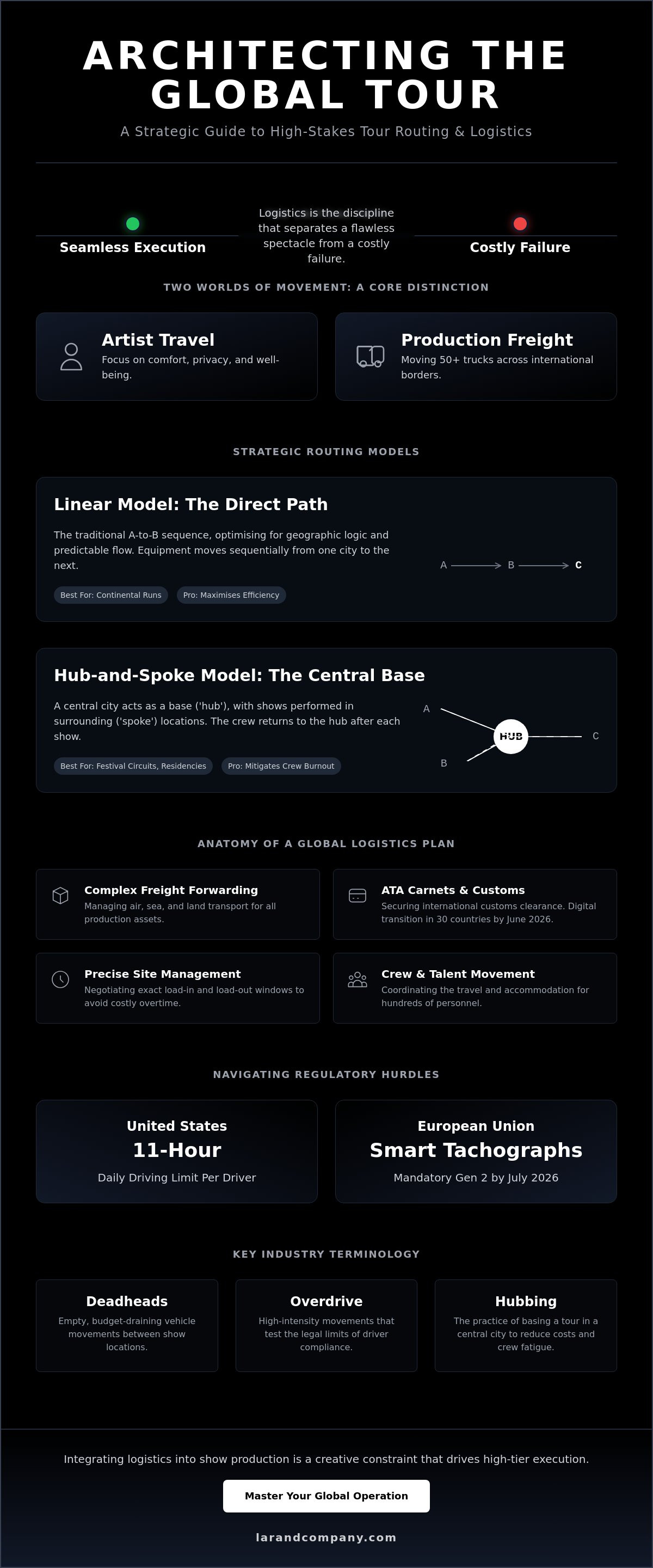
Distinguishing between artist travel and production freight is vital. Artist movement focuses on comfort and privacy. Production logistics involves the heavy lifting. Moving fifty trucks across international borders requires a different temperament. Routing is the foundational pillar of financial viability. A poorly planned route creates unnecessary "Deadheads". These empty vehicle movements drain the budget without advancing the show. Every mile must serve a purpose.
The Show Producer acts as the architect of this reality. They bridge the gap between creative ambition and the physical constraints of the road. Success depends on mastering the mechanics of the journey. "Overdrive" refers to high-intensity movements that test driver compliance limits. "Hubbing" allows a tour to base itself in a central city, reducing hotel costs and crew fatigue. These aren't just industry terms. They're the levers of a profitable tour.
The Strategic Importance of Logistics Oversight
Logistics dictates the "wow moment". If the video wall is stuck at a border, the creative vision fails. Efficient logistics of a concert tour protect the production budget. They minimise idle time and fuel consumption. Proactive management identifies bottlenecks early. This mitigates the risk of technical failure before the first case is loaded. It's about maintaining absolute composure under pressure.
Core Components of a Global Logistics Plan
A robust plan prioritises tangible execution. This includes managing complex freight forwarding and securing ATA Carnets for international customs clearance. As of June 2026, the transition to digital carnets in thirty countries has streamlined this process. Site management is equally critical. Precise load-in and load-out windows must be negotiated with venues to avoid overtime costs. Finally, the strategy must account for the movement of hundreds of crew members. You can see how we manage these complexities in our Show Production portfolio.
Strategic Routing Models: Linear, Non-Linear, and Hybrid Approaches
Mastering tour routing and logistics requires a choice between three primary frameworks. Routing models define the operational rhythm of a show. A linear strategy, the traditional "A to B" sequence, remains the standard for continental runs. It offers a predictable flow. Equipment moves in a straight line. This maximises efficiency across vast distances like North America or mainland Europe. It is a model built on geographic logic and sequential momentum.
Modern global shows often require a more sophisticated architecture. Non-linear and hub-and-spoke models are now essential for managing festival circuits and regional residencies. The "Nashville Style" has evolved into a global standard. It is no longer just for US bus tours. We apply this model across modern European and Middle Eastern markets. In regions like the UAE or Saudi Arabia, production often hubs in Dubai or Riyadh. The show moves to regional sites and returns to the centre. This provides the crew with a stable base. It mitigates burnout whilst maintaining the high-momentum required for stadium runs.
Success in these high-stakes environments relies on understanding The Logistics Powering Global Concert Tours. Every choice carries a significant financial weight. Choosing the right framework involves a calculated trade-off between speed and sustainability.
Linear vs. Non-Linear: Choosing the Right Framework
Geographic proximity is a traditional priority. However, venue availability often dictates the route. You must decide when to accept higher freight costs to secure a premium date. Non-linear routing often involves backtracking. This increases fuel consumption and wear on equipment. With EU diesel prices averaging €1.821 per litre as of June 2026, every additional kilometre must be justified. Despite this, hubbing remains a favoured choice for elite tours. It allows for a consistent standard of site management across different territories.
Managing Time Zones and Geographic Hurdles
Time zones and geographic hurdles are tangible risks. Calculating real travel time across international borders is a precise science. It is not just about the distance between London and Paris. You must account for customs windows and the effect of time zone shifts on load-in schedules. A lost hour at the border can delay a soundcheck. This level of detail is essential for managing complex event logistics for international artist tours. Our Show Production team ensures these frameworks are executed with absolute composure.
Navigating Regulatory Constraints: Driver Hours and International Compliance
Regulatory adherence is the silent engine of a successful global production. For high-profile shows, tour routing and logistics must account for a rigid web of international laws. These aren't merely suggestions. They are the physical boundaries of what is possible. Failing to respect these limits risks technical failure, heavy fines, and the safety of the entire crew. We prioritise a culture of absolute compliance to ensure every show goes ahead as scheduled.
The transition between North American and European territories requires a shift in operational temperament. In the US, drivers operate within an 11-hour driving limit after 10 consecutive hours off duty. Conversely, UK and EU regulations are more stringent. Managing "Double-Drive" logistics becomes essential for overnight stadium transitions. This involves employing co-drivers to keep the production moving whilst one driver rests. It is a precise orchestration of human resources that allows for "overdrive" movements across vast distances without compromising safety.
UK and European Driver Regulations
In the EU, the 9-hour daily driving limit is the standard. It can be extended to 10 hours only twice a week. A mandatory 45-minute break is required after every 4.5 hours of driving. These constraints dictate the rhythm of the road. The 45-hour weekly rest requirement is particularly impactful. It often necessitates scheduling "Day Off" shows in cities with high-tier infrastructure to accommodate the crew. As of July 2026, the mandatory use of second-generation smart tachographs for light commercial vehicles over 2.5 tonnes has added another layer of digital oversight to international transport.
International Freight and Customs (ATA Carnets)
Moving high-value production gear requires more than just a truck. It requires a meticulous paper trail. ATA Carnets act as a "passport for goods", allowing equipment to cross borders without paying duties or taxes. Since June 2026, thirty countries, including the UK and the 27 EU member states, have transitioned to digital carnets. This has improved efficiency, but the security deposit—typically 40% of the goods' value—remains a significant financial consideration.
Navigating the Middle East presents unique challenges. Logistics in the UAE, Saudi Arabia, and Qatar require local expertise and early customs consultation. Technical Production must be involved in these conversations months before the first load-in. At Lar&Co, we bridge this gap through our seasoned expert network. We ensure that your creative vision never stalls at a border crossing. For complex international projects, we invite you to discuss your requirements with our logistics team.
How to Organise a Global Tour Itinerary: A Step-by-Step Logistics Framework
Architecting an international tour is an exercise in engineering. It requires moving beyond simple scheduling into the realm of precise temporal management. Effective tour routing and logistics transform a creative vision into a tangible, repeatable operation. This framework ensures every movement is calculated for maximum impact and minimum risk. We rely on a disciplined sequence to maintain show integrity across borders.
The process begins by establishing "Anchor Dates" in primary markets. These are the non-negotiable stadium or festival bookings that define the tour's skeleton. Once these are set, a technical feasibility audit determines if the show can physically move between these points in the allotted time. Budgetary alignment follows. You must balance rising freight costs, influenced by global diesel averages like €1.821 per litre in the EU as of June 2026, against projected ticket revenue. Advancing the route involves securing local site management and labour. Finally, building in a "buffer" is essential. With current industry labour shortages, a contingency plan for unforeseen delays is the only way to protect the production's reputation.
The Technical Feasibility Audit
A technical audit is the foundation of show safety. It involves analysing load-out speeds for complex stadium stage designs. You must verify that every venue can accommodate 53-foot trailers or specialised mega-freight. If a stage requires forty-eight hours to strike but the next show is five hundred kilometres away in twenty-four hours, the route is fundamentally flawed. This level of planning is central to technical production for live events. We prioritise the architecture of the experience to ensure operational success without compromising the creative vision.
Advancing the Logistics with Local Partners
Local knowledge is indispensable in emerging high-tier markets. In cities like Riyadh or Dubai, understanding specific site regulations and customs behaviours is critical. Coordinating with local artist liaison for tours ensures talent transitions are as seamless as the production freight. This regional expertise prevents the friction that often stalls international projects. It's about maintaining a drumbeat of success through volume and precision. To see how we execute these frameworks at scale, view our recent global show production projects.
Integrating Logistics into Show Production: The Lar&Co Approach
Logistics is often viewed as a secondary concern. At Lar&Co, we treat it as a creative constraint that drives innovation. High-tier tour routing and logistics define the physical boundaries of a performance. If a stage design is too heavy for a specific border crossing, the vision must evolve. We don't see this as a limitation. We see it as the foundation of a resilient production. Every technical choice is vetted against the reality of the road. This ensures that the spectacle is never compromised by a lack of foresight.
Our "Producer as Architect" model ensures total cohesion across the project lifecycle. We merge Creative Direction with Technical Production and Financial Management into a single, unified strategy. This prevents the operational silos that often lead to budget overruns or technical failure. Managing a multi-million dollar logistics budget requires more than just spreadsheets. It requires the temperament to handle high-stakes variables with absolute composure. From the first manifest to the final load-out, our focus remains on tangible, reliable execution. We manage the details so the scale remains manageable.
Meticulous attention to detail is our standard. A manifest is not just a list of equipment. It is the DNA of the show. We track every asset with a level of precision that mirrors the complexity of the events we manage. This includes everything from high-end fashion house installations to large-scale civic ceremonies. By placing iconic legends and luxury brands within the same operational framework, we maintain a versatile and high-tier cultural authority.
Case Study: Stadium Tour Management at Scale
Managing the "Drumbeat of Success" across global hubs requires a constant, vigilant presence. Our work in major international entertainment centres allows us to maintain a rhythmic flow of activity. We specialise in stadium tour management services that deliver excellence at scale. In high-pressure scenarios, we rely on our gravity and portfolio to maintain order. We don't rely on overt promotion; we rely on results. This understated authority is what high-level stakeholders expect from an elite partner capable of handling significant challenges with ease.
Contact Lar&Co for Global Production Oversight
The complexity of global shows in 2026 demands constant monitoring. Our offices in London and Los Angeles provide a continuous loop of oversight across time zones. This geographic signature ensures we are always connected to the world's most significant cultural hubs. You're partnering with a seasoned, cosmopolitan team that is unflappable in the face of rare and significant challenges. We invite you to contact our production team to discuss your 2026 tour routing. Let us provide the quiet power behind the scenes whilst you focus on the stage.
Securing the Future of Global Show Production
A flawless international tour is built on the precise engineering of time and movement. You've seen how integrating technical feasibility audits and rigid regulatory compliance protects the financial viability of a project. By treating tour routing and logistics as the foundational pillar of production, you ensure that creative ambition never outpaces operational reality. Success in the high-stakes entertainment sector requires a sophisticated balance between high-momentum scheduling and the physical limits of the road. Every mile must serve the show.
With over 20 years of international expertise, we provide the quiet power required to manage these complexities. Our offices in London and Los Angeles offer constant oversight for a portfolio that spans iconic musical legends and high-end fashion houses. We invite you to discuss your global tour logistics with Lar&Co to ensure your 2026 itinerary is executed with absolute composure. Let's transform your vision into a resilient global reality that sustains the spectacle from the first load-in to the final curtain.
Frequently Asked Questions
What is the difference between tour routing and tour logistics?
Tour routing defines the sequence of dates and cities that form the tour's itinerary. It is the strategic "where" and "when" of the schedule. Tour logistics is the functional execution of that plan. It encompasses freight movement, transport compliance, and site management. Effective tour routing and logistics align these two disciplines to ensure the production remains financially viable and operationally sound.
How many hours can a tour bus driver work in the UK and Europe?
A driver in the UK and EU is limited to 9 hours of daily driving, which can be extended to 10 hours twice a week. A mandatory 45-minute break is required after 4.5 hours of driving. Weekly driving is capped at 56 hours. As of July 2026, second-generation smart tachographs are mandatory for all light commercial vehicles over 2.5 tonnes engaged in international transport, ensuring digital oversight of these limits.
What is an ATA Carnet and why is it essential for international tours?
An ATA Carnet is an international customs document that acts as a passport for high-value production equipment. It allows gear to cross borders without the payment of duties or taxes. This is essential for maintaining the production budget on global runs. Since June 2026, thirty countries, including the UK and all EU member states, have transitioned to digital carnets to improve efficiency at border crossings.
How does tour routing affect the overall production budget?
Routing efficiency directly dictates the overhead costs of a show. A logical, sequential route reduces fuel consumption and eliminates unnecessary hotel stays for the crew. Poor routing leads to increased "deadheading" and higher freight expenses. With EU diesel prices averaging €1.821 per litre in June 2026, even minor routing errors can result in significant financial strain on the production.
What is "deadheading" in the context of concert tour logistics?
Deadheading refers to the movement of a commercial vehicle, such as a production truck or crew bus, without a load or passengers. This often occurs when equipment must be moved between non-sequential tour dates. It's a non-revenue-generating expense that increases fuel and labour costs. Professional logistics management focuses on minimising these movements to protect the tour's financial integrity.
When should a tour manager involve a production agency in routing decisions?
A production agency should be involved during the initial "Anchor Date" phase. This allows for an immediate technical feasibility audit before venue contracts are finalised. Early involvement ensures that the creative vision is supported by a realistic movement strategy. It prevents the scheduling of "impossible" transitions that lead to technical failure or regulatory non-compliance.
How do you manage logistics for shows in the Middle East, such as Saudi Arabia or Qatar?
Managing Middle Eastern logistics requires local expert knowledge and early customs consultation. The region often necessitates a hub-and-spoke model, with production based in centres like Riyadh or Dubai. Success depends on navigating specific regional site management requirements and securing local labour. It's a high-stakes environment that demands a seasoned, cosmopolitan approach to ensure seamless transitions.
What are the risks of poor tour routing for the artist and crew?
Poor routing leads to chronic fatigue and talent burnout. It forces the crew into high-pressure "overdrive" movements that increase the risk of technical failure during load-in. Beyond the human cost, it risks regulatory fines for driver hours violations. A resilient routing strategy prioritises the well-being of the team to maintain the high-tier quality of the performance night after night.