Non-Traditional Event Venue Selection: A Practical Checklist for High-Impact Events

Novelty is not a production plan. A striking setting can give an event a distinctive point of view, but non-traditional event venue selection works best when the space serves the audience and the event’s purpose. A concept that looks compelling in photographs may tell a different story once access, infrastructure and site conditions are considered.
It’s right to want a venue that feels memorable. It’s also worth asking whether that distinctiveness will strengthen the experience or compete with it. The answer comes from assessing every option against the same priorities, rather than comparing spaces on atmosphere alone.
This practical framework will help you shortlist venues by event objectives, audience needs and production realities. You’ll learn which operational questions to address before committing, and how to balance creative ambition with a deliverable plan. Drawing on more than 20 years in live entertainment production, Lar&Co brings creative direction, technical production and site management into one joined-up view of the event, wherever it takes place.
Key Takeaways
• Start with the event’s purpose and audience, then decide whether an unconventional setting will strengthen the experience.
• Use a consistent framework for non-traditional event venue selection so distinctive features don’t overshadow essential requirements.
• Compare venue categories across audience impact, event fit, access, infrastructure and operational complexity.
• Assess the full guest journey, production needs and event-day operations before making a commitment.
• Bring creative direction, technical production, site management and budget oversight into one coordinated decision.
What makes a non-traditional event venue right for your event?
A non-traditional event venue is a space whose primary purpose is not hosting events. It might be an industrial building, a garden or a museum. The setting can make an event distinctive, but novelty alone is not a reason to choose it. The space should support what the event needs to communicate and how guests are expected to experience it.
Venue fit is the alignment between an event’s purpose, its audience and what the site can practically deliver. This keeps the decision grounded. A visually striking space may still be a poor fit if its layout works against the programme or makes the intended guest experience difficult to achieve.
Start with the event’s purpose, not the venue’s novelty
Before viewing spaces, clarify the event objective, audience expectations and intended atmosphere. Is the gathering designed to celebrate culture, bring colleagues together or create a live entertainment experience? Each purpose sets different expectations for the setting, guest journey and relationship between the audience and the programme.
A venue can reinforce the event story. A cultural celebration in a setting with a meaningful connection to the culture being honoured may give the occasion a stronger sense of place. By contrast, an impressive backdrop with no connection to the event can feel like decoration rather than part of the experience.
Use creative direction to define what the setting should contribute, then test whether the site can support that intention. Map how guests arrive, where they gather and how they move between programme moments. This turns non-traditional event venue selection from a search for a striking image into an assessment of purpose and delivery.
Recognise the main kinds of unconventional spaces
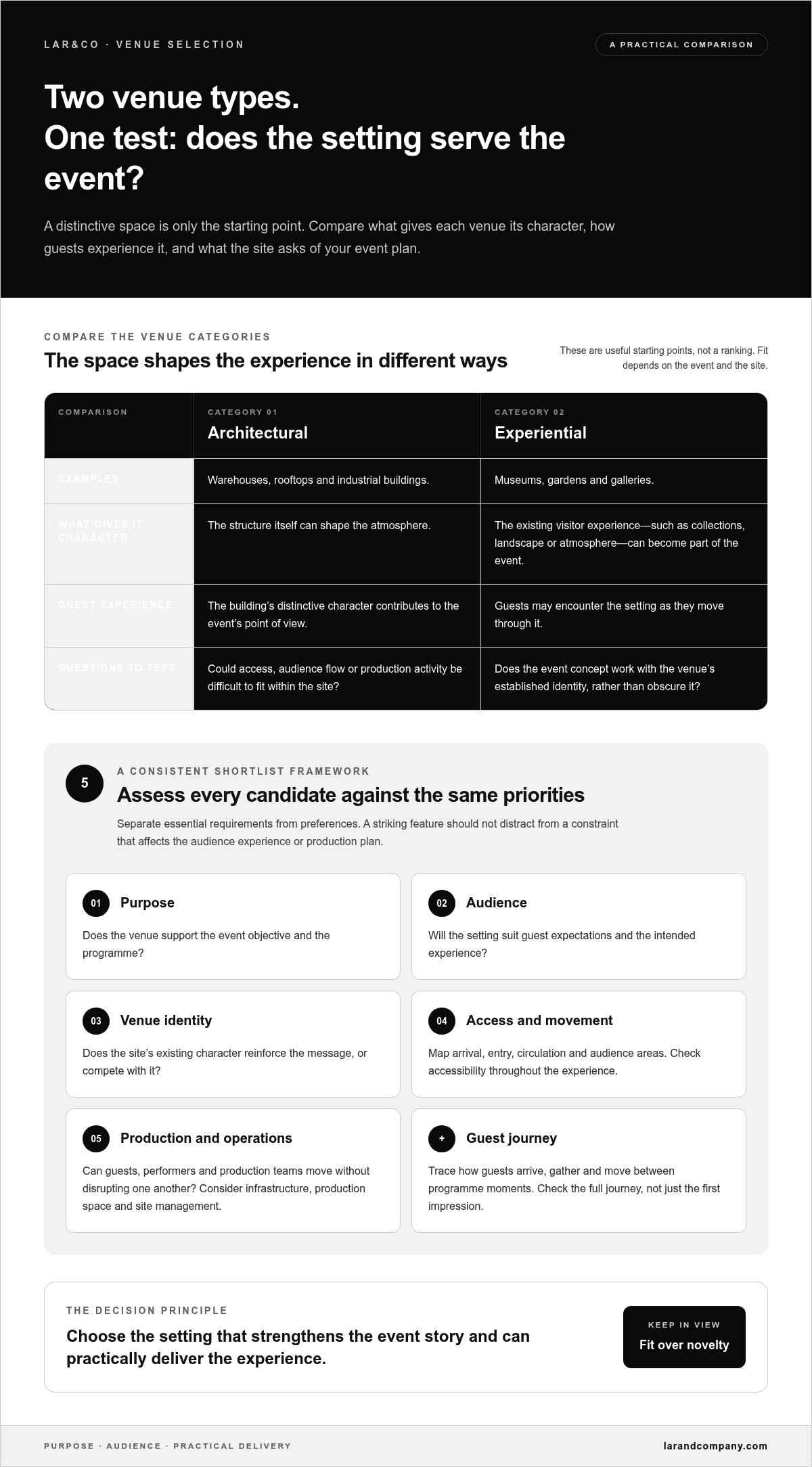
Unconventional venues fall broadly into architectural and experiential categories. Architectural spaces include warehouses, rooftops and industrial buildings, where the structure itself can shape the atmosphere. Their distinctive character may also raise practical questions about access, audience flow and how production activity fits within the site.
Experiential spaces include museums, gardens and galleries. Here, the existing visitor experience may become part of the event: guests might encounter the setting’s collections, landscape or distinctive atmosphere as they move through it. That differs from choosing a conventional event space simply because its architecture looks unusual. The venue’s established identity becomes part of the occasion, so the event concept should work with it rather than obscure it.
These categories are a useful starting point, not a ranking. Each site brings its own operating conditions, and the same type of space can suit one programme and challenge another. For a broad reference, Wikipedia’s Types of Event Venues offers a general overview of venue categories; the relevant distinction here is whether the space’s primary purpose is event hosting.
Local context matters, too. Site conditions and the surrounding environment differ by destination, so an idea that works in one city may need a different approach elsewhere. Whether you are considering a site in the UK, USA, United Arab Emirates, Saudi Arabia or Qatar, treat its character as one part of the event brief, alongside the audience experience and the practical realities of producing the programme.
How to assess non-traditional event venue fit before shortlisting
A clear brief makes venue comparisons more useful. Before reviewing photographs or arranging site visits, turn the event’s purpose into criteria that can be applied consistently. This keeps a dramatic architectural feature from distracting stakeholders from a constraint that could affect the audience experience or production plan.
Translate the event brief into venue criteria
Define who the audience is, what format the event will take and what the programme needs from the space. A seated presentation, a reception with moving guests and a live performance place different demands on a venue. Describe the intended atmosphere in practical terms, too: intimate, formal, celebratory or immersive.
Then separate essentials from preferences. Essentials might include a workable arrival route, accessible guest areas or space for the planned programme. Preferences could include a particular architectural detail or a striking view. Record how the venue should contribute to the guest journey and event narrative, so the shortlist reflects more than visual appeal.
Test the space against practical realities
Assess the whole journey, from arrival and entry to circulation, audience areas and back-of-house movement. Consider whether guests, performers and production teams can move through the site without disrupting one another. Assess accessibility throughout the experience, not just at the entrance.
Infrastructure and site-management needs also shape venue fit. Consider what the programme requires from the space, where production activity could take place and how the site will operate during the event. Technical production for live events is part of this assessment: production requirements should inform the shortlist, not be added after a venue has been chosen.
Use a simple scoring framework to compare each candidate against the same questions:
Purpose
Does the venue support the event objective?
Audience
Will the setting suit guest expectations and the intended experience?
Identity
Does the venue’s existing character reinforce the message, or compete with it?
Location
Does the destination and arrival experience make sense for the audience?
Operating model
Can the programme, production activity and site operation work together?
Mark each criterion as essential or preferred, then note any unresolved questions. A museum’s existing identity, for example, might give a cultural gathering meaningful context, while its normal visitor flow could affect how the event is arranged. The same feature can be an asset and an operational consideration.
Local operating requirements vary by destination and site. Identify the requirements that apply in the event’s jurisdiction and include them in the assessment. Avoid carrying assumptions from one location to another: planning for a project in the UK, USA, United Arab Emirates, Saudi Arabia or Qatar needs to account for the specific destination and site.
With this framework, non-traditional event venue selection becomes a disciplined comparison of creative value and practical fit. Record the evidence behind each score and make the remaining decisions visible before the shortlist is narrowed.
How to compare unconventional event venues beyond the wow factor
A shortlist becomes useful when each option is measured against the same criteria. Compare what the audience gains with what the event must coordinate. The aim isn’t to find a venue with no operational demands. It’s to understand whether those demands are justified by the experience and event fit.
The strongest option is the one whose distinctiveness earns its operational demands. Use the comparison below to frame discussion across venue categories, not to rank them. A warehouse, cultural space or outdoor setting can each be right for a particular event, depending on the brief and how the site can support it.
Compare architectural and experiential spaces
An architectural shell, such as a warehouse, may offer a flexible backdrop for shaping the event atmosphere. That flexibility can also mean more coordination around how the space will function. A cultural space brings an established identity and visitor experience that can add context, while influencing how guests move through the event. Outdoor settings can offer a strong sense of place, alongside different site and operational considerations.
| Venue category | Audience impact | Event fit | Access | Infrastructure | Operational complexity |
|---|---|---|---|---|---|
| Architectural shell, such as a warehouse | Atmosphere shaped by the building | Depends on how the space supports the event story | Consider arrival and movement through the site | Assess against the programme’s production needs | May require more coordination to shape the experience |
| Experiential space, such as a cultural venue | Existing identity can add context | Strong where the venue’s character complements the event | Consider how visitor routes affect guest flow | Account for the site’s existing use | Coordinate the event with the established experience |
| Outdoor setting | Creates a direct connection to place | Depends on the event format and setting | Review the full arrival and circulation journey | Assess site conditions against production needs | Plan around the particular conditions of the site |
Make trade-offs visible to decision-makers
Score each option against agreed must-haves and audience-facing benefits. Keep the criteria consistent, and record the reason for each score. A venue may have high creative value but raise questions about access or production. Showing both sides gives stakeholders a basis for weighing the trade-off rather than relying on a strong first impression.
Separate established facts from open questions. If a site visit is needed to understand circulation or production areas, record that as an assessment action. Don’t treat an unknown as proof that a venue will work, or as a reason to dismiss it prematurely.
Stakeholder alignment matters. Agree which criteria carry the greatest weight before comparing venues, then discuss how each option serves the event objective and audience. This helps prevent visual appeal from dominating a decision that also needs to account for delivery. In non-traditional event venue selection, coordination is part of the equation, not an automatic reason to reject a distinctive space.
Keep a short written rationale for each shortlisted option. It should explain the venue’s creative contribution, the practical trade-offs and the questions that need resolving before a decision.
A practical checklist for assessing a non-traditional event venue
A site assessment should turn a promising option into a clear operational picture. Follow the same sequence for every shortlisted space, and keep three things distinct in your notes: what you observed, what remains an open question, and what depends on local requirements. This makes the eventual decision easier to explain and act on.
What to record during a venue assessment
Walk the site with the event brief in view. Record routes, movement and working areas, not just the spaces guests will see. Note which features could shape the programme or staging concept, and capture local conditions that may affect how the event operates. List jurisdiction-specific requirements for resolution before commitment rather than relying on assumptions.
Review the brief.
Confirm the event objective, audience, programme and essential venue criteria. Use these as the reference point throughout the assessment.
Trace arrival and access.
Follow the guest journey from the surrounding area to the entrance and event spaces. Note access routes, transitions and any points where arrivals may converge.
Map movement through the site.
Consider how guests will circulate between programme moments. Record routes for performers, staff and service activity separately, including where their movement could intersect with audience flow.
Identify production areas and infrastructure.
Note potential production zones and the site features that may affect technical production. Record observations separately from questions that need further assessment.
Review event-day operations.
Consider how the site will function during the event, including how different activities can be coordinated. Large-scale event management guidance can help frame the wider coordination involved in a complex site plan.
Review local requirements and compare.
List jurisdiction-specific matters that need to be addressed. Then assess the venue against the same criteria used for the rest of the shortlist.
Turn observations into a confident decision
Once the visit is complete, organise the record into three categories: observed facts, open questions and decisions shaped by local requirements. This prevents an assumption from quietly becoming part of the recommendation. For each open question, name an owner and a next action so the team knows how it will be resolved.
Compare every venue against the agreed criteria, including audience experience, access, infrastructure and operating needs. Then summarise why the preferred option serves the event objective, what distinct features contribute to the experience, and which actions remain before commitment. That summary gives stakeholders a shared basis for the decision.
A disciplined non-traditional event venue selection process connects the site assessment to production planning. Lar&Co brings creative direction, technical production and site management into a joined-up view of live events, helping align the venue choice with the wider plan.
Bring venue selection into the wider show-production plan
A venue decision sets more than the event’s backdrop. It shapes the creative approach, the audience experience, the production plan and the decisions required to manage the site. Treating these as connected workstreams helps teams carry the event vision into delivery, rather than choosing a space first and addressing its implications later.
That joined-up view is central to effective non-traditional event venue selection. A distinctive venue may influence how guests arrive, where the programme unfolds and how the site operates. At this stage, the aim is to understand how the choice affects the overall plan and to make decisions with those connections in view.
Coordinate creative ambition with operational delivery
The selected space informs creative direction: its character, layout and relationship to the audience can shape the event’s atmosphere and flow. Production decisions should respond to those qualities, whilst site management considers how the event and its operational activity will work within the venue. Financial management brings the resulting priorities into budget oversight, so the team can weigh creative value against delivery needs.
This coordination doesn’t remove complexity. It makes the decisions visible and gives the team a shared basis for managing it. A disciplined process can help keep creative ambition and operational planning aligned as the event develops, without assuming every challenge can be resolved in advance.
Set up the next conversation around the project
A useful starting point is a concise picture of the event: its objective, audience, destination and the venue qualities under consideration. Add the programme’s central needs and any questions raised during the assessment. These details focus discussion on how the space can serve the intended experience and which decisions need to connect across production.
Lar&Co is an international show-production practice with more than 20 years of experience delivering high-profile live entertainment. Its projects span the UK, USA, United Arab Emirates, Saudi Arabia and Qatar, where destination and site context are part of planning the work. Lar&Co’s international production work includes concert tours, festivals, cultural celebrations and corporate events.
With creative direction, technical production, site management and financial management considered together, venue choice becomes part of a wider production decision. This approach is especially relevant to high-profile live experiences, where the setting, programme and operating plan need to support one another.
Explore Lar&Co’s show-production work to see how integrated production can support a distinctive venue for your event.
Make the venue decision the start of a stronger plan
A venue choice is also a statement of priorities. It shapes what the audience encounters and sets the conditions for the live experience to come. Keep the decision connected to the event’s purpose as planning moves forward. If the creative idea or programme changes, revisit whether the space still supports the experience you want to create.
For non-traditional event venue selection, carry the reasoning behind your choice into the wider production conversation. Be ready to share the event objective, audience, destination and venue considerations that matter most. This gives the team a clear starting point for aligning creative ambition with delivery and making informed decisions as the plan develops.
Lar&Co brings a considered production perspective to high-profile live experiences. Discuss your next live experience with Lar&Co and explore how creative direction, technical production, site management and financial management can bring a distinctive venue and event vision together.
Frequently Asked Questions
What is a non-traditional event venue?
It’s a place whose usual purpose is something other than hosting events, such as a working museum, gallery, warehouse or garden. The distinction is about how the site is used, not whether its architecture looks unusual. A purpose-built event space with striking design remains a traditional event venue. For non-traditional event venue selection, consider what the site normally does and how that identity may shape the event.
Are non-traditional venues suitable for corporate events?
Yes. A distinctive setting can give a corporate gathering a stronger sense of occasion, provided it suits the format and expectations of the people attending. A product presentation, for example, may need a different atmosphere from an informal team reception. Consider whether the venue helps focus attention on the event’s purpose, and whether its existing character supports the organisation’s message rather than competing with it.
How do I know whether an unusual venue can accommodate my event?
Test the proposed programme against the site, rather than relying on its advertised capacity or appearance. Consider how guests will arrive, where the main activity will take place and whether staff and service movement can work alongside the audience. Review accessibility, event layout and production needs as part of the same assessment. Record unanswered questions separately and resolve them before treating the venue as a viable choice.
Can a non-traditional venue support a large live event?
It can, if the site and operating plan can support the event’s audience, programme and production activity. A large event needs more than a generous-looking floor area: consider entry and exit flow, audience sightlines, space for performers and production teams, and how activity is coordinated across the site. Assess the proposed event configuration, not just the venue’s overall size, before deciding whether it is suitable.
What should I include in a non-traditional venue comparison?
Use the same criteria for each option. Include audience experience, relevance to the event, location, access, infrastructure and operational complexity. Add a clear record of must-haves, preferences and unresolved questions, so decision-makers can see why an option scores well and what still needs attention. A short written rationale is useful too: it connects the venue’s appeal to the event’s objectives instead of leaving the choice to personal taste.
When should venue selection happen in event planning?
Begin once the event objective, audience and broad format are clear, and before the creative and production plan depends on a particular site. This leaves room to compare options and understand how the chosen setting will shape later decisions. Destination matters: projects in the UK, USA, United Arab Emirates, Saudi Arabia and Qatar may face different local conditions and requirements, which should be considered early in planning.