Producing a Carbon Neutral Stadium Tour: The Producer’s Roadmap for 2026
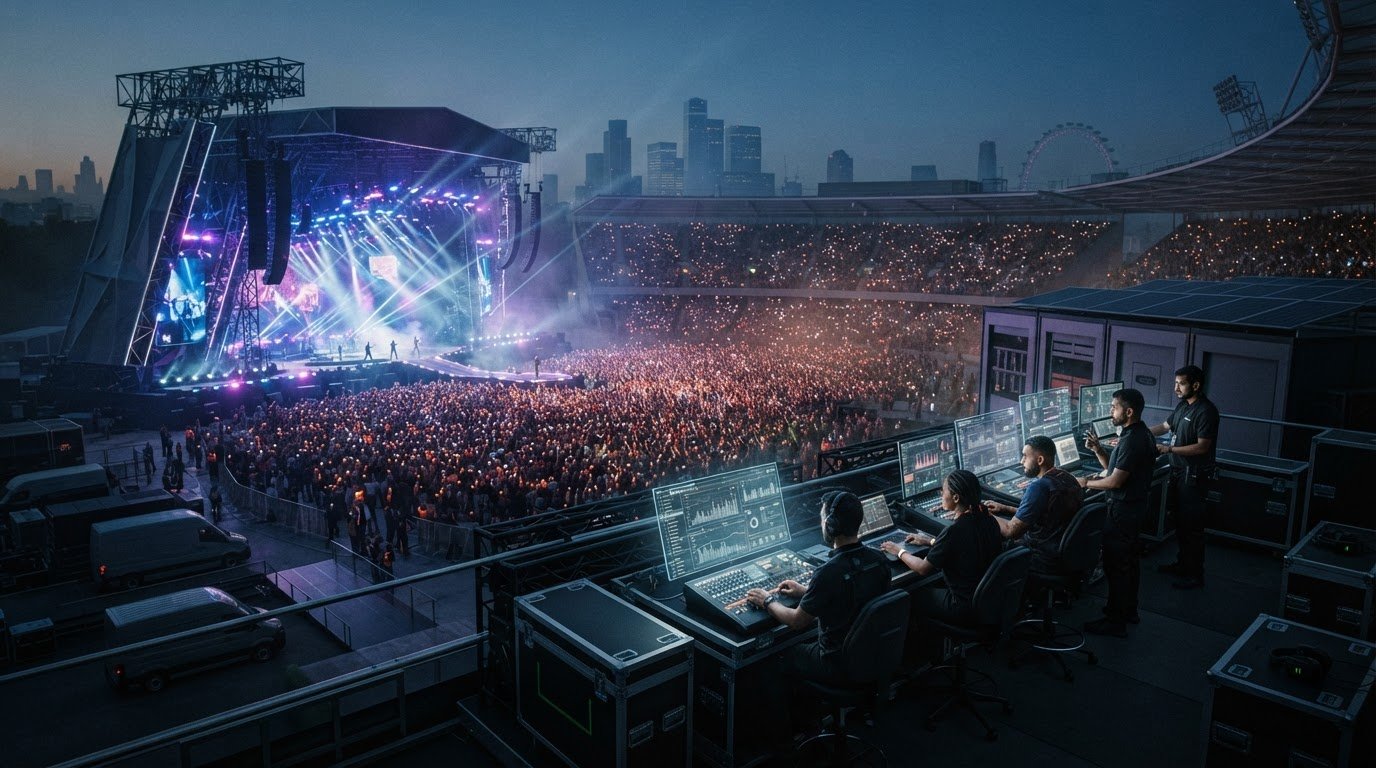
By 27 September 2026, the EU Directive 2024/825 officially blacklists carbon neutral claims based solely on offsets. For the global producer, the era of paying for credits to mask high-impact logistics is over. The industry now demands verified, in-boundary decarbonisation that stands up to the most rigorous audit.
We know that producing a carbon neutral stadium tour presents an immense technical challenge. You're balancing the high environmental impact of air freight with the need to maintain a world-class spectacle across diverse global territories. It's a complex puzzle of sourcing renewable power and measuring Scope 3 emissions without losing the creative impact that defines a legacy show.
This guide provides the definitive roadmap for executing large-scale tours whilst achieving verified neutrality in this new regulatory landscape. You'll learn how to implement a clear framework for sustainable logistics, reduce carbon through precise technical direction, and deliver the credible reporting your stakeholders require. We'll show you how to maintain the wow factor whilst meeting the ISO 20121:2024 standards that now define elite production.
Key Takeaways
• Understand the impact of the EU Directive 2024/825 and why traditional offsetting is no longer a credible strategy for verified neutrality.
• Discover the operational phases of producing a carbon neutral stadium tour, from pre-production audits to rigorous vendor selection.
• Learn how technical direction and financial oversight act as the primary levers for reducing energy consumption whilst managing the costs of green initiatives.
• Identify the 'Big Four' carbon drivers, specifically freight, travel, power, and waste, to focus reduction efforts where they yield the highest results.
• Master the integration of low-carbon logistics and renewable power sources without compromising the visual grandeur of a world-class production.
The Evolution of Sustainable Live Entertainment in 2026
The industry has reached a turning point. Since the EU Directive 2024/825 took effect in September 2026, the era of performative environmentalism has ended. Global tours now operate under a mandate of radical transparency. Producing a carbon neutral stadium tour is no longer a marketing choice; it's a logistical necessity. Stadium-scale shows face the highest scrutiny because their footprint is undeniable. From massive power draws to transcontinental freight, every element is visible to regulators and the public alike.
Creative vision and environmental responsibility are now integrated. A show's impact is measured by its efficiency as much as its aesthetic. We use technical direction to reduce energy consumption at the source, ensuring the spectacle remains undiminished. The producer serves as the central coordinator, bridging the gap between artists, promoters, and local authorities. This role requires a sophisticated understanding of global logistics and a calm temperament to manage high-stakes requirements with absolute composure.
Execution relies on tangible results rather than abstract creativity. We focus on:
• Strategic routing to prioritise rail and maritime transport over air freight.
• Technical design that incorporates low-energy LED and kinetic systems.
• Financial oversight to manage the investment in green infrastructure.
• Rigorous data collection to meet mandatory Scope 3 reporting standards.
The Rise of the Eco-Conscious Artist and Audience
Fan expectations drive the demand for low-carbon experiences. Research from the MIT Climate Machine in 2025 shows audience travel accounts for over 70% of a tour's footprint in certain regions. Artists now lead the charge, demanding "flight-shame" mitigation and better mass transit coordination. We address these needs by engineering tours that reduce reliance on air freight, using duplicate rigs to maintain momentum without the heavy carbon cost of constant aviation.
Regulatory Pressures and Industry Standards
Compliance is the new baseline for prestige. The ISO 20121:2024 standard provides the framework for sustainable event management principles, mandating Scope 3 tracing and climate action planning. Major hubs like London and Riyadh have introduced local mandates with strict energy benchmarks. Lar&Co navigates these regulations through meticulous technical direction, ensuring every show meets local requirements whilst maintaining the quality of a premier international production.
Mapping the Carbon Footprint of a Global Stadium Tour
Producing a carbon neutral stadium tour requires a forensic understanding of the 'Big Four' carbon drivers: freight, travel, power, and waste. Whilst Scope 1 and 2 emissions are within a producer's direct control, Scope 3 emissions across a multi-million pound budget present a higher level of complexity. These indirect emissions, including the supply chain and audience movement, often constitute the vast majority of the total footprint. For production teams looking to transform complex procurement into nature-aligned networks, strategic frameworks such as those outlined on janninebarron.com demonstrate how modern operations can transition towards regenerative supply chains. Meticulous data collection at the pre-production stage is essential. Without accurate auditing from day one, verified neutrality remains an impossibility.
Logistics and Freight: The Heavy Lifters of Carbon
Freight is the most significant operational hurdle in global entertainment. Choosing sea freight over air freight can reduce transport emissions by up to 95%, yet this requires longer lead times and duplicate stage sets. Modern roadmaps often utilise 'hub-and-spoke' models, where equipment is regionalised to minimise transcontinental movement. When aviation is unavoidable, the procurement of Sustainable Aviation Fuel (SAF) and the use of HVO-powered trucking fleets are non-negotiable standards. The Tyndall Centre live music decarbonization roadmap offers a scientific framework for these logistics, prioritising surface transport to protect both the budget and the environment.
Technical Power and Stage Design Efficiency
Technical direction provides the primary lever for reducing energy consumption on stage. We replace traditional diesel generators with mobile battery storage systems and hydrogen fuel cells. These technologies provide clean, silent power capable of supporting the most demanding stadium rigs. Transitioning to high-efficiency LED lighting and low-energy audio systems further reduces the draw. This is how technical production for live events must evolve to meet 2026 standards. By engineering efficiency into the design, we maintain the spectacle whilst ensuring absolute composure in our environmental delivery. You can view our previous large-scale productions to see how we balance complexity with execution.
Reduction vs. Offsetting: A Strategic Comparison
The hierarchy of carbon management is rigid. When producing a carbon neutral stadium tour, producers must adhere to a strict sequence: avoid, reduce, substitute, and finally, compensate. Direct reduction is the only credible path to verified neutrality. Relying on compensation to balance an unoptimised production is a strategic failure. We prioritise technical direction to eliminate emissions at the source. This ensures the visual impact remains undiminished whilst the carbon footprint is systematically dismantled. The goal is a show that is as efficient as it is spectacular.
The Limits of Carbon Offsetting
Offsetting is the final resort. The voluntary carbon market in 2026 is highly stratified. Following the implementation of the ICVCM Core Carbon Principles, there is a sharp divergence in credit pricing and credibility. High-integrity removals command premiums between €25 and €80 per metric ton, whilst legacy avoidance credits are often rejected under CSRD scrutiny. Using low-tier offsets for high-profile events creates immense reputational risk. It suggests a lack of commitment to genuine decarbonisation. We utilise the EPA greenhouse gas inventory guidance to ensure every kilogram of CO2e is accounted for before mitigation. Compensation should only address the residual, unavoidable footprint that remains after every technical and logistical lever has been pulled.
Direct Reduction Strategies for Producers
Tangible execution defines a seasoned producer. We focus on lightweighting stage sets to reduce freight weight and fuel burn. Utilising advanced composites and modular designs allows us to maintain the "wow" factor without the heavy carbon cost of traditional construction. This requires meticulous financial oversight to manage the investment in green initiatives. Direct reduction is the only credible path to verified neutrality when producing a carbon neutral stadium tour.
Our reduction framework includes:
• Regionalised vendor selection to source crews and equipment locally, reducing international travel.
• Circular scenic design that prioritises repurposed materials and guaranteed end-of-life recycling.
• Rigorous site management to ensure zero-waste-to-landfill targets are met across every global territory.
This shift from abstract creativity to reliable logistics ensures sustainability is engineered into the tour's DNA. It positions the production as a leader in international entertainment, capable of handling rare challenges with absolute composure.
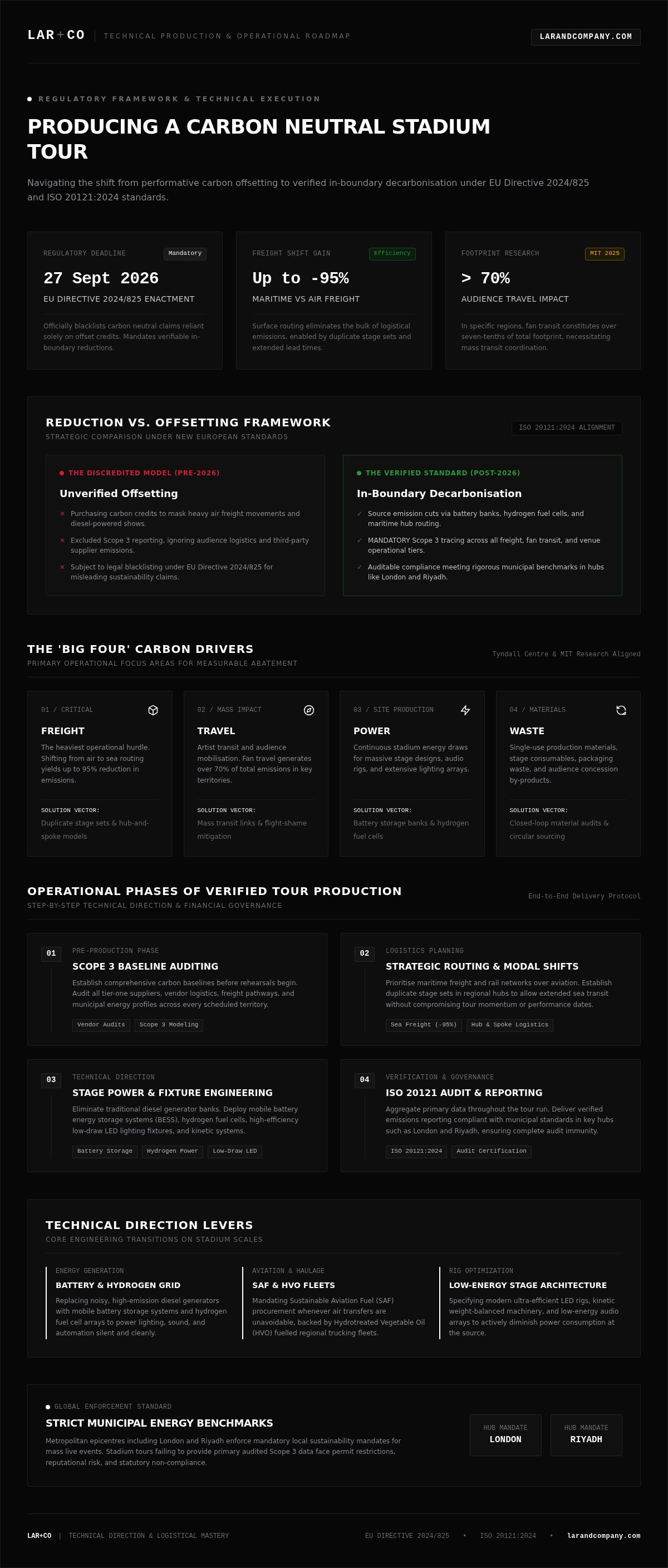
Roadmap to Producing a Carbon Neutral Stadium Tour
Producing a carbon neutral stadium tour requires a structured, multi-phase approach that embeds sustainability into the core operational blueprint. It isn't an afterthought. It's a fundamental requirement of modern technical direction. We divide the process into four distinct phases to ensure every element of the production is optimised for efficiency. This roadmap moves the conversation away from abstract goals and toward the tangible, reliable execution of complex global logistics.
Pre-Production: Setting the Sustainability Budget
Success begins months before the first load-in. Phase 1 focuses on the sustainability audit, establishing a baseline for energy, freight, and travel. This data informs the technical design in Phase 2. Carbon targets must be integrated into the production financial management process. We treat carbon as a currency. Every department, from lighting to catering, operates within a strictly defined carbon budget. Setting clear KPIs ensures accountability across the global team. This meticulous attention to detail prevents budget overruns caused by last-minute green initiatives.
On-Site Execution and Meticulous Site Management
Phase 3 is the execution phase. Real-time tracking is the engine of this stage. We monitor every kilowatt consumed and every tonne of waste generated during load-in and show days. This provides the transparency required for high-stakes international projects. By integrating this data into our site management, we identify inefficiencies instantly. A dedicated Sustainability Coordinator manages these streams, ensuring operational composure under pressure. Our stadium tour management services ensure compliance across diverse global territories, maintaining the production's integrity at every stop.
Phase 4 focuses on the final audit and post-tour reporting. We compile the real-time data into a comprehensive report that meets the scrutiny of global regulators. This ensures the tour's legacy is defined by its environmental integrity rather than just its visual impact. The final result is a verified, audit-grade account of the tour's footprint. This level of reporting is essential for stakeholders who demand credible results. Contact our production team to discuss how we can engineer sustainability into your next global tour.
Lar&Co: Sophisticated Oversight for Sustainable Vision
Lar&Co operates at the intersection of high-tier entertainment and logistical precision. Producing a carbon neutral stadium tour requires more than just environmental intent; it demands a sophisticated level of oversight. We merge world-class storytelling with environmental composure, ensuring that the artist's vision remains central whilst the production meets the highest global standards. This balance is achieved through 20 years of expertise in complex project delivery. We position ourselves as the elite partner for producers who refuse to compromise on quality or environmental ethics.
Fiscal integrity is the cornerstone of our approach. Managing multi-million pound 'green' budgets requires rigorous financial oversight to ensure that sustainability initiatives deliver tangible results without compromising the show's scale. We treat environmental investments with the same scrutiny as any other technical requirement. This ensures that every pound spent on carbon reduction is tracked, verified, and justified. Meticulous attention to detail is the foundation of our work, allowing us to manage high-stakes challenges with absolute composure. It's this temperament that allows us to manage high-value international projects with a focus on execution and results.
Global Reach, Local Expertise
Our global team provides the connectivity required to source sustainable solutions in unconventional locations. With offices in London and Los Angeles, we act as a bridge for international sustainability standards, navigating complex logistics across the UK, USA, and the Middle East. Whether it's sourcing renewable power in Riyadh or coordinating low-carbon freight in London, we handle these challenges with seasoned expertise. We understand the nuances of local government mandates and how they interact with global touring riders. You can view our previous work to see how we execute large-scale projects with efficiency and purpose.
Partnering for the Future of Entertainment
We project an image of international sophistication, acting as the quiet power behind the scenes. Our commitment to understated authority ensures that artists can deliver significant cultural celebrations without the logistical friction often associated with sustainable transitions. We handle the complexity so the creative vision can flourish. This versatility allows us to bridge the gap between musical legends and high-end fashion houses, applying the same level of professional prestige to every event. If you're ready to plan your next tour, Contact our team to discuss your vision.
Defining the Future of International Entertainment
The landscape of live entertainment has fundamentally shifted. Achieving verified neutrality isn't an optional accolade; it's the baseline for international prestige. Success depends on radical in-boundary decarbonisation and the forensically accurate mapping of Scope 3 emissions. By prioritising technical efficiency over traditional offsetting, producers maintain the grandeur of a stadium show whilst meeting the most rigorous global standards.
Producing a carbon neutral stadium tour is a high-stakes challenge that demands absolute composure and meticulous oversight. With 20 years of expertise in complex project delivery and a global presence in major hubs like London and Los Angeles, Lar&Co provides the technical and financial direction required for this transition. We ensure your creative vision is executed with precision and environmental integrity. It's time to move beyond performative greening and toward tangible, audit-grade results.
Partner with Lar&Co for your carbon neutral stadium tour to lead the industry into 2026.
Frequently Asked Questions
What is the primary carbon driver of a stadium tour?
Audience transportation is the most significant carbon driver, frequently accounting for over 70% of a tour's total emissions in the UK. When focusing strictly on production operations, air freight represents the largest impact, contributing approximately 35% of sector emissions. Our approach to producing a carbon neutral stadium tour involves reducing these loads through duplicate touring rigs and strategic maritime logistics to minimise aviation reliance.
Can a stadium tour actually be 100% carbon neutral?
Achieving verified neutrality requires a transition from traditional offsetting to radical in-boundary decarbonisation. Whilst total elimination of emissions is not yet possible for global logistics, producers can achieve verified status by reducing direct emissions by at least 50% through technical innovation. The residual, unavoidable footprint is then addressed through high-integrity carbon removals that meet the strict criteria of the EU Directive 2024/825.
How much does it cost to produce a carbon neutral stadium tour?
The investment required for a sustainable production varies based on the scale and geographic reach of the project. Whilst green technologies like battery storage and Sustainable Aviation Fuel (SAF) carry an initial premium, these costs are managed through meticulous financial oversight. We focus on cost-effective procurement and identifying operational efficiencies that help balance the investment required for green infrastructure across a multi-city itinerary.
What are the best alternatives to diesel generators for stage power?
Mobile Battery Energy Storage Systems (BESS) and hydrogen fuel cells are the most effective alternatives to diesel generators for high-demand stadium rigs. These systems provide clean, silent power that maintains the integrity of the show's audio and visual elements. We also prioritise 100% renewable grid interconnects at venues, ensuring that stage power is decoupled from fossil fuels whilst maintaining absolute operational composure.
How do you measure the carbon footprint of air freight for touring?
We measure the carbon footprint of air freight by calculating the total weight of the cargo against the distance travelled and the specific aircraft efficiency. Using standardised frameworks like the EPA greenhouse gas inventory guidance ensures the data is audit-grade. This forensic level of auditing allows our technical direction team to identify where maritime or rail alternatives can be substituted to reduce the overall impact.
What is Sustainable Aviation Fuel (SAF) and how does it help tours?
Sustainable Aviation Fuel is a liquid fuel produced from renewable waste and residues, such as used cooking oil. It can reduce lifecycle carbon emissions by up to 80% compared to traditional jet fuel. For international tours in 2026, SAF procurement is a critical component for unavoidable long-haul flights. It allows producers to address the most carbon-intensive element of global travel whilst maintaining a rapid tour momentum.
How does Lar&Co handle sustainability in regions with limited renewable infrastructure?
Lar&Co leverages its presence in hubs like London, Los Angeles, and the Middle East to navigate regions with varying infrastructure. In territories such as Saudi Arabia or Qatar, we implement bespoke technical solutions, including mobile battery banks and stage-integrated solar arrays. Our global team sources local vendors with verified credentials to minimise the need for international freight, ensuring sustainability is maintained even in unconventional locations.
What reporting standards should a carbon neutral tour follow?
Producers should adhere to the ISO 20121:2024 standard for sustainable event management, which mandates rigorous Scope 3 tracing. Additionally, tours operating in Europe must align with the Corporate Sustainability Reporting Directive (CSRD) for value-chain reporting. Following these frameworks ensures that all environmental claims are defensible and transparent. This level of credible reporting is essential for stakeholders and helps avoid the legal risks associated with modern greenwashing regulations.