Questions to Ask a Show Producer Before Hiring: A Practical Checklist
A compelling pitch can still leave the hardest questions unanswered. The questions to ask a show producer before hiring should reveal how creative ambition will translate into clear ownership, controlled budgets and dependable delivery, not simply how confidently someone presents an idea.
A producer needs to connect creative, technical and operational teams, but responsibilities can blur, budget assumptions can stay out of view and important decisions can lack a clear owner. A focused discussion brings these details into the open before the project gathers momentum.
This checklist helps you assess a producer’s creative judgement, delivery capability, financial oversight and fit for your live project. It also helps you evaluate the substance behind each answer, comparing specific examples, processes and reporting rather than relying on confidence alone.
From concept and technical planning to site management and financial control, the questions ahead help establish who is responsible for what, how risks and decisions are handled, and what happens next. The aim is to understand how a producer turns ambition into controlled delivery.
Key Takeaways
• Share your objectives, audience, format and measures of success before discussing solutions, so you can assess how well a producer understands the brief.
• Use focused questions to see how creative direction connects with technical feasibility, venue requirements and site delivery.
• Clarify who leads, advises and approves, then compare responsibilities, decision rights and reporting arrangements.
• The questions to ask a show producer before hiring should uncover budget assumptions, approval processes and how changes or risks are managed.
• Assess answers against clarity, evidence, accountability, project fit and communication, rather than relying on confidence or scale alone.
Questions to Ask a Show Producer Before Hiring: Start With Your Brief
A polished presentation can make a production sound compelling. The interview needs to reveal how the producer makes decisions, defines responsibilities and turns an idea into a workable plan. These questions to ask a show producer before hiring are designed to test delivery judgement, not presentation style.
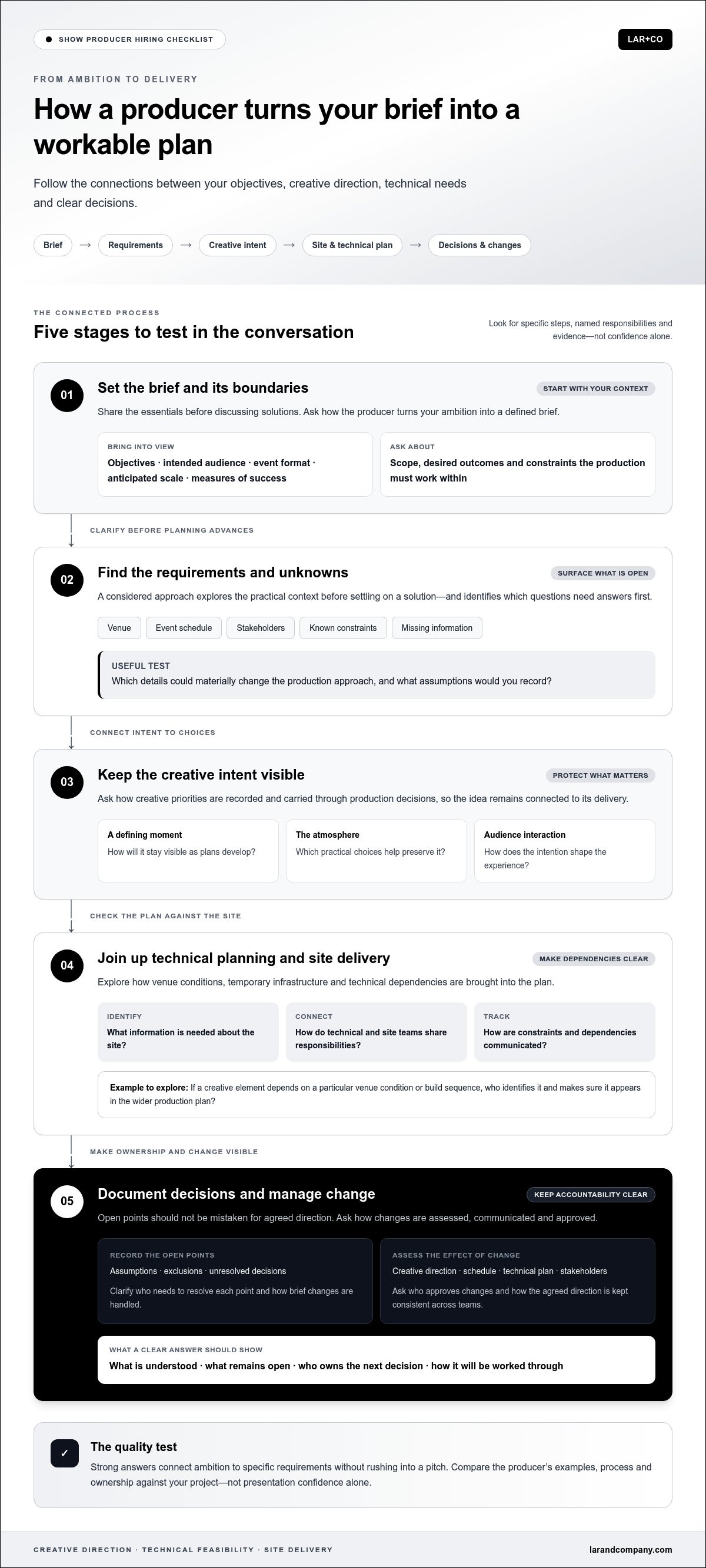
Before discussing solutions, share the essentials: your objectives, intended audience, event format, anticipated scale and how you’ll judge success. A producer can make useful recommendations only when the ambition and its boundaries are clear. Start with a practical brief: define the scope, the outcomes you want and the constraints the production must work within.
This is a focused hiring checklist, not a general guide to every responsibility a show producer might hold. Titles and remits can vary; a Television Producer Roles and Responsibilities overview, for example, covers a different production context. Here, the aim is to establish how a producer would approach your live project.
How would you turn our ambition into a workable brief?
Listen for questions that clarify the audience, creative priorities, format and measurable outcomes. If your goal is to create a shared experience for guests, ask how that intention would shape the show’s content, running order and production decisions. Lar&Co translates a client’s vision into a defined production approach, connecting creative direction with the practical work required to deliver it.
Ask how assumptions, exclusions and unresolved decisions are captured. A clear answer should explain how open points are documented, who needs to resolve them and how changes to the brief are handled. This helps distinguish an agreed direction from an early idea.
What would you need to understand before recommending an approach?
A considered response should explore the venue, event scale, schedule, stakeholders and known constraints before settling on a solution. Ask how the producer identifies missing information and decides which questions need answers first. Early priorities might include clarifying who approves the creative direction or understanding how the event schedule affects the production plan.
Examples help you judge whether the producer’s experience is relevant to your context. Lar&Co’s work spans tours, festivals, cultural celebrations and corporate events; its live entertainment project portfolio offers a view of that range. Ask what the producer would take from comparable work and what they would adapt rather than assume applies unchanged.
Keep the discussion grounded in your project. You might ask:
• Which details in our brief could materially change the production approach?
• What assumptions would you record before planning advances?
• Which decisions must be made early, and who should make them?
• How would you show that the proposed approach supports our stated outcomes?
Strong answers connect ambition to specific requirements without rushing into a pitch. They should make clear what is understood, what remains open and how those unknowns will be worked through. That gives you a firmer basis for comparing proposals than confidence or creative language alone.
Questions That Test Creative Vision, Technical Feasibility and Site Delivery
A strong creative idea needs a delivery plan that preserves what makes it distinctive. The next questions to ask a show producer before hiring should reveal how creative direction informs technical choices, venue planning and operational responsibilities, rather than sitting apart from them.
A compelling concept inspires; a production-ready plan connects that concept to the people, spaces, systems and decisions needed to deliver it. Ask the producer to explain that connection using a real example. Listen for clear steps and ownership, not just assurances that the details will be worked out later.
How will you protect the creative intent during delivery?
Ask how creative priorities are recorded and carried into production decisions. If a particular moment, atmosphere or audience interaction is central to the show, how will the producer ensure it remains visible as technical and site plans develop? Lar&Co’s creative direction bridges vision and execution, aligning the experience being designed with the practical choices required to realise it.
Changes are inevitable in a live project. Ask how proposed changes are assessed for their effect on the creative direction, schedule, technical plan and other stakeholders. A useful answer will describe how decisions are communicated, who approves them and how the agreed direction is kept consistent across teams. The technical production approach is part of this conversation: creative priorities need to inform delivery requirements from the outset.
How do you assess technical and site requirements early?
Explore how the producer brings venue conditions, temporary infrastructure and technical dependencies into planning. Ask what information they need about the site, how they identify constraints and how technical and site teams share responsibilities. For example, if a creative element depends on a specific venue condition or build sequence, who identifies that dependency and makes sure it is reflected in the wider production plan?
Strong answers show how connected requirements are surfaced, tracked and communicated. Ask how safety considerations and risk ownership are incorporated into planning. The Event Safety and Risk Management resource offers context for the safety dimension of live events; in the interview, focus on how the producer makes responsibilities and decisions clear for your particular project.
For an international production, ask how local teams and location-specific requirements are included in the process. A producer should explain how local knowledge informs planning and how communication is maintained across the people responsible for creative, technical and site delivery. This matters whether the project is a tour, festival, cultural celebration or corporate event, including work involving the UK, USA, United Arab Emirates, Saudi Arabia or Qatar. Lar&Co’s international practice, with offices in London and Los Angeles, brings experience across varied live-entertainment contexts.
• Which creative priorities will guide technical decisions?
• How are dependencies, responsibilities and changes tracked?
• How will local teams contribute to planning for each location?
Answers to these questions make the relationship between ambition and delivery tangible. Look for a clear account of how creative direction connects with technical production and site management, and how the team will carry decisions through to delivery.
Questions About Teams, Decisions and International Coordination
A complex production needs more than capable people. It needs clear lines of responsibility, timely decisions and communication that keeps the right stakeholders informed. These questions to ask a show producer before hiring can help you see whether the proposed team structure is practical, not simply collaborative in principle.
Who owns decisions and keeps stakeholders aligned?
Start by asking who will be your primary production contact, how issues are escalated and who has authority to resolve them. Clarify how client approvals, artist liaison and stakeholder updates fit into the process. If several people share responsibility, ask where each person’s remit begins and ends. Specific roles and decision points are more useful than broad assurances that everyone works as one team.
Then ask how often you’ll receive updates, what they’ll cover and how decisions will be recorded. Use the same comparison points across proposals:
Role
Who leads, advises, approves or delivers each area?
Decision rights
Who can make a decision, and whose approval is needed?
Reporting
Who provides updates, to whom and at what agreed cadence?
Use the same headings for each discussion. You’ll be able to spot gaps, duplicated authority or unclear escalation routes before they become sources of delay.
How do you coordinate teams across countries and venues?
For a project involving several locations, ask how local teams, suppliers and venue stakeholders are included in the production plan. Explore how schedules are shared, what information passes between teams and how handovers are managed as work moves from one venue or location to another. Ask for an example of how the producer would keep the overall plan coherent while making room for local input.
Responsibilities and working arrangements can vary by project and location. Ask how the producer identifies local requirements, agrees who will address them and keeps you informed. This is particularly useful when multiple teams contribute to a tour, festival or cultural celebration, where a decision at one location may affect planning elsewhere.
Lar&Co is an international practice with offices in London and Los Angeles, working across tours, festivals, cultural celebrations and corporate events. Its international show-production experience provides relevant context for discussing how teams and stakeholders are coordinated across different settings.
What should a clear coordination plan show?
Look for a practical explanation of how communication works day to day, not just a promise to keep everyone aligned. The producer should be able to identify the key contacts, approval route, reporting rhythm and handover points for your project. Ask how this information will be documented and updated as responsibilities evolve.
Strong answers make ownership visible. They show who acts, who decides and how others stay informed, while allowing the structure to reflect the project and its locations. That clarity gives you a sound basis for evaluating whether the proposed team can work as a coordinated production unit.
Questions That Reveal Budget Control, Risk Thinking and Accountability
A headline budget is only a starting point. The questions to ask a show producer before hiring should show how figures are built, monitored and connected to decisions throughout the project. Look for active financial oversight: clear assumptions, visible commitments and a defined process for reviewing changes, rather than a single total with little explanation.
Ask how the budget will reflect your project’s scope and priorities. Production budgets and controls should be shaped around the specific event, not assumed from a standard template. A useful discussion will clarify who prepares forecasts, who approves commitments and how you’ll see the effect of a proposed change before a decision is made.
How will you build, monitor and report the production budget?
Ask what assumptions inform the initial budget and how responsibilities are divided across the production. Find out how often you’ll receive an update, what it will show and how forecast changes will be explained. You should be able to distinguish between amounts already committed, expected costs and items still subject to a decision, rather than relying on a headline figure alone.
Clarify the approval route for commitments and changes. Who can authorise spend? How are procurement decisions made visible to you? If a creative or operational change affects the forecast, when will its implications be reported and who must approve it? These questions reveal whether financial management is integrated with production decisions. Lar&Co’s production financial management offers further context on this part of show delivery.
How do you identify and manage project risks?
Ask how the producer makes dependencies, decision deadlines and contingency planning visible. For example, if a venue decision or a late approval could affect the schedule, how would that dependency be recorded, who would own the next action and when would it be raised with you? This tests whether risks are considered early, rather than discussed only once they become urgent.
Then explore how emerging issues are escalated and tracked through to resolution. A useful answer connects each risk to an owner, a practical action and a clear communication route. Ask how you’ll know whether an issue is unresolved, being managed or closed, and how a change in its status will be reported. The process should make accountability clear without obscuring decisions in general assurances.
Clear ownership, timely reporting and documented decisions turn financial oversight and risk planning into practical project controls. As you compare producers, note whether their answers establish controls you can understand and apply to your event. Vague statements about keeping costs on track or managing challenges are less informative than a clear explanation of responsibilities, approvals and reporting.
Lar&Co provides financial oversight as part of show production, from concept through completion. A useful discussion should establish how budget reporting and approvals connect to the production’s wider decision-making process.
How to Assess the Answers and Agree the Next Step
After the interviews, compare what each producer has explained, not how persuasive the conversation felt. The questions to ask a show producer before hiring are useful only if they help you judge whether the answers fit the demands of your project. A consistent scorecard keeps the decision grounded in evidence rather than confidence, reputation or the apparent scale of past work.
For each producer, mark the following areas as clear, partly clear or unresolved. Add a short note or example to support each assessment.
Clarity
Are the proposed approach and next steps easy to understand?
Evidence
Did the producer give relevant examples or explain a specific method?
Accountability
Are responsibilities, approvals and reporting clear?
Project fit
Does the experience relate to your format, scale and delivery needs?
Communication
Were dependencies and uncertainties discussed directly?
Apply the same criteria to every conversation. A confident answer isn’t necessarily a complete one; look for a clear explanation of how the producer would act, who would be involved and what information would guide a decision. A large portfolio matters most when its examples show experience relevant to your project, not simply impressive scale.
What does a strong answer sound like?
Strong answers are specific without pretending every detail is already settled. They draw on relevant examples, explain the method behind a recommendation and identify dependencies that could affect delivery. Listen for coherence: creative decisions should connect to operational planning, and financial oversight should reflect the same agreed scope. Unsupported promises and vague assurances make that connection hard to assess.
What should be clear before you appoint a producer?
Before committing, make sure you can summarise the proposed scope, key responsibilities, communication arrangements and decision-making route. Record the assumptions behind the approach, approval points and immediate planning priorities. This gives both sides a shared reference, particularly if the brief develops or new stakeholders join the process.
Project fit includes the locations and teams involved. Lar&Co’s international production experience, supported by offices in London and Los Angeles, is relevant when a brief calls for coordination across countries or varied live-event contexts. Its end-to-end production management can bring creative intent, logistics and delivery into one joined-up approach.
Agree the next step in practical terms: what information is needed, who will provide it and which decisions should be addressed first. If the brief calls for integrated show production and oversight from concept through completion, a focused discussion can establish how the project’s priorities and delivery needs align.
Move from Evaluation to a Clear Production Plan
The questions to ask a show producer before hiring are a starting point for a more important conversation: what happens once the brief becomes a shared commitment? The next step is to turn clear answers into agreed responsibilities, priorities and decisions, so the production can move forward with purpose.
Lar&Co brings more than 20 years of experience in complex live entertainment to projects spanning tours, festivals, cultural celebrations and corporate events. Its international practice, with offices in London and Los Angeles, connects that breadth of experience with production oversight from concept through completion.
If you’re ready to explore how your creative ambition can become a coordinated live production, Discuss your show with Lar&Co. A focused conversation can help establish the right next steps for your project.
Frequently Asked Questions
When should I hire a show producer?
Hire a show producer while the concept is still taking shape, before key choices make the format, schedule or technical direction difficult to change. Early involvement allows production considerations to inform creative decisions rather than being added later. If planning is already under way, a producer can still help bring outstanding decisions into focus. The questions to ask a show producer before hiring can help you establish whether their involvement matches the stage your project has reached.
What is the difference between a show producer and an event organiser?
The distinction depends on the project, but a show producer typically leads the development and delivery of the live show, bringing creative, technical and production considerations together. An event organiser may focus more broadly on coordinating the event and its guest-facing elements. The roles can overlap. Before appointing anyone, agree which outcomes and workstreams sit within the producer’s remit, and which remain with your organisation or other stakeholders.
Should a show producer be involved before the venue is confirmed?
Yes, a producer can contribute before a venue is confirmed by identifying production needs that may affect venue suitability. For example, the intended staging, audience experience or technical requirements could influence which spaces are practical. Share the event’s priorities and any venue options under consideration. The producer can then help you understand what information is needed to assess the implications, without treating an early venue preference as a settled production plan.
How can I assess a show producer’s experience if my event is unique?
Look for transferable judgement, not an identical past event. Ask the producer to explain how they have handled comparable challenges, such as coordinating multiple stakeholders, adapting a creative idea to a site or managing a production with several moving parts. Then give them a realistic scenario from your project and ask what they would investigate first. Their reasoning can show how they approach unfamiliar details, not just what appears in their portfolio.
What information should I prepare before speaking to a show producer?
Prepare a short working note with the event’s purpose, intended audience, preferred format, potential dates and locations, and the people involved in approving decisions. Mark each detail as confirmed, provisional or unknown. Include any known constraints, such as a fixed announcement date or existing commitments, without trying to solve them in advance. This gives the producer useful context and makes it easier to identify which questions need attention during the first discussion.
Can one show producer manage an international production?
Yes, a lead producer can coordinate an international production when the remit, local inputs and communication structure are clearly established. For a project spanning the UK, USA, United Arab Emirates, Saudi Arabia or Qatar, discuss how information will move between the central team and people on the ground at each location. Clarify how location-specific requirements are identified and who owns each action. The production structure should reflect the places and teams involved.
What should a show producer proposal include?
A useful proposal should make the proposed engagement understandable before work begins. Look for a description of the intended scope, the producer’s role, key stages and deliverables, plus the assumptions on which the approach is based. It should also explain how changes to the brief would be handled and identify information or decisions needed to proceed. If anything remains open, the proposal should label it clearly rather than implying it has already been resolved.