Scenic Design for Live Events: A Masterclass in Visual Storytelling
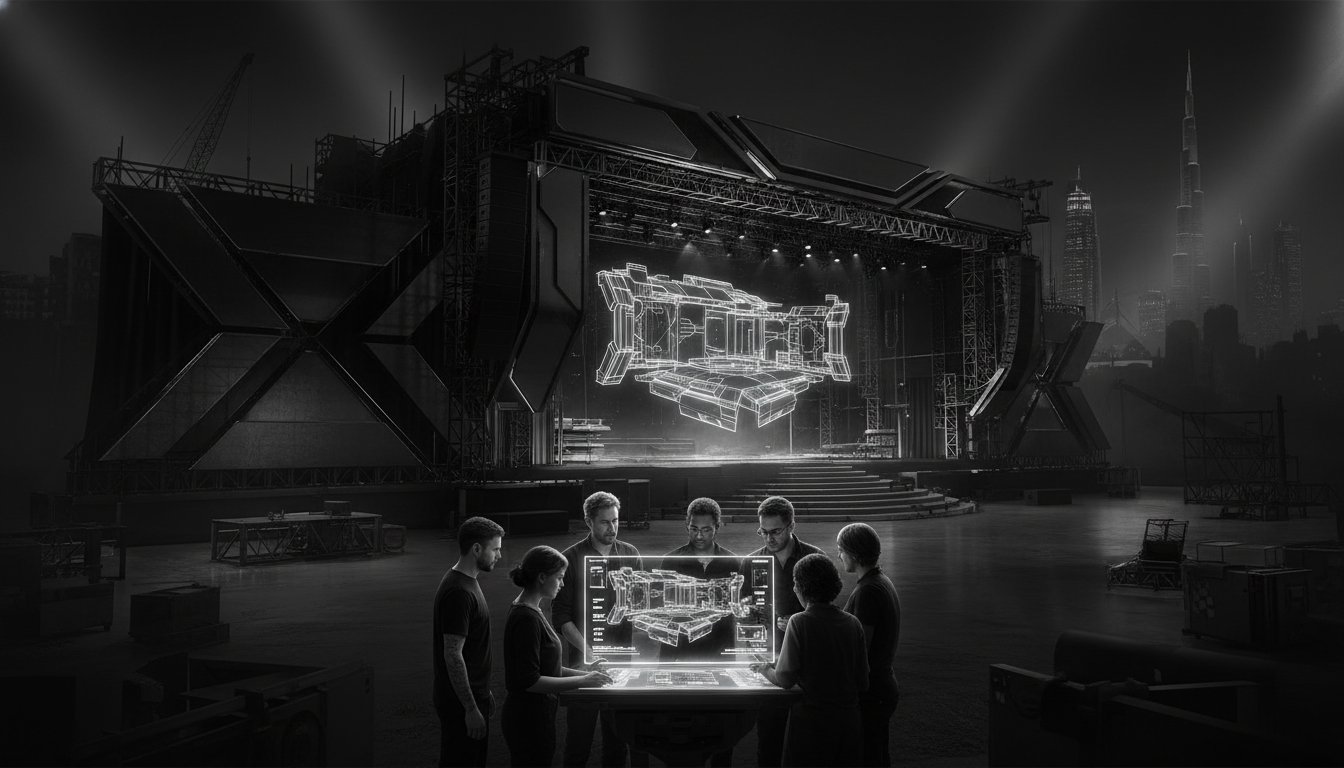
A breathtaking creative concept is a liability if it cannot survive the transition from the drawing board to the stage. In high-stakes global production, the distance between a masterpiece and a logistical failure is often measured in millimetres and minutes. You understand that scenic design for live events requires more than just a flair for the dramatic. It demands a rigorous alignment of creative direction with technical production to avoid the budget overruns and site management failures that plague less disciplined projects.
This article provides a framework for bridging the gap between ambitious vision and flawless execution. You'll discover how to maintain a cohesive visual narrative whilst navigating the complexities of international territories like Saudi Arabia and the UAE. We examine the transition from abstract concepts to tangible reality, focusing on the integration of Vectorworks 2026 workflows and strict adherence to ANSI E1.21-2024 safety standards for temporary structures. By the end, you'll have the insights needed to ensure every pound spent translates into maximum impact, delivering a sophisticated experience that functions as perfectly as it looks.
Key Takeaways
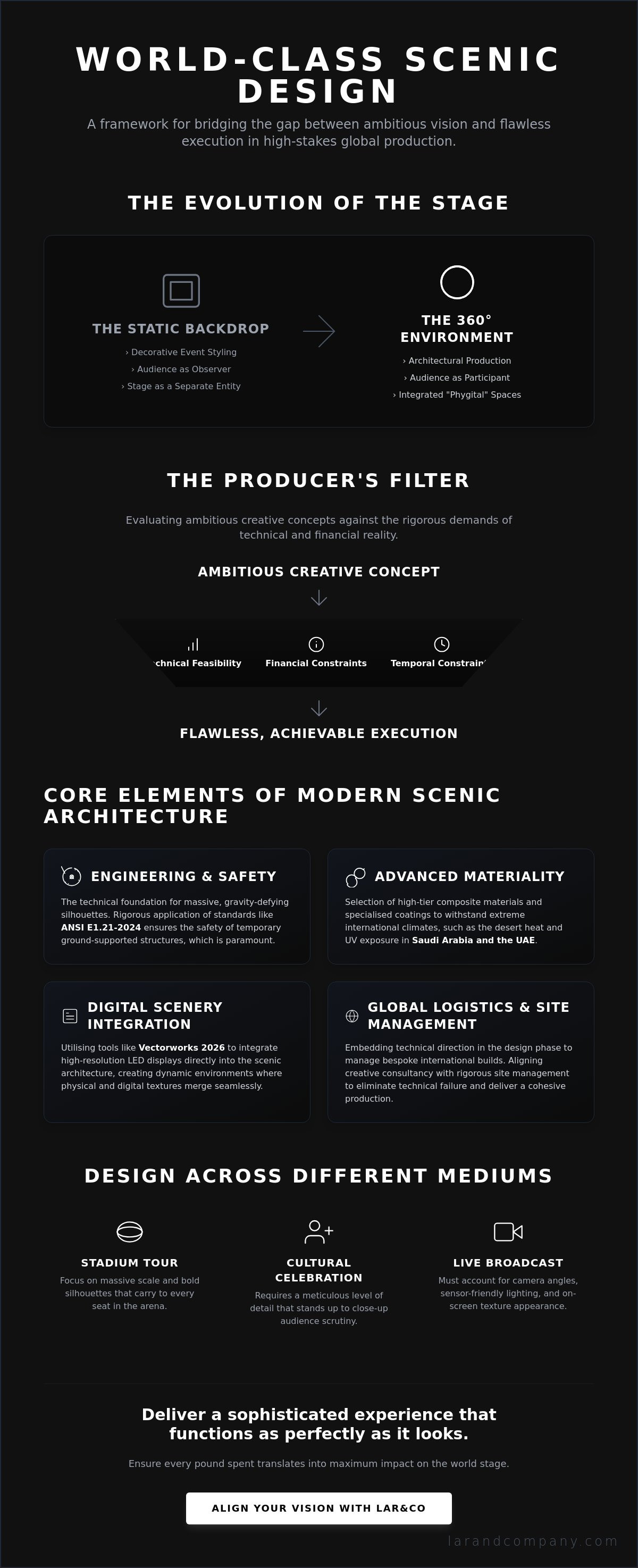
• Understand the evolution of the stage from a static backdrop to an immersive 360-degree environment that drives the visual narrative.
• Learn to apply the "Producer’s Filter" to evaluate if ambitious creative concepts are technically achievable within strict financial and temporal constraints.
• Discover how to select high-tier materials and engineering solutions that ensure scenic design for live events remains durable in extreme international climates.
• Master the complexities of global logistics and procurement to manage bespoke builds across diverse territories, including the UAE and Saudi Arabia.
• Align creative consultancy with rigorous site management to eliminate technical failure and deliver a cohesive, world-class production.
Defining Scenic Design for High-Profile Live Events in 2026
Scenic design for live events has moved past the era of the static backdrop. It's no longer a secondary concern to lighting or sound. In high-profile contexts, it functions as the silent lead, establishing authority before a single word is spoken. This discipline is the physical manifestation of a production's narrative, grounding abstract creative vision in tangible, three-dimensional reality. Whether for a global stadium tour or a prestigious civic ceremony, the environment dictates the emotional arc of the audience.
There is a fundamental distinction between decorative event styling and architectural scenic design. Styling relies on surface-level aesthetics to mask a space. Architectural production builds the space itself. It requires a deep understanding of technical production and site management to ensure that structures are not only visually arresting but also safe and functional. By 2026, the industry has shifted toward a model where the designer works as a creative consultant, ensuring that every beam, texture, and light source serves the overarching story. Our portfolio of global projects demonstrates this transition from mere decoration to total environmental control.
The Shift Towards Immersive Environments
Audiences in 2026 expect to be participants rather than observers. This demand has triggered an evolution toward 360-degree environments where the boundary between the stage and the spectator is blurred. We are seeing the rise of "phygital" spaces, where physical scenic elements are seamlessly integrated with digital content. This isn't about using screens as a background. It's about using them to extend the physical geometry of the set. Modern scenic design is the architecture of experience.
Scenic Design Across Different Mediums
Designing for a stadium requires a focus on massive scale and bold silhouettes that carry to the back of the arena. Conversely, intimate cultural celebrations demand a level of detail that stands up to close-up scrutiny. Live broadcast adds another layer of complexity. The design must account for camera angles, sensor-friendly lighting, and the way physical textures appear on screen. In every medium, understated authority in design yields the most sophisticated results. It's about the quiet power of a perfectly executed space that supports the performer without distracting from them.
The Core Elements of Modern Scenic Architecture
Elite scenic design for live events begins with engineering. A design that cannot withstand the structural stresses of a stadium tour or the environmental pressures of an outdoor civic ceremony is a liability. In 2026, the complexity of these builds requires a rigorous application of standards such as ANSI E1.21-2024 to ensure the safety of temporary ground-supported structures. This technical foundation allows for the creation of massive, gravity-defying silhouettes that define the world's most prestigious stages.
Materiality is a technical decision as much as an aesthetic one. When operating in territories like Saudi Arabia or the UAE, finishes must be selected for their resilience against extreme desert heat and UV exposure. High-tier scenic production utilises composite materials and specialized coatings that maintain their structural integrity and visual finish under harsh conditions. This level of precision ensures that the creative vision remains uncompromised from the first render to the final show day. Those pursuing a career in modern scenic and environment design now study these intersections of material science and traditional stagecraft.
Digital scenery has evolved from a simple background into a structural component. With the release of Vectorworks 2026, designers now utilise advanced LED wall creation tools to integrate high-resolution displays directly into the scenic architecture. This allows for dynamic environments where physical textures and digital content share the same geometric plane. Ensuring these complex systems function under pressure is the hallmark of our Technical Production team, where we bridge the gap between digital ambition and physical reality.
Structural Integrity and Site Management
Technical direction must be embedded in the design phase to manage the logistics of international builds. Managing temporary venue constructions in unconventional locations requires a modular approach. We design scenic components that are easily transportable whilst maintaining the appearance of a bespoke, permanent installation. This efficiency in site management reduces load-in times and mitigates the risk of technical failure during complex global tours.
The Synergy of Light and Surface
Every surface in a scenic build is a canvas for light. We select textures based on how they react to high-intensity show lighting, using matte finishes to absorb glare or metallic accents to create sharp highlights. Negative space is utilised strategically to provide depth, allowing the performer to remain the focal point amongst grand architectural gestures. The choice of paint finish or fabric weave is a calculated technical move that dictates the final visual atmosphere of the event.
Balancing Creative Ambition with Technical Feasibility
High-tier scenic design for live events exists at the intersection of artistic audacity and structural reality. A vision that ignores the laws of physics or the limits of a budget is merely a dream. Applying a 'Producer’s Filter' to every concept ensures that the final build is as impressive as the initial sketch. This rigorous evaluation process determines if a vision can be realised within the time and financial parameters available. Abstract aesthetics move toward tangible delivery.
Identifying potential failure points in complex scenic automation is a core part of our risk mitigation strategy. We stress-test designs against real-world conditions. This is particularly vital for high-value international projects where failure is not an option. Financial management ensures that the 'wow moments' receive the necessary investment. We keep the essential infrastructure robust but invisible. This allows the budget to be concentrated where it creates the most significant impact. Lar&Co bridges this gap by acting as a translator between the artist’s creative direction and the technical production reality. We protect the integrity of the vision whilst ensuring it is physically possible to build and safe to operate.
The Feasibility Audit
A technical feasibility study must occur before any design render is finalised. This level of scrutiny prevents costly mid-production pivots. Key considerations include:
• Analysis of wind loads and local weather patterns for outdoor scenic structures.
• Weight-bearing capacity assessments for existing venue points.
• Logistical mapping for bespoke scenic components in international territories.
For a deeper look at how we manage these architectural challenges, refer to our article on Technical Production for Live Events.
Managing Creative Expectations
Innovation shouldn't be stifled by technical limitations. It should be guided by them. We use 3D pre-visualisation to align all stakeholders on the final output. This tool provides a clear, shared understanding of the physical space. Using it, we maintain the most impactful elements of a design whilst ensuring fiscal integrity. Clear communication ensures that the artist's vision remains intact throughout the technical reality of the build. By providing transparent data on costs and logistics, we allow creative leads to make informed decisions about their favourite features. This collaborative approach results in a production that is both ambitious and entirely achievable.
Managing Scenic Logistics for International Productions
Sophisticated scenic design for live events requires a logistics strategy as precise as the initial render. Moving from a creative workshop to a global stadium stage involves navigating a landscape of shifting supply chains and rigid border protocols. Success depends on the ability to source bespoke materials globally whilst maintaining the flexibility to adapt to local constraints. In the UK and USA, established infrastructures offer predictability; however, the burgeoning markets of the Middle East demand a different level of agility and local connectivity.
Our 'Pack and Move' strategy is essential for high-momentum stadium tours. We design scenic elements for rapid installation and strike, ensuring that complex structures can be dismantled and transported within hours of a show's conclusion. This modularity doesn't compromise the aesthetic quality. It simply ensures that the visual narrative remains consistent across different continents. Meticulous site management coordinates local crews and international specialists, ensuring that the transition from a shipping container to a finished stage is seamless. If you are preparing a global tour, contact our production team to discuss your logistical requirements.
Navigating Global Border Requirements
Moving multi-million pound scenic assets across international borders requires more than just transport. It requires an understanding of diverse regulatory environments. Adhering to local safety standards whilst managing complex event logistics is a prerequisite for operating in territories like Riyadh or Doha. Local knowledge is indispensable here. It ensures that permits are secured and that the physical components of the scenic design for live events arrive on site without delay. We manage these complexities with absolute composure, ensuring that administrative hurdles never interfere with the creative output.
The Timeline of a Global Build
The timeline of a global build spans from initial workshop fabrication to the final on-site polish. Meticulous site management prevents delays during the critical 'wow moment' assembly. We oversee every stage of this progression to ensure the creative vision is never diluted by logistical friction. Every detail, from the first weld in the workshop to the final coat of paint on-site, is managed with rigorous precision. For comprehensive site-specific guidance, explore our insights on Large Scale Event Management. This ensures that when the house lights go down, the physical environment is flawless.
Delivering World-Class Scenic Environments with Lar&Co
Lar&Co operates at the highest tier of global show production. We rely on the gravity of our portfolio to establish credibility amongst the world's most demanding stakeholders. This portfolio spans from iconic musical tours to prestigious cultural fairs and large-scale civic events. Our role is often that of the quiet power behind the scenes, ensuring that scenic design for live events is executed with absolute composure. Elite partners choose us because we handle rare and significant challenges with a temperament suited for high-stakes international projects.
We maintain meticulous attention to detail throughout the entire process. This begins with creative consultancy and extends through technical production to final site management. Our presence in major entertainment hubs like London and Los Angeles allows us to project a persona of international sophistication. We don't just build stages. We create the physical environments where cultural history is made. Whether managing a bespoke build in the UAE or a stadium tour across Europe, our focus remains on tangible, reliable execution.
The Lar&Co Methodology
Our approach to managing high-value show production is sophisticated and calm. We specialise in translating complex visions into tangible, impactful live experiences that resonate globally. This requires a business culture focused on execution and results. By prioritising clarity and impact, we ensure that every stakeholder is aligned from the outset. Our team is comfortable operating at the intersection of entertainment and diplomacy, delivering results that speak for themselves. To learn more about our global team of talent, visit our about-us page.
Collaborate on Your Next Vision
We provide artistic direction and visual storytelling that defines global brands. This is paired with a rigorous commitment to financial management and transparent reporting. We understand that scenic design for live events must be both breathtaking and fiscally responsible. Our versatility allows us to bridge the gap between musical legends and high-end fashion houses with ease. We invite you to contact us to discuss your next project and discover how we elevate creative visions through world-class execution.
Mastering the Architecture of Experience
Exceptional scenic design for live events is a disciplined alignment of artistic audacity and structural integrity. You've seen how the transition from a creative render to a global stage requires a rigorous "Producer's Filter" to ensure technical feasibility and fiscal responsibility. From navigating the logistics of the Middle East to specialising in materials that withstand extreme climates, success is found in the details of execution. A cohesive visual narrative only survives when supported by meticulous site management and engineering precision.
Lar&Co brings over 20 years of expertise to complex global projects. With offices in London and Los Angeles, we manage everything from international festivals to bespoke cultural celebrations with absolute composure. We bridge the gap between ambitious vision and tangible reality, ensuring your narrative is delivered without technical failure or budget overruns. Our portfolio demonstrates a commitment to the highest tier of show production and global connectivity. Contact Lar&Co to deliver your next high-profile live experience. Let's transform your creative vision into a flawless architectural reality that resonates on a global scale.
Frequently Asked Questions
What is the difference between scenic design and event styling?
Scenic design is an architectural discipline focused on constructing the physical environment, whereas event styling relies on surface-level aesthetics. Design involves structural engineering and technical production to build the stage and its surroundings from the ground up. Styling typically utilises furniture, florals, and temporary maskings to enhance an existing space. Scenic design creates the narrative structure; styling provides the decorative finish.
How do you ensure a scenic design is technically feasible?
Ensuring scenic design for live events is technically feasible requires a rigorous audit during the initial concept phase. We use 3D pre-visualisation and advanced software like Vectorworks 2026 to stress-test structures against real-world physical constraints. This identifies potential failure points before fabrication begins. This process ensures the creative vision is delivered on time and within the venue's structural limits without compromising safety.
What are the most common materials used in modern scenic design for live events?
Modern builds utilise high-tier composites, tension fabrics, and structural aluminium for their durability and weight efficiency. We also integrate high-resolution LED panels and specialised coatings that react predictably under intense show lighting. In extreme climates, such as those found in Saudi Arabia or the UAE, materials are selected for their UV resistance and thermal stability to prevent warping or finish degradation.
How does scenic design impact the overall event budget?
Scenic design is a primary driver of the production budget, as it dictates the requirements for lighting, rigging, and site management. Effective financial management prioritises high-impact visual moments whilst maintaining robust, invisible infrastructure. By investing in modular and reusable designs, we reduce long-term costs for global tours. This allows for efficient budget allocation that maximises visual scale without unnecessary waste.
Can scenic design be adapted for live broadcast and digital audiences?
Designs are frequently tailored for "phygital" environments that cater to both in-person and digital spectators. This involves adjusting textures and finishes to suit camera sensors and creating depth through negative space for specific broadcast angles. We often integrate Extended Reality (XR) and projection mapping to expand the physical set for the screen audience, ensuring the visual narrative remains cohesive across all platforms.
What are the logistical challenges of international scenic production in the Middle East?
Logistical challenges include navigating complex border requirements and adhering to strict local safety standards like ANSI E1.21-2024. Managing the supply chain for bespoke builds requires deep local knowledge in hubs like Riyadh or Doha to ensure timely delivery. Extreme environmental heat also dictates the timeline for on-site builds and the selection of resilient materials that can withstand intense UV exposure.
How early should a technical director be involved in the scenic design process?
A technical director should be involved at the inception of the creative direction phase. Early integration prevents the development of concepts that are physically impossible or fiscally irresponsible. This collaboration ensures that the artistic vision is grounded in technical reality from the first sketch. It streamlines the transition to fabrication and site management, reducing the risk of costly mid-production pivots.
What role does automation play in 2026 scenic design?
Automation in 2026 focuses on kinetic scenic elements that move in real-time to support the performance narrative. This includes automated tracking systems for LED walls and modular stages that reconfigure themselves during the show. These systems are managed through advanced control software, ensuring that complex movements are executed with absolute precision and safety. Automation transforms the stage into a dynamic participant in the storytelling process.