Scenic Design for Live Events: The Architecture of Impactful Storytelling in 2026

A stage is not a background; it is a structural narrative that dictates the emotional trajectory of an entire audience. In the high-stakes world of international entertainment, the most ambitious creative visions often falter at the intersection of imagination and engineering. You've likely experienced the friction when creative teams dream of impossible geometries whilst technical crews struggle with weight loads or international shipping constraints. This disconnect leads to compromised aesthetics and avoidable budget overruns that no high-profile project can afford.
We understand that achieving a cohesive visual narrative requires more than just a sketch. It demands an elite fusion of artistic vision and technical precision. This article explores the architecture of scenic design for live events in 2026, demonstrating how to create unforgettable experiences through rigorous technical direction and site management. We'll examine the strategies for delivering scalable, technically sound structures that maintain their impact from London to Los Angeles, ensuring your global tour or cultural celebration remains both breathtaking and logistically flawless.
Key Takeaways
• Learn how modern scenic design for live events functions as a structural narrative, transforming static sets into immersive, multi-dimensional environments.
• Understand the essential role of technical direction in validating creative concepts to ensure structural integrity and financial feasibility.
• Discover how to integrate LED surfaces and projection mapping whilst selecting materials engineered for durability and efficient international logistics.
• Gain insights into the strategic workflow required for global delivery, from initial creative consultancy to meticulous site management.
• Explore the capabilities of an elite international practice in managing high-stakes projects across the UK, USA, and the Middle East.
Defining Scenic Design for Live Events: More Than a Backdrop
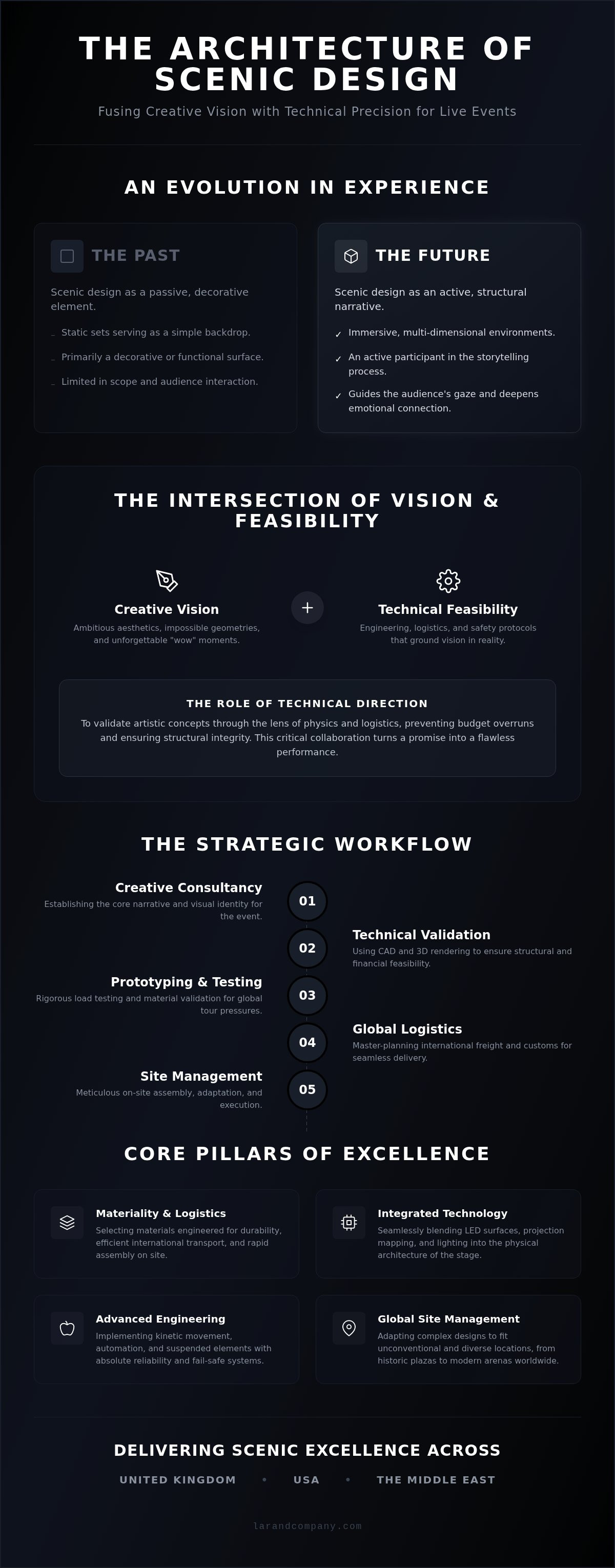
In the context of high-tier production, Scenic design represents the physical architecture of a show’s narrative. It isn't a passive element or a mere decorative surface. Instead, it's the structural environment that facilitates every beat of a performance. Elite scenic design for live events has evolved beyond the static sets of the past. It now encompasses immersive, multi-dimensional spaces that respond to the presence of the performer and the energy of the crowd.
This structural foundation is essential for establishing an unmistakable brand or artist identity. A stadium tour or a global cultural fair requires a visual signature that translates across different continents and venue scales. The physical set dictates how an audience perceives the scale of the event. It guides their gaze, influences their movement, and deepens their emotional connection to the content on stage. When executed with precision, the environment becomes an active participant in the storytelling process.
The Role of Scenography in Modern Live Entertainment
Scenography has undergone a radical transformation, moving from the intimate confines of traditional theatre to the vast, complex requirements of stadium-scale spectacles. Modern scenography isn't about filling space; it's about centring the audience within a curated experience. Scenography is the visual language of the stage. By blending physical structures with digital layers, designers create a sense of place that feels both tangible and limitless. This evolution ensures that even in a venue of eighty thousand people, the visual narrative remains focused and impactful.
Why Visual Storytelling Requires a Strategic Foundation
Every design choice made at the conceptual stage has a direct impact on technical delivery. The geometry of a stage determines the placement of lighting rigs, the sightlines for video surfaces, and the acoustic profile of the audio system. Strategic design considers the psychological impact of scale and colour, using these elements to manipulate the atmosphere of large-scale venues. A monolithic structure might project power and authority, whilst curved, organic forms suggest intimacy and fluidity. This level of Creative Direction for Live Shows ensures that the visual storytelling is grounded in technical reality, preventing the disconnect between a bold vision and its eventual execution on site.
The Intersection of Creative Vision and Technical Feasibility
A creative vision exists in a vacuum until it meets the rigour of engineering. In the high-stakes environment of global tours, a sketch is merely a promise. The actual value of scenic design for live events lies in its execution. If a concept cannot be safely rigged, transported, or assembled within a narrow load-in window, it's a liability. This is where the technical director becomes the most critical collaborator. They validate the artistic vision through the lens of physics and logistics, preventing the budget overruns that often plague poorly planned projects.
Precision begins in the pre-production phase. Using advanced CAD software and 3D rendering allows teams to identify structural clashes before a single piece of steel is cut. It's about more than just aesthetics. It's about calculating weight loads, wind resistance for outdoor festivals, and sightline clearances. These tools ensure that creative integrity isn't sacrificed for safety; rather, safety becomes the framework that supports the art.
Engineering the "Wow" Moment
Suspended scenic elements require meticulous attention to detail. Kinetic movement and automation add layers of complexity that demand absolute reliability. When a scenic piece moves, it must do so with silent, repeatable precision. This level of engineering ensures that the "wow" moment is a highlight, not a hazard. It requires a deep understanding of mechanical limits and a commitment to fail-safe systems.
Technical Feasibility: From Sketch to Stadium
The transition from a design studio to a stadium involves rigorous prototyping and load testing. This process ensures structures withstand global tour pressures, weather variables, and repeated assembly. Site management teams adapt these designs to fit unconventional locations, from historic plazas to modern arenas. This meticulous Technical Production for Live Events separates professional execution from amateur attempts.
Adhering to the latest 2026 safety standards, such as updated OSHA regulations for structural integrity, is a non-negotiable part of the process. Partnering with an experienced international practice ensures that technical feasibility is built into the design from day one, protecting both the audience and the artist’s vision.
Materiality and Technology: Elevating the Visual Narrative
The selection of materials is a tactical decision that dictates the lifespan and mobility of a production. For an international practice, scenic design for live events must balance aesthetic texture with the realities of global freight. In 2026, the industry is moving away from heavy timber builds towards lightweight composites that offer high structural integrity with reduced weight. This shift isn't just about ease of handling; it's a response to rising logistics costs and a commitment to eco-responsible design. Using recycled materials and noble finishes allows for a sophisticated look that remains environmentally conscious.
Every material choice impacts how a set interacts with light. A high-gloss finish might create unwanted reflections for a broadcast, whilst a matte, textured surface can better catch a projection. Achieving harmony between lighting design and scenic surfaces is essential. It requires a deep understanding of how different fabrics, paints, and metals respond to various light temperatures and intensities. This technical precision ensures the visual narrative remains consistent, whether viewed from the front row or through a camera lens.
Innovative Materials for Global Tours
Global tours demand modularity. Structures are engineered to break down into standard air-freight dimensions, ensuring they fit within the constraints of international shipping containers. Whilst traditional steel remains a staple for load-bearing elements, carbon-fibre reinforced polymers are increasingly used for complex, non-structural geometries. These materials must adhere to stringent international fire-retardant regulations. Every surface is tested to meet specific local codes, ensuring compliance with the 2026 updates to the Hazard Communication Standard (GHS) Revision 7 across all territories.
Integrating Digital and Physical Scenery
The boundary between physical structures and digital content has dissolved. Modern sets often incorporate transparent LED technology, which allows for visual depth without blocking sightlines or lighting positions. This creates a multi-dimensional environment where physical scenery acts as a canvas for high-resolution projection mapping. Advanced design tools, such as the 2026 updates to Vectorworks, allow for the precise mapping of video surfaces onto complex 3D forms during the pre-production phase.
In 2026, Augmented Reality (AR) is being used to extend physical sets into the digital sphere for broadcast and hybrid audiences. This integration offers a unique sensory experience that physical scenery alone cannot achieve. Whilst physical elements provide tangible scale and anchor the artist, digital layers offer infinite versatility. The result is a hybrid environment that feels both grounded and limitless, providing a level of immersion that defines the current tier of elite entertainment.
The Strategic Design Process: From Concept to Global Delivery
Execution at an elite level requires a workflow that bridges the gap between abstract creativity and the tangible logistics of international touring. The process of scenic design for live events must be grounded in rigorous financial management and precise scheduling from the outset. Without this strategic foundation, the most inspired designs remain confined to paper. Successful delivery involves a constant dialogue between creative visionaries, technical directors, and the artists themselves, ensuring the final structure serves the performance whilst remaining within budgetary parameters.
Phase 1: Creative Consultancy and Concept Development
The journey begins with creative consultancy to define the core objectives of the show. We translate the initial vision into a series of mood boards and sketches that establish the visual tone and spatial requirements. Artist liaison is critical during this approval phase to ensure the physical environment aligns with the performer's movement and technical needs. Establishing these parameters early prevents costly redesigns and ensures that every element, from the largest scenic flat to the smallest prop, contributes to the overall show identity.
Phase 2: Technical Direction and Global Logistics
Moving complex scenic components across international borders requires an expert understanding of global logistics. Technical direction involves organising freight schedules that account for customs clearances and local regulations in major hubs like the USA and the Middle East. Whether transporting by sea or air, every piece must be packed and documented with precision. Navigating these complexities is essential for maintaining the momentum of a global tour and ensuring that the equipment arrives on site exactly when the crew is ready to begin the build.
Phase 3: Site Management and On-Site Build
The final phase occurs on the venue floor. Site management teams coordinate large event crews during the load-in, managing tight schedules and temporary venue construction. This stage demands absolute composure and a strict adherence to health and safety standards, particularly when managing suspended loads or kinetic elements. Integrating these processes into a comprehensive Large Scale Event Management strategy ensures a flawless transition from the workshop to the stage.
Achieving this level of operational excellence requires a partner who understands the stakes of high-profile entertainment. To discuss the logistics of your next international project, contact our global team for a consultation on technical delivery and site management.
Lar&Co: Master-Planning Scenic Excellence for Global Audiences
Lar&Co operates as the quiet power behind the world's most prestigious stadium tours, festivals, and cultural celebrations. With over 20 years of expertise in complex projects, the practice has evolved from its foundations as LarMac into a global leader in show production and technical direction. Managing multi-million dollar budgets requires a temperament that balances artistic ambition with absolute fiscal composure. We don't just design sets; we master-plan the entire structural environment to ensure every high-profile event is executed with absolute precision.
The transition to Lar&Co represents an evolution of expertise, positioning the firm as an elite partner for stakeholders in the luxury, entertainment, and civic sectors. Our role is to manage the friction between creative desire and technical reality. By maintaining a presence in major international entertainment hubs, we provide the seasoned, cosmopolitan perspective required to navigate high-stakes projects across the UK, USA, and the Middle East.
The Lar&Co Approach: Understated Authority and Precision
Precision is the hallmark of our practice. We manage the complex infrastructure required for high-tier scenic design for live events, ensuring that every structural element is as reliable as it is visually striking. This meticulous attention to detail defines our work, from the initial creative consultancy to the final site management on the venue floor. We focus on the tangible, reliable execution of logistics, allowing the artistic vision to flourish without the risk of technical failure. You can explore the breadth of our international projects and find inspiration for your next production in the Lar&Co Work portfolio.
Global Connectivity for Rare and Significant Challenges
Operating from strategic offices in London and Los Angeles, Lar&Co provides a seamless bridge between diverse geographic locations. This global connectivity ensures that a show’s creative integrity remains consistent, whether it is being staged in a historic European plaza or a modern Middle Eastern arena. We navigate the nuances of international customs, local safety regulations, and complex freight schedules with the unflappable confidence of a seasoned expert.
Our team is comfortable operating at the highest levels of entertainment and diplomacy, handling the rare and significant challenges that come with stadium-scale spectacles. We provide the technical direction, financial oversight, and site management necessary to turn an abstract concept into a global success. For those ready to translate a visionary concept into a tangible, high-impact reality, contact Lar&Co for Creative Consultancy to begin the strategic design process.
Engineering the Future of Global Spectacle
The evolution of live entertainment in 2026 has transformed the stage into a structural narrative that dictates the emotional pulse of an audience. Elite scenic design for live events is no longer about decoration; it's about the precise fusion of creative consultancy and technical engineering. Success in this high-stakes environment requires a mastery of modular logistics, sustainable materiality, and the ability to maintain creative integrity across international borders.
Lar&Co provides the understated authority and rigorous financial management required to deliver multi-million dollar productions. With over 20 years of expertise and a global presence in London and Los Angeles, we're equipped to handle the most significant challenges in the industry. We manage the complex infrastructure behind the scenes, ensuring every show is as logistically flawless as it is visually breathtaking. Our team ensures that technical feasibility and artistic vision work in perfect harmony.
Partner with Lar&Co for your next high-profile production to translate your most ambitious visions into tangible, world-class experiences. Let's define the next generation of live storytelling together.
Frequently Asked Questions
What is the difference between stage design and scenic design for live events?
Stage design often refers to the basic physical layout and platforming, whilst scenic design for live events is the holistic structural narrative. It integrates textures, materials, and digital layers to facilitate the show's story. Scenic design acts as an active participant in the performance, whereas stage design is traditionally limited to the physical platform. This multi-dimensional approach ensures the environment supports every emotional beat of the production.
How much does scenic design typically cost for a large-scale stadium tour?
Costs for high-profile stadium productions depend on complexity, material choice, and the scale of international logistics. Large-scale builds involve significant production budgets that cover technical direction, fabrication, and global freight. Rather than fixed rates, these are managed through meticulous financial oversight to ensure cost-effective procurement whilst maintaining visual impact. We focus on transparent fiscal management to deliver exceptional results within the specific budgetary parameters of each project.
How do you ensure a complex scenic design is technically feasible for global travel?
We ensure feasibility through modular engineering and rigorous pre-production testing. Using 3D rendering and CAD software allows our technical directors to identify structural issues before fabrication. Every component is designed to fit standard shipping dimensions for sea or air freight. This meticulous attention to detail ensures that complex structures can be assembled and struck within tight load-in windows across various international territories, from the UK to the Middle East.
Can scenic design be integrated with augmented reality and digital elements?
Yes, modern scenography frequently blends physical structures with digital layers like projection mapping and Augmented Reality. In 2026, AR is used to extend the physical set for broadcast audiences, creating a sense of infinite scale. This integration requires precise technical production to ensure digital content aligns perfectly with physical scenic elements. The result is a seamless sensory experience that bridges the gap between the tangible and the virtual.
What materials are best for sustainable scenic design in 2026?
Sustainable design in 2026 focuses on noble materials that offer durability and recyclability, such as lightweight carbon-fibre composites and FSC-certified timber. Modular designs contribute to sustainability by allowing components to be reused across multiple tours or events. There is a strong industry move towards eco-responsible practices that optimise energy consumption and reduce the environmental impact of international freight. This approach ensures high-tier aesthetics without compromising ecological responsibilities.
How long does the scenic design process take from concept to delivery?
The timeline varies based on project scale, but high-profile productions typically require six to twelve months of lead time. This duration encompasses creative consultancy, technical validation, fabrication, and logistics planning. Starting the strategic design process early is essential for navigating complex international customs and ensuring the final build meets all safety standards. Meticulous planning during this period prevents budget overruns and ensures a flawless delivery on the venue floor.
Does Lar&Co provide technical direction for existing scenic concepts?
Lar&Co specialises in technical direction and site management for scenic design for live events, including projects with established creative visions. We act as the elite partner that validates and executes these concepts, ensuring they are structurally sound and logistically viable for global tours. Our team focuses on the tangible delivery of the infrastructure, providing the composure needed for high-stakes international projects whilst maintaining the original creative integrity through rigorous engineering.
How do you manage scenic design logistics in unconventional locations like deserts?
Managing builds in extreme environments requires specialised site management and a deep understanding of local environmental factors. We account for variables like wind resistance, sand ingress, and extreme temperature fluctuations during the engineering phase. Our global team coordinates the specialised technical logistics and local labour needed to maintain high-tier production standards in remote locations. This expertise ensures that even unconventional sites, such as deserts, can host world-class live experiences.