Stadium Show Technical Requirements: A Producer’s Checklist for 2026
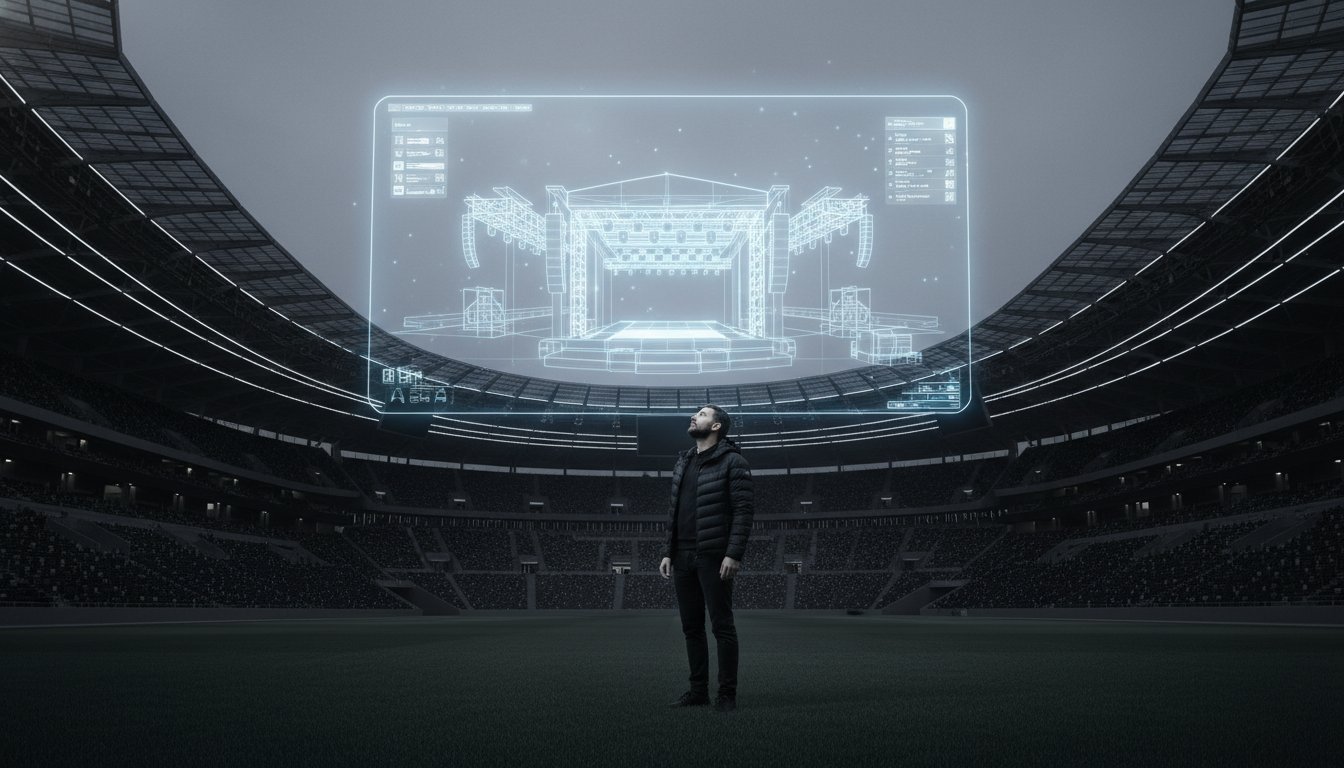
A stadium is not a venue. It is a vacant concrete shell. To the elite producer, it represents a complex logistical puzzle where the show itself acts as a temporary, high-performance machine. You likely recognise that transitioning a production to these massive scales requires far more than just doubling the equipment list. The physical constraints of roof capacities and the sheer demand for power redundancy can quickly turn a creative masterpiece into a technical liability.
Mastering the stadium show technical requirements for 2026 demands a shift from abstract creativity to the precise execution of infrastructure. This article provides a comprehensive framework to align your vision with technical feasibility. We will explore how to navigate updated standards like ANSI E1.21-2024 for temporary structures and the implementation of SMPTE ST 2110 for broadcast-grade reliability. By the end of this checklist, you will have the tools to mitigate structural risks, eliminate logistical bottlenecks, and deliver a world-class production with absolute composure.
Key Takeaways
• Adopt the "overlay" concept to transform sports-centric venues into sophisticated entertainment environments.
• Mitigate structural risks by distinguishing between static and dynamic loads whilst securing independent engineering sign-offs.
• Secure 100% broadcast redundancy through isolated power systems and Twin-Pack generator configurations.
• Utilise full CAD and BIM modelling to navigate the stadium show technical requirements and resolve venue obstructions during the planning phase.
• Align high-tier creative direction with tangible technical production to ensure flawless execution on an international scale.
The Infrastructure Gap: Adapting Sports Venues for Live Entertainment
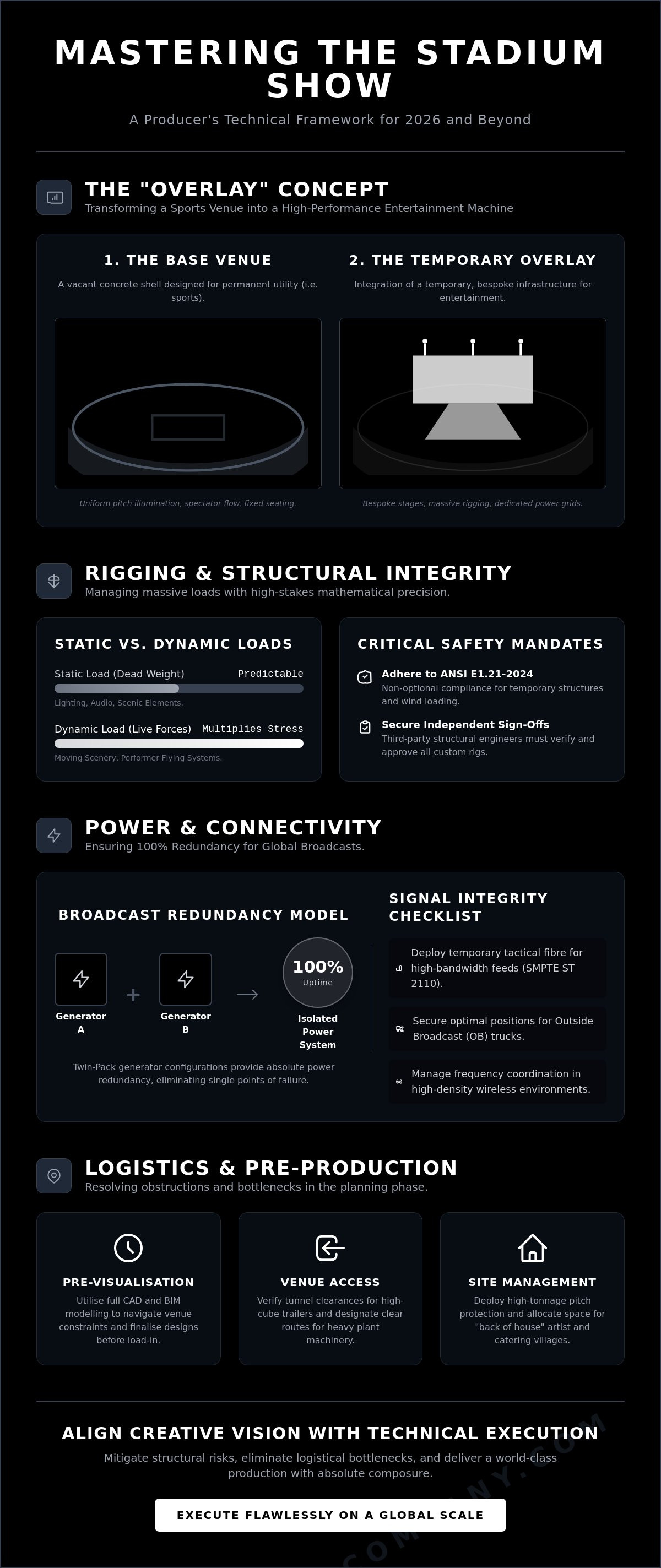
Stadiums are designed for permanent utility. They are engineered to facilitate sports, prioritising uniform pitch illumination and spectator flow for a specific type of event. A world-class concert tour, however, is a temporary machine. To bridge this gap, producers utilise the "overlay" concept. This involves the integration of temporary infrastructure—bespoke stages, massive rigging systems, and dedicated power grids—into a venue that was never intended to house them. Understanding these stadium show technical requirements is the difference between a seamless execution and a logistical failure.
Lighting presents an immediate challenge. Sports-specific floodlights focus on high-intensity, even coverage for athletes. Theatrical and broadcast lighting requires shadow, contrast, and precise colour temperatures. Consequently, the house lights are often entirely bypassed in favour of a temporary rig. Geometry is another friction point. Fixed seating creates a rigid perimeter that frequently clashes with the expansive footprint of modern stage designs. Producers must meticulously calculate the loss of "kill seats" against the gain of floor capacity whilst ensuring sightlines remain unobstructed.
Environmental factors are equally critical. Venue orientation dictates the sun path, which influences everything from load-in temperatures to the effectiveness of early-evening visual effects. Wind behaviour is also a primary concern. The stadium's architecture can create micro-climates and vortexes, requiring rigorous analysis to determine the safe operational limits for suspended LED screens and scenic elements.
Venue Access and Site Logistics
Logistical success relies on the "mega-truck" footprint. Tunnel clearances must be verified for high-cube trailers and heavy plant machinery before the first vehicle arrives. Pitch protection systems are essential. These must support high-tonnage stage builds without damaging the underlying turf or drainage systems. Site management must also designate space for "back of house" artist villages and catering compounds, which often compete for space with existing team transport routes.
Broadcast and Media Infrastructure
Global broadcasts demand absolute signal integrity. Whilst modern stadiums have existing fibre optic runs, these are often insufficient for high-bandwidth entertainment feeds. Producers frequently deploy temporary tactical cable to bridge these gaps. Optimal positions for Outside Broadcast (OB) trucks and satellite uplinks must be secured with clear sightlines. In major international hubs, managing signal interference amongst high-density wireless environments is a constant technical priority that requires dedicated frequency coordination.
Rigging and Structural Integrity: Managing Massive Loads at Height
Stadium rigging is a discipline of high-stakes mathematics. Whilst static loads representing the dead weight of lighting, audio, and scenic elements are predictable, dynamic loads introduce variables that demand rigorous scrutiny. These dynamic forces, generated by moving scenery or performer flying systems, can multiply the stress on a venue's infrastructure significantly. When planning a global tour, understanding technical feasibility for events is paramount to ensuring the creative vision does not exceed the physical limits of the venue.
Outdoor environments introduce the added complexity of wind loading. Large-scale LED video walls act as massive sails, catching air and transferring immense pressure to the supporting structure. Without precise calculation, a sudden gust can jeopardise the entire build. Adhering to international Rigging and Structural Integrity standards, such as ANSI E1.21-2024, is not optional. It is a fundamental requirement for safe operation. Producers must engage third-party structural engineers to provide independent sign-offs on all custom rigs. This ensures every stadium show technical requirements are met with absolute precision and documented safety margins.
Roof Load Capacity and Point Loads
Stadium roofs vary significantly in their ability to support heavy equipment. Total Uniformly Distributed Load (UDL) capacity is often a misleading metric for producers. The more critical figure is the specific point load limit at individual rigging nodes. Many older venues, constructed before the era of 100-tonne production rigs, lack the structural reinforcement required for modern spectacles. In these instances, we often deploy mother-grids or ground-supported structures to bypass the roof's limitations entirely. This allows for the execution of massive designs whilst maintaining the integrity of the host building.
Automation and Kinetic Elements
Kinetic elements add a layer of sophistication that requires specialised technical specifications. High-speed winches and performer flying systems demand dedicated control networks and redundant braking mechanisms. Heavy-duty stage lifts and revolving floors also require substantial power allocations, often separate from the main lighting rig. Safety protocols for automated elements moving above live audiences are stringent. They involve multiple layers of fail-safes and real-time load monitoring. Our approach to Technical Production prioritises these safety frameworks without compromising the visual impact of the show.
Power and Connectivity: Ensuring Redundancy for Global Broadcasts
Relying on house power is a risk few elite producers are willing to take. Whilst FIFA's Stadium Guidelines establish rigorous benchmarks for permanent venue utilities, these systems are rarely designed for the "dirty" electrical noise generated by a massive touring rig. We advocate for the implementation of "Show Power". This is a completely isolated electrical ecosystem. It protects sensitive broadcast equipment from the fluctuations of the venue's HVAC and lighting systems, ensuring that the stadium show technical requirements for stability are met without compromise.
Redundancy is the absolute priority for high-stakes international projects. Twin-Pack generators provide 100% seamless failover. If one engine fails, the second takes the full load without a flicker in the video wall or a pop in the audio. This level of reliability is essential for global broadcasts where a single second of downtime represents a significant financial loss. Our approach to Technical Production integrates these fail-safes as a standard protocol rather than an optional extra.
International tours face the challenge of varying global standards. Moving a production between the UK, USA, and GCC regions requires a sophisticated understanding of voltage and frequency shifts. A rig designed for 50Hz in London must be adaptable for 60Hz in Los Angeles or Riyadh. Furthermore, the shift towards sustainability is accelerating. Integrating large-scale battery storage and HVO (Hydrotreated Vegetable Oil) fuel is now a standard part of the logistical framework. It reduces the carbon footprint whilst maintaining the high-momentum energy required for world-class entertainment.
Electrical Distribution and Stability
Massive LED screens and lighting dimmers create significant harmonic distortion. This can overheat neutral conductors and damage sensitive electronics if not managed correctly. We require Power Factor Correction in temporary stadium grids to maintain efficiency. For outdoor structures, earth bonding and lightning protection are critical safety requirements. They ensure the safety of the crew and the longevity of the equipment amongst unpredictable weather conditions.
Data Architecture and Network Security
Modern stadium shows are data-heavy environments. We build robust VLAN structures to separate lighting, audio, and broadcast traffic, often utilising SMPTE ST 2110 standards for IP-based media transport. This prevents network congestion and ensures that a spike in video data doesn't interrupt the audio feed. Primary and secondary Dante or AVB networks provide audio distribution redundancy. Cybersecurity is the final layer. Show control systems connected to the internet must be protected by enterprise-grade firewalls to prevent external interference.
The Stadium Show Technical Checklist: A Producer’s Pre-Flight Guide
Execution is the only metric that matters in high-stakes entertainment. A producer’s pre-flight guide transforms abstract creative direction into a tangible, safe reality. This checklist serves as the architectural foundation for managing complex stadium show technical requirements across international borders. It ensures that every stakeholder, from the site manager to the broadcast director, operates from a single source of truth.
Site Survey
Develop a full CAD and BIM model of the venue. Every obstruction, from structural pillars to scoreboard heights, must be documented to prevent on-site modifications.
Power
Calculate total KVA requirements with a minimum 20% headroom. Ensure full redundancy through Twin-Pack systems to eliminate any single point of failure.
Rigging
Preliminary plots must be submitted to venue structural engineers at least 6 months prior to load-in. This lead time is essential for verifying roof capacities and node limits.
Health & Safety
Ensure strict compliance with CDM (Construction Design and Management) regulations in the UK, or the local equivalent in international territories. This includes full risk assessments for all high-risk zones.
Logistics
Create a detailed load-in schedule (MOS) coordinated with venue operations. This must account for pitch protection installation and heavy plant machinery movement.
Audio and Visual Coverage
Uniformity is the primary challenge in massive arenas. SPL (Sound Pressure Level) mapping is required to ensure consistent audio coverage for every seat without causing noise bleed into surrounding residential areas. Delay towers must be placed with precision and time-aligned to compensate for the massive distances inherent in 80,000-capacity venues. For visual elements, LED screens must meet high NIT requirements to remain visible during daylight segments of the show. This prevents the "washed out" effect that can diminish the spectator experience before sunset.
Site Management and Crew Welfare
Large-scale productions require significant plant machinery, including telehandlers, forklifts, and cherry pickers. Producers must evaluate the specific requirements for each phase of the build. Defining the ratios between local labour and touring crew is also critical for maintaining specialist skill levels whilst managing budgets. Site safety inductions and PPE requirements for high-risk zones are non-negotiable. These protocols protect the crew and ensure the project remains on schedule despite the high-momentum nature of the build.
Managing these intricate frameworks requires a partner with global experience and an unflappable temperament. To ensure your production meets these rigorous standards, you may contact our specialist team to discuss your upcoming project requirements.
Navigating Global Complexity: How Lar&Co Delivers Flawless Execution
A stadium is a blank canvas. Transforming that canvas into a world-class production requires more than creative ambition. It demands a rigorous architectural approach to technical production for live events. At Lar&Co, we act as the bridge between visionary creative direction and the tangible, safe execution of complex logistics. Our role is to ensure that every stadium show technical requirements are met with absolute composure, regardless of the geographic or structural challenges involved.
Meticulous attention to detail is our standard. This precision prevents the budget overruns and technical failures that often plague large-scale projects. We have managed complex logistics in some of the most unconventional locations on earth, including remote desert festivals where infrastructure must be built from the ground up. This experience in high-stakes environments allows us to anticipate risks before they manifest on site. We focus on the reliable execution of the impossible.
Technical Direction and Site Management
Our approach to site management prioritises operational control. We coordinate a vast network of stakeholders, ensuring that the transition from conceptual design to on-site engineering is seamless. Directing large-scale event crews in diverse global environments requires a seasoned, cosmopolitan expertise. We manage these high-momentum builds by maintaining clear communication channels and strict adherence to the master operational schedule. This efficiency is vital when working within the tight windows of international stadium availability.
Financial Oversight for High-Stakes Productions
Managing multi-million dollar technical budgets requires total transparency. Our financial management services provide high-level stakeholders with the confidence that resources are being allocated efficiently across global tours. We focus on cost-effective procurement and rigorous fiscal reporting to protect the project's bottom line. To see our history of stadium-scale execution in practice, visit our work page. We remain the quiet power behind the scenes, delivering flawless results for the world's most significant cultural and entertainment events.
Securing the Future of Stadium Entertainment
A stadium is more than a venue; it's a temporary machine that requires a disciplined framework to function. We've identified how the overlay concept transforms concrete shells into elite stages. Success relies on mitigating structural risks and ensuring power redundancy whilst maintaining a seamless logistical flow. Addressing these stadium show technical requirements with precision ensures that your creative vision remains feasible and safe on a global scale.
Executing high-stakes international projects requires a partner with an unflappable temperament. Lar&Co provides over 20 years of expertise in high-profile entertainment. With offices in London and Los Angeles, we specialise in technical direction and site management for the world's most significant cultural events. We invite you to discuss your stadium show technical requirements with Lar&Co. Let's ensure your next production is delivered with absolute composure and flawless results.
Frequently Asked Questions
What are the primary power requirements for a stadium concert?
Total power requirements are determined by a precise KVA calculation that accounts for all lighting, audio, and video elements. A minimum 20% headroom is essential to manage peak loads without triggering breakers. Producers must ensure that the electrical system is balanced across three phases to prevent neutral overheating, particularly when running massive LED installations that draw significant current from the temporary grid.
How do you determine if a stadium roof can support a tour rig?
Roof capacity is verified through a combination of original architectural blueprints and current structural engineering reports. We analyse the specific point load limits of each rigging node rather than relying on total weight capacities. If the existing infrastructure can't meet the stadium show technical requirements, we implement ground-supported mother-grids to ensure the safety of the build whilst protecting the venue's integrity.
What is the difference between utility power and show power?
Utility power is the venue's permanent supply used for concessions, HVAC, and basic house lighting. Show power is a bespoke, isolated electrical grid typically provided by mobile generators. This isolation is critical to avoid harmonic distortion and voltage drops caused by the venue's heavy machinery. Such fluctuations can damage sensitive digital production equipment and interrupt live broadcast feeds during high-stakes events.
How long does it typically take to load-in a stadium show?
A standard stadium load-in typically requires 72 to 120 hours of continuous operation. This timeline is strictly managed through a Master Operational Schedule that coordinates the arrival of up to 50 trucks. The process begins with pitch protection and stage positioning, followed by rigging and technical integration. Efficiency is paramount as stadium availability is often limited by tight windows between sporting fixtures.
What pitch protection is required for heavy stage equipment?
High-tonnage stage builds require specialised interlocking flooring systems made of high-density plastic or aluminium. These systems distribute the weight of cranes and telehandlers across a wider surface area to prevent soil compaction. The protection must also allow for airflow and moisture management. This ensures the underlying turf remains healthy for subsequent sporting events without requiring expensive and time-consuming replacements.
How do you manage noise complaints for outdoor stadium events?
Noise mitigation relies on advanced SPL mapping and directional audio technology. We use cardioid subwoofer arrays and precisely angled line-source speakers to focus sound within the bowl whilst minimising spill into residential areas. Real-time monitoring at the stadium perimeter allows the technical team to adjust levels instantly. This ensures the production remains within the decibel limits set by local councils and environmental regulations.
What are the health and safety requirements for stadium crews in the UK?
UK operations must comply with the Construction (Design and Management) Regulations 2015. This involves detailed risk assessments, method statements, and the appointment of a principal designer. For international projects, we also adhere to standards like California's Assembly Bill 1775. This requires crews to have completed OSHA-10 or General Entertainment Safety training to work in public venues, ensuring a global standard of safety.
Can modern stadiums support 4K live broadcast requirements?
Most modern venues can support 4K broadcasts, but they often don't have the permanent bandwidth for uncompressed feeds. Meeting the stadium show technical requirements for 4K involves deploying tactical fibre optic cables and implementing SMPTE ST 2110 standards. Additionally, lighting levels must be increased to provide the higher lux levels and colour consistency required for 4K HDR sensors to capture high-quality imagery.