Technical Feasibility for Events: A Producer’s Guide to Delivering the Impossible
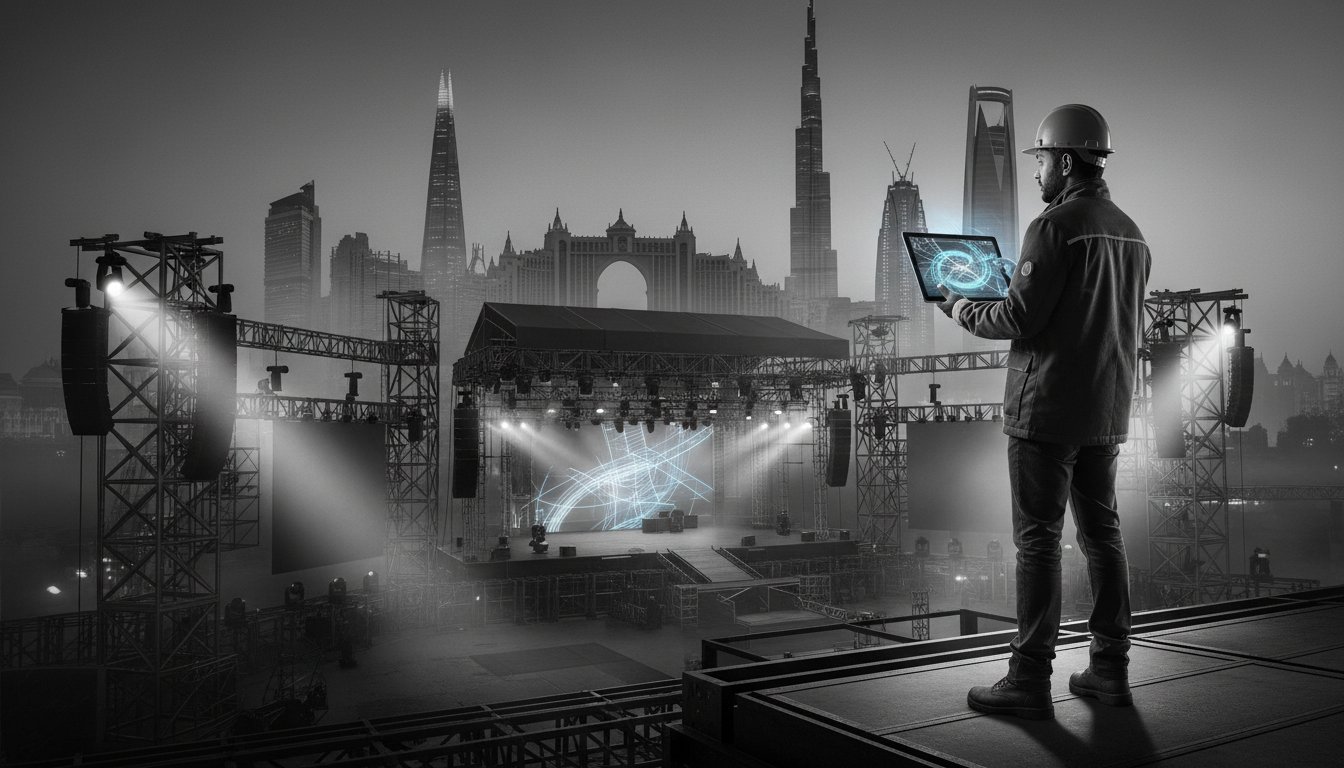
Technical feasibility is not the enemy of creative ambition; it's the only reason the curtain rises at all. For producers managing high-stakes international projects, assessing the technical feasibility for events is the critical bridge between a visionary concept and a safe, deliverable reality. You understand the pressure of the global stage. It's natural to feel the weight of evolving regulations, such as the 2026 OSHA updates on heat illness or the March 2026 NFPA 101 Life Safety Code revisions, whilst trying to maintain the integrity of a world-class design.
This guide provides a definitive framework for determining if a complex build is truly viable. It ensures your most ambitious visions transition from the drawing board to the site without compromising safety or financial stability. We'll explore the essential "go/no-go" criteria, international compliance strategies, and the rigorous engineering standards required to deliver the impossible with absolute composure. You'll learn how to organise complex logistics to mitigate risk before procurement begins.
Key Takeaways
• Distinguish between financial viability and structural reality to ensure your creative vision is physically deliverable.
• Identify the critical pillars of a technical audit, focusing on structural integrity and the power requirements for advanced stage technology.
• Master the process of assessing technical feasibility for events in unconventional locations, from arid desert environments to protected historic city centres.
• Implement a rigorous 5-step framework to transition from a conceptual "must-have" list to a comprehensive infrastructure audit.
• Discover how meticulous technical production and site management transform feasibility reports into flawless, world-class live experiences.
Defining Technical Feasibility in High-Profile Show Production
Technical feasibility for events is the systematic evaluation of whether a creative concept can be physically constructed and safely operated. It's the bridge between the abstract and the tangible. Whilst a project may be financially viable, technical feasibility asks a different question. Is it physically possible within the laws of physics and the specific site? This distinction is vital for high-profile productions. A budget can be adjusted. Gravity and structural load limits are non-negotiable. In the context of elite show production, this process involves deep-dive analysis into structural engineering, electrical distribution, and digital signal paths.
A formal feasibility study serves as the foundation for all technical production for live events. It moves the conversation away from abstract creativity and toward the tangible, reliable execution of complex logistics. The Producer’s role is to act as the synthesiser. They must balance the Creative Director's ambition with the Engineer's reality. This ensures that the technical infrastructure supports the vision without compromise, maintaining absolute composure even when facing rare and significant challenges.
The Intersection of Art and Engineering
Creative visions often outpace current engineering capabilities. This is particularly true in luxury sectors and high-tier entertainment hubs where the goal is to deliver what has never been seen before. "Blue-sky" thinking is essential, yet it requires a technical anchor to avoid catastrophic failure or late-stage cancellations. Involving technical directors during the earliest creative phases isn't a move to restrict imagination. Instead, it's a tool for creative liberation. When the boundaries of what is physically possible are clearly defined, the creative team can innovate with confidence. By defining the technical parameters early, producers avoid the friction of redesigning a show weeks before the launch.
Key Objectives of a Technical Audit
The primary goal of an audit is to identify "show-stopper" risks before they become expensive errors during procurement. These risks often involve site-specific constraints such as floor weight limits in historic venues or wind-load requirements for outdoor structures. A comprehensive audit accomplishes three specific things:
• It identifies the specialised talent and high-tier equipment required to execute the design safely.
• It establishes a realistic timeline for the build, rehearsal, and de-rig phases, accounting for the complexity of the installation.
• It provides a clear "go/no-go" framework that mitigates financial and safety risks before any contracts are signed.
This systematic approach ensures that every logistical element is polished and professional. It prioritises clarity and impact over decorative prose, reflecting a business culture focused on execution and results.
The Core Pillars of a Technical Feasibility Audit
A technical audit isn't a simple checklist; it's a rigorous stress test of a creative vision. When assessing technical feasibility for events, we look far beyond the aesthetic. We examine the physical bones of the project. This systematic process ensures that every ambitious design is backed by engineering reality. It requires a deep understanding of structural limits, energy demands, and the logistical friction of high-tier locations. Our past international projects demonstrate how these pillars support even the most complex builds with absolute composure.
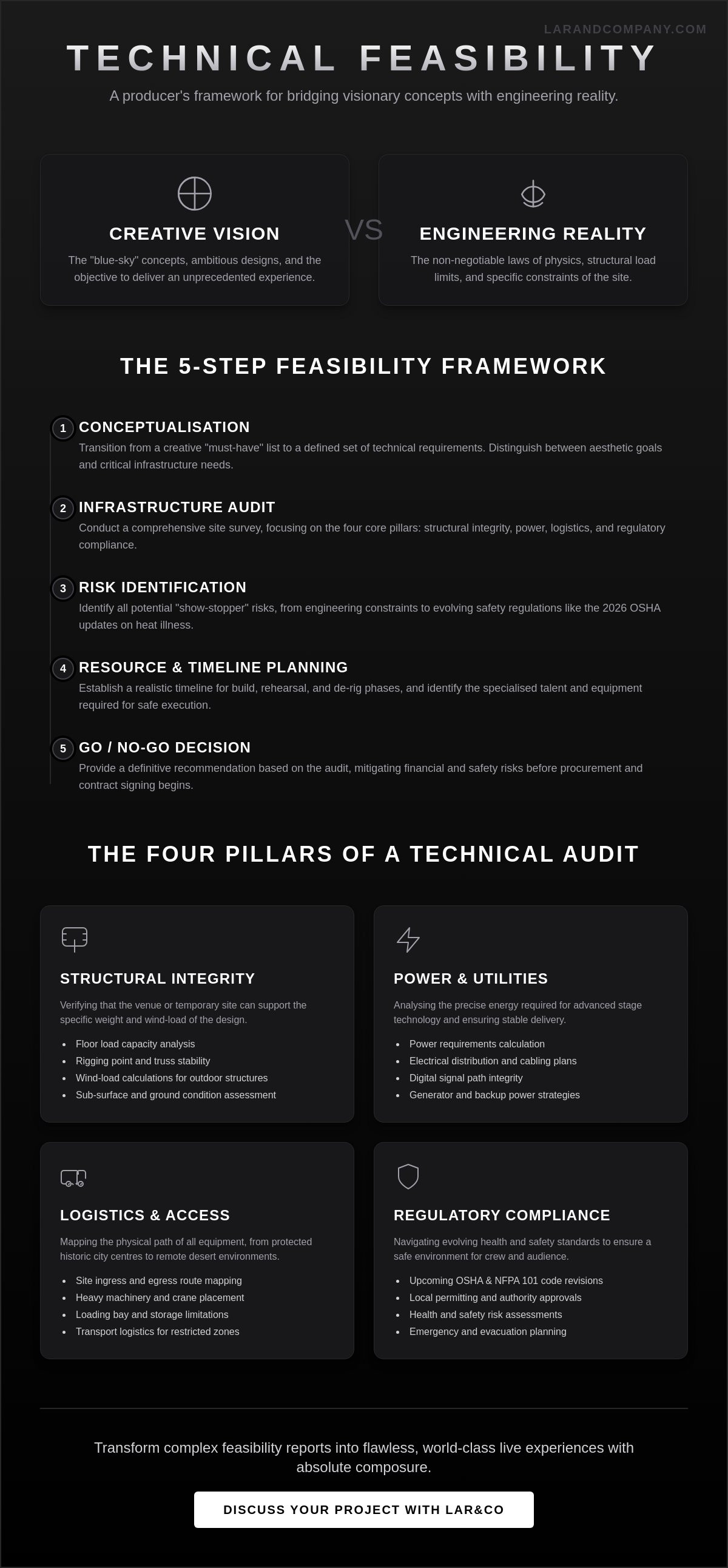
The audit focuses on four critical areas:
Structural Integrity
Verifying that the venue or temporary site can support the specific weight and wind-load of the design.
Power and Utilities
Analysing the precise "juice" required for innovative stage technology for live shows.
Logistics and Access
Mapping the physical path of equipment into restricted city centres or unconventional spaces.
Regulatory Compliance
Navigating health and safety standards, such as the 2026 OSHA federal Heat Illness Prevention Standard or California’s AB 1775 requirements.
Structural and Mechanical Requirements
Structural feasibility is the non-negotiable baseline for audience safety. We assess floor loads, rigging points, and the stability of temporary structures against local environmental data. In 2026, static calculations aren't enough. We use advanced CAD and 3D modelling to pre-visualise technical stress points before a single piece of equipment leaves the warehouse. This identifies potential failures in the digital phase, where they're easily corrected. Whether it's a 30-tonne LED ceiling or a custom stage in a historic London square, the mechanical limits of the site dictate the design's evolution.
Power Distribution and Redundancy
Modern productions demand massive energy. We calculate total KVA requirements for lighting rigs, immersive audio systems, and high-resolution video walls. For high-profile live broadcast events, we implement "triple-redundancy" to ensure the show never goes dark. This involves a primary grid connection supported by twin synchronised generators. We also evaluate the feasibility of on-site power versus the need for temporary power farms in remote territories. In regions with unstable infrastructure, this power strategy is the most critical component of the technical audit. It's the difference between a flawless delivery and a costly technical failure.
Assessing Site-Specific Challenges and Infrastructure
The environment is a variable that cannot be controlled, only managed. Assessing technical feasibility for events requires a deep understanding of how a location's physical and climatic conditions dictate the build. High-profile productions often choose sites for their cultural or aesthetic gravity rather than their technical readiness. A desert in the UAE offers a stunning backdrop but presents extreme heat and sand ingress risks. Conversely, a historic city centre in London offers prestige but introduces severe access restrictions and weight limits on protected surfaces. We analyse these variables to ensure the infrastructure is as resilient as the creative vision.
Climate factors play a decisive role in the "go/no-go" decision. For outdoor projects in 2026, compliance with the federal Heat Illness Prevention Standard is a non-negotiable operational requirement. This affects crew rotation and requires specialised cooling for technical hubs. Wind-load calculations are equally vital for any temporary structure. In arid regions, sand and dust require equipment with specific ingress protection (IP) ratings to prevent failure. These environmental realities are the primary drivers of the technical design, ensuring the show remains operational regardless of the elements.
Effective site management involves planning the invisible. This includes crew catering, waste management, and temporary sanitation. These elements are the foundation of a functional site. Without them, even the most advanced technical setup will fail due to human fatigue or logistical friction. We also account for local labour laws and technical standards, such as California’s AB 1775, which mandates specific training certifications. Navigating these regional nuances is essential for maintaining the momentum of a global production schedule.
Temporary Venue Construction
Building a bespoke cultural pavilion or a pop-up stadium requires more than just scaffolding; it requires an engineering-first approach to ground conditions. We assess soil compaction and the need for specialised foundations or laser-levelling. This ensures the structural integrity of the build remains intact over the duration of the event. Our global site management expertise allows us to transform raw land into world-class venues, handling the complex logistics that many agencies overlook.
International Logistics and Supply Chain
Delivering large scale event management globally requires precision freight planning. We determine if bespoke elements can reach the site within the timeframe, managing the complexities of customs and ATA carnets. This involves a strategic balance between local sourcing and imported specialised tech. By identifying high-tier local partners, we manage budgets and carbon footprints whilst ensuring the equipment meets our rigorous international standards. It's a process that relies on connectivity and unflappable execution.
How to Conduct a Technical Feasibility Study: A 5-Step Framework
Execution is a discipline, not an accident. Conducting a study on the technical feasibility for events is a non-linear process that requires constant feedback between creative and engineering teams. This systematic approach ensures that every "impossible" vision is grounded in physical possibility. At Lar&Co, we employ a five-step framework to provide high-level stakeholders with the confidence required to proceed with complex builds. It's a process designed to move the conversation from abstract ambition to tangible, reliable results.
Step 1: Define the Creative Vision and Technical "Must-Haves".
Identify the core elements that define the show's success and align them with technical requirements.
Step 2: Conduct a Comprehensive Site Survey and Infrastructure Audit.
Physically verify the site data and structural bones discussed in earlier stages of planning.
Step 3: Consult Specialised Engineers.
Engage structural, electrical, and automation experts to validate the load, signal, and power requirements.
Step 4: Develop a Risk Mitigation and Contingency Strategy.
Identify potential failure points and build redundancies into the technical architecture.
Step 5: Final Feasibility Report.
Deliver a clear "go/no-go" document with recommended technical solutions and a validated delivery timeline.
The Technical Risk Assessment
A feasibility study is only as good as its worst-case scenario planning. We quantify risk levels for every high-stakes technical element, from aerial performer rigging to complex pyrotechnic sequences. This isn't about avoiding risk; it's about managing it with absolute composure. We create "Plan B" and "Plan C" scenarios that maintain the show's creative integrity even if a primary system fails. For international projects, this includes assessing the impact of local environmental shifts on technical performance. To ensure your vision is backed by this level of rigour, contact our technical production team for a comprehensive audit.
Prototyping and Technical Rehearsals
Confidence is built through verification. We use small-scale mock-ups and digital twins to prove technical concepts before they reach the site. Off-site technical rehearsals are essential for verifying feasibility during the pre-production phase. This allows our team to validate automation software and cues in a controlled environment, away from the pressure of the main build. By the time the equipment arrives at the venue, the technical path is already proven. This process removes uncertainty and ensures the build remains on schedule, regardless of the project's scale or location.
Beyond the Report: Executing Complex Logistics with Lar&Co
A feasibility report is a strategic asset, but its value is only realised through precise execution. Determining the technical feasibility for events is the first step in a journey toward excellence. At Lar&Co, we don't just identify what is possible; we engineer the path to deliver it. Our approach moves the conversation away from theory and toward the tangible, reliable execution of complex logistics. We translate the rigorous data of a feasibility audit into a high-momentum production schedule that respects both the creative vision and the operational reality. This transition requires a business culture focused on execution and results, where clear communication is paramount.
Our technical direction and site management teams operate with the composure required for high-stakes, international projects. We handle the "impossible" by relying on seasoned expertise and a global network of high-tier partners. This ensures that every logistical friction point is anticipated and smoothed before it impacts the build. Whether we are managing a prestigious cultural fair or a large-scale civic event, our focus remains on purpose and efficiency. We act as the quiet power behind the scenes, ensuring the technical infrastructure remains invisible whilst the creative vision takes centre stage.
A Portfolio of Proven Feasibility
Our reputation is built on the gravity of our portfolio. We have delivered projects where technical feasibility was the single point of failure, successfully navigating the complexities of multi-million dollar budgets with understated authority. We invite you to explore our Work to see how we transform ambitious concepts into world-class live experiences across major entertainment hubs. Each project serves as a drumbeat of success, demonstrating our capability through volume and tangible results. We bring a sophisticated, calm, and highly confident temperament to every challenge, regardless of scale.
Partnering for Your Next Global Event
Lar&Co operates as an international practice with a presence in major hubs including London and Los Angeles. This geographic signature allows us to provide seamless technical production and financial management across different time zones and territories. We offer high-level stakeholders a unique combination of technical direction and financial oversight, ensuring that every investment is protected by rigorous engineering standards. For those ready to move beyond the abstract and toward absolute execution, contact us for a confidential feasibility consultation. We are ready to manage your next significant challenge with absolute composure and professional prestige.
Delivering Global Excellence Through Engineering Rigour
High-profile show production requires a disciplined transition from vision to reality. Mastery of technical feasibility for events ensures that even the most daring concepts are structurally sound and operationally resilient. We've explored the necessity of rigorous site audits and the importance of a systematic framework to protect high-tier investments. This process is the only way to safeguard your creative integrity whilst mitigating significant financial and safety risks.
With over 20 years of expertise in complex show production, Lar&Co specialises in managing multi-million dollar budgets across the globe. Our offices in London and Los Angeles provide the connectivity required for seamless international delivery. We act as the quiet power behind the scenes; we ensure every logistical detail is handled with absolute composure. Discuss your vision with our technical directors to ensure your next project is backed by elite technical production and site management. Let's transform your most ambitious creative visions into flawless, world-class experiences.
Frequently Asked Questions
What is the difference between a general feasibility study and a technical one?
General feasibility focuses on market demand and commercial viability to determine if a project is worth the investment. Technical feasibility for events is a specialised engineering check that asks if the design can be physically constructed and operated safely. It prioritises the laws of physics and site-specific infrastructure over abstract business goals or market trends.
At what stage of event planning should we conduct a technical feasibility audit?
Conduct an audit during the earliest creative phases, ideally before any procurement begins. Waiting until the design is finalised creates significant financial risk and may lead to costly late-stage cancellations. Early involvement allows technical directors to anchor ambitious visions to deliverable solutions, ensuring the technical infrastructure supports the creative intent from the outset.
Can a technical feasibility study save money on a large-scale event?
Yes, a study prevents the waste of budget on equipment or designs that cannot be safely implemented. It identifies expensive technical errors and logistical friction points before they manifest on-site. By validating the infrastructure early, producers ensure that procurement is precise and that the project avoids the high costs of emergency re-engineering during the build.
What happens if a creative concept is deemed technically unfeasible?
We pivot the engineering approach to maintain the creative integrity of the vision. A "no-go" result is an opportunity to re-engineer the concept into a deliverable reality. Our role is to find a safer, more reliable path that achieves the same aesthetic impact without compromising structural integrity or audience safety. It's about refinement rather than restriction.
Do we need a feasibility study for an indoor venue that already has infrastructure?
Yes, every high-profile production requires a specific audit regardless of the venue's permanent facilities. Existing rigging points and power grids have finite load limits that may not support modern, high-density LED walls or immersive audio systems. We verify these site-specific constraints against the unique demands of your show to prevent infrastructure failure or power blackouts.
How does technical feasibility impact event health and safety compliance?
Technical feasibility is the foundation of a robust health and safety strategy. It identifies critical hazards such as wind-load risks for temporary structures or electrical distribution failures. In 2026, this process is essential for ensuring compliance with updated regulations, including the OSHA federal Heat Illness Prevention Standard and the latest NFPA life safety codes for large-scale gatherings.
What are the most common technical "show-stoppers" in outdoor festivals?
The most frequent failures involve inadequate ground compaction and insufficient wind-load ratings for bespoke stages. In contemporary production, a lack of power redundancy for live broadcasts and failing to account for extreme environmental conditions, such as sand or intense heat, are also major risks. Technical feasibility for events addresses these variables to ensure the show remains operational in any territory.
Who should be involved in the technical feasibility process?
The process requires a synthesised team of elite experts to ensure absolute composure during execution. This typically includes the Producer, the Technical Director, and specialised Structural or Electrical Engineers. Site Managers and Creative Directors must also contribute to ensure the engineering solutions align with the logistical flow and the artistic ambition of the project.