Temporary Venue Construction: A Producer’s Guide to Bespoke Infrastructure
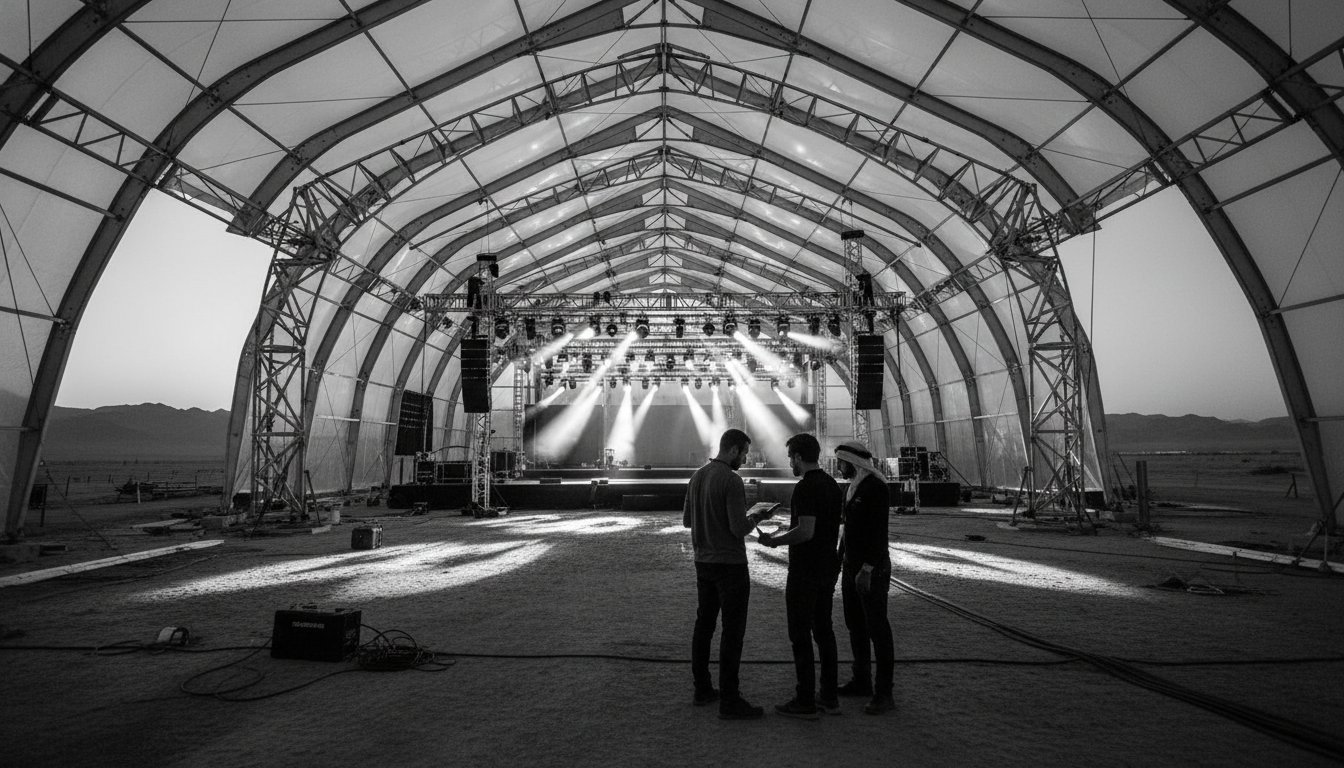
A world-class event environment is not a facilities hire task. It is a feat of technical engineering that must be led by show production expertise. As the global market for temporary event structures scales towards a projected $12.7 billion by 2033, the margin for error in temporary venue construction has vanished. Producers now operate in a landscape where the 2024 International Building Code updates and regional mandates, such as the 2025 California Building Code, dictate every structural decision from the outset.
You recognise that integrating high-spec stage, sound, and lighting into a temporary shell is a high-stakes balancing act. It's a challenge of navigating complex global logistics whilst maintaining absolute safety standards under pressure. This guide provides the technical orchestration needed to deliver bespoke infrastructure in any territory with absolute composure. We will explore the logistical precision required for site management, the nuances of international regulatory hurdles, and the strategies to mitigate financial risk through expert technical production.
Key Takeaways
• Differentiate bespoke temporary architecture from standard event tents to ensure infrastructure meets high-performance show requirements.
• Assess ground stability and load-bearing limits through rigorous technical feasibility studies on unconventional global sites.
• Orchestrate global supply chains for temporary venue construction to maintain absolute precision across international territories.
• Mitigate operational risk by aligning with international safety standards and complex fire regulations in diverse jurisdictions.
• Unify site management and technical production to ensure the seamless integration of show technology within a bespoke shell.
Defining the Scope: Temporary Architecture vs. Traditional Event Tents
High-spec entertainment demands more than a marquee. It requires a technical shell that functions with the permanence of a theatre but the flexibility of a mobile installation. Temporary venue construction is the bridge between these two worlds. Whilst traditional event tents provide basic weather protection, bespoke temporary architecture creates a high-performance environment designed for the rigours of modern show production. Precision is the baseline; aesthetics are non-negotiable.
The "off-the-shelf" tent model relies on standard dimensions and limited load-bearing capacities. In contrast, a custom-engineered temporary venue is a bespoke asset. It is designed to support massive technical rigs, complex acoustic treatments, and immersive scenic elements that standard structures cannot accommodate. This discipline draws from the history of Ephemeral architecture, where the structure itself serves as a temporary monument to a specific cultural moment, prioritising structural integrity and technical adaptability over mere shelter.
The Evolution of Temporary Structures in 2026
The industry has moved beyond PVC skins. In 2026, the shift towards semi-permanent materials is driven by the need for superior insulation and acoustics. Modern modular builds now utilise rigid wall systems and insulated roofing that rival permanent buildings in thermal performance. This evolution is supported by the 2024 International Building Code updates, which recognise public-occupancy temporary structures (POTS) for durations of up to one year. Sustainability is also a primary driver. Modular systems are now engineered for repeated global deployment, using recyclable alloys and low-impact foundation systems that leave no trace on the host site.
When to Choose Temporary Construction Over Existing Venues
Mastering temporary venue construction allows producers to bypass the limitations of traditional bricks-and-mortar spaces. A bespoke build offers a "blank canvas" for creative direction, allowing the infrastructure to be built around the stage design rather than forcing the show to fit a room. This is essential for high-tier projects in desert landscapes, historic city centres, or remote private estates where no infrastructure exists.
Logistical freedom is the ultimate luxury. Custom venues allow for the strategic placement of entry and exit points to manage large-scale crowd flow with absolute efficiency. When existing venues present too many compromises in technical production or site management, a bespoke build is the only viable path. You can see the results of this approach in our international portfolio of work, where we transform unconventional sites into world-class entertainment hubs.
Conducting a Technical Feasibility Study for Unconventional Sites
A successful site management plan begins with a technical feasibility study. It is the cornerstone of temporary venue construction. This process moves beyond visual inspections; it requires quantitative data to ensure the structure can withstand the physical realities of its environment. By identifying constraints early, producers can preserve the creative vision whilst mitigating the risk of structural failure or logistical delays. This foundational work ensures that the prestige of the event is never compromised by technical oversights.
Assessing ground conditions is the first priority. Desert landscapes require rigorous sand stability analysis to prevent structural shift during high-wind events. Urban environments present different challenges. We must calculate the load-bearing limits of historic pavement or identify subterranean voids that could collapse under the weight of a technical rig. These factors dictate the foundation system, whether it involves weighted ballasts or chemical ground anchors that leave the surface intact. Every decision is driven by the need for absolute structural stability.
Environmental factors are equally critical. Wind load calculations must account for local gust patterns, whilst thermoregulation systems must manage extreme temperature fluctuations in glass-walled structures. In remote areas, mapping utility access is a logistical necessity. We analyse power requirements, water supply, and data connectivity early to prevent operational bottlenecks. Our Expert Event Site Management Services ensure that these technical requirements are integrated into the build schedule from day one.
Step-by-Step Site Assessment Framework
Precision begins with topographical surveys. These ensure level foundations for complex stage automation and tiered seating. Access audits determine if heavy plant and transport vehicles can reach the centre of the site without damaging protected surroundings. Ground-bearing capacity is the critical metric that determines the maximum weight a site can safely support for stadium-scale temporary builds. We use this data to calculate the exact footprint of the structure and the distribution of the technical load.
Regulatory and Heritage Considerations
Building in sensitive historic zones requires navigating strict planning permissions. We conduct environmental impact assessments to ensure we leave no trace in protected landscapes. This involves liaising with local authorities in regions like Saudi Arabia or the UAE, where regulations for large-scale entertainment are sophisticated and evolve rapidly. Adhering to standards such as the UMass Amherst Temporary Structure Guidelines provides a reliable framework for safety and permitting amongst international stakeholders. If you are planning a project in a restricted territory, contact our team to discuss the technical requirements.
Orchestrating Global Logistics and Site Management
Global logistics for high-spec entertainment requires a temperament of absolute composure. Managing the movement of structural components across international borders is a core pillar of temporary venue construction. It involves navigating complex customs protocols whilst maintaining rigid build timelines. When components originate from multiple continents, the margin for error is non-existent. A single delayed shipment can compromise the entire production schedule.
The Technical Director acts as the bridge between the physical shell and the creative vision. They oversee the critical intersection where the heavy engineering of the build meets the delicate requirements of show technology. Coordinating multi-disciplinary crews is a logistical drumbeat. Scaffolders, riggers, and lighting technicians must operate in a choreographed sequence to avoid site congestion. This level of site management ensures that the transition from a construction site to a world-class venue is seamless and efficient.
Fiscal oversight is a defining responsibility in large-scale builds. Producers manage multi-million pound budgets for infrastructure procurement, balancing technical necessity with financial discipline. Every line item is tracked with precision to ensure the project remains viable without sacrificing quality. This level of transparency is essential for high-level stakeholders who demand both excellence and accountability.
Procurement and Vendor Coordination
Selecting the right partners is a strategic decision. We often balance international partners who bring specialised technical expertise with local specialists who provide regional knowledge. Aligning these vendors creates a rhythmic flow of deliveries, preventing bottlenecks on site. Precise Production Financial Management is required to coordinate these global contracts and ensure that procurement stays on programme.
Site Operations and Infrastructure Management
The site office serves as the nerve centre of the construction phase. It monitors progress in real-time and coordinates all on-site activity. Infrastructure management extends to the installation of temporary power grids and high-capacity HVAC systems. These elements ensure the bespoke shell offers the same environmental comfort as a permanent theatre. We also implement sophisticated waste management and sanitation systems for high-tier hospitality areas, maintaining the prestige of the environment throughout the event duration.
Mitigating Risk: Safety, Regulations, and Contingency Planning
Safety is the non-negotiable foundation of any high-tier build. Temporary venue construction on a global scale requires an unflappable approach to risk management. We adhere to the highest international standards, including the UK’s CDM regulations, whilst adapting to the specific mandates of every territory we enter. This ensures that every structure is as safe as it is spectacular. Compliance is not a checkbox; it is a fundamental design requirement that protects the prestige of the project.
Fire safety in temporary environments requires meticulous planning. We specify flame-retardant materials for all scenic and structural elements. Egress routes are calculated with precision to manage high-density crowds and ensure rapid evacuation if required. Suppression systems and fire-rated partitioning are integrated directly into the bespoke shell. This level of detail is essential for maintaining the integrity of the event and the safety of high-profile guests.
We use advanced structural monitoring to track real-time performance. Sensors, including anemometers and strain gauges, measure wind speed and structural stress throughout the build and the live event. This data-driven approach allows for immediate adjustments if environmental conditions change. Comprehensive Event Health and Safety Management is integrated into our technical production workflow from the first day of site management.
Contingency Planning for High-Stakes Builds
High-stakes builds require robust contingency protocols. We establish clear weather-related triggers to pause construction or evacuate a structure if wind speeds exceed safety limits. This is particularly vital in coastal or desert locations where weather patterns shift rapidly. Supply chain redundancies are equally vital. We maintain secondary sourcing routes to mitigate the risk of critical components being delayed at international customs. This foresight is detailed in our guide to Crisis Management for Events.
Managing Large Event Crews Safely
Managing large event crews safely is a matter of culture, not just compliance. We implement rigorous induction processes for all international crews working on-site. This ensures every individual understands the specific hazards of the location and the structure. Meticulous attention to detail is required to maintain safety in high-pressure, deadline-driven environments. Dynamic risk assessments are conducted continuously during the final 48 hours before doors open to address the rapid changes of a live site. For a partner capable of managing these complex risks with absolute composure, contact our technical production team.
The Lar&Co Approach: Integrating Infrastructure with Show Production
Many providers treat the venue as a separate entity from the performance. They deliver a shell and leave the technical complexities to a different team. At Lar&Co, we reject this fragmented model. We believe temporary venue construction is an integral part of the show itself. By unifying technical production and site management under a single producer, we ensure that every structural decision supports the creative vision. This integrated approach eliminates the friction often found in multi-vendor builds, where the "box" and the "show" are treated as unrelated tasks.
Managing multi-million pound production budgets requires absolute composure. Our financial management team operates with the discipline needed for high-stakes international projects. We don't just build a structure; we engineer an environment where technical show requirements and structural integrity exist in perfect alignment. This meticulous focus allows our clients to focus on the performance whilst we handle the tangible execution of the logistics. Our role is to act as the quiet power behind the scenes, ensuring that the most ambitious creative goals are anchored by reliable engineering.
From Creative Concept to Structural Reality
Bridging the gap between artistic creative direction and structural engineering is our core expertise. We translate ambitious stage designs into reliable, high-performance temporary venues that function with the permanence of a traditional theatre. This process ensures that the "wow factor" is never compromised by technical limitations or site constraints. Whether it is a bespoke theatre in a desert landscape or a high-end fashion show in a historic city centre, we create rare and significant audience moments through precision engineering. View our work to see temporary infrastructure in action across our global portfolio.
Your Partner for Global Excellence
Our presence in major entertainment hubs like London, Los Angeles, and the Middle East allows us to mobilise world-class talent rapidly. We leverage an elite network of specialists who understand the temperament required for high-value builds in challenging locations. This global reach ensures that the Lar&Co standard of excellence is maintained, regardless of the territory. We are experienced in navigating the unique cultural and regulatory bridges required to deliver meticulous results on a global scale. Contact Lar&Co for bespoke production management and start the conversation for your next high-profile project.
Securing Excellence in Global Temporary Infrastructure
Successful temporary venue construction is defined by the seamless transition from technical engineering to world-class entertainment. It requires a disciplined focus on technical feasibility and a refusal to separate the physical shell from the show it houses. By prioritising rigorous risk mitigation and unified site management, you ensure that every bespoke environment is as safe as it is spectacular.
Lar&Co brings over 20 years of expertise to these complex global logistics. With offices in London and Los Angeles, we ensure seamless international delivery for the world's most significant challenges. Our portfolio spans iconic stadium tours and prestigious cultural celebrations, reflecting a temperament capable of managing high-value builds with absolute composure. This experience allows us to navigate the intersection of technical production and structural engineering with unparalleled precision.
We are ready to translate your creative vision into a tangible, reliable reality. Discuss your high-profile temporary build with Lar&Co and secure a partner dedicated to meticulous execution. Let's build something extraordinary together.
Frequently Asked Questions
What is classed as a temporary venue structure for high-profile events?
High-profile temporary venues are bespoke, high-performance environments engineered for specific live entertainment requirements. These include modular theatres, custom arenas, and glass-walled pavilions designed to support substantial technical rigs and immersive scenic elements. They differ from standard marquees through their structural integrity, acoustic performance, and compliance with permanent building standards.
How long does it take to complete temporary venue construction?
Timelines are dictated by the scale of the infrastructure and the complexity of the host site. Whilst a standard modular build might take ten days, a stadium-scale temporary venue often requires several weeks of on-site construction. This is always preceded by months of technical planning, feasibility studies, and global logistics orchestration to ensure the build stays on programme.
Can temporary venues withstand extreme weather like desert winds or heavy snow?
Yes, modern temporary venues are engineered to meet specific regional climate risks. Many jurisdictions now utilise the 2024 International Building Code, which allows for calculated load reductions based on approved operations and management plans. This ensures structures remain stable during high-wind events in desert landscapes or under significant snow loads in alpine regions.
Do I need planning permission for a temporary event structure in the UK?
Planning permission is typically required if a structure remains in place for more than 28 days. However, requirements vary significantly in historic centres or protected landscapes. Producers must liaise with local authorities early to navigate heritage constraints and ensure all safety certifications are in place before site work commences.
How much does it cost to build a bespoke temporary venue?
Investment levels depend entirely on the technical specification, the site's ground conditions, and the duration of the event. A bespoke build in a remote location involves higher logistical costs than a project in an established urban centre. Stakeholders should work with their technical production partner to establish a precise budget that reflects their creative and structural requirements.
What is the difference between a clearspan structure and a traditional marquee?
A clearspan structure uses a rigid frame that requires no internal support poles, offering an unobstructed interior for stage design and crowd movement. This is the foundation of modern temporary venue construction for high-spec shows. Traditional marquees rely on poles and guy ropes, which often interfere with sightlines and technical rig placement.
How are utilities like power and air conditioning managed in temporary venues?
Utilities are delivered through temporary grids and high-capacity HVAC systems housed in external plant areas. These systems are ducted into the bespoke shell to provide the same environmental comfort as a permanent theatre. We manage these utility connections as part of the wider technical production to ensure they operate silently and efficiently.
What happens to the site after the temporary venue is dismantled?
The objective is a "no trace" restoration of the original site. Effective site management involves a rigorous deconstruction plan that removes all infrastructure, foundations, and utility connections. This is essential for maintaining the prestige of the event and the integrity of sensitive locations, such as historic estates or protected natural environments.