Troubleshooting Last-Minute Event Changes With Clear Next Steps
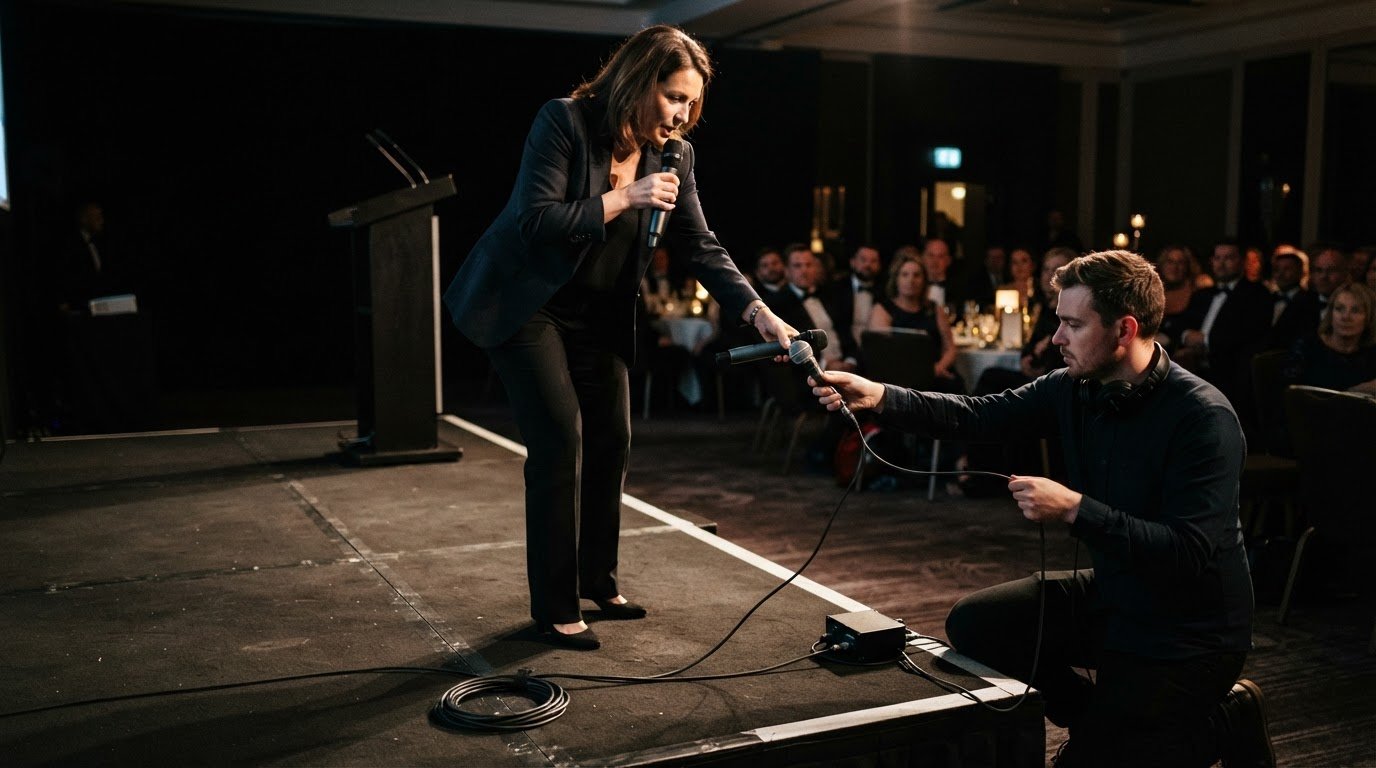
Expect last-minute changes, then respond in a clear order: establish what has changed, assess its effect on safety, timing and essential event components, assign decisions, and communicate confirmed updates promptly. Effective troubleshooting last-minute event changes means protecting the essentials first, then adapting the schedule and practical arrangements around them.
A speaker may cancel, weather may disrupt an outdoor plan, or a venue, supplier or technical element may become unavailable. These are not reasons to improvise without structure. A calm, timely response helps the team understand what to do and gives affected guests, speakers and suppliers a reliable picture of what happens next.
This guide explains how to anticipate likely changes, assess their severity and choose the next action. It covers schedule buffers, backup arrangements and clear communication, helping you keep people aligned as the event plan changes.
Key Takeaways
• Map the event’s critical components and prepare alternatives for likely disruptions, including speaker cancellations, severe weather and technical issues.
• Build 10–15-minute fire-breaks into the schedule to absorb overruns without immediately disrupting later sessions.
• Before acting, take five minutes to gather facts, identify who is affected and rank the most urgent consequences.
• Give each update a clear owner and share confirmed changes promptly with the people who need to act on them.
• After the event, debrief with the team and use what you learn to improve contingency plans and communication protocols.
1. Communicating changes to teams, vendors, stakeholders, and attendees
In the United States, changes to event details can create confusion or disputes if ticket terms, supplier agreements and attendee notices no longer align. Review the relevant agreements and applicable local requirements before announcing a revised time, venue or programme. A clear record of approved changes helps everyone act on the same information.
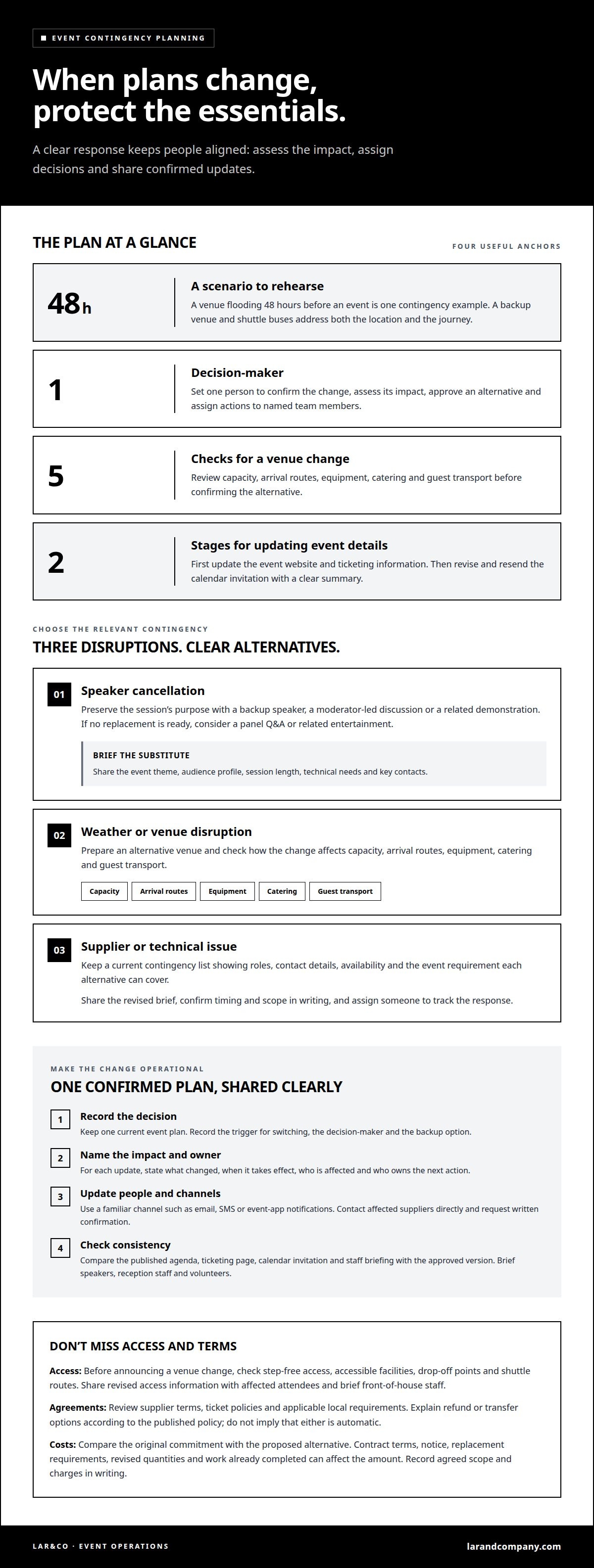
Set one decision-maker and maintain one current event plan. That person confirms the change, assesses its impact, approves an alternative and assigns actions to named team members. For example, one lead briefs the client, another updates suppliers and a third prepares attendee communications. This structure keeps troubleshooting last-minute event changes focused and prevents conflicting instructions.
Assign an owner to update each event website, ticketing page and calendar invitation using the relevant platform’s editing tools. Update the website and ticketing information first, then revise and resend the calendar invitation with a clear summary of the change. An event app or online agenda can also display the latest schedule. Afterwards, check every channel for consistent details.
Use an agreed real-time channel, such as a team messaging group, for operational updates. Each message should state what changed, when it takes effect, who is affected and who owns the next action. If a corporate session moves rooms, name the new room and ask floor staff to update signs. Keep the shared event document current so onsite teams do not rely on an older version.
Contact affected suppliers directly if a change alters timing, access or delivery. State the revised requirement, request written confirmation and record dependencies in the event plan. If a session moves later, confirm new arrival and setup times with the relevant suppliers. Tell the client what the change affects, which alternative is in place and what remains unchanged.
For attendees, use a familiar channel, such as email, SMS or event-app notifications. Put the new detail first: “The afternoon session is now in Room B.” Add the reason where useful, explain the alternative and provide one route for questions. Send urgent updates promptly, then brief speakers, reception staff and volunteers so their answers match the notice.
Assign someone to monitor delivery and respond to attendee questions. Compare the published agenda, ticketing page, calendar invitation and staff briefing with the approved version. If questions reveal that a notice is unclear, revise it across the affected channels. This final step is central to troubleshooting last-minute event changes, keeping teams, suppliers and guests aligned around one plan.
Establish emergency communication protocols and delegate decision-making authority to avoid unnecessary delays. A delayed decision can cause ripple effects for suppliers, staff and the guest experience.
2. 😱 What last minute changes could arise?
A speaker cancellation can unsettle a programme, especially when that person anchors a keynote or panel. Prepare a replacement format in advance: a backup speaker, a moderator-led discussion or a short demonstration tied to the event theme. If a corporate gala loses its keynote, a replacement panel can preserve the session’s purpose without pretending the original plan remains unchanged.
Prepare a concise briefing for each backup speaker or entertainer. Include the event theme, audience profile, session length, technical needs and key contacts. A moderator can bridge a late change by introducing the substitute, adapting questions and explaining the revised running order. If no replacement is ready, use the gap for an impromptu panel Q&A or related entertainment, then tell attendees clearly what has changed.
Weather can force an outdoor event indoors, disrupt access or require a venue move. Prepare an alternative venue and map the practical consequences: room capacity, arrival routes, equipment, catering and guest transport. A wedding venue flooding 48 hours before an event is a useful contingency scenario: activating a backup vineyard and arranging shuttle buses addresses both the location and the journey.
How much do common last-minute changes cost, including venue, catering and supplier fees? The amount depends on contract terms, notice, replacement requirements, revised quantities and work already completed. Compare the original commitment with the proposed alternative before approving a change, and record the agreed scope and charges in writing.
Cancellation and rescheduling terms affect whether tickets can be refunded or transferred. Review the published ticket policy and relevant agreements, then explain the available options clearly to ticket holders. Do not imply that a transfer or refund is automatic: state what the policy allows and how an attendee can act.
To find and confirm backup suppliers, staff or equipment quickly, keep a current contingency list with roles, contact details, availability status and the event requirement each person or supplier can cover. Contact the most suitable alternative, share the revised brief and obtain written agreement on timing, scope and dependencies. Assign someone to track the response instead of relying on an unanswered message.
Check the impact of accessibility and transport changes before announcing an alternative. If a venue move changes step-free access, accessible facilities, drop-off points or shuttle routes, identify affected attendees and arrange a workable equivalent. Share revised routes and access information directly with those affected, and brief front-of-house staff so assistance matches the updated plan.
For each critical element, record the trigger for switching plans, the decision-maker and the backup option. A speaker cancellation, weather warning or supplier failure can then prompt a defined response, not a rushed search for an improvised solution.
3. Agenda buffers and flexible scheduling
Build slack into the agenda before a live programme begins. Add at least 15 minutes to the time estimated for each session, then place extra 10–15-minute fire-breaks between demanding blocks. These buffers absorb overruns without forcing every later speaker, meal or transition to move. In event planning, a flexible schedule is a working control, not unused time.
Choose where each buffer matters most. A keynote with audience questions may overrun; catering may need longer to serve hot drinks during a break-out session. One example describes an event running 30 minutes behind for these reasons. Protect the next fixed commitment by shortening a flexible networking period or adjusting a later transition, rather than compressing every session.
Mark fixed points and adaptable elements in the running order. A performance start, venue access window or transport departure may be difficult to move; a networking interval or informal welcome may have more flexibility. Record the decision-maker and acceptable adjustment beside each flexible item. This gives staff a clear sequence under pressure and prevents conflicting edits.
If a venue becomes unavailable, activate the prepared alternative and compare its capacity, access, layout and technical setup with the original. Rebuild the running order around the new venue’s constraints, reassign setup tasks and tell affected suppliers what has changed. If weather moves an outdoor event indoors, check room availability and revise arrival, staging and session timings together.
Keep the schedule modular. Group sessions, breaks and transitions so one change can stay within a block. If a speaker needs extra time, the stage manager can use a planned buffer before the next session. If the delay exceeds that allowance, the authorised lead can choose which flexible element to shorten and update the master schedule.
For a corporate event, rehearse the change process as well as the preferred plan. Walk through a delayed session, an indoor move and a late supplier arrival with the people responsible for each task. Specify which schedule is current, who can approve edits and how the revised version reaches the onsite team. This makes the plan usable under pressure.
After each schedule adjustment, check for knock-on effects. Review speaker readiness, room turnover, catering service and guest movement before confirming new timings. A revised session start may also shift a meal or transport call. Record the approved change in the running order, then brief the teams whose work depends on that timing.
4. Staying calm and assessing the severity of a problem
An unexpected issue can seem larger before its effects are clear. Take five minutes to gather facts before committing to a response. Identify what happened, when it began, who is affected and which event component depends on it. For example, a delayed delivery may affect room setup, but not the entire programme.
Assess immediate and longer-term consequences before choosing an action. A technical fault during a presentation may affect the current session; a venue access issue may affect attendee safety, arrival routes and the schedule. Separate urgent risks from disruptions that can be contained. This helps the event lead focus on the issue with the greatest impact.
Use a simple severity test. Consider whether the problem affects safety, essential access, a critical programme moment or several teams at once. Then decide whether the lead should act directly or delegate defined tasks. A local signage error may need one staff member; a venue-wide power fault may require coordinated decisions from technical, site and client stakeholders.
Keep the response controlled and specific:
• State the confirmed facts, rather than repeating speculation.
• Name the person authorised to decide the next step.
• Assign one owner to each urgent task.
• Set a point to review the situation and its impact.
Clear leadership sets the tone for staff and attendees. Give direct instructions that name the action and the person responsible. If a presentation screen fails, for example, the lead can assign a technician to diagnose it while another team member prepares the offline presentation backup. Avoid asking several people to solve the same task without coordination.
Software can support situational awareness, but it cannot replace judgement. Use the current schedule, incident notes and team updates to establish what has changed. Record the decision, its owner and any outstanding dependency in one shared place. This gives stakeholders a reliable account and prevents new updates from relying on outdated assumptions.
Address a developing issue before it expands. If a supplier reports a late arrival, establish which setup tasks depend on that delivery and whether the delay affects doors or programme timings. Escalate only the consequences that require a decision. This keeps the response proportionate and gives the team room to resolve smaller problems without disrupting unaffected work.
After making an immediate decision, reassess. Check whether the action worked, whether new people or event elements are affected, and whether the severity has changed. If the solution creates another delay, revise the plan and assign the next task. Calm assessment is a repeatable process, not a single decision made under pressure.
Expecting last-minute changes
Plan for change as a normal event condition, not a failure of preparation. For each critical component, record a likely disruption, its effect and a practical alternative. A risk matrix can rank each issue by likelihood and impact. A speaker cancellation, a weather shift and a supplier delay then each have a distinct response, rather than competing for attention without clear priorities.
Start with the dependencies behind each session. Note which people, suppliers, spaces and technical elements must be ready for it to proceed. If a keynote depends on one speaker and one presentation file, identify a moderator-led alternative and an offline copy. If an outdoor performance depends on clear weather, map the indoor layout and identify which setup tasks must change.
Use advance checkpoints to surface risks while options remain open. Hold a final checkpoint meeting one week before the event, then another two days before it. Ask participants about changes to travel plans or length of stay one week before the event. Where the schedule permits, arrange for speakers to arrive two nights before they are needed, leaving room to manage travel disruption.
Build a practical buffer into guest information. Set the rooming-list deadline a couple of days before the list is needed, giving the team time to resolve changes. Keep extra signage and name cards available for revised room assignments, late arrivals or corrected names. These small preparations can prevent one updated detail from creating a queue at registration.
Supplier relationships are part of contingency planning. Establish working contacts before event week and make sure each supplier understands critical timings and dependencies. A catering change, for example, may affect service timing, room turnover and the next session. A prepared contact path helps the team establish what can still be delivered and which alternative keeps the programme viable.
Protect the team’s decision-making capacity during the pressure period. Clear troubleshooting-team members’ calendars during the final two days before the event and throughout the event. Brief each person on their responsibilities and escalation route. This gives the team time to manage developing issues instead of resolving them between unrelated commitments.
Afterwards, use a team debrief to improve the next plan. Review what changed, which contingency worked and where information arrived too late. Invite perspectives from each department, then update the risk matrix, supplier contacts and communication protocol. Each event can make the next response more precise.
Treat last-minute changes as an expected part of planning, and prepare to respond rather than seeing them as proof that preparation has failed. A calm, adaptable approach makes it easier to assess what has changed and choose a workable response. Preparing alternatives for each aspect of the event also makes adjustments easier to manage, rather than leaving the team to improvise without a fallback.
Keep extra signage and name cards available so the team can respond when event details change. Strong supplier relationships also support readiness: established working contacts can help planners prepare for disruptions and identify alternatives when plans need to shift. Together, these practical steps support a flexible response while the event is underway.
Lar&Co: Show Production
Lar&Co delivers Show Production for complex live events where a late change affects the programme, technical delivery or onsite coordination. Turn to the team when a revised schedule or event setup requires coordinated decisions across creative and operational elements. Technical Production and Site Management support practical delivery, while Creative Direction helps keep changes aligned with the experience.
Clear priorities, defined responsibilities and a current plan help teams manage change without losing sight of the event’s purpose. For a significant live project, Lar&Co brings these disciplines together to support delivery.
Contact Lar&Co about your event to discuss your project.
Make change-readiness part of the next brief
The strongest response begins before the next change arrives. As you shape your next event, decide how the team will recognise a material change, who can authorise a response and how that decision will guide delivery. Put those expectations into the working brief so the plan guides action rather than sitting unused in a document.
This makes troubleshooting last-minute event changes a practical part of production planning, not a separate crisis process. For complex live projects, Lar&Co can help align creative intent with the operational decisions needed to deliver it. Bring the key objectives, known dependencies and areas of uncertainty into the conversation to establish a clear basis for planning.
Contact Lar&Co about your event to discuss the demands of your project. With a clear brief and the right structure, your team can move forward with purpose.
Frequently Asked Questions
😱 What last minute changes could arise?
Last-minute changes can affect the programme, venue, suppliers, guest arrangements or event technology. A speaker might withdraw, severe weather could disrupt travel, or an internet outage could prevent a planned demonstration. Registration may also need adjustments if guest details change. Consider how one disruption affects linked elements: a venue change, for instance, can alter transport, signage, room layouts and accessibility arrangements.
What is the immediate checklist for handling last-minute event changes?
Use a short sequence: establish the confirmed issue, identify its effects, choose an authorised decision-maker, assign tasks and record the revised plan. Check what must happen before doors open, such as testing a replacement presentation or updating arrival instructions. Then confirm that affected teams have received the correct version. Keep unresolved questions visible and assign an owner, rather than allowing assumptions to become instructions.
How should event organisers notify attendees about schedule, venue, or speaker changes?
Send a direct notice through the channel attendees use, with the changed detail in the subject line or first sentence. For a venue move, include the full new address and revised arrival guidance; for a speaker change, name the replacement only after the programme is agreed. Add a timestamp, update digital notices and onsite screens, and remove outdated printed information where possible.
How can event teams prioritise decisions and assign responsibilities during a last-minute change?
Rank decisions by immediate safety, access, programme continuity and the number of people affected. Give one lead authority over the decision, then assign separate owners for operational tasks, supplier coordination and attendee information. For example, if a room becomes unusable, one person can assess alternatives while another checks guest movement. Keep a brief decision log so the team can see what was approved and what remains outstanding.