Weather Contingency: A Producer's Guide to Continuity
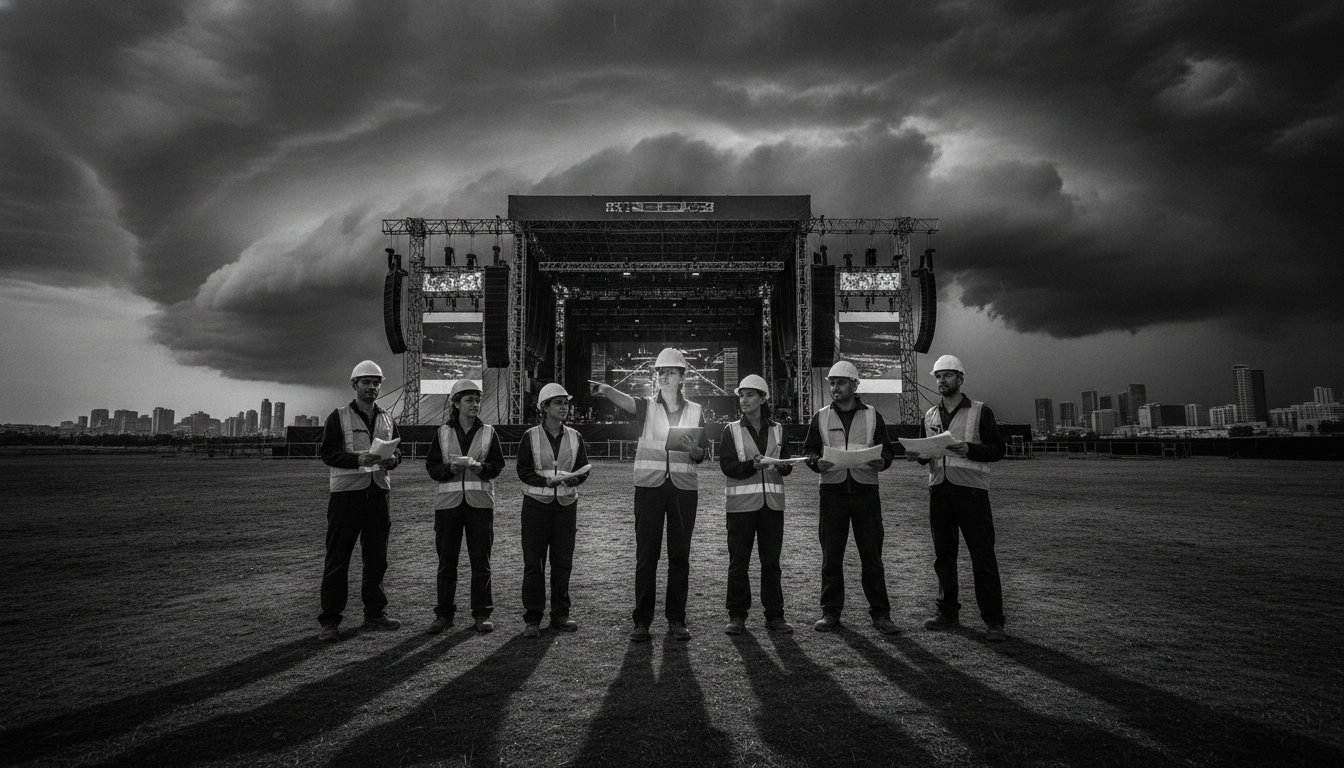
In 2025, weather disruptions accounted for 22% of all total loss events in the global entertainment sector. For a producer handling high-profile international shows, environmental volatility isn't just an inconvenience. It's a direct threat to the financial and reputational foundation of the project. Mastering weather contingency planning for events is the difference between a controlled technical pause and a catastrophic cancellation. It requires a sophisticated integration of engineering and logistical composure that ensures the show continues regardless of the environment.
You recognise the immense pressure of managing site safety in extreme climates, especially when the eyes of the world are on your stage. This guide provides a robust framework for decision-making under high-stakes conditions. We'll explore the technical assurance required to engineer resilient structures and the site management strategies that maintain professional prestige during environmental chaos. You'll master the logistics needed to safeguard your portfolio against the unpredictable, ensuring your production remains unflappable in the face of any storm.
Key Takeaways
• Integrate weather planning into the earliest creative and financial phases to safeguard the project’s reputation and financial stability.
• Apply advanced engineering standards and precise wind-load analysis to ensure temporary structures remain resilient against environmental volatility.
• Develop a definitive framework for weather contingency planning for events to enable swift, data-driven decision-making during high-stakes scenarios.
• Establish a singular chain of command and clear crisis protocols to manage artist liaison and site safety with absolute composure.
The Strategic Necessity of Weather Contingency in Show Production
High-profile show production operates at the edge of what's technically possible. Relying on favourable conditions is a fundamental error. Sophisticated weather contingency planning for events isn't an optional "Plan B". It's an essential engineering requirement. A single unmanaged weather event can dismantle a multi-million pound budget and decades of brand equity in hours. We don't rely on hope. We rely on meticulous technical direction and site management to safeguard every asset.
True continuity starts during the creative phase. It's the intersection where artistic vision meets environmental reality. If a stage design can't withstand the wind loads of its specific location, the vision is fundamentally flawed. By integrating meteorological data into the earliest concepts, we protect the production's integrity and the stakeholder's investment. This proactive approach ensures that the site is engineered for resilience from day one. A robust approach to weather contingency planning for events is the only way to safeguard high-profile international shows.
The Financial and Reputational Stakes of Live Continuity
Every second of downtime on a stadium tour or cultural celebration has a specific fiscal weight. Beyond the immediate loss of ticket revenue or broadcast fees, the long-term reputational damage to an artist or a host nation is often unquantifiable. Robust contingency plan development ensures continuity is maintained even when the environment becomes hostile. Effective production financial management integrates these risks into the initial budget. Resilience is a core asset. It's not a sunk cost. Maintaining stakeholder confidence requires visible preparation. It demonstrates that the production team is in total control of the variables.
Global Context: From London Rain to Saudi Sandstorms
Logistics must adapt to the specific geography of the venue. A site management strategy designed for the persistent drizzle of London will fail against the sudden, intense heat or sandstorms of the Middle East. A "one-size-fits-all" weather plan is a liability in international production. High-stakes hubs require local meteorological expertise and a site-specific approach. We specialise in managing these rare challenges with absolute composure. This ensures that global tours maintain their momentum regardless of the climate. Proactive site management means identifying geographic "show-stoppers" before they arrive on the radar.
Advanced Risk Assessment for High-Stakes Environments
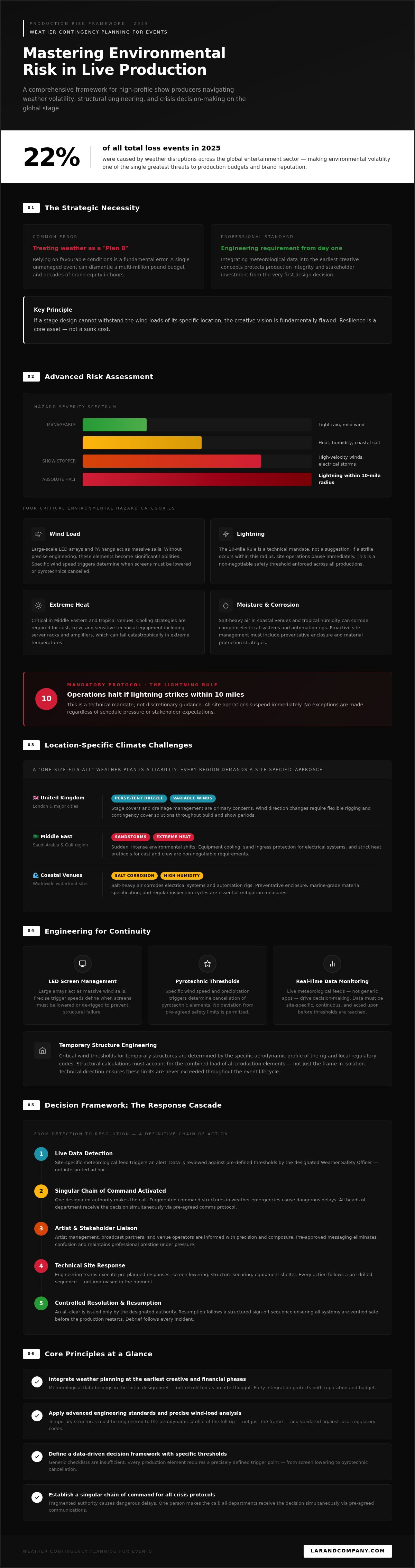
Sophisticated show production demands a shift away from generic safety checklists. Effective risk assessment involves assessing weather risks through the lens of structural engineering and technical limits. We distinguish between spectator discomfort and genuine operational danger. Whilst light rain might be managed with stage covers, high-velocity winds or electrical storms are absolute show-stoppers. Identifying these triggers early is the foundation of professional weather contingency planning for events.
Wind load analysis is paramount for modern stage builds. Large-scale LED arrays and PA hangs act as massive sails. Without precise engineering, these elements become significant liabilities in gusty conditions. We also enforce the Lightning 10-Mile Rule. If a strike occurs within this radius, site operations pause immediately. This isn't a suggestion; it's a technical mandate. Heat mitigation is equally critical. In regions like the Middle East, we implement cooling strategies for cast, crew, and sensitive technical equipment, such as server racks and amplifiers, which can fail in extreme temperatures.
Quantifying Environmental Thresholds
We define specific triggers for every production element. This includes the exact wind speed at which LED screens must be lowered or when pyrotechnics are cancelled. The critical wind threshold for temporary structures used in large scale event management is determined by the specific aerodynamic profile of the rig and local regulatory codes. Our technical direction ensures these limits are never exceeded. We also monitor the impact of moisture on complex automation. Salt-heavy air in coastal venues or tropical humidity can corrode electrical systems if not mitigated through proactive site management.
Real-Time Meteorological Monitoring
Data must be live. We don't rely on generic weather applications. We integrate professional, on-site weather stations directly into the production hub. This provides hyper-local data for immediate decision-making during high-momentum shows. Constant collaboration between our site management teams and professional meteorologists ensures we stay ahead of shifting patterns. This rigorous approach to weather contingency planning for events is why the world's most prestigious shows trust our oversight. You can explore our portfolio of international projects to see this technical precision in action.
Engineering for Continuity: Technical and Site Solutions
Resilience is an engineered outcome. Hardening the site involves temporary venue construction that mirrors permanent structural standards. We manage storm-related outages through dual-redundant power systems and synchronised generator sets. These systems ensure that critical lighting, audio, and broadcast feeds remain online even if the primary grid fails. Reliability is built into the infrastructure from the first cable pull. We don't accept power failure as a possibility for high-profile international shows.
Stage configurations must remain adaptable. We evaluate "roof-on" versus "roof-off" production based on forecasted wind loads and precipitation. This decision affects everything from pyrotechnic safety to camera angles. Audience ingress and egress logistics are designed with adverse weather in mind. We ensure clear, safe pathways and sheltered holding areas are available during heavy rain or wind. Protecting the attendee experience is as vital as protecting the stage. It's about maintaining the composure of the entire event site.
Technical Direction and Weather-Proofing AV
Technical direction ensures that high-end lighting and sound consoles are protected from moisture through bespoke enclosures and climate-controlled booths. In extreme desert heat, LED processors and server racks require dedicated cooling systems to prevent thermal shutdown. Our approach to technical production for live events incorporates environmental shielding as a standard design element. We treat technical shielding as a necessity for maintaining the show's aesthetic integrity under pressure. Every piece of sensitive equipment is isolated from environmental threats.
Site Management and Temporary Infrastructure
Site management addresses ground stability for heavy equipment in unconventional locations, such as remote deserts or heritage sites. We implement advanced drainage solutions and temporary flooring to prevent site saturation. Ballast requirements for temporary structures are calculated based on specific wind-load standards for the region. We also establish "safe-state" protocols for overnight storms. This ensures the site remains secure when the crew is off-duty. Meticulous weather contingency planning for events transforms a potential environmental crisis into a managed technical operation. Our focus remains on the tangible, reliable execution of complex logistics regardless of the forecast.
Communication and Crisis Protocols: The Human Element
Precision in engineering is meaningless without a clear chain of command. In the high-stakes environment of international show production, decision-making must be rapid and definitive. We establish a singular authority to make the final call on show continuity. This prevents the paralysis that occurs when too many stakeholders weigh in during a crisis. Effective weather contingency planning for events relies on this human architecture. It ensures that safety remains the priority whilst protecting the production's creative and financial interests. Decisions are made with clinical efficiency, based on the real-time data gathered by our technical teams.
Managing a crew of 200 or more requires absolute composure. We use encrypted, multi-channel radio systems to keep technical teams informed without creating alarm. Every member of the production understands their role in a weather-related "safe-state" transition. Audience communication must be transparent and authoritative. We provide clear, factual updates through site-wide PA systems and digital displays. This maintains order and prevents the spread of misinformation. Transparency builds trust. It demonstrates that the production is in total control of the variables, even when the environment is chaotic.
The Decision-Making Matrix
We structure "Go/No-Go" meetings around objective data points rather than subjective feelings. These sessions are brief, functional, and focused on immediate results. We balance artistic delivery against health and safety obligations with absolute precision. The show producer acts as the unflappable centre of operations. They filter technical reports from site management and translate them into actionable commands for the crew. This matrix ensures that every decision is backed by engineering reality. It allows the production to pivot quickly without compromising the integrity of the show.
Managing Global Stakeholders and High-Profile Talent
High-profile shows often involve VIPs, government officials, and global talent. Communicating delays to these stakeholders requires a sophisticated, cosmopolitan touch. We maintain a meticulous attention to detail even under extreme environmental pressure. This ensures that artist liaison for tours remains a priority during a site crisis. We manage expectations by providing clear timelines and technical justifications for every operational shift. This professional prestige is what allows us to handle rare challenges with total confidence. If you require a production partner capable of maintaining this composure under environmental chaos, contact our offices to discuss your project logistics.
The Lar&Co Approach: Sophisticated Risk Mitigation
Lar&Co brings over 20 years of international expertise to the most complex logistical challenges in the entertainment industry. Our approach to weather contingency planning for events is rooted in meticulous attention to detail and global oversight. We don't just plan for rain; we engineer for total continuity. This involves a practice-led approach to site resilience that spans from the temperate climates of London to the extreme heat of Riyadh. We specialise in translating the most ambitious creative visions into a tangible, weather-hardened reality that protects both the budget and the brand.
We operate with what we call a "Global Elite" mindset. This temperament is required to manage high-stakes, high-value international projects with absolute composure. High-profile shows cannot afford a reactive stance when environmental volatility strikes. We provide the technical direction and site management required to ensure that weather never escalates into a crisis. Our history reflects an ability to operate at the highest levels of entertainment and diplomacy. We act as the quiet power behind the scenes, ensuring that the show maintains its momentum regardless of the atmospheric conditions.
International Reach and Local Connectivity
Our strategic presence in London and Los Angeles facilitates seamless global show production across multiple time zones. This international reach allows us to bridge geographic gaps and leverage a network of world-class technical talent and site management experts. We understand the specific wind-load standards and environmental regulations required in every major entertainment hub. This local connectivity ensures that we have the necessary resources and meteorological intelligence on the ground long before the first structure is built. You can discuss your next high-profile project with our team to ensure your technical logistics are handled by seasoned professionals who understand the stakes.
The Quiet Power Behind the Scenes
Our credibility relies on the gravity of our portfolio rather than overt promotion. We have managed technical production and site logistics for iconic musical legends, prestigious cultural fairs, and large-scale civic events. This breadth of experience allows our team to anticipate environmental challenges that less experienced practices might overlook. We remain committed to flawless execution in every environment, from desert sands to coastal winds. Whether it's a global stadium tour or a bespoke cultural celebration, our focus remains on tangible, reliable results. You can view our international work portfolio for definitive examples of resilient show production that thrives under pressure.
Securing the Future of Global Live Entertainment
Environmental volatility is a constant in international show production. It's a technical variable that must be managed through precise engineering and logistical composure. Professional weather contingency planning for events isn't about avoiding the storm. It's about building a site and a team capable of performing through it. By integrating technical redundancy and a definitive chain of command, you protect the multi-million pound investment and the artistic integrity of the show.
Lar&Co brings over 20 years of international expertise to every project. With offices in London and Los Angeles, we specialise in high-profile, high-stakes live entertainment across the globe. We provide the quiet power behind the scenes, ensuring your production remains unflappable regardless of the climate. Our practice-led approach transforms environmental risks into managed logistical outcomes. Partner with Lar&Co for flawless international show production and ensure your creative vision is never compromised by the elements. Your next stadium tour or cultural celebration deserves this level of technical assurance.
Frequently Asked Questions
What are the most common weather risks for international stadium shows?
Wind is often the most significant hazard, especially when sustained speeds exceed 35 mph. Other primary risks include lightning strikes, extreme heat, and sudden precipitation. In 2025, weather accounted for 22% of total market cancellations globally. Producers must account for geographic specificities, such as sandstorms in the Middle East or tropical humidity, which can corrode sensitive electronics. Comprehensive weather contingency planning for events identifies these risks long before the site build commences.
How do wind loads affect the safety of temporary stage structures?
Wind loads transform temporary structures, LED arrays, and PA hangs into massive sails. These elements require precise engineering to withstand specific regional standards. Sustained winds exceeding 35 mph typically require lowering or securing structures to prevent mechanical failure. We calculate ballast requirements and structural integrity based on the aerodynamic profile of the entire rig. This technical assurance ensures that the stage remains resilient and safe for artists, crew, and attendees under environmental pressure.
Who is responsible for the final decision to cancel an event due to weather?
The final decision to pause or cancel a show rests with a predetermined chain of command, usually led by the show producer or technical director. This authority is established during the pre-production phase to prevent decision-making paralysis during a crisis. Whilst artist management and local officials are consulted, the lead producer makes the definitive call based on real-time meteorological data and engineering limits. Clear leadership maintains the composure required for high-stakes international projects.
How does extreme heat impact high-end technical production equipment?
Extreme heat can cause high-end technical equipment, such as LED processors, amplifiers, and media servers, to enter thermal shutdown. This leads to immediate show failure. We implement dedicated cooling systems and climate-controlled enclosures to isolate sensitive hardware from high temperatures. Additionally, OSHA updated heat safety regulations in 2026, requiring written prevention programmes and acclimatisation plans for crew. Effective site management protects both the technical architecture and the human element from environmental stress.
What is the "Lightning 10-Mile Rule" in professional event management?
The Lightning 10-Mile Rule is a mandatory safety protocol where site operations pause immediately if a strike occurs within a ten-mile radius. This provides a necessary buffer for a safe evacuation or technical "safe-state" transition before the storm arrives. We monitor strikes using on-site weather stations and hyper-local forecasting. This rule is a non-negotiable component of weather contingency planning for events, ensuring that high-profile shows prioritise human life and safety over production momentum.
Can a show be weather-proofed without compromising the creative design?
Resilient show production does not require creative compromise. It requires the early integration of technical direction into the creative process. By designing stage covers and structural shielding as part of the aesthetic, we protect the artistic vision from the elements. Bespoke enclosures for lighting and sound consoles can be hidden within the set design. This ensures that the show's visual integrity remains intact whilst the technical infrastructure is hardened against environmental volatility and unpredictable climates.
How do you manage audience safety during an unexpected weather evacuation?
Audience safety depends on clear ingress and egress logistics. We ensure that pathways are wide, well-lit, and designed for rapid movement during adverse weather. Sheltered holding areas are designated within the site management plan to provide refuge without causing congestion. Communication is handled through site-wide PA systems and digital displays to provide transparent, factual updates. This authoritative approach prevents panic and ensures that every attendee is moved to safety with absolute order and composure.
What role does insurance play in weather contingency for live shows?
Insurance provides a vital financial safeguard against unmanaged weather delays or total cancellations. General liability policies for major events often range from $500 to $5,000 annually, whilst basic rain insurance can cost as little as $150. Carriers now place greater emphasis on an organiser's "safety culture," often lowering premiums for those with documented weather monitoring and emergency response plans. Robust financial management integrates these costs to protect the production's multi-million pound budget from environmental volatility.